When you’re managing an off-grid system, staying informed about your battery health is essential. The right battery monitor can make a significant difference in efficiency and safety. With various options available, each offering unique features, choosing the best one for your needs isn’t straightforward. Let’s explore the top contenders and the key factors to evaluate, ensuring you make an informed decision that enhances your energy management.
ECO-WORTHY 48V LiFePO4 Battery Monitor with Touchscreen

If you’re an off-grid solar enthusiast or a DIYer seeking a reliable battery monitor, the ECO-WORTHY 48V LiFePO4 Battery Monitor with Touchscreen is an excellent choice. Designed for V3 version 51.2V 100Ah LiFePO4 server rack batteries, it’s compatible with ECO-WORTHY’s 48V 100Ah and 50Ah models. The 4.3-inch touchscreen provides real-time readings of voltage, current, and more, ensuring you stay informed. You can customize parameters post-login, making it perfect for advanced users. With ultra-low power consumption and easy RS232 connections, installation is a breeze. Plus, ECO-WORTHY’s multi-language support enhances your user experience considerably.
Best For: Off-grid solar enthusiasts and DIYers seeking a reliable and customizable battery monitoring solution.
Pros:
- Intuitive 4.3-inch touchscreen for real-time monitoring of key battery metrics.
- Customizable settings for advanced users after secure login.
- Ultra-low power consumption and easy installation with RS232 connections.
Cons:
- Not compatible with V2 versions of ECO-WORTHY batteries.
- May require advanced knowledge for optimal configuration and customization.
- Limited language options, although it supports English, Chinese, and Ukrainian.
Renogy 500A Battery Monitor with Shunt
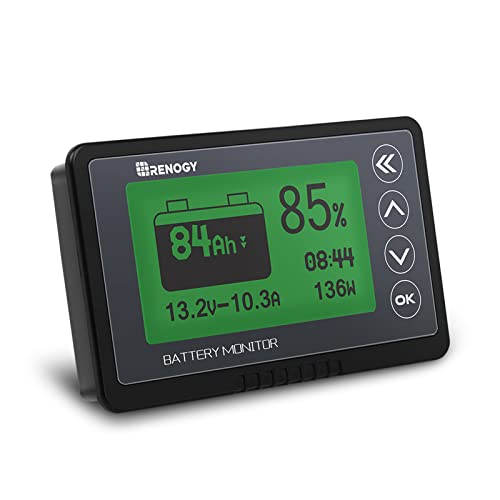
The Renogy 500A Battery Monitor with Shunt is an excellent choice for off-grid enthusiasts who demand precision and reliability. With a measurement range of 10V-120V and support for up to 500A, it offers 1% accuracy for voltage and current readings. You’ll appreciate the high and low voltage alarms, ensuring your batteries remain safe from over-discharge. The high-definition backlight display shows essential metrics like voltage, current, and battery capacity, making monitoring effortless. Plus, its lightweight design and transparent shunt holder simplify installation. With a solid customer rating and a 30-day return policy, you can trust Renogy to meet your off-grid needs.
Best For: Off-grid enthusiasts seeking a precise and reliable battery monitoring solution.
Pros:
- 1% Accuracy: Provides precise voltage and current measurements for better battery management.
- High and Low Voltage Alarms: Protects batteries from over-discharge and enhances longevity.
- User-Friendly Display: High-definition backlight display with customizable brightness for easy reading.
Cons:
- Limited to 12V Batteries: Not suitable for systems outside the 12V range.
- Weight: At 75 grams, it may be considered slightly heavier than some other lightweight alternatives.
- Installation Required: Requires installation which may be challenging for some users without technical skills.
FOXWELL 600A Bluetooth Battery Monitor

For anyone managing an off-grid system, the FOXWELL 600A Bluetooth Battery Monitor stands out with its advanced wireless real-time tracking capabilities. You can easily monitor voltage, current, power, and state of charge through the PRO BMS Bluetooth app. It’s compatible with various battery types, making it perfect for RVs, boats, and solar setups. With up to 30 days of historical data, you can analyze trends to optimize your energy use. Plus, custom alerts keep you informed about any critical limits. Its easy setup and lab-grade accuracy guarantee you’re always in control, while low power consumption means extended monitoring without draining your battery.
Best For: Individuals managing off-grid systems such as RVs, boats, or solar setups who need reliable battery monitoring.
Pros:
- Advanced wireless real-time tracking of voltage, current, and power via the PRO BMS Bluetooth app.
- Historical data access for up to 30 days allows for trend analysis and energy optimization.
- Easy setup with lab-grade accuracy and low power consumption for extended monitoring.
Cons:
- May require a smartphone for full functionality with the Bluetooth app.
- Initial setup might be challenging for users unfamiliar with battery monitoring systems.
- Limited compatibility with certain battery types outside the specified range.
Renogy ONE Core Off-Grid Energy Monitoring Panel

Renogy ONE Core stands out as the ideal choice for anyone seeking an all-encompassing solution to monitor and manage energy in off-grid settings like RVs, cabins, or boats. This versatile panel offers 24/7 energy monitoring through Bluetooth and RS485 connectivity, keeping you informed about your power usage. With a robust 10,000mAh Lithium-ion Polymer battery, it guarantees efficient management. You can remotely monitor your systems via the DC Home App, allowing control from anywhere. Plus, its compatibility with smart accessories enables you to automate your off-grid lifestyle, providing convenience and peace of mind wherever you are.
Best For: Individuals seeking a comprehensive energy monitoring solution for off-grid living in RVs, cabins, boats, or tiny homes.
Pros:
- 24/7 energy monitoring with Bluetooth and RS485 connectivity for real-time insights.
- Remote management capabilities via the DC Home App, allowing control from anywhere.
- Compatible with smart accessories for enhanced automation and convenience.
Cons:
- Requires compatible Renogy batteries for optimal power monitoring functionality.
- Limited to 12V DC and 24V DC power devices, which may not suit all applications.
- Initial setup may be complex for users unfamiliar with energy monitoring systems.
500A Shunt Battery Monitor with 2.4″ Color Screen

A standout feature of the 500A Shunt Battery Monitor is its 2.4″ color screen, which makes it an ideal choice for off-grid system enthusiasts and anyone looking to keep a close eye on their battery health. This monitor supports various battery types, including LiFePO4 and flooded options, ensuring compatibility with your setup. Its high precision current detector provides real-time voltage and current measurements, while the backlit display enhances readability. Plus, the monitor automatically saves data during power failures, preventing any loss. With adjustable brightness and safety alarms, you’ll never be left in the dark about your battery’s status.
Best For: Off-grid system enthusiasts and individuals seeking a reliable battery health monitoring solution.
Pros:
- High precision current detector ensures accurate real-time voltage and current measurements.
- Backlit 2.4″ color screen enhances visibility and user experience.
- Automatic data storage during power failures protects against data loss.
Cons:
- May require professional installation for optimal setup in some vehicles.
- Limited to specific voltage range (8-100V), which may not suit all battery systems.
- The screen size may be too small for those who prefer larger displays for reading from a distance.
ANCEL BM Series Battery Monitor (BM300 Pro Bluetooth)
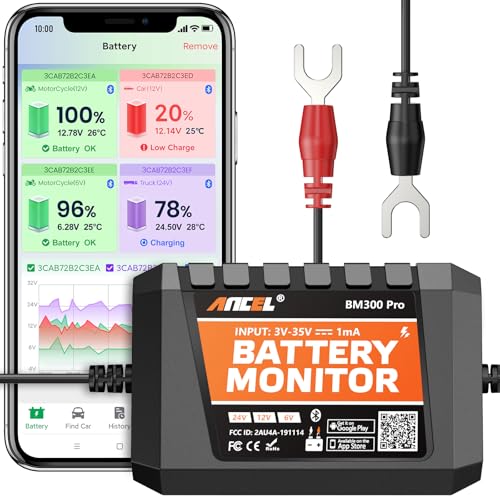
The ANCEL BM300 Pro Bluetooth battery monitor is a game-changer for anyone managing off-grid systems, from RV enthusiasts to boat owners. This advanced monitor supports 6V, 12V, and 24V systems, making it perfect for various vehicles. With Bluetooth 5.3, you’ll enjoy real-time monitoring through a mobile app and a stable connection. It tracks battery health, cranking, and charging systems while storing 72 days of data for trend analysis. Its robust design features an IP67 waterproof rating, reverse connection, and short-circuit protection, ensuring durability. You’ll stay informed and secure, enhancing your off-grid experience effortlessly.
Best For: The ANCEL BM300 Pro Bluetooth battery monitor is best for RV enthusiasts, boat owners, and anyone managing off-grid systems requiring reliable battery health monitoring.
Pros:
- Monitors battery health, cranking, and charging systems in real-time via a mobile app.
- Durable design with IP67 waterproof rating and protection against reverse connection and short-circuits.
- Stores up to 72 days of data for historical comparison and trend analysis.
Cons:
- Requires a mobile device for full functionality, which may not be suitable for all users.
- Optimal performance is dependent on using the device in open environments without obstructions.
- Limited to lead-acid battery types, which may not accommodate all battery technologies.
LiTime 500A Battery Monitor for RV and Solar Panel

For RV enthusiasts and solar panel users, the LiTime 500A Battery Monitor stands out as an essential tool for managing battery systems ranging from 8V to 120V. This monitor features an LCD backlight screen that displays crucial data like voltage, current, capacity, and remaining charge time. When your battery’s voltage or capacity dips below the set threshold, the monitor alerts you with a flashing display and a buzzer alarm every 10 seconds. Installation is straightforward, and it’s compatible with various battery types, including Li-ion and AGM. With the LiTime 500A, you’ll keep your off-grid systems running smoothly and efficiently.
Best For: RV enthusiasts, motorcycle riders, and solar panel users looking for an effective battery management solution.
Pros:
- Provides real-time data on battery voltage, current, and capacity for informed decision-making.
- Easy installation with included tools and detailed instructions.
- Compatible with a wide range of battery types, enhancing versatility.
Cons:
- Not waterproof, making it unsuitable for marine environments.
- Requires a specific installation setup that may not be suitable for all users.
- Buzzer alarm may be disruptive in quiet settings.
ECO-WORTHY Battery Monitor with Hall Sensor

If you’re looking for a reliable battery monitor to enhance your off-grid experience, the ECO-WORTHY Battery Monitor with Hall Sensor stands out with its high-precision Hall monitoring system. This monitor tracks battery percentage, voltage, current, and capacity in real-time, making it perfect for RVs, golf carts, and off-grid homes. With a 3.5-inch touchscreen and ten brightness levels, it guarantees visibility in any lighting. Plus, its programmable alarms alert you to high/low voltage and overcurrent, helping you maintain battery health. You’ll appreciate the auto-sleep feature, which conserves power while keeping you informed about your battery’s status.
Best For: Those seeking a comprehensive battery monitoring solution for RVs, golf carts, and off-grid homes.
Pros:
- High-precision Hall monitoring provides real-time tracking of battery metrics.
- Touchscreen display with adjustable brightness ensures clear visibility in various conditions.
- Programmable alarms enhance safety by alerting users to potential issues with battery health.
Cons:
- May require installation expertise for optimal setup in certain applications.
- The touchscreen could be less responsive in wet or humid conditions.
- Limited compatibility with battery types outside the specified range (9-80V).
BINTA 500A Battery Monitor Shunt for Lifepo4 and Gel Batteries
Designed specifically for off-grid enthusiasts, the BINTA 500A Battery Monitor Shunt excels in providing real-time monitoring for Lifepo4 and Gel batteries across various applications. This monitor supports 0-500A currents and works with 8-100V battery types, making it ideal for RVs, boats, and solar setups. You’ll appreciate its 2.4-inch color LCD screen that displays precise readings of capacity, voltage, and current, all clearly labeled. Plus, it saves your data during power loss and alerts you with high/low capacity warnings. Installation is a breeze thanks to the included 10ft shielded cable and accessories, ensuring you stay informed and efficient.
Best For: Off-grid enthusiasts and users of Lifepo4 and Gel batteries seeking precise real-time battery monitoring across various applications.
Pros:
- Precise Monitoring: Offers accurate readings of battery capacity, voltage, and current with a ±1% margin of error.
- User-Friendly Display: Features a 2.4-inch color LCD screen with a backlight and clearly labeled data for easy visibility.
- Easy Installation: Comes with a 10ft shielded cable and necessary accessories for straightforward setup.
Cons:
- Limited to Specific Battery Types: Primarily designed for Lifepo4 and Gel batteries, which may not suit all users.
- Requires Power for Alerts: The alarm functions and display rely on power, which may limit functionality during outages if not properly managed.
- Potential Learning Curve: Users unfamiliar with battery monitoring systems may need time to fully understand all features and settings.
Bluetooth Battery Monitor BM7 for 6V, 12V, 24V Batteries

The Bluetooth Battery Monitor BM7 stands out as an ideal choice for off-grid enthusiasts and anyone managing a variety of battery types, including 6V, 12V, and 24V systems. It monitors lead-acid and lithium batteries, providing real-time insights into battery health, voltage, and temperature. With Bluetooth 5.3, you can connect within 10 meters, allowing easy access to data via the app. The monitor supports up to four batteries simultaneously, ensuring you stay informed. Plus, its smart chip offers over 99.6% accuracy, while built-in safety features protect against short circuits and reverse connections, keeping you and your equipment safe.
Best For: Off-grid enthusiasts and individuals managing multiple types of batteries in vehicles and energy storage systems.
Pros:
- Supports real-time monitoring of lead-acid and lithium batteries with high accuracy.
- Bluetooth 5.3 connectivity allows for easy data access from up to four batteries within a 10-meter range.
- Equipped with safety features such as reverse connection and short-circuit protection, ensuring user safety.
Cons:
- Requires permanent installation, which may not be suitable for all users or applications.
- The app functionality is limited to a 10-meter range, restricting monitoring distance.
- May not be compatible with battery types outside of the specified range (6V, 12V, 24V).
Factors to Consider When Choosing a Battery Monitor for Off Grid Systems
When you’re picking a battery monitor for your off-grid system, several key factors can make a big difference. You’ll want to evaluate compatibility with your battery types, the monitoring features that best suit your needs, and how user-friendly the display is. Don’t forget to check for alarm functions and power consumption efficiency to guarantee you’re maximizing your setup.
Compatibility With Battery Types
Choosing the right battery monitor for your off-grid system hinges on its compatibility with various battery types. It’s important to verify the monitor supports lead-acid, lithium-ion, and lithium iron phosphate (LiFePO4) batteries to maximize functionality. Check that it accommodates voltage specifications, typically ranging from 8V to 120V, to match your system’s needs. Look for monitors that work with multiple battery chemistries, like sealed, gel, and flooded batteries, offering you flexibility for future upgrades. Additionally, prioritize models with programmable alarms for over-discharge and high/low voltage protection, vital for maintaining battery health. Finally, consider accuracy; choose a monitor that measures voltage and current within ±1% for reliable performance in your off-grid setup.
Monitoring Features Offered
To effectively manage your off-grid battery system, you’ll want a monitor that offers thorough real-time readings of key metrics like voltage, current, state of charge (SoC), and temperature. Look for high-precision measurement capabilities, ideally with an accuracy of ±1% or better, to guarantee reliable data for battery health. Features such as historical data tracking and trend analysis can help you identify patterns and optimize energy usage over time. Additionally, alarms for high/low voltage and overcurrent conditions are essential for preventing battery over-discharge, promoting longevity. While usability isn’t the focus here, a user-friendly interface with customizable display options can enhance your experience, making monitoring easier in various lighting conditions.
Display and Usability
How can the right display and usability features enhance your experience with a battery monitor for off-grid systems? A clear display size and type, like a touchscreen or LCD, can make a huge difference in readability and interaction in various lighting conditions. Backlit displays are especially useful in low-light environments, allowing you to check battery status easily. Look for user-friendly interfaces that provide quick access to voltage, current, and state of charge. Customizable display settings, such as brightness levels, help conserve battery power while improving usability. Additionally, features that offer historical data access and trend analysis can give you valuable insights into battery performance, helping you manage your off-grid system more effectively.
Alarm and Safety Functions
A reliable battery monitor not only enhances usability with clear displays but also incorporates essential alarm and safety functions to protect your off-grid system. Alarm functions are crucial for preventing over-discharge; they alert you when voltage or capacity dips below preset thresholds, helping to extend battery life. Many monitors come with programmable alarms for high and low voltage, overcurrent, and low State of Charge (SOC), boosting overall safety. Real-time alerts via mobile apps or audible alarms notify you of abnormal conditions, allowing for prompt corrective actions. Additionally, safety features like reverse connection and short-circuit protection safeguard both your battery and yourself. Some monitors even save the latest data during power failures, ensuring critical information isn’t lost for future assessments.
Power Consumption Efficiency
When selecting a battery monitor for your off-grid system, it is essential to prioritize power consumption efficiency. Look for devices that operate below 1W and less than 0.1W in standby mode to minimize energy drain. Monitors with auto-sleep functions can conserve energy when not in use, extending your battery life considerably. By choosing efficient power usage, you can enjoy longer monitoring periods without frequent recharges or replacements, enhancing your system’s reliability. High accuracy in readings (±1% or better) is also important for effective battery management, indirectly improving power efficiency. Additionally, consider models with energy-saving features like adjustable display brightness, which help reduce consumption while still delivering essential monitoring information.
Installation and Setup Process
Choosing the right battery monitor for your off-grid system involves several key factors, especially regarding installation and setup. First, verify the monitor includes detailed installation instructions and compatible wiring options for a straightforward process. Many models come with shunt holders and clear positive/negative markings, which simplify installation and help you avoid wiring errors. Look for monitors that use shielded cables to minimize interference, enhancing reading accuracy. A user-friendly interface is vital, allowing you to easily configure settings and access battery performance data after installation. Additionally, consider models with auto-sleep and wake-up features to optimize power consumption during the setup phase. These considerations will help you achieve an efficient and hassle-free installation.
Wireless Connectivity Options
As you evaluate battery monitors for your off-grid system, consider how wireless connectivity can enhance your monitoring experience. Many modern monitors feature Bluetooth, letting you track battery performance and health in real-time via a smartphone app within about 10 meters. Options like RS485 and Bluetooth Low Energy (BLE) allow for continuous communication with your energy systems. Some monitors even offer historical data tracking, enabling you to analyze trends for better energy management. Plus, you’ll receive instant notifications about battery status and alarms directly on your device. Don’t forget to check the power consumption; low-power monitors, consuming as little as 0.4W, are essential to guarantee they don’t drain the battery you’re monitoring.