Choosing the right clamp meter can make electrical diagnostics faster, safer, and far less frustrating. The best models balance current measurement, voltage testing, and useful extras without overcomplicating the job.
In this roundup, we focus on clamp meters for electrical troubleshooting that fit real-world residential, commercial, and HVAC work.
Best 10 Clamp Meters for Electrical Troubleshooting Picks for 2026
All-Purpose AC/DC Testing
Klein Tools CL390 AC/DC Digital Clamp Meter
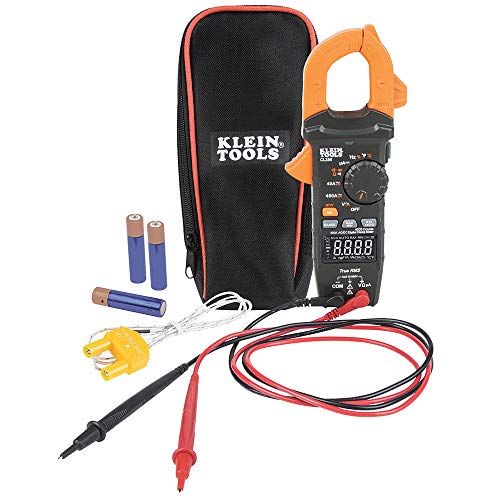
- AC/DC current via clamp jaw
- TRMS with auto-ranging
- NCVT, temp, and multimeter functions
Best For: General electrical troubleshooting with broad measurement coverage
Compact High-Current Choice
Fluke 302+ Digital Clamp Meter

- Measures AC current up to 400A
- 30 mm jaw for larger conductors
- CAT IV 300V / CAT III 600V rating
Best For: Simple high-current and voltage troubleshooting
Value Feature Blend
IDEAL INDUSTRIES 61-737 AC Clamp Meter

- Up to 400A AC and 600V AC/DC
- True RMS with NCV alerts
- Backlit display and included pouch
Best For: Technicians wanting a well-rounded, ready-to-carry clamp meter
HVAC-Focused Utility
Klein Tools CL445 HVAC Clamp Meter

- AC current, inrush, and NCVT via clamp
- Dual voltage/current display
- Includes case, clips, thermocouple, and leads
Best For: HVAC and electrical service work with inrush measurement
Smart Circuit-Finding Clamp Meter
Ideal Electrical 61-747 TightSight Clamp Meter

- Instant tracing for energized circuits
- Smart breaker-location mapping
- Dual backlit display with rugged build
Best For: Electricians who need quick breaker tracing and dependable everyday troubleshooting
Trusted True-RMS Utility Clamp Meter

- True RMS for more accurate readings
- AC current, AC/DC voltage, resistance, continuity
- IEC safety standard with CAT III/CAT IV ratings
Best For: Commercial and residential electricians who want a reliable core troubleshooting meter
Feature-Rich Diagnostic Clamp Meter

- TRMS with up to 600A AC/DC current
- Real-time curve recording for intermittent faults
- Rechargeable battery and 2-inch TFT display
Best For: Technicians who need a rechargeable multi-function meter for detailed fault tracking
Compact Everyday Tester
Klein Tools CL120 Digital Clamp Meter
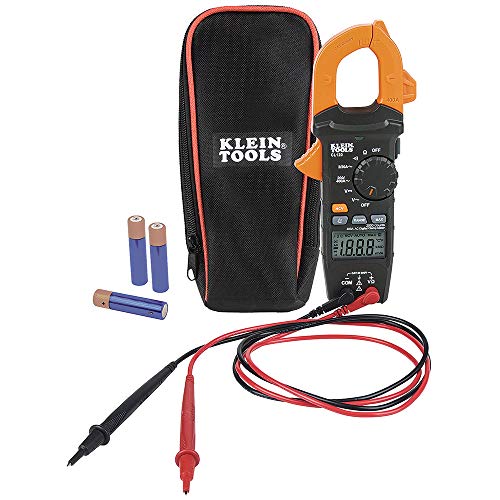
- 400A AC clamp with auto-ranging
- AC/DC voltage, resistance, continuity
- Built-in NCVT and backlit display
Best For: General troubleshooting and everyday electrical checks
Feature-Rich Diagnostic Pick
Klein Tools CL490 AC/DC Digital Clamp Meter

- AC/DC current with TRMS accuracy
- Dual display and reverse-contrast LCD
- Wide test-lead range plus temperature
Best For: More advanced troubleshooting and broader diagnostics
Balanced Field Choice
Klein Tools CL220 Digital Clamp Meter

- AC clamp current with NCVT
- TRMS, auto-ranging, and backlit display
- Adds temperature testing
Best For: Practical all-around troubleshooting with temperature support
All-Purpose AC/DC Testing – Klein Tools CL390 AC/DC Digital Clamp Meter
For clamp meters for electrical troubleshooting, the Klein Tools CL390 is a flexible all-around pick that handles current measurement through the clamp jaw and a wide range of meter functions through the test leads. It also adds integrated non-contact voltage testing, TRMS accuracy, and a reverse-contrast display for easier day-to-day electrical checks.
Best For: Electricians and maintenance users who want one clamp meter for AC/DC current, voltage, continuity, resistance, temperature, and more.
Pros:
- Measures AC/DC current through the clamp plus AC/DC voltage, resistance, continuity, frequency/duty cycle, capacitance, diode test, DC microamps, and temperature.
- Integrated non-contact voltage testing is built into the clamp jaw.
- TRMS and auto-ranging support more accurate readings.
- Reverse-contrast LCD improves visibility in different lighting.
Cons:
- Uses test leads for many measurement functions beyond current and NCVT.
- Hands-free use may require an optional magnetic hanger sold separately.
Overall, the CL390 is a practical general-purpose choice when you need broad electrical troubleshooting capability in a single clamp meter. It is especially useful if you want AC/DC current support along with common multimeter functions in one tool.
Compact High-Current Choice – Fluke 302+ Digital Clamp Meter
The Fluke 302+ is a compact option for clamp meters for electrical troubleshooting when you want simple, reliable current and voltage checks in a smaller package. It measures AC current up to 400A, offers AC/DC voltage measurement up to 600V, and carries a CAT IV 300V/CAT III 600V safety rating.
Best For: Users who need a straightforward clamp meter for high AC current checks and basic troubleshooting on large conductors.
Pros:
- Measures AC current up to 400A with a 30 mm jaw for larger conductors.
- Also measures AC/DC voltage up to 600V.
- 1.8% accuracy supports troubleshooting tasks.
- Includes TL75 hard point test leads, 2 AA batteries, and a two-year warranty.
Cons:
- Fewer advanced measurement functions are listed than on more feature-rich models.
- Best suited to core clamp meter tasks rather than broad specialty diagnostics.
In practice, the 302+ is a clean fit if you value portability and the essentials over extra features. It is a solid service meter for common electrical checks where a compact form factor matters.
Value Feature Blend – IDEAL INDUSTRIES 61-737 AC Clamp Meter
If you are comparing clamp meters for electrical troubleshooting, the IDEAL INDUSTRIES 61-737 offers a strong mix of core test functions and safety features. It measures up to 400A AC, supports 600V AC/DC, and includes true RMS accuracy, non-contact voltage sensing, and an illuminated alert system for 40–600V detection.
Best For: Technicians who want a feature-rich clamp meter with practical alerts, backlit visibility, and a carrying pouch.
Pros:
- Measures up to 400A AC plus 600V AC/DC, frequency, resistance, continuity, capacitance, diodes, and temperature.
- True RMS helps with accurate readings on non-linear signals.
- Non-contact voltage sensing includes illuminated LED and audible alerts.
- Backlit display, probe tip holder, hanging strap clip, test leads, thermocouple, batteries, and pouch are included.
Cons:
- It is listed as a compact unit, so users wanting a larger screen may prefer other options.
- Current measurement is AC clamp-based rather than broader AC/DC clamp current.
This model stands out for combining useful troubleshooting functions with everyday convenience features. It is a sensible pick when you want a well-rounded meter that is ready to carry and use right away.
HVAC-Focused Utility – Klein Tools CL445 HVAC Clamp Meter
For clamp meters for electrical troubleshooting in HVAC service, the Klein Tools CL445 is built around the functions technicians use most. It measures AC current, inrush, and non-contact voltage through the clamp, while the leads handle AC/DC voltage, resistance, continuity, frequency/duty cycle, DC microamps, diode test, capacitance, and temperature.
Best For: HVAC and electrical professionals who need inrush current, dual voltage/current display, and a thin clamp jaw for tighter spaces.
Pros:
- Measures AC current, inrush, and NCVT through the clamp jaw.
- Dual display shows voltage and current simultaneously.
- TRMS, auto-ranging, Max/Min, Data Hold, and auto-power off add practical field features.
- Includes carrying case, alligator clips, K-Type thermocouple, test leads, safety caps, and 3 AAA batteries.
Cons:
- It is oriented specifically toward HVAC use rather than a broad all-purpose clamp meter design.
- Maximum operating voltage and included accessories may be more than basic users need.
The CL445 is the most specialized option in this group, with a feature set that makes sense for service work and tight access. If your troubleshooting often involves HVAC systems or inrush readings, it is especially well matched.
Smart Circuit-Finding Clamp Meter – Ideal Electrical 61-747 TightSight Clamp Meter
For clamp meters for electrical troubleshooting, the Ideal Electrical 61-747 is built to speed up fault-finding with instant tracing and smart identification. It is aimed at everyday residential and commercial testing, with a rugged body, easy controls, and a clear dual backlit display that helps reduce guesswork on busy jobs.
Best For: Electricians who want quick breaker tracing and dependable all-around troubleshooting in homes or commercial spaces.
Pros:
- Instant tracing helps detect energized circuits quickly.
- Smart identification maps breaker locations to cut down on guesswork.
- Dual backlit displays and probe holder support easier daily use.
- Rugged build is suited to jobsite conditions.
Cons:
- Measures up to 400A AC/DC, which may be limiting for heavier-duty work.
- Focuses on troubleshooting features rather than advanced logging.
This is a practical choice if your priority is faster circuit location and straightforward electrical testing. It balances useful diagnostics with a durable design, making it a strong fit for routine field troubleshooting.
Trusted True-RMS Utility Clamp Meter – Fluke 323 Clamp Meter
If you want a straightforward tool for clamp meters for electrical troubleshooting, the Fluke 323 focuses on the essentials: AC current, AC/DC voltage, resistance, and continuity. Its true RMS sensing helps with accurate readings on linear or non-linear loads, while the compact jaw opening and audible continuity check make day-to-day diagnostics efficient.
Best For: Commercial and residential electricians who want a simple, reliable clamp meter for core troubleshooting tasks.
Pros:
- True RMS sensing improves reading accuracy on different load types.
- Measures AC current to 400A and AC/DC voltage to 600V.
- Audible continuity sensor speeds up circuit checks.
- Meets IEC safety standard 61010-1 with CAT IV/CAT III ratings.
Cons:
- Does not measure DC current.
- Fewer advanced functions than multi-feature troubleshooting meters.
The Fluke 323 is a solid pick when you want trusted core measurements without extra complexity. It is especially appealing for users who value safety ratings, consistent performance, and a familiar troubleshooting workflow.
Feature-Rich Diagnostic Clamp Meter – FNIRSI DMC-100 Clamp Meter
For clamp meters for electrical troubleshooting with more diagnostic depth, the FNIRSI DMC-100 adds TRMS measurement, NCV, live wire testing, and real-time curve recording. The large 2-inch TFT color screen and rechargeable battery make it practical for longer maintenance sessions, while its broad measurement set supports automotive, household, and light industrial work.
Best For: Technicians who want a rechargeable, multi-function clamp meter for tracking intermittent faults and mixed electrical repairs.
Pros:
- TRMS support with up to 600A AC/DC current measurement.
- Real-time curve recording helps track intermittent electrical faults.
- 2-inch TFT display with adjustable brightness and dual themes.
- Rechargeable Type-C battery reduces downtime from replacements.
Cons:
- Voltage measurement requires test leads; clamp jaws are current-only.
- More feature-heavy than a basic clamp meter, which may add complexity for simple jobs.
The DMC-100 stands out when troubleshooting calls for visualization and data capture, not just quick readings. It is a versatile option for users who move between automotive, home, and light maintenance tasks and want extra diagnostic detail.
Compact Everyday Tester – Klein Tools CL120 Digital Clamp Meter
If you want clamp meters for electrical troubleshooting that cover the basics without adding complexity, the Klein Tools CL120 is a practical pick. It measures AC current through the clamp and handles AC/DC voltage, resistance, continuity, and non-contact voltage testing with the test leads and integrated jaw detection.
Best For: General electrical troubleshooting, quick current checks, and everyday service work.
Pros:
- Measures AC current up to 400A with auto-ranging for simpler setup
- Built-in NCVT in the clamp jaw adds convenient non-contact voltage testing
- Backlit LCD helps readings stay visible in low-light areas
- Includes test leads, safety caps, carrying case, and AAA batteries
Cons:
- AC current only through the clamp, not AC/DC current like higher-feature models
- No TRMS capability listed
- Fewer advanced functions than the CL490
This is a straightforward, well-equipped meter for basic troubleshooting tasks where speed and convenience matter more than advanced measurement modes.
Feature-Rich Diagnostic Pick – Klein Tools CL490 AC/DC Digital Clamp Meter
For clamp meters for electrical troubleshooting where you want broader test coverage, the Klein Tools CL490 adds more diagnostic tools than the simpler models. It measures AC/DC current through the clamp and expands into voltage, resistance, continuity, frequency/duty cycle, DC microamps, diode test, capacitance, and temperature with the included thermocouple.
Best For: Users who need a more capable troubleshooting meter with a wider range of electrical tests.
Pros:
- Measures AC/DC current and includes TRMS for more precise readings
- Dual display design improves visibility from different viewing angles
- Reverse-contrast backlit LCD is easier to read in varied environments
- Supports a wide range of test-lead functions, including microamps, diode, capacitance, and temperature
Cons:
- More functions may be more than casual users need
- Magnetic hanger is sold separately
- Includes more modes, which can make it less streamlined than basic models
The CL490 is the most versatile option in this group, making it a strong choice when troubleshooting jobs call for more than just current and voltage checks.
Balanced Field Choice – Klein Tools CL220 Digital Clamp Meter
If you need clamp meters for electrical troubleshooting and want a balanced feature set, the Klein Tools CL220 sits between a basic tester and a full diagnostic meter. It measures AC current through the clamp, supports NCVT, and adds AC/DC voltage, resistance, continuity, and temperature testing with the leads and thermocouple.
Best For: Electricians and DIYers who want a practical all-around clamp meter with temperature testing.
Pros:
- AC current clamp measurement plus integrated NCVT for quick checks
- TRMS and auto-ranging help support accurate measurements
- Temperature testing adds useful versatility for service work
- Backlit display improves readability in dim areas
Cons:
- Measures AC current only through the clamp, not DC current
- Fewer advanced functions than the CL490
- Less specialized than a dedicated diagnostics meter
The CL220 is a sensible middle-ground choice when you want useful troubleshooting features without stepping up to the most complex model.
How We Picked the Best Clamp Meters for Electrical Troubleshooting
We looked for Clamp Meters for Electrical Troubleshooting that offer a practical combination of AC/DC current range, voltage measurement, resistance and continuity checks, and helpful safety features. Priority went to models that are easy to read, simple to operate, and suitable for common field work.
We also weighed clamp opening size, auto-ranging, True RMS performance, non-contact voltage detection, and specialty functions such as inrush current or temperature measurement when those features add real value.
Quick Comparison
For basic electrical work, a straightforward meter with AC current and voltage testing is usually enough. For broader diagnostics, look for AC/DC capability, True RMS, and continuity/resistance modes. HVAC-focused users may benefit from temperature, microamp, and inrush functions, while higher-count displays and dual-readout screens can improve readability in busy work environments.
Key Buying Factors for Clamp Meters for Electrical Troubleshooting
Measurement Needs
Match the meter to the tasks you handle most often. If you mainly test panels, branch circuits, or receptacles, AC current and AC/DC voltage may be sufficient. If you service systems with electronics, motors, or solar components, AC/DC and True RMS can be more important.
Jaw Size and Current Range
A larger jaw opening makes it easier to clamp around thicker conductors or bundled wires. Current range matters too: 400A covers many everyday jobs, while 600A can offer more headroom for heavier-duty use.
Readability and Ease of Use
Auto-ranging, clear displays, backlighting, and dual displays can reduce mistakes and speed up testing. If you work in dim mechanical rooms or cramped panels, visibility is a major advantage.
Safety and Convenience Features
Look for built-in non-contact voltage detection, robust category ratings, and solid leads and probes. Extra functions like continuity, resistance, temperature, and inrush current can save time when you need a single tool for multiple checks.
Who Should Buy Which Clamp Meters for Electrical Troubleshooting?
Electricians who want a dependable everyday meter should prioritize a balanced model with AC/DC voltage, current measurement, and continuity testing. HVAC technicians should lean toward meters with temperature, microamps, and inrush capability. Budget-minded buyers may prefer simpler options with core testing functions, while advanced users may want higher-count, True RMS models with broader diagnostic coverage.
If you are comparing Clamp Meters for Electrical Troubleshooting, choose the one that best matches your typical workload rather than the longest spec sheet. The right meter is the one you can read quickly, trust in the field, and use often.