Choosing the right home energy monitor for solar panels can make a big difference in how well you track solar production, household usage, and grid import or export.
In this roundup, we focus on monitors that help homeowners make smarter energy decisions, improve self-consumption, and see where electricity is really going in the home.
Best 10 Home Energy Monitor for Solar Panels Picks for 2026
Best for Solar Net Metering
Emporia Vue 3 Home Energy Monitor

- Monitors whole-home usage and solar/net metering
- Provides real-time, circuit-level energy data
- UL-certified design for added safety confidence
Best For: Homeowners with solar who want detailed circuit-level monitoring and net metering insights.
Best Value
Bi-Directional WiFi Energy Meter

- Tracks imported and exported grid energy
- Compares solar production with home usage
- Integrates with Home Assistant and Modbus
Best For: Homeowners with solar PV who need real-time net metering and automation-ready data.
Best for Solar Surplus Automation
Meross 18-Circuit Energy Monitor

- 18-circuit monitoring with real-time usage tracking
- Home Assistant integration for solar surplus automation
- No subscriptions, local data, and 2-year warranty
Best For: Solar homeowners who want circuit-level visibility and automatic control of excess solar power.
Best for Small Spaces

- Tracks solar PV output and grid consumption
- Wi‑Fi app monitoring via Tuya/Smart Life
- 2 x 80A CT clamps for single-phase homes
Best For: Single-phase solar homeowners who want app-based net metering visibility.
Best for Home Assistant
20-Circuit Whole Home Energy Monitor
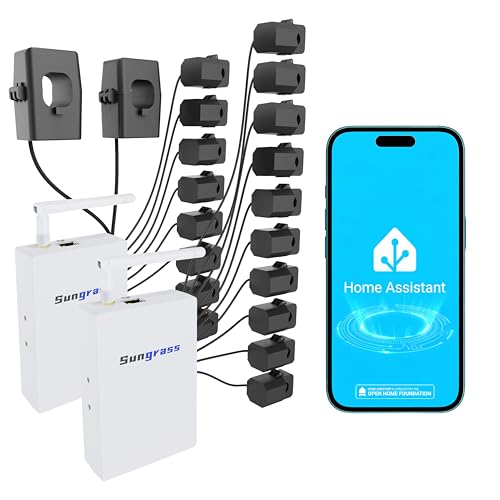
- Deep Home Assistant integration for monitoring and automations
- Tracks solar self-consumption, grid feed-in, and whole-home loads
- Local data storage with Wi-Fi and Ethernet connectivity
Best For: DIY smart-home users who want detailed solar and whole-home energy tracking with local control.
Best for Multi-Phase Solar Homes

- Real-time tracking for solar, grid import/export, and household use
- Supports split-phase, single-phase, and three-phase systems
- Wi-Fi app access with optional Home Assistant and MQTT integration
Best For: Homeowners with solar panels and multi-phase wiring who want whole-home energy visibility.
Best for Local Control
Refoss Smart Home Energy Monitor

- Local-only Web UI, Open API, and MQTT support
- Native Home Assistant integration for automation
- Solar net metering features with ±1% accuracy
Best For: Solar homeowners who want private, local-first monitoring and automation.
Best for Circuit-Level Solar Tracking
WiFi Home Energy Monitor with 3 CT Clamps
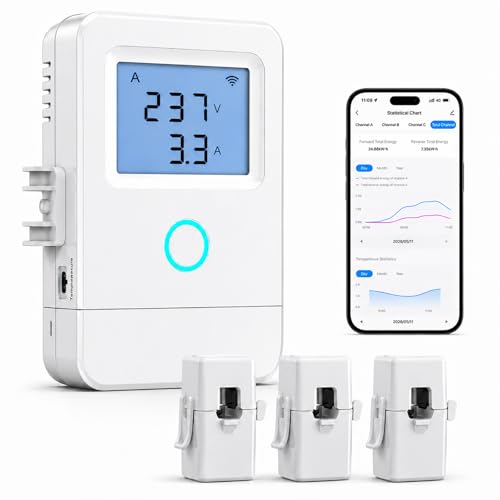
- Monitors up to 3 selected circuits at once
- Smart Life/Tuya app shows live power and energy data
- Historical tracking helps spot usage trends
Best For: Homeowners who want targeted solar and appliance circuit monitoring in the Smart Life/Tuya app.
Best for Solar & Net Metering
Emporia Vue 3 Home Energy Monitor

- UL Listed safety certification
- Tracks solar production and net metering
- 8 circuit sensors for detailed monitoring
Best For: Homeowners who want detailed solar and net metering visibility with app-based energy management.
Best for Solar Tracking

- Tracks solar production and net metering
- UL Listed with app-based real-time monitoring
- Supports up to 16 branch circuit sensors
Best For: Homeowners with solar who want detailed live monitoring and appliance-level insights.
Best for Solar Net Metering – Emporia Vue 3 Home Energy Monitor
If you want a practical home energy monitor for solar panels, the Emporia Vue 3 is built for tracking whole-home usage plus solar production and net metering data. It gives you real-time visibility into where electricity is going, which helps you spot waste, compare circuit loads, and better understand how your system performs day to day.
Best For: Homeowners with solar who want detailed circuit-level monitoring and net metering insights.
Pros:
- Tracks whole-home consumption and solar/net metering data in one system
- Real-time monitoring helps identify high-draw appliances and usage spikes
- Circuit-level visibility can support smarter energy management decisions
- UL-certified design adds confidence for safety-focused buyers
Cons:
- Installation is more involved than plug-in energy monitors
- Works best for users comfortable with panel-based setup
- Advanced features may be more than casual users need
For homeowners comparing the best home energy monitor for solar panels, the Vue 3 stands out for its mix of solar tracking, net metering support, and granular usage data. It is a strong fit if you want more than simple totals and prefer actionable detail at the circuit level.
Best Value – Bi-Directional WiFi Energy Meter
If you want a home energy monitor for solar panels that can show both import and export in real time, this bi-directional DIN-rail meter is built for the job. It tracks grid usage versus solar production, works with net metering setups, and gives you the data you need for billing, reporting, and energy management.
Best For: Homeowners with solar PV who want a single meter for tracking imported and exported energy, especially in net metering setups.
Pros:
- Tracks imported and exported grid energy in real time
- Useful for solar production comparison and billing reports
- Open API and Home Assistant / Modbus integration support
- DIN-rail form factor suits permanent panel installation
Cons:
- Installation is more technical than plug-in monitors
- May be overkill if you only need basic appliance-level tracking
For buyers who need detailed solar and grid flow data, this home energy monitor for solar panels offers stronger insight than simple usage-only meters. It’s a practical pick if you want to compare your solar income against your electric bill and feed the data into a smart home platform.
Best for Solar Surplus Automation – Meross 18-Circuit Energy Monitor
If you want a home energy monitor for solar panels that does more than just show usage, the Meross Smart Home Energy Monitor is built for real-time tracking, circuit-level visibility, and solar surplus detection. It’s a strong fit for homeowners who want detailed energy data without subscriptions, plus local Home Assistant control for smarter automation.
Best For: Solar homeowners who want to automatically route excess generation to EV chargers, water heaters, and other high-use loads.
Pros:
- Monitors 18 circuits, including 2 main circuits and 16 branch circuits, for detailed whole-home insight.
- Home Assistant support enables solar surplus detection and automation with local-only data.
- No subscription fees, with up to 5 years of data storage and exportable reports.
- ETL-certified with a 2-year warranty and easy clamp-on installation.
Cons:
- Home Assistant features will matter most to users already comfortable with smart home setup.
- Installed monitoring is more involved than a simple plug-in energy meter.
For solar-equipped homes, this Meross unit stands out because it combines accurate usage tracking with automation-friendly surplus detection. If your goal is to get more value from every watt your panels produce, it’s one of the more capable home energy monitor for solar panels options in this roundup.
Best for Small Spaces – EdgeAnt 2x80A WiFi Monitor
If you want a practical home energy monitor for solar panels, this EdgeAnt unit is built to show both solar generation and grid usage in the Tuya/Smart Life app. It’s a straightforward single-phase clamp meter with Wi‑Fi access, real-time readings, and long-term tracking, making it useful for checking self-consumption and spotting waste.
Best For: Homeowners with single-phase solar setups who want app-based monitoring and basic net metering visibility.
Pros:
- Tracks solar PV output and grid consumption for net metering insight
- Wi‑Fi app control through Tuya/Smart Life for remote monitoring
- Includes 2 x 80A CT clamps for whole-home single-phase monitoring
- Shows key electrical metrics plus hour/day/month/year records
Cons:
- Single-phase design may not suit larger or split-phase systems
- Data retention is limited to just over one month
- Installation depends on following the wiring diagram carefully
For buyers comparing a home energy monitor for solar panels, this EdgeAnt model stands out for its solar net metering focus and simple app access. It’s a solid fit if you mainly want visibility into where your power is coming from and where it’s going, without paying for a more advanced energy management system.
Best for Home Assistant – 20-Circuit Whole Home Energy Monitor
If you want a home energy monitor for solar panels that goes beyond basic usage tracking, this 20-circuit system is built for real-time insight and automation. It’s a strong fit for homeowners who already use Home Assistant and want local, detailed monitoring of solar self-consumption, grid feed-in, and whole-home loads.
Best For: DIY smart-home users who want deep Home Assistant integration, local data control, and detailed solar energy tracking across multiple circuits.
Pros:
- Native Home Assistant integration with real-time monitoring and automation support
- Tracks solar, V2G, and BESS flows with bidirectional metering
- Local-first data storage for better privacy, speed, and reliability
- Wi-Fi and Ethernet connectivity plus scalable 20-circuit coverage
Cons:
- Best suited to users comfortable with smart-home setup and circuit-panel installation
- More advanced than a basic app-only energy monitor
- Requires enough panel space and planning for multi-circuit deployment
For buyers who want a home energy monitor for solar panels with automation-friendly software and detailed whole-home visibility, this model stands out. Its local processing, expandable circuit coverage, and solar-focused analytics make it especially useful for turning energy data into actionable savings.
Best for Multi-Phase Solar Homes – WEM3050T WiFi Energy Meter
If you want a home energy monitor for solar panels that handles more than basic plug-level tracking, the WEM3050T is built for whole-home insight. It monitors grid import/export, consumption, and solar interaction in real time, with support for split-phase, single-phase, and three-phase systems.
Best For: Homeowners with solar panels who want a Wi-Fi energy monitor for whole-home usage, grid flow, and multi-phase support without needing a gateway.
Pros:
- Tracks solar generation, grid export, and self-consumption in one system
- Works with split-phase, single-phase, and three-phase electrical setups
- Connects directly to Wi-Fi with free iOS, Android, and web access
- Supports advanced integrations like Home Assistant, MQTT, and Node-RED
Cons:
- Installation is more involved than a simple plug-in monitor
- Advanced features may be unnecessary for users who only want basic readings
This is a strong fit if you need a home energy monitor for solar panels that can scale from simple app-based tracking to deeper smart home integration. It offers a practical balance of real-time visibility, broad system compatibility, and optional advanced control.
Best for Local Control – Refoss Smart Home Energy Monitor
If you want a home energy monitor for solar panels that keeps your data off the cloud, the Refoss monitor is built for local-first tracking and automation. It works with Home Assistant, MQTT, and a built-in web UI, making it a strong fit for homeowners who want real-time visibility, solar net metering support, and hands-on control over when loads run.
Best For: Solar homeowners who want privacy-focused monitoring, local automation, and circuit-level control without subscription fees.
Pros:
- Local-only access with Web UI, Open API, and MQTT for stronger privacy
- Native Home Assistant integration plus solar-focused automation options
- ±1% accuracy and detailed real-time circuit monitoring
- ETL certified with clamp-on installation and no cloud requirement
Cons:
- Installation may be more involved than plug-in energy monitors
- Works best for users already comfortable with smart home tools
For buyers comparing a home energy monitor for solar panels, this Refoss model stands out for privacy, local control, and automation flexibility rather than app-only simplicity. It is especially appealing if you want to shift surplus solar into daytime loads and manage usage without depending on a cloud service.
Best for Circuit-Level Solar Tracking – WiFi Home Energy Monitor with 3 CT Clamps
If you want a practical home energy monitor for solar panels that focuses on selected circuits rather than whole-home estimates, this WiFi unit gives you real-time visibility into the loads that matter most. With three CT clamps, app-based tracking, and historical usage data, it’s a useful pick for monitoring solar-related circuits, HVAC, water heaters, and other high-draw appliances.
Best For: Homeowners who want to track a few important circuits in the Smart Life/Tuya app, especially for solar-related monitoring and major appliance usage.
Pros:
- Tracks up to 3 selected circuits at once with included CT clamps
- Shows voltage, current, power, and energy data in the Smart Life/Tuya app
- Useful historical trends for spotting usage patterns over time
- Temperature alert and limited remote ON/OFF support add extra control
Cons:
- Requires panel wiring and is best installed by a qualified electrician
- Only monitors selected circuits, not every load in the home
- Remote switching is limited to one circuit at up to 15A
As a home energy monitor for solar panels, it’s strongest when you want to compare a few dedicated circuits and see how solar-related loads are behaving in real time. It’s less of a plug-and-play gadget and more of a monitoring tool for buyers who care about data and targeted circuit insight.
Best for Solar & Net Metering – Emporia Vue 3 Home Energy Monitor
If you want a home energy monitor for solar panels that helps you track generation, usage, and export in one place, the Emporia Vue 3 is a strong fit. It installs inside most circuit panels with clamp-on sensors and pairs with the Emporia app for near real-time visibility into where power is going.
Best For: Homeowners who want detailed solar and net metering data, plus app-based control for spotting waste and managing electric bills.
Pros:
- UL Listed for added safety and peace of mind
- Tracks solar production and net metering alongside whole-home use
- Supports app alerts, automations, and cost-saving insights
- Includes 8 circuit sensors for more granular monitoring
Cons:
- Requires 2.4 GHz Wi-Fi and an internet connection
- Installation may be more involved than plug-in monitors
- Some electrical setups need an additional 200A sensor sold separately
For buyers comparing a home energy monitor for solar panels, the Vue 3 stands out for combining safety certification, circuit-level visibility, and useful solar tracking. It is especially appealing if you want more than basic usage numbers and prefer actionable data you can use to reduce peak-demand costs and improve overall efficiency.
Best for Solar Tracking – Emporia Vue 3 Energy Monitor
If you want a practical home energy monitor for solar panels, the Emporia Vue 3 stands out for real-time usage tracking, net metering visibility, and app-based control. It’s built for homeowners who want to see where power is going, spot waste quickly, and manage energy costs with live data.
Best For: Homeowners with solar who want detailed real-time monitoring, net metering support, and app alerts.
Pros:
- Tracks solar production and net metering alongside whole-home usage
- UL Listed safety certification and 1-year warranty
- Supports up to 16 branch circuit sensors for appliance-level monitoring
- Real-time app data with automation features for cost savings
Cons:
- Requires installation in the circuit panel
- Needs 2.4 GHz Wi-Fi and internet access
- Some sensors are sold separately
The Vue 3 is a strong pick if you want a home energy monitor for solar panels that goes beyond basic usage totals and gives you actionable insight into billing, export, and day-to-day consumption.
How We Picked the Best Home Energy Monitor for Solar Panels
We prioritized monitors that provide real-time visibility, support for solar-aware tracking, and practical installation options for common home setups. We also favored products with useful app or dashboard features, strong smart-home compatibility, and the ability to monitor whole-home usage or multiple circuits when needed.
Because solar systems vary widely, the best choice depends on whether you want simple household tracking, circuit-level detail, or more advanced integration with platforms like Home Assistant or open APIs.
Quick Comparison: What Matters Most
Before buying, compare CT clamp count, single-phase versus three-phase support, cloud versus local control, and whether the monitor can show net energy flow clearly. For many buyers, a Home Energy Monitor for Solar Panels should also make it easy to distinguish consumption from solar surplus and grid usage.
Key Buying Factors for Home Energy Monitor for Solar Panels
Monitoring Depth
Whole-home monitoring is enough for many households, but circuit-level monitoring is better if you want to isolate major loads such as HVAC, EV charging, or water heating.
Solar Compatibility
Look for clear support for solar self-consumption, net metering, or bidirectional energy tracking. If you have a solar array with battery storage, make sure the device can reflect charging and export behavior accurately.
System Type and Electrical Service
Match the monitor to your electrical setup. Single-phase homes need different hardware than three-phase properties, and panel layout can affect how easy installation will be.
Connectivity and Integrations
Wi-Fi is common, but local options such as Modbus, open APIs, and Home Assistant support can be better for reliability and advanced automation. If privacy matters, a no-cloud model may be the smarter pick.
Installation and Expansion
Consider how many CT clamps or circuits you need now and whether you may want to expand later. A little extra capacity can save you from replacing the system as your energy needs grow.
Who Should Buy Which Home Energy Monitor for Solar Panels?
If you want the easiest all-around option, choose a monitor with strong app support and straightforward setup. If you want deeper insight into solar production and household loads, pick a circuit-monitoring model. For advanced smart-home users, a local-first or API-friendly monitor is often the best fit. And if you have a more complex electrical panel or three-phase service, choose hardware designed specifically for that setup.
In short, the best Home Energy Monitor for Solar Panels is the one that matches your panel type, your data needs, and how hands-on you want to be with monitoring and automation.