A solar array needs more than panels: its mounting hardware must fit the roof, support the planned layout, and meet local installation requirements. Kits can look similar while including different rails, clamps, brackets, and grounding parts.
These 10 options span compact two-panel setups through larger arrays. Use the guide below to narrow them by roof type, panel dimensions, and what you may still need to buy.
Best 10 Roofsolar Mounting Systems Picks for 2026
Shingle-Roof Pick

- Four 88-inch USA-made rails
- Sealed T-brackets and clamps included
- Grounding lugs and wire clips included
Best For: Four-panel asphalt-shingle roof projects
Mid-Size Array Pick

- Fits eight 42-inch-wide panels or ten 26-inch-wide panels
- Adjustable clamps fit 30–45 mm frames
- Includes grounding lugs and wire clamps
Best For: Mid-size arrays using the specified panel widths
Short-Rail Pick
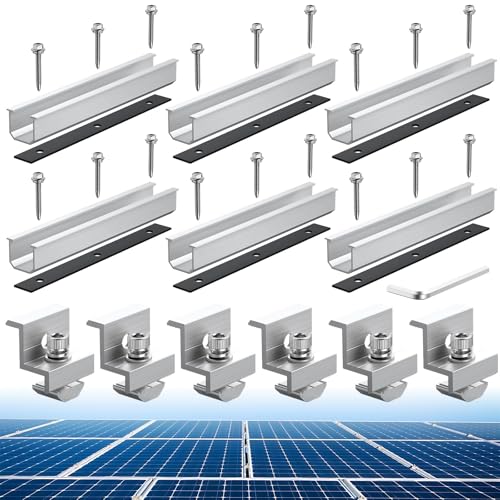
- Six 7.87-inch aluminum rails
- End clamps for 30 mm or 35 mm frames
- Includes Z-brackets and fasteners
Best For: Small installations needing short rail sections
Large-Array Pick

- Fits twelve 42-inch-wide or fifteen 26-inch-wide panels
- Adjustable clamps fit 30–45 mm frames
- Includes ground lugs and wire clamps
Best For: Larger arrays using the specified panel widths
Best for Easy Setup

- Supports up to ten specified 320W panels
- 16 anodized aluminum rails
- Grounding and cable hardware included
Best For: Larger multi-panel installations
Best for Everyday Use

- Eight 47.2-inch rails
- Connectors extend rail layouts
- Fits 30–35 mm framed panels
Best For: Four- or five-panel projects
Two-Panel Pick
Compact Side-by-Side Mount Kit

- Designed for two side-by-side panels
- Six 4.72-inch short rails
- Includes clamps, seals, and screws
Best For: Compact two-panel installations
Best for Smaller Arrays

- Eight 47.2-inch rails
- Fits up to five specified 320W panels
- Includes roof and cable hardware
Best For: Smaller framed-panel roof arrays
Best for Large Arrays
- Twenty 47.2-inch rails
- Fits up to thirteen specified 320W panels
- Includes 30 wire clips
Best For: Larger framed-panel arrays
Best Mid-Size Option
- Twelve 47.2-inch rails
- Fits up to seven specified 320W panels
- Includes eight grounding lugs
Best For: Mid-size framed-panel arrays
Shingle-Roof Pick – Four-Panel Rail Kit
For a four-panel shingle-roof project, this is one of the more complete roofsolar mounting systems in the lineup. It pairs four 88-inch, USA-made aluminum rails with splicers, clamps, sealed T-brackets, grounding lugs, and wire clips.
Best For: A four-panel installation on an asphalt-shingle roof.
Pros:
- Includes four 88-inch rails and four rail splicers.
- Supplies clamps, sealed T-brackets, lag bolts, grounding lugs, and wire clips.
- Lists a 134-mph wind rating and a 1.4 kN/m² snow-load rating.
Cons:
- Designed around a four-panel shingle-roof layout; other roof types may require different mounting hardware.
- The listed wind and snow ratings should still be checked against local project requirements.
The included electrical-mounting accessories reduce the number of separate parts to source. Confirm your panel dimensions, roof attachment plan, and local requirements before ordering.
Mid-Size Array Pick – Tandefio 8–10 Panel Kit
This Tandefio kit suits shoppers comparing roofsolar mounting systems for a larger array: it is specified for eight 42-inch-wide panels or ten 26-inch-wide panels. Its aluminum-alloy rails come with adjustable clamps, L-brackets, grounding lugs, and wire clamps.
Best For: An eight-panel array, or a ten-panel array using the specified smaller panel width.
Pros:
- Includes rails, connectors, clamps, L-brackets, and attachment hardware.
- Adjustable end and middle clamps accommodate 30–45 mm panel frames.
- Includes eight grounding lugs and 16 wire clamps.
Cons:
- Advertised panel count depends on panel width.
- Check whether the included L-brackets and gaskets suit your particular roof covering and attachment plan.
It is a practical parts bundle for the stated panel sizes, but verify frame thickness and roof compatibility before planning the layout.
Short-Rail Pick – Anbte Z-Bracket Kit
Unlike full-length roofsolar mounting systems, this Anbte kit supplies six individual 7.87-inch aluminum rails with Z-brackets and end clamps. Its compact format may suit a small installation where short mounting sections are appropriate.
Best For: Small home, RV, or marine panel installations that call for short rails.
Pros:
- Includes six short rails, Z-brackets, fasteners, and a wrench.
- Two-hole end clamps have sides intended for 30 mm and 35 mm panel frames.
- Uses aluminum-alloy brackets, stainless steel screws, and EPDM rubber mats.
Cons:
- The 7.87-inch sections are not a substitute for a full-length rail layout.
- The stated end-clamp fit is limited to 30 mm or 35 mm frames.
Check your panel frame depth and mounting-surface requirements closely; this is a short-rail hardware set, not a complete multi-panel racking package.
Large-Array Pick – Tandefio 12–15 Panel Kit
For shoppers sizing up roofsolar mounting systems for a larger project, this Tandefio bundle is specified for twelve 42-inch-wide panels or fifteen 26-inch-wide panels. It includes aluminum-alloy rails, adjustable clamps, L-brackets, and wiring accessories.
Best For: A large array using the specified panel widths and 30–45 mm frames.
Pros:
- Includes 12 rails, 20 connectors, and 24 L-brackets.
- Adjustable end and middle clamps fit 30–45 mm panel frames.
- Supplies 12 ground lugs and 24 wire clamps.
Cons:
- The 12- or 15-panel capacity is tied to the stated panel widths.
- At a listed 54 pounds, the kit is heavier to handle than the smaller bundles here.
Its component count makes it worth considering for a larger layout, provided you confirm panel dimensions and that the attachment hardware suits the installation site.
Best for Easy Setup – 10-Panel Aluminum Rail Kit
For larger roofsolar mounting systems, this kit supplies rails and hardware for up to ten 320W panels with 34.7-inch widths. Its 16 aluminum rails connect into eight roughly 7.9-foot sections; panels are not included.
Best For: Buyers planning a multi-panel array who want rails, roof brackets, clamps, grounding hardware, and cable clips in one kit.
Pros:
- Includes 16 rails, 14 connectors, 16 L-brackets, and mid and end clamps.
- Anodized 6005-T5 aluminum rails and adjustable clamps accommodate framed panels within the stated thickness ranges.
- Includes grounding lugs, wire clips, lag bolts, and EPDM washers.
Cons:
- Panels must be purchased separately.
- At 45.3 pounds, it is a substantial kit to handle.
This is the most expansive kit here, but check your panel dimensions and roof attachment requirements before choosing a layout.
Best for Everyday Use – 4–5 Panel Roof Rail Kit
This 4–5 panel kit suits buyers comparing roofsolar mounting systems for a moderate-size installation. Eight 47.2-inch aluminum rails and six connectors offer layout flexibility, while the included clamps fit framed panels 30–35 mm thick.
Best For: A four- or five-panel roof, shed, cabin, or other small off-grid project using compatible framed panels.
Pros:
- Includes rails, connectors, eight L-brackets, and mid and end clamps.
- Connectors allow the rails to be extended for different layouts.
- Five cable clips and four grounding clamps help organize the finished array.
Cons:
- Supplied clamps are specified for 30–35 mm panel frames.
- Includes fewer cable clips than its stated 4–5 panel capacity might require for some wiring layouts.
It fills the gap between a two-panel setup and a larger array; confirm panel-frame thickness and the intended attachment surface before ordering.
Two-Panel Pick – Compact Side-by-Side Mount Kit
If you need roofsolar mounting systems for just two panels, this compact kit is designed for a side-by-side installation. It pairs six 4.72-inch short rails with clamps, rubber seals, and self-drilling screws for standard framed panels 30–35 mm thick.
Best For: A small two-panel project where short mounting rails suit the planned panel and roof layout.
Pros:
- Purpose-built for two side-by-side panels.
- Includes six short rails, four end-clamp sets, and two mid-clamp sets.
- Anodized aluminum rails, stainless steel hardware, and rubber seals are included.
Cons:
- Not intended for more than two panels.
- Fits standard framed panels 30–35 mm thick, not frameless panels.
The small parts list makes this a focused alternative to full-length rail kits, provided its short-rail design matches your installation plan.
Best for Smaller Arrays – 5-Panel Aluminum Rail Kit
For a smaller installation, this roofsolar mounting systems kit supplies eight 47.2-inch aluminum rails that join into four 7.9-foot sections. It is sized for up to five 320W panels at the stated 34.7-inch panel width; panels are not included.
Best For: Smaller framed-panel arrays needing a rail kit with roof attachments and cable-management hardware.
Pros:
- Anodized 6005-T5 aluminum rails and six connectors provide the racking foundation.
- Adjustable end clamps fit 30–45mm frames; mid clamps fit 30–40mm frames.
- Includes L-brackets, lag bolts, EPDM washers, four grounding lugs, and eight wire clips.
Cons:
- Five-panel capacity applies to the specified 320W panels; check your own panel dimensions before ordering.
- Solar panels must be purchased separately.
This is the compact option of the three kits. Confirm the panel layout, roof attachment details, and clamp fit before installation.
Best for Large Arrays – 13-Panel Aluminum Rail Kit
If your plans call for a larger array, this roofsolar mounting systems kit includes twenty 47.2-inch rails, joining into ten 7.9-foot sections. The stated capacity is up to thirteen 320W panels at 34.7 inches wide, with no solar panels included.
Best For: Larger framed-panel layouts that need substantial rail coverage and included wire-management accessories.
Pros:
- Includes 20 L-brackets, 18 connectors, and adjustable end and mid clamps.
- Anodized 6005-T5 aluminum rails are designed for outdoor use.
- Comes with lag bolts, EPDM washers, 16 grounding lugs, and 30 wire clips.
Cons:
- At a listed 54.9 pounds, the kit is heavier to handle than a small rail package.
- The stated panel count depends on panel width; panels are sold separately.
Choose this kit when the larger rail count matches your layout, rather than assuming the 13-panel rating applies to every module size. Verify roof attachments and frame thickness for your installation.
Best Mid-Size Option – 7-Panel Aluminum Rail Kit
This mid-size roofsolar mounting systems kit provides twelve 47.2-inch rails that connect into six 7.9-foot sections. It is specified for up to seven 320W panels measuring 34.7 inches wide, making it a step up from the five-panel kit without the rail count of the 13-panel package.
Best For: Mid-size framed-panel arrays needing rails, adjustable clamps, grounding lugs, and wire clips in one kit.
Pros:
- Includes 10 connectors and 12 L-brackets for assembling the rail layout.
- Adjustable end clamps fit 30–45mm frames; mid clamps fit 30–40mm frames.
- Includes lag bolts, EPDM washers, eight grounding lugs, and 14 wire clips.
Cons:
- Solar panels are not included.
- The seven-panel rating is based on the specified panel width, so other modules may require a different layout.
The twelve-rail package offers a useful middle ground. Check your panel measurements, roof attachment requirements, and clamp compatibility before buying.
How We Picked the Best Roofsolar Mounting Systems
We focused on practical differences visible in the kit descriptions: stated panel capacity, rail quantities and lengths, roof-attachment hardware, clamps, and extras such as grounding lugs or wire clips. The selection covers small projects and larger arrays, including kits marketed for specific panel counts or 320W panels. A listed panel count is a planning shortcut, not proof that your modules, roof, or local code are compatible.
Quick Comparison by Project Size
For a compact array, start with the two-panel rack kit or one of the four- to five-panel roof kits. The five- and seven-panel rail kits suit intermediate layouts, while the eight- to ten-panel Tandefio kit and the ten-panel rail kit target larger projects. The 12- to 15-panel Tandefio kit and 13-panel rail kit offer higher stated capacities. One kit lists 7.87-inch aluminum rails; verify how its short rail sections attach and whether that configuration works for your panel layout before comparing it with longer-rail kits.
Compare the complete bill of materials, not just the advertised capacity. For example, some descriptions explicitly mention grounding hardware or wire management, while others emphasize clamps and roof brackets. Confirm what is actually in the box and what your installation will require separately.
Key Buying Factors for Roof Solar Mounting Systems
Roof Type and Attachment
Check whether the attachment method is intended for your roof covering and structure. The four-panel kit specifically names shingle-roof mounting and T-mounting brackets; other listings may require closer inspection. Fasteners must reach appropriate structural members, and every roof penetration needs a suitable flashing and waterproofing method. Do not assume generic brackets include either.
Panel Fit, Layout, and Rail Support
Match clamp ranges to your module frame thickness, and check rail spacing against the module maker’s approved clamping zones. Compare panel dimensions, orientation, roof setbacks, and attachment spacing with the kit’s rail lengths and quantities. Kits described around 320W panels are not automatically compatible with every 320W module; physical dimensions and frame specifications matter more than wattage alone.
Structural and Electrical Requirements
Confirm that the mounting design can meet site-specific wind, snow, and roof-load requirements. Check the supplied components for documented compatibility and required listings. Grounding and bonding parts must work with the rails and modules you choose; wire clips can help organize cables but do not replace an approved electrical design.
Who Should Buy Which Roofsolar Mounting Systems?
Choose a two-panel kit for a genuinely small layout, or a four- to five-panel option if your planned array and roof measurements fit. Mid-size buyers can compare five-, seven-, and eight- to ten-panel kits by included hardware and required rail spans. For larger arrays, compare the ten-, 12- to 15-, and 13-panel options against a measured layout rather than relying on the headline count. Before ordering any Roofsolar Mounting Systems, have your installer or qualified designer confirm roof attachment, structural loads, electrical bonding, and permit requirements.