A solar tracker can help a panel face the sun as it moves across the sky, but the right choice depends on what you’re building. A portable panel with tracking is a different purchase from a controller that needs motors, a mount, and a panel to become a working system.
These 10 picks span ready-to-use portable gear, hands-on learning kits, and single- or dual-axis controllers. Use the buying guide below to narrow them down by project scope, compatibility, and installation effort.
Best 10 Solar Tracker Systems Picks for 2026
Portable Off-Grid Pick
REDIGOO 160W Folding Solar Tracker

- 160W-rated folding panel with dual-axis tracking
- 16 lb; tool-free setup in about 5–10 minutes
- Keep tracking unit and ports dry
Best For: Dry-weather camping with a compatible power station
Sensor-Rich Learning Kit
KEYESTUDIO Arduino Solar Tracker

- Four light sensors and two tracking servos
- 11 online tutorials plus extra sensor modules
- Assembly, code upload, and batteries required
Best For: Arduino learners seeking a multi-module project
Rigid-Panel Tracker
Dual-Axis System with App Control

- Tracks a separate rigid panel on two axes
- Supports panels up to 1.1 m wide and 25 kg
- Recommended panel power: 300–500W
Best For: Owners of compatible rigid solar panels
Introductory STEM Build
LAFVIN Solar Tracking Starter Kit

- Guided DIY assembly and programming
- Includes graphical programming test code
- No specified power or charging output
Best For: Guided tabletop solar-tracking lessons
Adjustable Dual-Axis Controller
Sun Automatic Tracking Controller

- Real-time dual-axis tracking
- LCD and infrared manual control
- Requires two brushed DC motors and limits
Best For: DIY dual-axis platforms with compatible motors and limits
Single-Axis Controller Pick
Automatic Solar Tracking Remote Control

- Single-axis tracking controller
- Automatic tracking and remote control listed
- Voltage and motor requirements unspecified
Best For: Buyers able to verify single-axis system compatibility
Sensor-Equipped Dual-Axis Kit
LCD Tracker Controller with Wind Sensor
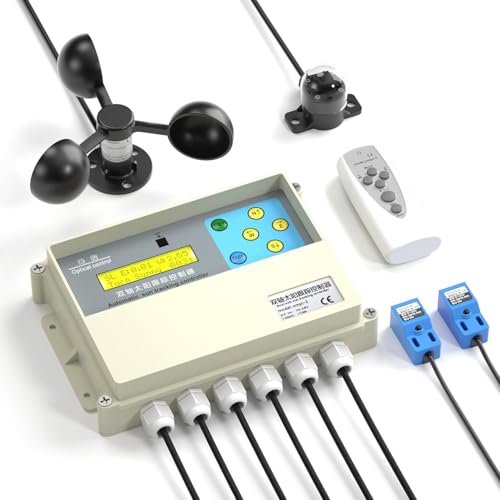
- Dual-axis automatic tracking
- Wind sensor and remote included
- Platform and motors not listed
Best For: DIY and off-grid dual-axis projects needing wind sensing
Basic Controller
2-Axis Solar Tracker Controller

- Automatic 2-axis tracking controller
- Listed weight: 1.76 ounces
- Compatibility details not supplied
Best For: Buyers able to verify controller compatibility
Sensor Kit
Dual-Axis Controller With Wind Sensor

- Sunlight and wind sensors listed
- LCD and remote for adjustments
- Verify four-direction limit-switch setup
Best For: Builders wanting a controller and sensor bundle
White Controller
Dual-Axis Sun Tracker Controller

- Listed for dual-axis tracking
- White plastic construction
- Included hardware not specified
Best For: Buyers prepared to confirm specifications
Portable Off-Grid Pick – REDIGOO 160W Folding Solar Tracker
For campers comparing solar tracker systems, the REDIGOO combines a 160W-rated folding panel with automatic dual-axis tracking. It weighs 16 lb and is designed for tool-free setup in about 5–10 minutes.
Best For: Dry-weather camping or van-life setups that need a portable tracked panel for a compatible power station.
Pros:
- Tracks the sun automatically rather than requiring repeated manual angle changes.
- Includes a 4-in-1 cable and DC adapter set for a range of power-station inputs.
- Folds for transport and comes with separate bags for the panels and tracking head.
Cons:
- The tracking unit and ports must stay dry; do not use it in rain.
- Actual output depends on sunlight and the connected station’s input limits.
This is the ready-to-use portable option in the lineup, but check your station’s input specifications and plan to deploy it only in clear, dry weather. The advertised 300W comparison describes potential daily yield, not the panel’s 160W rated output.
Sensor-Rich Learning Kit – KEYESTUDIO Arduino Solar Tracker
Among educational solar tracker systems, this KEYESTUDIO kit offers a hands-on way to build and program a tracker. It pairs four ambient-light sensors and two servos with a solar panel, plus additional modules for broader electronics experiments.
Best For: Teens and adults who want to learn Arduino-based tracking, wiring, and sensor programming.
Pros:
- Includes 11 online tutorials that progress from individual modules to integrated projects.
- Adds a phone-charging module, temperature and humidity sensing, a BH1750 light sensor, and an LCD.
- Reserved IIC, UART, and SPI connections support further experiments.
Cons:
- Arrives unassembled and without code preloaded.
- Batteries are not included.
Choose this for the range of components and coding exercises, not as a ready-to-run outdoor power setup. Allow time to assemble it, upload the code, and supply batteries.
Rigid-Panel Tracker – Dual-Axis System with App Control
For buyers who already have a rigid panel, this is one of the solar tracker systems designed to move a separate panel rather than supply one. Its dual-axis mechanism uses light sensing to adjust panel orientation automatically, and the listing also specifies app control.
Best For: Owners of compatible rigid panels who want automatic tracking without replacing their panel.
Pros:
- Supports rigid panels up to 1.1 m wide and 25 kg; the stated recommended panel range is 300–500W.
- Senses light in 10 directions to guide automatic pitch and pan adjustments.
- Foldable design separates into two parts for transport.
Cons:
- Not intended for foldable panels; check panel dimensions and weight before buying.
- The supplied notes do not detail app features or setup requirements.
This makes the most sense if you can match an existing rigid panel to the stated limits. The claimed efficiency gain of up to 30% should be treated as a manufacturer claim, not an assured result for every site.
Introductory STEM Build – LAFVIN Solar Tracking Starter Kit
If your interest in solar tracker systems is educational rather than off-grid power, the LAFVIN starter kit focuses on assembling and programming a tracking project. It includes a tutorial with step-by-step assembly guidance and graphical programming test code.
Best For: Learners who want a guided, hands-on introduction to solar tracking and coding.
Pros:
- Step-by-step guidance supports the assembly process.
- Programming exercises connect the physical build with coding practice.
- Compact project format suits tabletop learning.
Cons:
- It is a DIY learning project, not a ready-made tracker for a full-size power panel.
- The supplied notes do not specify panel output or charging capacity.
This is the simpler learning-focused choice if you value guided assembly over an extensive list of extra modules. Note that the supplied details call it a kids’ kit but also state a manufacturer-recommended age of 18 and up.
Adjustable Dual-Axis Controller – Sun Automatic Tracking Controller
For builders comparing solar tracker systems, this 24V controller offers real-time, dual-axis sun tracking with adjustable parameters and an LCD display. It controls a compatible platform rather than supplying a complete tracker.
Best For: DIY dual-axis platforms with two brushed DC motors and a limit function.
Pros:
- Tracks the sun on two axes in real time.
- Supports wind leveling and leveling and centering on cloudy nights.
- Offers button and infrared wireless manual control.
Cons:
- Requires a two-motor platform with a limit function.
- Southern Hemisphere use requires reversing east–west and north–south connections from the manual’s Northern Hemisphere instructions.
Choose this if you already have—or plan to build—the specified motorized platform and want control settings you can adjust.
If you’re looking at single-axis solar tracker systems, this automatic tracking controller is listed with remote control. The supplied details are sparse, so treat it as a controller to investigate rather than a confirmed complete tracker kit.
Best For: Buyers seeking a single-axis controller who can verify system compatibility before purchase.
Pros:
- Specified for single-axis solar tracking.
- Listed with automatic tracking and remote control.
Cons:
- Supplied specifications do not state voltage or motor requirements.
- Included accessories and installation requirements are not detailed.
Its single-axis focus may narrow your search, but confirm the electrical requirements and what’s included before ordering.
Among controller-focused solar tracker systems, this 24V dual-axis kit stands out for its listed sunlight sensor, wind sensor, LCD controller, and remote. It is designed to adjust panel alignment east–west and north–south.
Best For: DIY, farm, RV, or off-grid projects seeking a dual-axis controller kit with wind sensing.
Pros:
- Tracks on both east–west and north–south axes.
- Wind sensor can trigger a protective position adjustment or lock.
- Includes an LCD menu, remote, and wiring guide.
Cons:
- Listed components do not identify a mounting platform or drive motors.
- Hemisphere switching requires changing sensor orientation.
This is a practical choice if you want the specified sensors and controller together; check your planned platform and motor setup separately.
Basic Controller – 2-Axis Solar Tracker Controller
If you are comparing solar tracker systems by controller, this 2-axis automatic solar tracking unit is a basic option. The listing identifies it as a motor speed controller but gives little detail about installation or compatible hardware.
Best For: Buyers who can confirm compatibility before ordering a standalone controller.
Pros:
- Listed for automatic 2-axis solar tracking.
- Compact listed package dimensions of 0.39 x 0.39 x 0.39 inches.
- Listed weight of 1.76 ounces.
Cons:
- Notes do not specify included sensors, motors, or limit switches.
- Electrical requirements and installation details are not provided.
Consider this only after checking the controller’s specifications against the rest of your planned setup.
Sensor Kit – Dual-Axis Controller With Wind Sensor
For buyers building solar tracker systems, this dual-axis controller kit lists a sunlight sensor, wind sensor, limit sensors, LCD display, and remote control. Its stated functions include real-time sunlight tracking and leveling in wind.
Best For: Builders seeking a controller bundle with sensing and adjustment controls.
Pros:
- Includes sunlight and wind sensors, limit sensors, and a remote.
- LCD and operating panel allow parameter adjustment.
- Listing describes cloudy-day and nighttime return functions.
Cons:
- Listing says limit switches are required in all four directions; confirm whether the supplied sensors cover your installation.
- Southern Hemisphere use requires reversing east-west and north-south from the manual’s Northern Hemisphere instructions.
This is the most clearly specified bundle here, but check motor compatibility and the full limit-switch requirements before installation.
White Controller – Dual-Axis Sun Tracker Controller
This white dual-axis automatic tracking controller is another option to examine when shopping for solar tracker systems. The supplied listing gives its color, plastic construction, and weight, but few setup details.
Best For: Buyers who can obtain specifications before choosing a dual-axis controller.
Pros:
- Listed as a dual-axis automatic tracking controller.
- White plastic housing is specified.
- Listed item weight is 837 g.
Cons:
- Display is listed ambiguously as LCD or LED.
- Notes do not identify included sensors, motors, or installation requirements.
The listing is too sparse to judge system fit; confirm the display, included parts, and electrical specifications with the seller.
How We Picked These Solar Tracker Systems
We organized the 10 products by what a buyer can actually do with them: use a portable tracked panel, learn with a small DIY kit, or control a larger tracking build. We also looked at the listed tracking axes, controls, sensors, and intended use. Product names alone cannot establish real-world energy gains, weather resistance, or long-term reliability, so confirm those details in current specifications before ordering.
Quick Comparison: Which Type Fits Your Project?
Portable Panel and Learning Kits
The REDIGOO is the choice to investigate if you want a portable panel with dual-axis tracking rather than a controller-only project. The KEYESTUDIO and LAFVIN kits suit experiments, programming practice, and demonstrations. Treat a STEM kit as a learning platform, not a substitute for a full-size outdoor tracker.
Controllers and Larger Builds
The remaining picks center on single- or dual-axis tracking controls. A single-axis controller suits a build designed to follow the sun in one direction. Dual-axis options add a second direction of movement, but also require a compatible mount, actuators, wiring, and power. Features such as app access, an LCD, a remote, or a wind sensor may help with operation; check each listing for exactly what is included.
Key Buying Factors for Solar Tracker Systems
Check What Comes in the Box
“System,” “kit,” and “controller” do not guarantee a complete installation. Before comparing prices, identify whether the package includes a panel, mounting structure, motors or actuators, sensors, cables, and a power supply. Budget for every missing part.
Match the Controller to the Hardware
Confirm motor type, voltage, current limits, travel limits, and sensor connections against your planned hardware. Also check panel weight and dimensions against the mount’s capacity. If you are upgrading an existing array, verify that its wiring and site layout leave room for safe movement throughout the day.
Plan for Weather and Maintenance
Outdoor builds need suitable enclosures, secure foundations, cable management, and a way to handle high winds. A listed wind sensor is useful only if the controller and mount support an appropriate protective response. Moving parts add inspection and maintenance compared with a fixed rack.
Keep Performance Claims in Perspective
Tracking can increase the time a panel faces direct sunlight, but the benefit varies with location, shading, season, and energy used by the tracker itself. Do not equate a marketing power comparison with a panel’s rated output. For larger installations, compare the total installed cost and expected energy production with a fixed array.
Who Should Buy Which Solar Tracker Systems?
Choose the portable tracked panel if convenience is your priority and its size and output meet your needs. Pick a KEYESTUDIO or LAFVIN kit if your goal is to learn sensors, coding, and tracking behavior. Choose a single-axis controller for a simpler compatible DIY mechanism; consider dual-axis controls when you have the space, hardware, and budget for two-direction movement. If you need a dependable outdoor power installation but do not want to source and maintain mechanical components, compare fixed-mount solar before committing to a tracker.