Choosing the right tester can speed up troubleshooting and improve confidence on the job. For industrial maintenance teams, the best option depends on voltage range, safety rating, and how quickly you need results.
This roundup covers practical picks for common plant and facility tasks, including non-contact detection, twin-probe checks, and combo testers for broader electrical diagnostics.
Best 10 Voltage Testers for Industrial Maintenance Picks for 2026
Rugged Multi-Function Tester for Tight Spaces
Fluke T5-600 Voltage, Continuity & Current Tester

- Measures AC/DC volts up to 600 V
- OpenJaw AC current measurement up to 100 A
- SlimReach probes and 10-foot drop durability
Best For: Technicians needing a durable all-in-one field tester
Simple Neon Presence Tester
NSi TES-2 120/240 VAC Neon Tester

- Dual neon lights show 120 or 240 VAC presence
- Double insulated housing with test leads
- Pocket clip for easy carry
Best For: Basic AC voltage presence checks
Pocket Non-Contact Voltage Detector
Fluke 1AC II VoltAlert Non-Contact Tester

- Non-contact AC detection from 90 to 1000 V
- Red tip glow and audible beeper
- Continuous self-test with audible/silent mode
Best For: Quick non-contact AC voltage checks
Basic Twin-Probe AC Tester
NSi TES-111 Twin Probe Voltage Tester

- Neon light indicates 80 to 250 VAC
- Double insulated housing and test leads
- Pocket clip for portability
Best For: Simple AC voltage checks with a compact probe design
Dual-Range Non-Contact Pen
Klein Tools NCVT3P Voltage Tester

- 12-1000V or 70-1000V dual-range AC detection
- Audible and flashing LED alerts
- Built-in flashlight and pocket clip
Best For: Maintenance techs needing a compact quick-check voltage pen
Three-Piece Field Kit
Klein Tools 69149P Electrical Test Kit
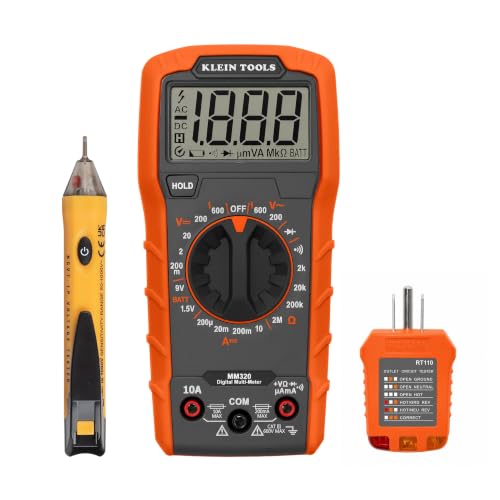
- Includes multimeter, non-contact tester, and receptacle tester
- Measures up to 600V AC/DC and 10A DC
- Useful for continuity and wiring checks
Best For: Technicians wanting a compact multi-tool electrical test kit
Budget Non-Contact Pen
Neoteck 12-1000V AC Voltage Detector
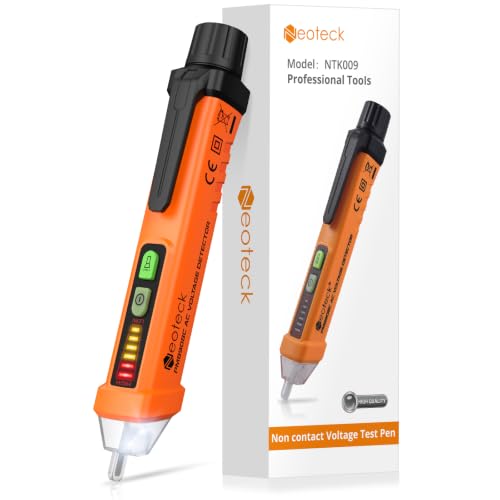
- Non-contact AC detection from 12-1000V
- Sound and LED alerts for live/null wire checks
- Built-in flashlight and compact body
Best For: Budget-minded users needing a simple routine safety tester
Industrial Grade NCVT
Ideal 61-627 Non-Contact Tester

- Detects AC voltage from 50V to 600V
- CAT IV 600V rated for industrial use
- LED and audible alerts with auto shut-off
Best For: Fast, portable AC voltage checks in maintenance work
Compact Safety Pen

- 50V to 1000V AC detection range
- Pocket clip and 6.6-foot drop protection
- LED and audible alerts with auto power-off
Best For: Routine AC voltage checks with pocket-friendly durability
Signal Display Tester

- Dual-range AC detection from 12V to 1000V
- Signal percentage and bar graph display
- Live/null wire detection with buzzer alarms
Best For: Maintenance tasks that need signal feedback and low-voltage support
Rugged Multi-Function Tester for Tight Spaces – Fluke T5-600 Voltage, Continuity & Current Tester
If you need voltage testers for industrial maintenance that can handle more than one job, the Fluke T5-600 is built for quick electrical checks in the field. It automatically selects AC/DC voltage, measures current up to 100 A without contact, and includes detachable SlimReach probe tips for tighter access.
Best For: Technicians who want a durable all-in-one tester for voltage, continuity, resistance, and current checks.
Pros:
- Automatically measures AC and DC volts with digital resolution up to 600 V
- OpenJaw current measurement handles AC current up to 100 A without contact
- Detachable SlimReach probe tips help in tight spaces
- Rugged design is rated to withstand a 10-foot drop
Cons:
- Not a dedicated non-contact voltage detector
- Current measurement is for AC only
- May be more tool than needed for simple voltage-only checks
For maintenance teams that need a dependable tester for routine troubleshooting, this model offers a strong balance of versatility and durability. The integrated protection circuit also lets it stay connected longer than a solenoid tester, which can be useful during diagnostic work.
Simple Neon Presence Tester – NSi TES-2 120/240 VAC Neon Tester
For straightforward voltage testers for industrial maintenance, the NSi TES-2 keeps the job simple with dual neon lights that indicate AC voltage presence at 120 or 240 VAC. Its compact, corded design and pocket clip make it easy to carry for quick checks.
Best For: Basic AC voltage presence checks where a simple neon tester is sufficient.
Pros:
- Dual neon lights indicate AC voltage at either 120 or 240 VAC
- Double insulated housing adds protection
- Pocket clip supports easy carry on the job
- UL specified and made in the United States
Cons:
- Limited to AC voltage presence indication
- Does not provide digital readout
- Not designed for advanced diagnostics or current measurement
This is a practical pick when you want a no-frills indicator rather than a multifunction meter. It is best suited to quick confirmation tasks where simplicity and portability matter more than expanded measurement features.
Pocket Non-Contact Voltage Detector – Fluke 1AC II VoltAlert Non-Contact Tester
If you need voltage testers for industrial maintenance that are fast to use and easy to carry, the Fluke 1AC II VoltAlert is a pocket-sized non-contact detector for AC voltage. The tip glows red and a beeper sounds when voltage is detected, and the unit runs a continuous self-test so you know it is working.
Best For: Quick non-contact AC voltage checks in a compact pocket tool.
Pros:
- Non-contact detection for 90 to 1000 V AC, or 200 to 1000 V AC
- Tip glow and audible beeper provide clear voltage indication
- Continuous self-test helps confirm operation
- Audible/silent mode adds convenience on the job
Cons:
- AC voltage only, with no DC testing
- Does not measure current or resistance
- Best for detection, not detailed troubleshooting
This is a strong utility tool for fast voltage awareness during inspections and maintenance rounds. Its CAT IV rating and simple operation make it a practical choice when quick, non-contact verification is the priority.
Basic Twin-Probe AC Tester – NSi TES-111 Twin Probe Voltage Tester
For industrial maintenance tasks that call for a simple contact-style check, the NSi TES-111 is a compact twin-probe option among voltage testers for industrial maintenance. It uses a neon light to indicate AC voltage from 80 to 250 VAC and includes double insulated housing and test leads.
Best For: Simple AC voltage checks with a compact twin-probe design.
Pros:
- Neon indicator shows AC voltage from 80 to 250 VAC
- Double insulated housing adds protection
- Includes test leads for direct contact testing
- Pocket clip improves portability
Cons:
- AC only, with no DC capability listed
- No digital display or advanced measurement features
- Best suited to basic presence checks rather than troubleshooting
This tester makes sense when you want a straightforward visual indication and a small footprint in your tool kit. It is a solid fit for basic AC verification, but it is not the right choice if you need broader diagnostic functions.
Dual-Range Non-Contact Pen – Klein Tools NCVT3P Voltage Tester
For voltage testers for industrial maintenance, the Klein Tools NCVT3P is a practical non-contact pen for quick safety checks on energized circuits and equipment. Its dual-range detection helps you narrow in on voltage more precisely, while the audible and flashing LED alerts make live wires easy to identify in noisy or low-light work areas.
Best For: Maintenance techs who want a compact, CAT IV-rated non-contact tester with a built-in flashlight for fast field checks.
Pros:
- Dual-range detection: 12-1000V or 70-1000V AC
- Audible and flashing LED alarms for clear voltage indication
- Built-in flashlight for improved visibility at the panel or jobsite
- Compact design with pocket clip and auto power-off
Cons:
- Detects AC voltage only
- Designed as a quick-check pen, not a full diagnostic meter
This is a strong fit when your priority is fast, portable voltage detection with straightforward alerts and added visibility. The CAT IV 1000V rating and dual-range function make it especially useful for routine maintenance tasks where speed and convenience matter.
Three-Piece Field Kit – Klein Tools 69149P Electrical Test Kit
For voltage testers for industrial maintenance, this Klein Tools 3-piece kit is a handy all-in-one setup for basic electrical checks. It combines a multimeter, a non-contact voltage tester, and a receptacle tester, giving maintenance teams a simple way to verify voltage, continuity, wiring, and common outlet faults.
Best For: Technicians who want a compact starter kit for voltage checks, continuity testing, and wiring verification.
Pros:
- Includes three useful tools in one kit
- Multimeter measures up to 600V AC/DC, 10A DC, and resistance
- NCVT1P provides non-contact voltage detection with audible and visual alerts
- Receptacle tester helps identify correct wiring and common faults
Cons:
- Less specialized than dedicated industrial testing gear
- Kit components are geared toward basic troubleshooting rather than advanced diagnostics
If you need coverage across several common maintenance checks, this kit offers good versatility without forcing you to piece together separate tools. It is especially useful for technicians who want one purchase to handle voltage, continuity, and receptacle verification.
Budget Non-Contact Pen – Neoteck 12-1000V AC Voltage Detector
For voltage testers for industrial maintenance, the Neoteck non-contact pen is a simple option for quick AC voltage checks in everyday electrical work. It uses sound and LED alerts to distinguish live from neutral wires, and the integrated flashlight adds convenience when working at switches, outlets, fixtures, or breakers.
Best For: Users who want an affordable, easy-to-carry voltage tester for routine safety checks and basic troubleshooting.
Pros:
- Non-contact AC detection from 12-1000V
- Sound and LED indicators help identify live and null wires
- Includes an emergency flashlight for dark work areas
- Compact design with CE CAT III 600V and RoHS certification
Cons:
- AC voltage only
- Not suitable for Christmas light testing, per the product notes
- Basic pen tester rather than a full diagnostic instrument
This model makes sense when you need a lightweight tester for fast safety checks instead of a full feature set. It is straightforward to use, portable, and well suited to general maintenance tasks where quick voltage confirmation is the main goal.
Industrial Grade NCVT – Ideal 61-627 Non-Contact Tester
If you need voltage testers for industrial maintenance, this Ideal NCVT is a straightforward non-contact option for quickly checking outlets, switches, panels, and cables. It detects AC voltage from 50V to 600V, adds audible and LED alerts, and is built with CAT IV 600V safety rating for everyday troubleshooting in demanding environments.
Best For: Electricians and maintenance techs who want a compact non-contact tester for fast AC voltage checks.
Pros:
- Non-contact detection helps verify live circuits without touching conductors.
- CAT IV 600V rating supports industrial and residential electrical work.
- LED and audible alerts make live-voltage status easy to spot.
- Auto power-off and low-battery indicator help keep it ready for use.
Cons:
- Only covers AC voltage from 50V to 600V.
- No LCD readout or advanced signal display.
- Uses 2 AAA batteries, so replacements are part of routine upkeep.
This is a practical, no-frills tester for quick safety verification and basic diagnostics. If your maintenance work centers on standard AC voltage detection and portability, it fits the job well.
Compact Safety Pen – Klein NCVT1P Voltage Tester
For voltage testers for industrial maintenance, this Klein pen-style non-contact model is designed for quick AC checks in cables, circuit breakers, lighting fixtures, switches, and outlets. It covers 50V to 1000V AC, adds flashing LED and audible alerts, and includes a pocket clip plus drop protection for regular field use.
Best For: Technicians who want a simple, durable pen tester with a broad AC voltage range.
Pros:
- Broad 50V to 1000V AC detection range suits many troubleshooting tasks.
- Non-contact testing is useful for fast checks on common electrical components.
- Flashing LED and beeping alerts provide clear voltage indication.
- Pocket clip and 6.6-foot drop protection support everyday carry.
Cons:
- Designed for non-tamper-resistant outlets; other Klein models are recommended for those.
- No display beyond LED and audible alerts.
- Focuses on standard AC detection rather than low-voltage specialty features.
This is a dependable pick if you want a familiar, easy-to-carry tester for routine maintenance checks. Its simple operation and durable build make it a strong fit for fast on-the-job verification.
Signal Display Tester – KAIWEETS Dual Range NCV Pen
Among voltage testers for industrial maintenance, this KAIWEETS model stands out for combining non-contact detection with an LCD-style signal percentage readout. It supports dual ranges from 12V to 1000V AC, uses sound and light alarms, and can help identify live versus null wires, making it useful when you want more feedback than a basic tester provides.
Best For: Users who want a non-contact tester with signal strength feedback and low-voltage support.
Pros:
- Dual-range detection covers 12V to 1000V AC for more flexible testing.
- Signal percentage and bar graph give more intuitive voltage feedback.
- Live/null wire indication and breakpoint finding add troubleshooting value.
- Flashlight, auto power-off, and low-power indicator improve day-to-day usability.
Cons:
- More feature-rich than a basic tester, so operation is less minimal.
- Display and sensitivity settings may be more than some users need.
- Low-voltage and high-voltage ranges require selecting the right mode.
This model is a smart choice if your maintenance work includes both standard and low-voltage circuits and you want stronger visual cues. It offers more diagnostic insight without giving up the convenience of non-contact testing.
How We Picked These Voltage Testers for Industrial Maintenance
We focused on tools that fit real maintenance workflows: fast fault-finding, clear indications, and dependable safety credentials. Priority went to testers with useful voltage ranges, strong CAT ratings where applicable, easy-to-read alerts, and formats that suit everyday field use, from pocket pens to more capable multi-function testers.
Quick Comparison: What Type of Tester Do You Need?
If you need a fast first check, a non-contact voltage tester is usually the simplest choice. For confirming live versus neutral or checking outlets and conductors more directly, a probe-style tester can be more informative. When you want one tool for more than voltage presence, a combo unit with current or continuity functions may be the better fit.
Key Buying Factors for Voltage Testers for Industrial Maintenance
Voltage Range
Match the tool to the systems you service. Low-voltage control work and common facility circuits may only need a modest range, while broader plant applications call for tools that cover standard line voltages with enough headroom for safe verification.
Contact Versus Non-Contact
Non-contact testers are ideal for quick screening before opening panels or starting diagnostics. Contact testers typically provide more certainty for specific measurements, but they require proper technique and access. Many maintenance teams keep both styles in the toolbox.
Safety Rating and Build
Look for CAT ratings appropriate to the environment and the type of distribution gear you work around. Industrial maintenance often involves panels, disconnects, and equipment where durability, insulation quality, and clear alarm signals matter as much as measurement range.
Visibility and Ease of Use
Audible alerts, bright LEDs, flashlights, pocket clips, and simple one-hand operation can save time during inspections. In noisy plants, a tester with both sound and visual indicators is especially useful.
Extra Functions
Some Voltage Testers for Industrial Maintenance also add continuity, current detection, or signal-strength style indicators. These extras are helpful if you want one compact tool for more stages of troubleshooting without carrying a full meter.
Who Should Buy Which Voltage Testers for Industrial Maintenance?
Facility technicians and electricians who need fast safety checks should start with a reliable non-contact tester. Maintenance pros who handle more detailed diagnostics may prefer a multi-function model with current or continuity capabilities. If your work is mostly basic verification on standard circuits, a simple neon or pen-style tester can be enough, provided it matches your voltage and safety requirements.
For mixed industrial environments, the smartest choice is often to keep a quick non-contact tester on hand and pair it with a second tool for confirmation. That combination covers speed, confidence, and flexibility without overcomplicating routine maintenance work.