Choosing the right tester can make solar diagnostics faster, safer, and far more accurate. Whether you need a simple voltage check or full PV performance data, the best tools save time on the roof and in the field.
Our roundup of voltage testers for solar installations focuses on practical features, measurement range, and ease of use so you can match the tool to your system and workflow.
Best 10 Voltage Testers for Solar Installations Picks for 2026
Solar MPPT Meter for PV Diagnostics
UNI-T UT673PV Solar Panel Tester

- Measures Pmax, Vmp, Imp, Voc, and Isc
- Self-powered design with no batteries needed
- Large screen shows results simultaneously
Best For: PV installers and manufacturers who need detailed panel performance checks
Non-Contact Safety Tester Pen
Klein Tools NCVT1P Voltage Tester

- Detects AC voltage from 50 to 1000V
- LED and audible alarms give clear alerts
- Pocket clip and drop protection for field use
Best For: Quick non-contact AC voltage checks around solar work areas
Portable PV Power Checker

- Measures Pmax, Vmp, Imp, Voc, and Isc
- Automatic and manual modes for flexible testing
- 3.2-inch backlit LCD for outdoor readability
Best For: Routine PV panel checks in residential and light commercial installs
All-in-One PV Fault Tester
2000W Solar Panel Tester Multimeter

- Combines MPPT tester and 60,000-count multimeter
- Handles up to 2000W PV testing and 2000V AC/DC
- Stores test records and shows color-coded curves
Best For: Technicians needing both solar diagnostics and high-voltage electrical testing
PV Performance Verifier
ZIBOO FT-1000W Solar Panel Tester
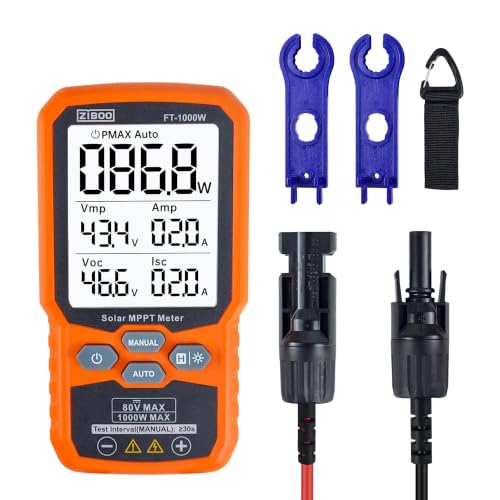
- Measures Voc, Isc, Vmp, and power up to 1000W.
- CAT III 1000V / CAT IV 600V safety rating.
- Backlit LCD, data hold, and IP54 outdoor resistance.
Best For: Technicians checking PV output and MPPT performance
High-Capacity Array Tester

- Tests 5W to 1800W arrays with 20V to 120V range.
- Supports both series and parallel panel connections.
- Large LCD, auto VOC reading, and multiple safety protections.
Best For: Higher-power PV systems and mixed panel layouts
DC Energy Monitor
150A Watt Meter for Solar DC Systems

- Tracks volts, amps, watts, Ah, and Wh in one display.
- Works on DC 7V to 100V systems up to 150A.
- Backlit LCD suits solar, RV, marine, and battery setups.
Best For: Monitoring battery-backed solar and other DC systems
Solar Panel Precision Tester
LODESTAR LD673PV Solar Panel Tester

- Measures Pmax, Vmp, Voc, Isc, and current
- Up to 1000W; Voc 12–80V and Isc 35A
- Backlit LCD with reverse polarity protection
Best For: Single-panel solar installation checks and maintenance
High-Capacity Field Tester
1800W Solar Panel Tester MPPT Multimeter
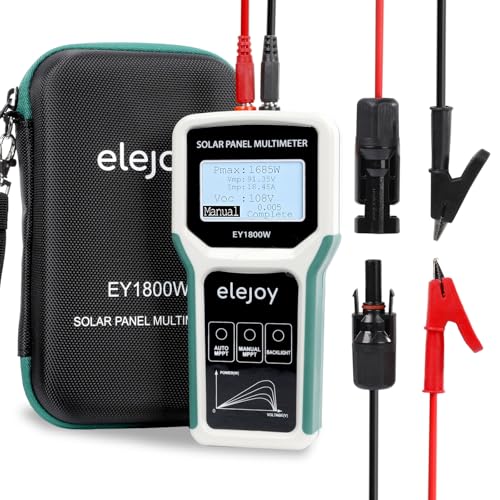
- Reads Pmax, Voc, and Isc in real time
- Rated up to 1800W with 60A max current
- Portable kit with MC-4 connectors and alligator clips
Best For: Quick PV performance checks and troubleshooting in the field
Professional High-Voltage Tester
ZIBOO FT-2000W Solar Panel Tester

- Tests up to 2000W with 12–150V Voc range
- Measures Voc, Isc, Vmp, and Amp with ±0.8% accuracy
- CAT III 1000V / CAT IV 600V with IP54 protection
Best For: Professional PV array testing and high-voltage field maintenance
Solar MPPT Meter for PV Diagnostics – UNI-T UT673PV Solar Panel Tester
If you’re comparing voltage testers for solar installations, the UNI-T UT673PV is built more like a PV diagnostic tool than a simple probe. It checks maximum power, peak power voltage, peak power current, open circuit voltage, and short circuit current, so it can help spot panel abnormalities during installation or maintenance.
Best For: Installers, manufacturers, and end users who want a portable, self-powered solar panel tester for MPPT checks.
Pros:
- Measures Pmax, Vmp, Imp, Voc, and Isc for comprehensive solar panel testing
- Large screen with automatic measurement and simultaneous result display
- Self-powered from the solar panel, so no batteries are needed
- Includes MC4 test lead and a CAT 0 60V rated lead
Cons:
- Focused on solar panel diagnostics rather than general electrical testing
- Safety rating on the included MC4 test lead is limited to CAT 0 60V
The UT673PV makes the most sense when your job is validating PV module performance rather than checking household circuits. Its broad measurement set and built-in protections give it a practical edge for field testing solar installations.
Non-Contact Safety Tester Pen – Klein Tools NCVT1P Voltage Tester
For basic voltage testers for solar installations, the Klein Tools NCVT1P is a simple non-contact pen for finding AC voltage in nearby wiring and components. It detects voltage from 50 to 1000V AC and gives a clear visual and audible alert, which is useful when you want a quick check before working around energized circuits.
Best For: Quick non-contact AC voltage checks on wiring, breakers, fixtures, and outlets.
Pros:
- Non-contact AC voltage detection with 50 to 1000V range
- Bright LED plus audible beeping alert when voltage is detected
- Auto power-off helps conserve batteries
- Compact body with pocket clip and 6.6-foot drop protection
Cons:
- Only detects AC voltage, not solar panel performance data
- Not intended as a full PV tester for module commissioning
- For tamper-resistant outlets, Klein recommends a different model
This is the kind of tool you keep in a pocket for fast safety checks, not deep solar diagnostics. If your solar work includes verifying nearby AC circuits and general electrical safety, the NCVT1P stays simple and dependable.
Portable PV Power Checker – SK-705 Solar MPPT Tester
If you need voltage testers for solar installations that focus on panel output, the SK-705 is designed to measure photovoltaic module performance quickly. It reads Pmax, Vmp, Imp, Voc, and Isc, and supports both automatic and manual testing for commissioning, servicing, and inspection work.
Best For: Installers and technicians who want a compact solar panel tester for routine PV checks.
Pros:
- Measures key PV values including Pmax, Vmp, Imp, Voc, and Isc
- Supports both automatic and manual test modes
- 80V DC max and up to 35A current range for many PV panels
- 3.2-inch backlit LCD improves readability outdoors
Cons:
- Limited to 80V DC maximum, so it is not for high-voltage PV strings
- Battery-powered rather than self-powered from the panel
The SK-705 is a practical fit for residential and many commercial panel checks where portability matters. Its simple display, included accessories, and dual test modes make it easy to bring into day-to-day solar installation work.
All-in-One PV Fault Tester – 2000W Solar Panel Tester Multimeter
Among voltage testers for solar installations, this 2-in-1 unit stands out because it combines a PV MPPT meter with a high-count digital multimeter. It is built for heavy-duty solar panel testing, while also handling AC/DC voltage and other electrical checks during installation, acceptance, and maintenance.
Best For: Solar technicians who want one tool for PV panel testing and high-voltage electrical diagnostics.
Pros:
- Combines MPPT PV testing with a 60,000-count digital multimeter
- Supports up to 2000W PV testing and 2000V AC/DC measurement
- Logs test data and visualizes curves for performance analysis
- Includes multiple protections plus a rechargeable battery and color display
Cons:
- More complex than a basic voltage pen or simple solar tester
- Likely more tool than needed for straightforward quick checks
This model is geared toward technicians who need deeper diagnostic capability, not just a pass/fail reading. With curve visualization, data storage, and broad multimeter functions, it is the most feature-rich option in this roundup.
PV Performance Verifier – ZIBOO FT-1000W Solar Panel Tester
If you need voltage testers for solar installations that do more than just read volts, the ZIBOO FT-1000W is built for practical PV troubleshooting. It measures Voc, Isc, Vmp, current, and maximum power up to 1000W, making it useful for checking panel output, shading-related losses, and general module performance in the field.
Best For: Solar technicians, installers, and maintenance crews validating panel performance and MPPT behavior.
Pros:
- Measures Voc from 12V to 80V and Isc up to 35A with ±0.8% accuracy.
- Tracks Vmp and current in real time to help spot degradation or shading issues.
- CAT III 1000V / CAT IV 600V rating with double-insulated probes for safer high-voltage PV work.
- Backlit LCD, data hold, IP54 resistance, and auto-off support outdoor use.
Cons:
- Limited to 1000W maximum power, so larger arrays may exceed its range.
- Focused on solar panel testing rather than a general-purpose multimeter role.
For hands-on PV diagnostics, this tester is a strong fit when you want a solar-specific tool with safety-focused design and straightforward readouts. It looks especially well matched to rooftop and field maintenance where quick checks matter.
High-Capacity Array Tester – 1800W Solar Panel Tester
For voltage testers for solar installations that need more headroom, this 1800W solar panel tester is designed to handle larger and more complex PV setups. It reads voltage, current, and power, supports both series and parallel panels, and automatically displays VOC, which can speed up routine troubleshooting on portable, rooftop, or array-based systems.
Best For: Installers and solar troubleshooters working with higher-power arrays and mixed panel configurations.
Pros:
- Handles 5W to 1800W with 20V to 120V and up to 60A input ranges.
- Supports both series and parallel-connected panels.
- Large LCD is easy to read in bright sunlight and auto-reads VOC.
- Multiple protections include overvoltage, overheating, overcurrent, and overload safeguards.
Cons:
- Must keep total panel power under 1800W.
- Panels must be disconnected from other devices or loads before testing.
This is a good pick when you need one solar tester for a wider variety of panel layouts and higher-output systems. The included MC4 and alligator clip cables make it more flexible for field use, while the 12-month warranty adds reassurance.
DC Energy Monitor – 150A Watt Meter for Solar DC Systems
If you want voltage testers for solar installations that also track full DC system behavior, this 150A watt meter is a versatile monitor for battery-backed solar setups. It measures voltage, current, watts, amp-hours, and watt-hours, which makes it useful for checking how a solar system, battery bank, or DC circuit is performing over time.
Best For: DIY solar, battery bank, and DC power users who need ongoing energy monitoring.
Pros:
- Displays 8-in-1 readings including volts, amps, watts, Ah, and Wh.
- Wide input range works with DC 7V to 100V systems and up to 150A.
- High-resolution LCD with blue backlight is easy to read in many conditions.
- Useful for solar, automotive, marine, RV, and other DC projects.
Cons:
- Not a solar panel MPPT tester for Voc/Isc module checks.
- Designed for DC system monitoring rather than panel-level diagnostics.
This meter makes sense when your solar setup is centered on batteries and DC loads rather than direct panel testing. It offers broad monitoring in a compact format, but it is better for system analysis than for verifying individual module output.
Solar Panel Precision Tester – LODESTAR LD673PV Solar Panel Tester
If you need voltage testers for solar installations that focus on single-panel diagnostics, the LODESTAR LD673PV is built for exactly that job. It measures Pmax, Vmp, Voc, Isc, and current on PV modules up to 1000W, with a backlit display that shows the key readings on one screen for faster onsite checks.
Best For: Installers, electricians, and DIY solar users testing individual panels during installation or maintenance.
Pros:
- Measures Pmax, Vmp, Voc, Isc, and amperage for detailed panel testing
- Handles up to 1000W, with Voc from 12–80V and Isc up to 35A
- Large backlit LCD supports real-time, single-screen reading
- Includes reverse polarity protection, test leads, MC4 disconnect tool, and pouch
Cons:
- Only for single-panel measurement, not series or parallel connected panels
- Lower power and voltage range than some higher-capacity testers
Overall, this is a practical choice if your workflow centers on fast, precise module-level checks rather than array-level diagnostics. Its compact, certified design makes it easy to carry and dependable for routine solar installation work.
High-Capacity Field Tester – 1800W Solar Panel Tester MPPT Multimeter
For solar installations that need a straightforward field tool, this 1800W MPPT tester covers the core measurements technicians rely on. It reads Pmax, Voc, and Isc in real time, and the clear LCD makes it easier to compare panel output against specifications during troubleshooting.
Best For: Installers and technicians who want a portable tester for quick PV performance checks in the field.
Pros:
- Measures Pmax, Voc, and Isc for real-time panel diagnostics
- Rated for up to 1800W, with 60A max current and 120V rated voltage
- Portable design with EVA toolkit and no batteries required
- Includes MC-4 connectors and alligator clips for easy hookup
Cons:
- Feature set is more basic than some higher-end professional testers
- Limited voltage rating compared with high-voltage PV test gear
This model is a sensible option if you want a simple, portable meter for routine panel validation and troubleshooting. It focuses on the essentials, which can make field testing faster and less complicated for everyday installation work.
Professional High-Voltage Tester – ZIBOO FT-2000W Solar Panel Tester
Among voltage testers for solar installations, the ZIBOO FT-2000W is geared toward heavier-duty professional work. It measures Pmax up to 2000W, Voc up to 150V, and Isc up to 35A, while also supporting real-time tracking of Vmp and Amp for identifying shading or degradation issues.
Best For: Solar professionals working on higher-voltage PV arrays, field maintenance, or validation work.
Pros:
- High-capacity testing up to 2000W with 12–150V Voc range
- Measures Voc, Isc, Vmp, and Amp with ±0.8% accuracy
- CAT III 1000V / CAT IV 600V rating with IEC/EN 61010 compliance
- Backlit LCD, data hold, IP54 protection, and auto-off for field use
Cons:
- More advanced than needed for simple single-panel checks
- Designed for professional use, so it may be more tool than casual users need
If you need a robust tester for serious PV work, this one stands out for its safety rating and broader measurement range. It is especially well suited to technicians who want better visibility into panel behavior in outdoor or high-voltage environments.
How We Picked These Voltage Testers for Solar Installations
We focused on tools that are relevant for real PV work: voltage range, current handling, MPPT or power-testing capability, display clarity, and overall usability. We also looked for models that cover common solar troubleshooting tasks, from basic live-voltage checks to panel and string performance testing.
Quick Comparison
If you need a fast safety check, a non-contact tester is useful for confirming the presence of AC voltage nearby, but it is not a substitute for PV measurement. For solar panel diagnostics, MPPT meters and photovoltaic multimeters are the more appropriate choice because they can measure Voc, Isc, Vmp, and Pmax under the right conditions.
Key Buying Factors for Voltage Testers for Solar Installations
Measurement Range
Match the tester to your system voltage and current. Smaller meters may be ideal for low-voltage or compact arrays, while higher-capacity models are better for larger modules and more demanding field tests.
What It Measures
Look for the functions you actually need. Basic voltage-only tools are fine for quick checks, but solar installers usually benefit more from testers that can capture open-circuit voltage, short-circuit current, maximum power, and operating voltage.
Display and Readability
A bright, easy-to-read screen matters in outdoor work. Large color displays and clearly labeled readings reduce mistakes and make it easier to interpret results in sunlight or cramped equipment spaces.
Safety and Workflow
For solar testing, safe handling and clear measurement procedures are essential. Auto and manual measurement modes, proper input limits, and stable probes or clamps can make the job more efficient and reduce user error.
Who Should Buy Which Voltage Testers for Solar Installations?
DIY homeowners and basic troubleshooters may only need a simple tester for quick voltage verification. Installers and technicians working on modules, strings, or inverter-side diagnostics should prioritize MPPT solar testers or photovoltaic multimeters. If you service a wide range of systems, choose a model with higher voltage and current limits so you can work confidently across more jobs.
In short, the best Voltage Testers for Solar Installations are the ones that fit your system size, measurement needs, and day-to-day workflow. Choose the lightest tool that still gives you the readings you rely on, and you’ll get more accurate results with less hassle.