Keeping an eye on gates, barns, and equipment yards is harder when outlets and internet access are scarce. Solar-powered wireless camera kits can simplify installation, but their performance depends on sunlight, network coverage, and where you place each camera.
These 10 systems cover different camera counts, resolutions, storage options, and connection types. Use the guide below to narrow the field before checking whether a kit fits your property’s layout.
Best 10 Wireless Solar Farm Security Systems Picks for 2026
Best for Pan-and-Tilt Coverage
aosu D1 Classic 4-Camera Solar Kit
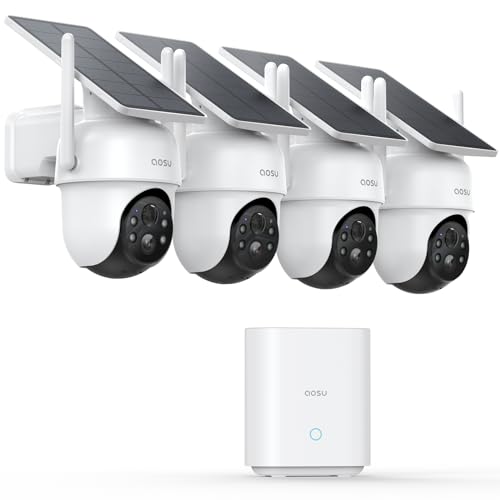
- Four pan-and-tilt cameras with motion tracking
- 32GB encrypted local storage; no required subscription
- 2K/3MP video with color night vision
Best For: Adjustable coverage around multiple buildings or gates
Best for Fixed-View Monitoring
aosu 2K QHD 4-Camera Solar Kit

- Four fixed 130° camera views
- 32GB encrypted local storage; no required subscription
- Dual-band Wi-Fi and cam-to-cam event tracking
Best For: Defined gates, driveways, and fence-line approaches
Best for Large-Property Expansion

- Eight cameras included; supports up to 10
- 1TB local HDD with offline HDMI viewing
- 4MP color night vision and IP66 rating
Best For: Multiple farm buildings and access points
Best for Expandable Pan-and-Tilt Coverage
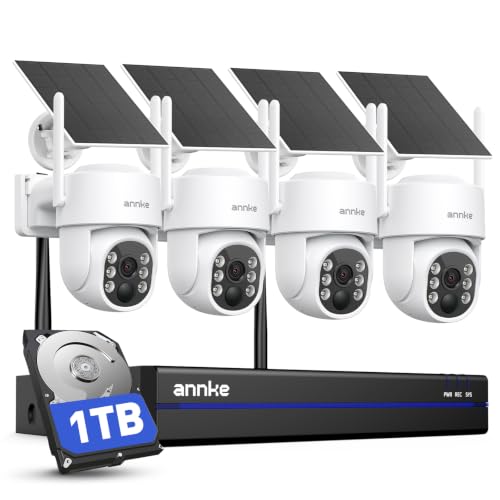
- Four 4MP pan-and-tilt solar cameras
- 1TB local NVR; supports up to 10 cameras
- Dual-band Wi-Fi and human detection
Best For: Growing coverage around buildings and work areas
Best for Local Storage
Vivideye 4MP Solar Camera System

- 128GB centralized local storage
- Eight-channel expandable hub
- 4MP cameras with motion tracking
Best For: Wi-Fi-covered farm buildings needing local recordings
Best for Off-Grid Coverage

- Four solar-powered 2K cameras
- 4G LTE hub works without Wi-Fi
- Data plan and TF card required
Best For: Remote farm sites with cellular coverage
Best for Flexible Wi-Fi Setup
Gianteye Four-Pack 2K Solar Cameras

- Four 2K solar cameras
- Supports 2.4GHz and 5GHz Wi-Fi
- Optional microSD or cloud storage
Best For: Wi-Fi-covered farmhouses and nearby outbuildings
Best for Wide-Area Tracking
aosu D1 Max 4-Camera 4K Solar Kit

- Four 4K pan-and-tilt cameras
- People and vehicle auto tracking
- 32GB included local storage
Best For: Tracking activity across several nearby outdoor approaches
Best for Simple Four-Point Coverage
GMK 4-Pack 2K Solar Camera System
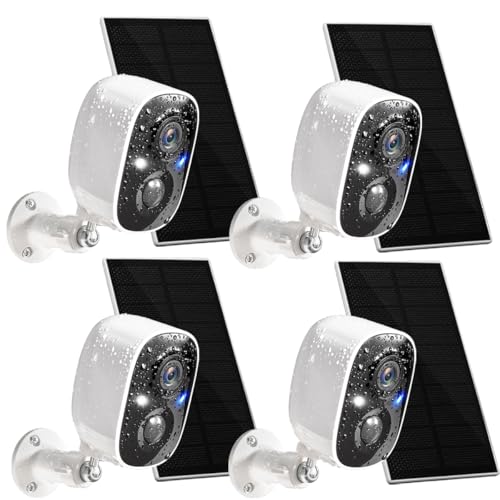
- Four 2K cameras with 110° views
- Two-way talk, lights, and siren
- Requires 2.4GHz Wi-Fi
Best For: Four defined outdoor spots within 2.4GHz Wi-Fi range
Best for Six-Point Coverage

- Six 2K outdoor cameras
- 32GB included local storage
- Cross-camera event timelines
Best For: Multiple outdoor coverage points managed in one app
Best for Pan-and-Tilt Coverage – aosu D1 Classic 4-Camera Solar Kit
For buyers comparing wireless solar farm security systems, the aosu D1 Classic offers four outdoor cameras that pan, tilt, and automatically track motion. It suits locations where a fixed view could leave gaps, provided the cameras can connect to the aosuBase.
Best For: Monitoring several gates, buildings, or work areas with adjustable views and local storage.
Pros:
- Four cameras provide 360° coverage with automatic motion tracking.
- Included aosuBase has 32GB of encrypted local storage with no required subscription.
- 2K/3MP video, color night vision, and four-feed live viewing aid incident review.
Cons:
- Wi-Fi connectivity is needed; the notes do not establish coverage across a large property.
- The stated solar operation calls for about three hours of sunlight daily.
The cross-camera event view is useful when activity moves between monitored areas. Check Wi-Fi reach and sunlight at each mounting point before relying on it for farm coverage.
Best for Fixed-View Monitoring – aosu 2K QHD 4-Camera Solar Kit
Among wireless solar farm security systems, this aosu four-camera kit is a practical choice for watching defined approaches rather than sweeping across open areas. Each compact solar camera has a fixed 130° view, making placement at gates, driveways, and fence lines especially important.
Best For: Buyers who want four fixed views, local playback, and app-based alerts without a required subscription.
Pros:
- Included aosuBase provides 32GB of encrypted local storage and free playback.
- Dual-band Wi-Fi, simultaneous four-camera viewing, and cam-to-cam event tracking simplify monitoring.
- 2K color night vision and siren, spotlight, and app alerts add useful nighttime options.
Cons:
- Fixed-angle cameras cannot pan to follow activity outside their positioned views.
- The stated all-day solar operation assumes about two hours of direct sunlight daily.
This is a good fit when you can map out four specific monitoring points. Confirm Wi-Fi coverage and sunlight at each location, particularly along distant fence lines.
Best for Large-Property Expansion – Hiseeu 8-Camera Solar System
The Hiseeu eight-camera kit stands out among wireless solar farm security systems for buyers covering multiple buildings or access points. Its base station includes a 1TB hard drive, supports up to 10 cameras, and can display footage locally through HDMI without an internet connection.
Best For: Larger properties that need eight starting cameras, expansion room, and local viewing.
Pros:
- Eight included cameras and support for up to 10 provide room to broaden coverage.
- 1TB local recording and HDMI display access do not require a subscription or internet for on-site viewing.
- 4MP color night vision, IP66 weather resistance, and dual-band Wi-Fi support outdoor monitoring.
Cons:
- Remote viewing requires connectivity, even though local HDMI viewing works offline.
- The stated year-round solar operation calls for four hours of direct sunlight daily.
- The notes say some upgraded AI detection features require a paid cloud plan.
For barns, workshops, and other spread-out monitoring points, the included camera count and local recorder are compelling. Plan camera-to-base connectivity carefully before installing units at distant locations.
Best for Expandable Pan-and-Tilt Coverage – ANNKE 4-Camera Solar NVR Kit
For wireless solar farm security systems that may need to grow, this ANNKE kit starts with four solar-powered pan-and-tilt cameras and a local NVR. The supplied 1TB hard drive and support for up to 10 cameras make it worth considering when additional monitoring points are planned.
Best For: Buyers who want movable camera views, local recording, and room to add cameras later.
Pros:
- Each camera offers 270° pan and 90° tilt, plus 4MP full-color night footage.
- Included 1TB NVR stores footage locally without monthly fees and supports up to 10 cameras.
- Dual-band Wi-Fi, PIR and human detection, and two-way audio support day-to-day monitoring.
Cons:
- Four cameras are included; covering more locations requires additional cameras.
- The IP65 rating and stated operating range should be checked against conditions at exposed mounting sites.
The pan-and-tilt views can help cover broad areas around buildings without committing every camera to one fixed angle. As with any Wi-Fi-based setup, verify connection quality at the intended mounting locations.
Best for Local Storage – Vivideye 4MP Solar Camera System
For wireless solar farm security systems covering buildings and nearby yards with reliable Wi-Fi, this Vivideye setup pairs 4MP solar cameras with an eight-channel hub. Its included 128GB of centralized local storage avoids a required recording subscription.
Best For: Wi-Fi-covered farm buildings where centralized, subscription-free recordings matter.
Pros:
- Included 128GB hub storage keeps recordings off the cameras and supports remote playback.
- Expandable eight-channel hub supports up to eight Vivideye cameras.
- Pan-and-tilt cameras offer automatic motion tracking, human alerts, two-way audio, and color night vision.
Cons:
- Requires Wi-Fi coverage; 5GHz has less reach than 2.4GHz at longer installation distances.
- Solar charging depends on adequate sunlight at each camera location.
The hub is a useful safeguard if a camera is damaged or removed. For distant fields without Wi-Fi, a cellular system is a better fit.
Best for Off-Grid Coverage – Four-Camera 4G LTE Solar Kit
Among wireless solar farm security systems, this four-camera kit stands out for sites without Wi-Fi or power outlets. A solar-powered 4G LTE hub connects the cameras for remote viewing wherever its US cellular service has coverage.
Best For: Remote farm entrances, ranch buildings, and outbuildings with cellular coverage but no usable Wi-Fi.
Pros:
- Four 2K solar cameras and a solar-powered cellular hub need no on-site Wi-Fi or outlets.
- Human tracking, pan-and-tilt coverage, color night vision, and two-way audio support remote checks.
- The hub accepts a TF card up to 256GB for centralized local recordings without a storage subscription.
Cons:
- The pre-installed SIM requires a paid data plan, and service is limited to US regions.
- Local recording requires a separately purchased TF card.
This is the most practical option here when cellular coverage reaches a remote site but Wi-Fi does not. Budget for the data plan and check coverage before installation.
Best for Flexible Wi-Fi Setup – Gianteye Four-Pack 2K Solar Cameras
For wireless solar farm security systems around a Wi-Fi-connected house or outbuilding, this Gianteye four-pack offers wire-free solar installation and a choice of 2.4GHz or 5GHz networking. Its 2K cameras add app-controlled pan and tilt without requiring a cloud subscription.
Best For: Farmhouses and nearby outbuildings with Wi-Fi coverage and a preference for flexible storage.
Pros:
- Detachable solar panels and built-in batteries simplify placement without power cables.
- Dual-band Wi-Fi lets you favor 2.4GHz reach or 5GHz speed.
- Human detection, motion-activated color night vision, two-way audio, and optional local or cloud storage.
Cons:
- Requires Wi-Fi coverage; it does not provide cellular connectivity for distant fields.
- MicroSD cards are not included, and local storage is not described as a shared central hub.
Choose this kit when camera placement and storage choice matter more than centralized recording. The notes conflict on its weather rating, so confirm that specification before mounting in a particularly exposed location.
Best for Wide-Area Tracking – aosu D1 Max 4-Camera 4K Solar Kit
For buyers comparing wireless solar farm security systems, the aosu D1 Max offers four 4K cameras with pan, tilt, and automatic tracking to watch multiple outdoor approaches. Its detached solar panels give you flexibility to place each panel for sunlight.
Best For: Monitoring several nearby yards, driveways, or outbuilding approaches where moving subjects may cross camera views.
Pros:
- 4K video, 6× digital zoom, and color or infrared night viewing.
- 360° pan-and-tilt coverage with automatic people and vehicle tracking.
- Included 32GB local storage, expandable to 1TB, with no subscription required.
Cons:
- The four-camera kit may need expansion for larger properties.
- Night-vision range is listed at 33 feet.
Cross-camera timelines can make it easier to review movement between covered areas. Plan camera and solar-panel positions around the specific approaches you need to see.
Best for Simple Four-Point Coverage – GMK 4-Pack 2K Solar Camera System
The GMK four-pack is a straightforward option among wireless solar farm security systems for covering a gate, shed, yard, or chicken coop. Each 2K camera combines a solar panel and rechargeable battery with a 110° viewing angle.
Best For: Buyers who want four wire-free cameras for separate outdoor spots and have 2.4GHz Wi-Fi available at each location.
Pros:
- Four 2K cameras offer color and infrared night-vision modes.
- Two-way talk, flashing lights, and a siren provide ways to respond to activity.
- IP65 weather resistance and a choice of memory-card or optional cloud storage.
Cons:
- Works only with 2.4GHz Wi-Fi, not 5GHz.
- Advanced AI features and cloud storage are offered as a trial rather than included indefinitely.
This kit suits defined coverage points more than sweeping views: its cameras have fixed 110° fields of view, so placement matters. Check Wi-Fi coverage at every mounting location before buying.
Best for Six-Point Coverage – aosu 2K Six-Camera Solar Kit
For wireless solar farm security systems that need more camera positions from the start, this aosu kit supplies six 2K outdoor cameras. Split solar panels let you aim the cameras at entrances or paths while mounting the panels where they receive sunlight.
Best For: Monitoring several entrances, paths, or outbuildings through one app without a mandatory storage subscription.
Pros:
- Six cameras, with the option to add more as coverage needs change.
- Included 32GB aosuBase local storage and support for expansion up to 1TB.
- PIR and AI human detection, cross-camera event timelines, and color night vision.
Cons:
- The app displays up to four camera feeds simultaneously, not all six.
- A microSD card for storage expansion is sold separately.
The six-camera layout is useful when coverage is spread across multiple points. Solar performance varies with sunlight, season, placement, and settings, so map both camera views and panel locations before installation.
How We Picked the Best Wireless Solar Farm Security Systems
We compared the listed camera count, advertised resolution, solar setup, connectivity, storage, and expansion options of the 10 selected kits. Those specifications help identify a sensible fit for farm use, but they do not verify real-world battery life, radio range, weather resistance, or detection accuracy. Check the current product listing and warranty before buying.
Quick Comparison: Match the Kit to the Site
For several nearby buildings or approaches, the four-camera kits provide a starting point. The six-camera aosu kit and eight-camera Hiseeu kit offer more initial viewpoints; Hiseeu also advertises expansion to 10 channels. The aosu D1 Max advertises 4K cameras, while the ANNKE package pairs four 4MP cameras with a 4K NVR and 1TB hard drive. If there is no usable Wi-Fi at the installation site, the listed 4G LTE kit is the clearest cellular option—but confirm carrier compatibility, data costs, and signal strength first.
Key Buying Factors for Wireless Solar Farm Security Systems
Connectivity and Coverage
“Wireless” does not necessarily mean internet-free. Most Wi-Fi systems still need reliable coverage at each camera or a compatible hub. Measure the distance from buildings to gates and test connectivity at mounting height. Trees, metal sheds, and terrain can block signals. Cellular cameras need coverage and typically a data plan; a multi-camera cellular kit may have ongoing costs even if it has no video-storage subscription.
Solar Power and Placement
Check whether each camera has its own panel, how panels mount, and whether replacement parts are available. Position panels for unobstructed sun while keeping cameras aimed at useful choke points. Short winter days, shade, and frequent motion events can reduce battery runtime, so plan for occasional manual charging where sunlight is limited.
Recording, Alerts, and Storage
Decide whether you need clips of activity or more continuous recording: battery-powered solar cameras may not support the latter. Compare local card or NVR storage, cloud options, retention limits, and what happens when storage fills. Person or vehicle detection can reduce false alerts from livestock and moving vegetation, but verify the available detection settings for each model.
Image Detail and Durability
Higher resolution helps most when the camera is close enough to capture identifiable detail. For long driveways, prioritize camera position, lighting, night-vision range, and field of view over pixel count alone. Check the stated weather rating and operating temperature against your climate.
Who Should Buy Which Wireless Solar Farm Security Systems?
Choose a four-camera Wi-Fi kit for a compact farmstead with dependable coverage. Consider the six- or eight-camera packages when you need more viewpoints from the outset. Look at the ANNKE NVR bundle if local hard-drive storage is a priority, or a 4K aosu kit if finer image detail is important at practical camera distances. For a remote entrance without Wi-Fi, investigate the 4G LTE kit after confirming cellular service and its total running cost. No single kit will cover an entire large property without careful placement and a connectivity plan.