A DC-to-DC charger helps keep a second battery charged while you drive, but the right choice depends on more than amp rating. Your alternator, battery chemistry, cable run, and solar plans all affect what will work well.
These 10 options span compact chargers, higher-output models, isolated designs, and units with built-in solar regulation. Use the comparisons below to narrow the field before checking the wiring and specifications for your vehicle.
Best 10 Dc to Dc Charger for Dual Battery System Picks for 2026
Flexible Current Pick
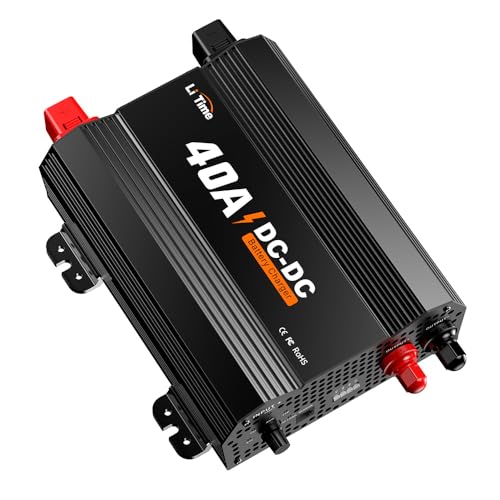
- 40A output or 20A low-current port
- LiFePO4 and lead-acid profiles
- Not waterproof
Best For: Dry-location RV and camper service-battery charging
Smart Alternator Pick

- Configurable input and output currents
- Built-in Bluetooth monitoring
- IP65 enclosure; 700W continuous rating
Best For: Monitored 12V dual-battery setups with intelligent alternators
Alternator-and-Solar Pick
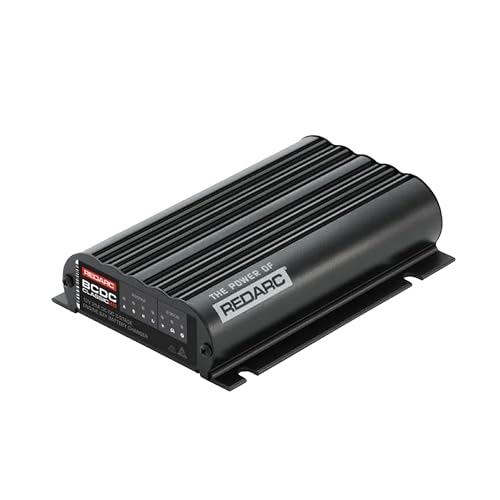
- Alternator and solar inputs
- Built-in MPPT with solar priority
- Sealed for demanding travel conditions
Best For: Solar-equipped overlanding and RV dual-battery systems
App-Ready 40A Pick

- 40A alternator-powered charging
- Engine-running detection
- Monitoring needs separately sold hardware
Best For: 40A vehicle charging with optional app-based monitoring
Best for Bluetooth Monitoring
Victron Orion-Tr Smart 30A Isolated Charger

- 30A, three-stage charging
- Built-in VictronConnect Bluetooth
- Supports lead-acid and lithium
Best For: App-monitored alternator-to-service-battery charging
Best for Solar and Alternator Input
Renogy Smart 30A DC-DC MPPT Charger
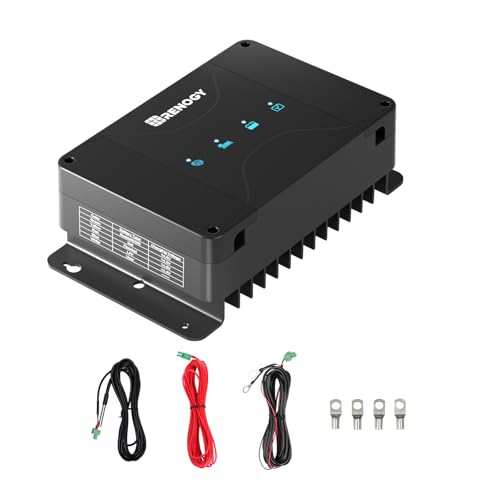
- 30A solar-and-alternator charging
- Built-in MPPT prioritizes solar
- Bluetooth needs a separate module
Best For: RVs and vans with solar panels and alternator charging
Best High-Output Marine Option
Victron Orion XS 50A EMC Charger

- 50A, 700W continuous rating
- Configurable input and output currents
- EMC-enhanced for VHF-radio settings
Best For: Higher-output marine and smart-alternator systems
Best with Extra Features
Victron Orion-Tr Smart 12/12V 18A Isolated

- 18A isolated 12V-to-12V charging
- Bluetooth monitoring via VictronConnect
- Supports lead-acid and lithium batteries
Best For: 12V vehicle and boat setups prioritizing app-based monitoring
Best for High-Current 12V Charging

- 60A 12V-to-12V charging
- Supports lithium, AGM, gel, and flooded batteries
- D+ connection controls engine-running charging
Best For: 12V RVs and vehicles with a compatible D+ connection
Best for Mixed-Voltage Systems

- Supports 12V and 24V configurations
- 50A rating and adaptive four-stage charging
- Bluetooth monitoring via VictronConnect
Best For: Installations needing 12V/24V flexibility and app monitoring
Flexible Current Pick – LiTime 12V 40A DC-DC Charger
If you need a dc to dc charger for dual battery system use with different battery chemistries, this LiTime offers a battery-type selector and 40A charging, plus a low-current port that limits output to 20A.
Best For: RV or camper owners charging a 12V LiFePO4 or lead-acid service battery who want a lower-current option.
Pros:
- Selectable charging profiles for LiFePO4 and lead-acid batteries.
- Can reactivate a lithium battery after BMS shutdown.
- Isolated input and output, with reverse-polarity, short-circuit, and temperature protections.
Cons:
- Not waterproof or suitable for marine environments.
- No solar input is specified in the supplied details.
The 20A limit makes this a more adaptable choice than a fixed-40A unit, but plan to install it in a dry location and verify that its charging setup suits your vehicle.
Smart Alternator Pick – Victron Orion XS 50A
The Victron Orion XS is a dc to dc charger for dual battery system installations where alternator compatibility and adjustable charging matter. Its 12V-to-12V design provides up to 50A, with configurable input and output currents.
Best For: Drivers with intelligent alternators who want app-based setup and charging visibility.
Pros:
- Adjustable currents help match the charger to the alternator and service battery.
- Built-in Bluetooth supports configuration, live data, and a 30-day history through VictronConnect.
- Rated for continuous 700W output at 40°C and housed in an IP65 enclosure.
Cons:
- Designed for 12V-to-12V systems, not a listed 24V output setup.
- No integrated solar input is specified.
Choose this when control and monitoring are priorities; its engine-running detection and adjustable input current are especially useful when protecting an intelligent alternator from excess load.
Alternator-and-Solar Pick – REDARC Dual Input 25A
For a dc to dc charger for dual battery system use that combines driving and solar charging, the REDARC 25A accepts alternator and solar inputs. Its built-in MPPT regulator prioritizes solar power when available.
Best For: Overlanders and RV owners who want one charger for alternator and solar input to a secondary battery.
Pros:
- Dual inputs support alternator and solar charging.
- MPPT regulation and Green Power Priority favor available solar energy.
- Supports AGM, gel, lead-acid, calcium, and LiFePO4 batteries.
- Sealed electronics are designed for water crossings, dust, heat, and vibration.
Cons:
- 25A output is lower than the 40A and 50A options in this roundup.
- Its stated common battery-bank range is 75–200Ah.
This is the clearest fit when solar integration and rugged installation matter more than maximum charging current. Check your battery-bank size and charging needs against its 25A rating.
App-Ready 40A Pick – Renogy 12V DC-DC Charger
The Renogy 40A is a dc to dc charger for dual battery system installations that need engine-running detection and multi-stage charging. It supports lithium, AGM, gel, and flooded batteries, with a compact wall-mount design.
Best For: RV or vehicle owners who want 40A alternator-powered charging with optional remote monitoring.
Pros:
- Alternator detection enables charging when the engine runs.
- LiFePO4 activation can be switched on or off.
- Includes overload, short-circuit, over-temperature, and over-voltage protections.
- Optional connectivity provides app settings and up to 365 days of charging data.
Cons:
- App control requires a separately sold BT-2 module or Renogy One Core.
- No built-in solar input is specified.
This is a practical 40A choice if you value automatic engine-based operation. Budget for the additional hardware if remote settings and charging history are part of your plan.
Best for Bluetooth Monitoring – Victron Orion-Tr Smart 30A Isolated Charger
If you want a dc to dc charger for dual battery system use with straightforward phone-based setup, the Victron Orion-Tr Smart is a 12V-to-12V, 30A option. It uses three-stage charging to move power from a vehicle or boat’s starting battery to its service battery.
Best For: Drivers and boat owners who want built-in Bluetooth monitoring for a 30A alternator-fed service battery.
Pros:
- Built-in Bluetooth works with VictronConnect for status checks and adjustments.
- Supports lead-acid and lithium batteries.
- Isolated design and screw terminals suit a range of installations.
Cons:
- 30A output may not suit buyers looking for a higher-current charger.
- No solar input is listed in the supplied specifications.
This is the practical pick when app access and battery compatibility matter more than combining alternator and solar charging in one unit.
Best for Solar and Alternator Input – Renogy Smart 30A DC-DC MPPT Charger
For an RV or van that charges from both its alternator and solar panels, this Renogy dc to dc charger for dual battery system setups combines 30A DC-DC charging with an MPPT solar input. It prioritizes solar when both sources are available and supports lithium, AGM, gel, and flooded batteries.
Best For: RV and van owners who want solar and alternator charging managed by one 12V charger.
Pros:
- Dual inputs accept solar and alternator power, with solar prioritized when both are active.
- Built-in MPPT and three-stage charging support service-battery charging.
- Works with traditional and smart alternators.
Cons:
- Bluetooth monitoring requires a separately sold BT-2 module.
- Its 30A rating may be limiting for higher-current setups.
Choose this model if consolidating solar and driving-time charging is the priority; budget separately for the Bluetooth accessory if phone monitoring matters.
Best High-Output Marine Option – Victron Orion XS 50A EMC Charger
Victron Energy Orion XS 12/12-Volt 50 Amp DC-DC Battery Charger with EMC Enhancements
Check Price On AmazonThe Victron Orion XS is a higher-output dc to dc charger for dual battery system installations that need up to 50A of 12V charging. This EMC-enhanced version is recommended for marine use and other applications with VHF radios, while its configurable input and output currents help match the charger to the alternator and service battery.
Best For: Marine or vehicle installations needing 50A charging, smart-alternator support, and EMC enhancements for VHF-radio environments.
Pros:
- Rated for 50A and 700W continuous output at 40°C.
- Adjustable input and output currents, plus engine-running detection.
- IP65 design and VictronConnect access to live data and 30-day history.
Cons:
- No solar input is listed in the supplied specifications.
- Its 50A capability may be more than a smaller system needs.
This is the stronger fit when charging capacity and alternator configuration take precedence, particularly where the EMC-enhanced model’s marine recommendation is relevant.
Best with Extra Features – Victron Orion-Tr Smart 12/12V 18A Isolated
If you want a dc to dc charger for dual battery system use in a vehicle or boat, the Victron Orion-Tr Smart charges a service battery from the alternator and starter battery. Its isolated 12V-to-12V design delivers 18A and uses three-stage charging.
Best For: 12V vehicle or boat setups that prioritize Bluetooth monitoring over high charging current.
Pros:
- Monitor status and adjust settings through Bluetooth and the VictronConnect app.
- Supports lead-acid and lithium service batteries.
- Screw terminals simplify connections; multiple units can be connected in parallel for more output.
Cons:
- Its 18A output is lower than the higher-current chargers in this roundup.
- Limited to 12V input and 12V output.
Choose this model when app-based control and an isolated 12V charging path matter more than maximum current. If your system needs 24V conversion, look elsewhere.
Best for High-Current 12V Charging – Renogy REGO 60A DC-DC Charger
The Renogy REGO is a dc to dc charger for dual battery system builds that need up to 60A of 12V-to-12V charging. Its three charging stages support lithium, AGM, gel, and flooded batteries, making it a versatile option for RVs and other vehicles.
Best For: 12V RV or vehicle setups with a compatible D+ connection that need higher charging current.
Pros:
- 60A rating offers more charging current than lower-output models.
- Supports LiFePO4, AGM, gel, and flooded batteries.
- D+ engine-running connection helps prevent charging from draining the starter battery.
- Listed protections include overload, reverse polarity, and over-temperature protection.
Cons:
- Requires a D+ wire connection for its engine-running control.
- Designed for 12V input and 12V output, not mixed-voltage systems.
This is the pick for a compatible 12V setup where charging current is the priority. Before buying, confirm that you can make the required D+ connection and accommodate the charger’s listed dimensions.
Best for Mixed-Voltage Systems – Victron Orion XS 1400 50A
For a dc to dc charger for dual battery system installations involving 12V, 24V, or both, the Victron Orion XS 1400 offers more voltage flexibility than a 12V-only model. It uses the alternator to charge a house battery through the starter battery and provides adaptive four-stage charging.
Best For: Dual-battery installations that need 12V/24V flexibility and Bluetooth monitoring.
Pros:
- Supports 12V and 24V systems, including conversion between the two voltages.
- Rated at 50A with a stated efficiency of 98.5%.
- Engine-running detection helps prevent starter-battery drain.
- VictronConnect provides Bluetooth access to charging status and performance history.
Cons:
- Full remote VRM management requires an additional Victron communication center.
- Confirm the exact input/output configuration before ordering: the supplied title describes 12/24V capability, while the provided details list 24V input and output.
The Orion XS 1400 stands out for systems where voltage compatibility and monitoring justify a more capable charger. Check the specific model’s electrical configuration against your batteries before installation.
How We Picked the Best Dc to Dc Charger for Dual Battery System
We selected models across common output levels and installation needs: compact isolated chargers, 25–40A everyday options, 50–60A high-output units, and dual-input chargers with solar support. We also considered stated battery-chemistry compatibility, voltage configurations, and useful features such as Bluetooth monitoring. This is a specification-based buying guide, not a claim that every unit was independently bench-tested.
Quick Comparison: Which Type Fits Your Build?
- Limited alternator capacity or smaller batteries: Consider an 18A or 25A charger, provided its charging profile matches your battery.
- Typical 12V auxiliary system: A 30A or 40A charger can offer a practical balance of charging speed and electrical demand.
- Large battery bank or shorter drives: A 50A or 60A model may replenish energy faster, but only if the alternator, wiring, and battery can support it.
- Alternator and solar charging: Look at dual-input models with built-in MPPT if you want one device to manage both sources. Check how each model prioritizes its inputs.
- Mixed voltages or grounding requirements: Check input/output voltage specifications and whether an isolated design is necessary.
Key Buying Factors for a DC-To-DC Charger for Dual Battery System
Match the Battery and Charge Rate
Confirm that the charger offers the charging profile required by your auxiliary battery, whether lithium, AGM, or gel. Check the battery maker’s maximum charge-current guidance before choosing an amp rating. More output is not automatically better for a small battery or a vehicle with limited spare alternator capacity.
Verify Voltage and Vehicle Compatibility
Check both the input and output voltage, especially if your vehicle uses a 24V electrical system or your house battery differs from the starter battery. For vehicles with variable-voltage smart alternators, confirm the charger’s activation and input-voltage requirements against the manufacturer’s instructions.
Plan the Installation
Cable size, run length, fusing, mounting location, and ventilation matter as much as the charger’s headline output. Follow the maker’s wiring specifications and place protection where instructed. Choose an isolated model when your electrical layout calls for separate input and output grounds; do not assume isolation is required for every installation.
Decide Whether You Need Solar Integration
An MPPT-equipped dual-input charger can simplify a van or RV build if you charge from both a solar panel and the alternator. Check solar voltage and current limits before connecting panels. If you already own a suitable solar controller, a conventional DC-to-DC charger may be the simpler purchase.
Who Should Buy Which Dc to Dc Charger for Dual Battery System?
Choose a lower-amp charger for modest battery banks or constrained vehicle electrical systems. Consider a 30–40A model for a conventional 12V setup when its charge rate and wiring requirements fit. Move to 50–60A only after confirming the full system can deliver and accept that current. Pick a dual-input MPPT model if you want integrated solar charging, an isolated model when your grounding design requires one, and a 12V/24V-capable option when your vehicle and auxiliary battery voltages differ. Before ordering any Dc to Dc Charger for Dual Battery System use, verify the exact model’s specifications—not just its product title—against your battery, alternator, and installation plan.