If you want to see exactly how much power your devices use, an outlet power meter with data logging is one of the most practical tools you can buy. It helps you track consumption, spot inefficient appliances, and estimate real operating costs.
The best models combine clear displays, overload protection, and app or onboard logging so you can monitor usage over time instead of relying on rough guesses.
Best 10 Outlet Power Meter with Data Logging Picks for 2026
Wi-Fi Smart Plug Monitor
AC WiFi Watt Meter with Color Display

- Tuya/Smart Life Wi-Fi app control
- Bill-setting and energy monitoring
- Timer, countdown, and protection features
Best For: app-connected home monitoring with basic cost tracking
EV Charging Monitor
PN2500 Level 1 Wi-Fi Power Meter

- Class 1.0 accuracy with 0.001A resolution
- Logs watts, kWh, volts, amps, PF, Hz, and cost
- Built for Level 1 EV charging and other high loads
Best For: detailed tracking on EV charging circuits
Industrial Smart Meter
LP405 Heavy-Duty Energy Logger

- Offline logging with included microSD card
- 25A capacity for ACs, heaters, and heavy loads
- Tracks rates, PF, events, and working time
Best For: long-term logging on heavy-duty appliances
Dual-Outlet Energy Monitor
Briidea Two-Socket Power Analyzer
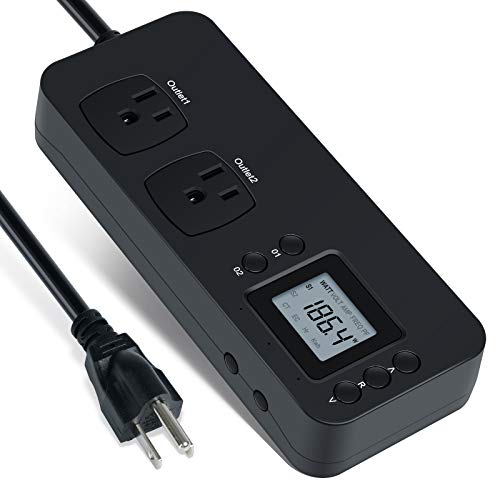
- Monitors two devices independently
- Keeps energy data after power loss
- Measures watts, volts, amps, kWh, and PF
Best For: simple dual-device monitoring at home
Advanced Logging Meter
PR10-E US15A Power Meter Plug/Home Power metering Socket

- Auto logs historical data for list or chart review.
- Alarm settings cover voltage, current, power, and temperature.
- 3 display pages plus reset and factory restore options.
Best For: Detailed home power monitoring with alerts and long-term records.
Heavy-Duty Outlet Monitor

- Built-in storage records long-term usage data automatically.
- Measures voltage, current, frequency, and power factor.
- 20A setup includes a circuit breaker and wider device support.
Best For: Higher-load outlets that need logged usage data and power-quality analysis.
Flexible Display Logger

- Logs multiple readings including cost, kWh, and runtime.
- Split display with a 2.9-meter cable improves placement.
- Saves data through outages and supports overload alarms.
Best For: Appliance-level monitoring in tight spaces with flexible display placement.
Real-Time Outlet Monitoring
20A AC Power Meter with 6.56FT Cable

- Tracks voltage, current, power, frequency, power factor, and kWh.
- Retains historical consumption data after a power outage.
- Long 6.56 ft cable helps with flexible display placement.
Best For: Home, classroom, and light commercial plug-in monitoring
Budget Usage Tracker
Upgraded Watt Meter with Backlight
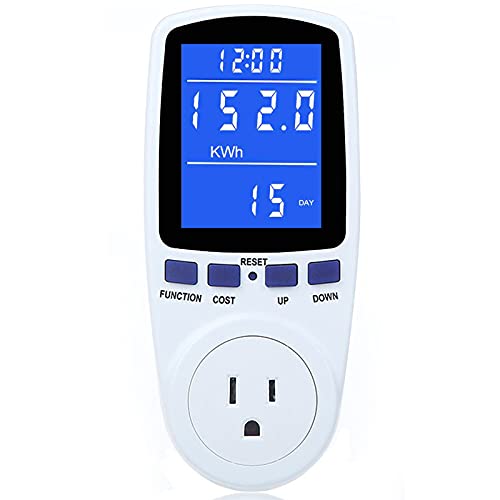
- Displays watts, kWh, volts, amps, hertz, power factor, cost, and runtime.
- Memory function keeps readings after unplugging or a power failure.
- Large backlit LCD makes the data easier to read.
Best For: Household appliance monitoring and bill tracking
Load-Safe Energy Logger
Multifunction 20A Outlet Monitor

- Tracks voltage, current, power, energy, power factor, and frequency.
- Supports long-term data logging for billing and load assessment.
- Built-in GFCI protection and overload safeguards add safety.
Best For: Plug-and-play monitoring with long-term data logging
Wi-Fi Smart Plug Monitor – AC WiFi Watt Meter with Color Display
If you want an outlet power meter with data logging that also gives you remote control, this AC WiFi watt meter is built for practical everyday monitoring. It tracks electricity use, supports timer and countdown functions, and lets you set electricity unit pricing for bill estimates, while the Tuya/Smart Life app adds Wi-Fi access and remote management.
Best For: Home users who want app-based monitoring, basic logging, and cost tracking from a plug-in meter.
Pros:
- Wi-Fi app support through Tuya or Smart Life for remote monitoring and control
- Electricity bill setting helps estimate usage cost more easily
- Built-in timer and countdown functions add scheduling flexibility
- Over current, over voltage, and over power protection help guard connected loads
Cons:
- Best suited to standard plug-in AC loads rather than specialty industrial use
- Data logging details are less explicit than on advanced log-focused monitors
This is a solid choice if you want a feature-rich plug-in monitor with a large color display and app connectivity. It leans more toward smart control and billing awareness than deep analytics, but it covers the essentials well for everyday outlet monitoring.
EV Charging Monitor – PN2500 Level 1 Wi-Fi Power Meter
For buyers looking for an outlet power meter with data logging on a higher-current circuit, the PN2500 is aimed at Level 1 EV charging and other 60-240V loads. It records a wide range of metrics, including watts, kWh, amps, volts, PF, Hz, time, and cost, and the Wi-Fi app control makes it easier to review charging or appliance usage over time.
Best For: EV owners and users who need detailed usage tracking on a 25A pass-through monitor.
Pros:
- Class 1.0 accuracy with 0.001A resolution for more precise readings
- Tracks watts, kWh, time, amps, voltage, PF, Hz, and cost
- Wi-Fi app control supports remote viewing from iOS or Android
- Designed for Level 1 EV charger pass-through monitoring and other high-load use
Cons:
- More specialized than a basic plug-in outlet meter
- Focused on 5-15 style monitoring rather than general household convenience
The PN2500 is the most data-heavy option here, especially if you need detailed consumption tracking and cost calculations. Its strength is precision and breadth of measurement, making it a good fit when logging matters as much as monitoring.
Industrial Smart Meter – LP405 Heavy-Duty Energy Logger
If you need an outlet power meter with data logging for heavy appliances, the LP405 stands out with its offline logging and industrial 25A design. It tracks accumulated energy, live electrical readings, and time-of-use billing, while the included microSD storage gives it a stronger logging angle than many Wi-Fi-only plug meters.
Best For: Heavy-duty AC, heater, or industrial-style monitoring with long-term offline records.
Pros:
- Offline data logging with included 128MB microSD card for long-term records
- Tracks voltage, current, power, PF, rates, working time, and events
- 25A heavy-duty rating suits ACs and heaters better than standard 16A sockets
- Supports Tuya/Smart Life control plus overload and voltage protection
Cons:
- More complex than a simple plug-in monitor
- Best value comes from users who will use the logging and tariff features
This is the strongest pick for buyers who care about logging history, not just live readings. The combination of offline storage, triple-rate billing, and heavy-duty capacity makes it well suited to demanding power monitoring jobs.
Dual-Outlet Energy Monitor – Briidea Two-Socket Power Analyzer
For anyone comparing an outlet power meter with data logging across two devices, the Briidea monitor is a simple, practical option. Its dual-outlet design lets you track two appliances independently, while the meter records power, volts, amps, hertz, kWh, cumulative time, and power factor with memory that survives power loss.
Best For: Users who want to monitor two household devices separately from one plugged-in unit.
Pros:
- Two outlets let you monitor two devices independently
- Retains cumulative time and energy data after power loss
- Measures watts, volts, amps, hertz, kWh, and power factor
- Overload warning helps with safety awareness above 1200W
Cons:
- Less advanced than Wi-Fi or app-connected monitors
- No smart-home control or remote logging features listed
This model is best when you want straightforward measurement without extra setup. It does the core monitoring job well, especially if your priority is keeping separate tabs on two devices at once.
Advanced Logging Meter – PR10-E US15A Power Meter Plug/Home Power metering Socket
If you want an outlet power meter with data logging for long-term tracking, the PR10-E stands out with automatic historical record keeping that can be reviewed as a list or chart. It also adds alarm settings for voltage, current, power, and temperature, making it useful when you want more than basic wattage readings.
Best For: Users who want detailed logging, alarm alerts, and multiple display views for home power monitoring.
Pros:
- Automatically records historical data for review as a list or chart.
- Offers alarm functions for voltage, current, power, and temperature limits.
- Includes three display pages for overview, one-shot electrical data, and real-time parameters.
- Can clear total consumption/history or restore factory settings from the menu.
Cons:
- Uses a menu-driven interface that may take some setup time.
- More feature-heavy than a simple plug-in watt meter.
This is a strong pick if logging and alerting matter as much as measurement. The 2.4-inch TFT color LCD and long-term record retention make it a practical monitoring tool for users who like to track trends instead of just instant readings.
Heavy-Duty Outlet Monitor – 20A 125V AC Power Meter
This outlet power meter with data logging is built for users who want a heavier-duty monitor with long-term records and broader electrical analysis. It measures current, voltage, frequency, and power factor, while its built-in storage automatically records historical power consumption data for later backtracking.
Best For: Homes, shops, or labs that need a 20A outlet monitor with recorded usage history and expanded power analysis.
Pros:
- Automatic storage records long-term historical consumption data.
- Measures voltage, current, frequency, and power factor.
- Includes a 20A circuit breaker for wider device compatibility.
- Can analyze power quality issues like fluctuations, sags, swells, and transients.
Cons:
- More specialized than a basic energy meter.
- Designed around a NEMA 5-15P to 5-20R interface, so fit matters.
For buyers who care about data logging and deeper electrical insight, this model offers a strong mix of monitoring and analysis. It is especially appealing when you need both recorded usage trends and a more robust 20A outlet setup.
Flexible Display Logger – KETOTEK Watt Meter Plug
If you need an outlet power meter with data logging that is easy to place and easy to read, this KETOTEK model is a smart option. It tracks power, energy, voltage, current, frequency, power factor, cost, min/max power, and runtime, while also saving data through outages so you do not lose your history.
Best For: Everyday appliance monitoring where a remote display, saved data, and alarm reminders are useful.
Pros:
- Tracks many parameters, including kWh, cost, min/max power, and runtime.
- Backlit LCD display with a 2.9-meter cable for flexible placement.
- Automatically saves data during a power outage.
- Includes overload, kWh, and cost alarms for added protection.
Cons:
- Requires a CR2032 battery, which is included but still adds one more component.
- Best suited to plug-in appliance monitoring rather than whole-home use.
This is a practical choice if you want logging plus convenience. The split display design makes it easier to use in tight or awkward spaces, and the alarm features help it do more than just report numbers.
Real-Time Outlet Monitoring – 20A AC Power Meter with 6.56FT Cable
If you want an outlet power meter with data logging for basic energy checks and troubleshooting, this 20A AC meter keeps the focus on live readings and retained usage history. It monitors voltage, current, power, frequency, power factor, and kWh, while the long cable makes it easier to position the display where you can actually read it.
Best For: Home, classroom, and light commercial users who need plug-in monitoring with saved usage data.
Pros:
- Tracks voltage, current, power, frequency, power factor, and energy use in real time.
- Stores historical consumption data even during a power outage.
- 6.56 ft 12AWG cable adds flexibility for placement and viewing.
- Includes short-circuit and overload protection for safer monitoring.
Cons:
- No advanced app-based logging or export features mentioned.
- Resetting recorded data requires holding the side button.
- Designed for standard outlet use, so it is not a universal power analyzer.
This is a practical pick if you mainly need straightforward outlet power meter with data logging functionality plus a clear LCD readout. It is especially useful when you want to spot changing load trends without complicated setup.
Budget Usage Tracker – Upgraded Watt Meter with Backlight
This outlet power meter with data logging is built for users who want easy-to-read consumption tracking and a memory function without extra complexity. It measures watts, kWh, volts, amps, hertz, power factor, cost, and runtime, while the backlit screen helps make the readings easier to see day or night.
Best For: Household appliance monitoring, bill tracking, and anyone who wants a simple plug-in energy meter with saved readings.
Pros:
- Shows 7 monitoring modes, including power, energy, cost, and runtime.
- Large backlit LCD improves visibility and has wide viewing angles.
- Data memory function saves readings after unplugging or power failure.
- Overload protection displays a warning when load limits are exceeded.
Cons:
- Maximum overload setting tops out at 3680W, so it is not for heavy loads beyond that range.
- Backlight behavior needs manual setting changes if you want always-on display.
- Details focus on plug-in household use rather than advanced analysis tools.
Overall, this model is a good fit if you want straightforward energy monitoring with memory and a readable display. It is especially appealing for tracking appliance usage and estimating electricity cost over time.
Load-Safe Energy Logger – Multifunction 20A Outlet Monitor
For buyers comparing an outlet power meter with data logging, this 20A multifunction unit stands out for its mix of real-time measurements and long-term tracking support. It monitors voltage, current, power, electricity consumption, power factor, and frequency, and the plug-in design keeps setup simple.
Best For: Users who want plug-and-play outlet monitoring with long-term data logging for billing or load assessment.
Pros:
- Measures voltage, current, power, energy use, power factor, and frequency in real time.
- Supports long-term data logging for residential, commercial, and industrial analysis.
- Includes built-in GFCI ground-fault protection and overload/short-circuit safeguards.
- 6.56 ft 12AWG cable makes placement more flexible.
Cons:
- Uses a basic LCD interface with no app connectivity mentioned.
- Long-press reset may be less convenient if you frequently clear records.
- Best suited to devices compatible with NEMA 5-15P or 5-20R sockets.
This is a strong choice if safety and long-term tracking matter as much as measurement. It works well for spotting power-quality issues, comparing device loads, and keeping energy records organized.
How We Picked the Best Outlet Power Meter with Data Logging
We focused on monitors that make daily energy tracking easier, with a mix of built-in data logging, readable displays, and useful protection features. We also prioritized models that fit common household and heavy-duty use cases, from simple plug-in monitoring to higher-current outlet monitors and smart Wi-Fi options.
Selection factors included measurement range, screen clarity, logging or memory functions, overload protection, outlet compatibility, and whether the device suits a home, workshop, or EV charging setup.
Quick Comparison: What Matters Most
Not every Outlet Power Meter with Data Logging is built for the same job. Basic plug-in meters are ideal for everyday appliances, while 20A and 25A models are better for higher-load equipment. Smart Wi-Fi units are best if you want remote access or longer-term usage history, and industrial-style meters are useful when you need more detailed monitoring and protection.
Key Buying Factors for an Outlet Power Meter with Data Logging
Measurement Range and Load Rating
Match the meter to the device you plan to measure. A standard 15A meter works for many household electronics, but larger appliances, tools, and EV charging setups may require 20A or 25A capacity. Always check voltage, current, and outlet format before buying.
Logging Method
Some meters store usage data directly on the device, while others send readings to an app or Wi-Fi dashboard. If you want long-term trends and easy export, choose a model with clear memory or wireless logging. If you mainly need quick spot checks, onboard tracking may be enough.
Display and Readability
Backlit LCD and color screens make a big difference if the outlet is in a dim room, garage, or utility area. A clear screen should show watts, volts, amps, kilowatt-hours, and any cost or billing data you plan to monitor.
Safety and Protection Features
Look for overload protection, overvoltage or undervoltage alerts, and sturdy construction. These features are especially important for continuous-use devices or high-draw equipment that may run for long periods.
Who Should Buy Which Outlet Power Meter with Data Logging?
If you want simple home energy checks, choose a compact plug-in meter with a backlit display. If you need more insight into appliance costs, look for a model with stronger logging and billing functions. For higher-demand equipment, pick a 20A or 25A outlet monitor with the right plug and outlet format. And if remote monitoring matters, a Wi-Fi-enabled meter is the most convenient choice.
In short, the best Outlet Power Meter with Data Logging is the one that matches your load, shows the readings you care about, and stores data in a way that actually helps you make better buying and usage decisions.