Level’s Level 2 EV Charger is a practical portable charging option for drivers who want a faster home setup without locking themselves into a fixed wall unit.
If you need a J1772 charger with adjustable current, app control, and travel-friendly flexibility, this model has a clear case.
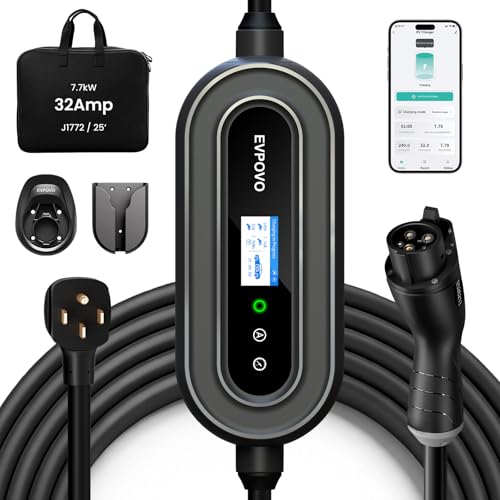
Level 2 EV Charger Review Summary
This Level 2 EV Charger review comes down to one question: do you want a portable, flexible charger that can serve as both a home solution and a backup travel unit?
Based on the listing, this is a strong fit for drivers who value speed, a long cable, and simple control over current settings, especially if they need something that works with a standard J1772 vehicle and can be moved when necessary.
The product is not trying to be the most minimal charger on the market.
Instead, it leans into versatility: 240V operation, adjustable amperage, Wi-Fi app control, physical buttons, and a ruggedized enclosure.
That combination makes it especially appealing for EV owners who want to charge at home, but do not want to give up portability or control.
Review Scorecard
| Category | Score | Why it matters |
|---|---|---|
| Charging flexibility | 9/10 | Adjustable 16/20/24/32A output fits different breaker situations and driving needs. |
| Portability | 9/10 | The portable design and included 25ft cable make it useful beyond a permanent garage install. |
| Safety features | 8/10 | ETL listing and CCID20 leakage protection are strong listing-level safety signals. |
| Weather readiness | 8/10 | The NEMA Type 4 enclosure and weatherproof design support outdoor use. |
| Ease of control | 8/10 | App scheduling and onboard buttons cover both smart and simple users. |
| Vehicle compatibility | 9/10 | J1772 support and broad compatibility with common EVs and PHEVs widen the buyer pool. |
| Value proposition | 8/10 | It bundles speed, portability, and controls into one unit, reducing the need for separate chargers. |
For the right buyer, this is a well-rounded portable Level 2 charger rather than a niche accessory.
It suits EV owners who want a flexible daily charger, a backup unit for travel, or one charger they can move between locations without losing important controls.
Key Features and Specifications of Level 2 EV Charger
The main appeal of this charger is that it combines several purchase drivers in one product.
The listing describes a 240V NEMA 14-50 plug for higher-speed charging, plus a 120V 5-15 connector for emergency use.
That means the unit is not limited to one scenario, which matters if you want a charger that can adapt to both home and on-the-road needs.
It is rated at up to 32 amps and 7.68kW, with a claimed range gain of about 25 miles per hour of charging under favorable conditions.
The amperage can be adjusted to 16A, 20A, 24A, or 32A through the app or buttons.
That matters because not every home circuit can support the same load, and this flexibility gives the charger a better chance of fitting a real-world electrical setup.
The cable is 25 feet long and made from TPU, which the listing says stays flexible even in very cold temperatures.
That is useful for garages, driveways, and situations where the outlet is not directly beside the parking spot.
A longer cable also reduces the need to reposition the car awkwardly just to reach the plug.
Safety and enclosure details are another major part of the pitch.
The charger is ETL listed to UL 2594 and UL 2231-1/-2, and the listing mentions integrated CCID20 leakage protection.
The enclosure is described as NEMA Type 4 and weatherproof, which makes it more credible as an outdoor or semi-outdoor charger than a bare-bones portable cable.
The smart side is straightforward rather than overbuilt.
The Wi-Fi app supports scheduling off-peak charging and checking real-time stats, while physical buttons let you adjust current or set delay timing without depending on your phone.
That split is practical, because EV charging gear should still be usable when the app is inconvenient.
In compatibility terms, the charger is aimed at J1772 standard vehicles and a wide range of common EVs and plug-in hybrids.
The listing specifically mentions models from Ford, Jeep, Toyota, Hyundai, Kia, Chevrolet, Volkswagen, Honda, Acura, BMW, and Rivian, which signals broad mainstream coverage rather than a narrow ecosystem.
Pros and Cons of Level 2 EV Charger
Pros
- Adjustable amperage gives you flexibility across different circuits and use cases.
- The 25-foot TPU cable is a meaningful practical advantage for driveway and garage setups.
- App control plus onboard buttons makes it easy to use for both smart and non-smart charging routines.
- ETL listing and leakage protection are reassuring for a portable charging product.
- The weatherproof enclosure and rugged cable suggest better outdoor suitability than many basic portable chargers.
- Support for both daily use and emergency travel charging increases the product’s usefulness.
Cons
- The feature set is broad, so buyers who only want a bare-minimum charger may find it more complex than necessary.
- Portable chargers still depend on the quality of the outlet and circuit behind them, so the charger cannot solve weak electrical infrastructure.
- The listing makes strong claims about performance and durability, but those are still manufacturer claims rather than hands-on verification here.
Overall, the pros outweigh the cons if your goal is a flexible, multipurpose charger.
If you only need a fixed garage unit and do not care about portability or app scheduling, a simpler wall-mounted option may be a better fit.
Who Should Buy Level 2 EV Charger?
This charger makes the most sense for drivers who want one unit to cover several jobs.
If you charge at home most nights but also want a backup charger you can take with you, the portable design is a strong advantage.
It also suits households that may need to reduce amperage depending on the circuit available, since the adjustable output makes that easier.
It is a good fit for EV and plug-in hybrid owners who use a J1772 inlet and want straightforward controls without committing to a more permanent installation.
The app can help if you schedule charging around utility rates or simply like monitoring charge sessions, while the physical controls help if you prefer a no-fuss setup.
You should probably skip it if your only goal is the cleanest possible wall-mounted install and you already know your charging setup will never move.
In that case, a dedicated hardwired charger may be a more elegant fit.
It is also less compelling if you do not need the emergency 120V connector or the travel-oriented portability.
Charging Setup and Use Cases of Level 2 EV Charger
Home Garage Charging
For home use, the appeal is predictable overnight charging with the ability to tune current to the circuit.
That makes the charger feel more adaptable than a one-setting device, especially in homes where electrical capacity is not uniform across every outlet or garage branch.
Travel and Backup Use
Because the product is portable and includes both a 240V plug option and a 120V emergency connector, it is better positioned as a travel companion than a fixed charger.
That can be valuable for drivers who split time between home, relatives, rental properties, or multiple parking locations.
Weather and Outdoor Placement
The weatherproof enclosure and cold-flex cable are important if the charger will live near a driveway or outdoor parking spot.
Nothing in the listing suggests you should treat it as indestructible, but the design choices point in the right direction for seasonal exposure.
Smart Scheduling and Daily Convenience
The app scheduling feature is most useful for drivers who want off-peak charging or simply want the charger to start later in the night.
The fact that the charger also works through buttons means the smart features feel optional rather than mandatory, which improves day-to-day usability.
Alternatives to Level 2 EV Charger
If you want a similar portable charger with broad compatibility, the ChargePoint Home Flex is a common benchmark to compare against.
It is worth considering if you want a more established brand name in home charging.
If portability and rugged usage are priorities, the Emporia EV Charger is another credible search target.
Buyers often compare it when they want a strong mix of smart controls and home charging practicality.
If you want a premium EVSE option with a strong reputation, the Tesla Universal Wall Connector is worth a look, especially for mixed-connector households that want a more permanent installation.
If your main goal is a flexible portable Level 2 charger, the Grizzl-E portable EV charger is also in the right conversation.
It is a relevant comparison point for buyers who care about durability and simple charging behavior.
Is Level 2 EV Charger Worth It?
Yes, for the buyer who wants a portable J1772 charger with real flexibility, this Level unit looks worth serious consideration.
The combination of adjustable amperage, long cable reach, app scheduling, onboard controls, safety certifications, and weather-aware design gives it a broader use case than many entry-level chargers.
Buy it if you want one charger that can handle home use, travel use, and different circuit limits without a lot of compromise.
Skip it if you only want a permanent, fixed wall charger and do not need portability, app control, or the emergency connector.