Finding the right conductor or breaker can turn a frustrating service call into a quick, controlled job. The best wire tracers for electricians help identify circuits, trace cables, verify continuity, and troubleshoot wiring with less guesswork.
This roundup compares 10 practical options, from AC circuit breaker finders to tone-and-probe kits for data, telephone, coaxial, and speaker cables.
Best 10 Wire Tracers for Electricians Picks for 2026
Advanced Circuit Tracing

- Traces energized and non-energized circuits
- Adjustable sensitivity and signal feedback
- Includes NCV, voltage indicators, and case
Best For: Electricians needing a versatile circuit tracer kit
Network Tone Tracing
Fluke Pro3000 Tone and Probe Kit

- Five SmartTone options identify wire pairs
- Loud probe supports noisy locations
- Designed for non-active network tracing
Best For: Network and cable pair identification
High-Voltage Circuit Finding
Ideal SureTrace Plus Circuit Tracer

- Traces systems up to 600V AC/DC
- Includes continuity testing and NCVT
- Designed for one-person circuit tracing
Best For: High-voltage circuit troubleshooting and fault finding
Low-Voltage Cable Tracing
Klein VDV500-820 Tone Probe Kit

- Supports Ethernet, telephone, speaker, and data cables
- Five tones transmit up to 1,000 feet
- Tests continuity and polarity
Best For: Accessible non-energized low-voltage cable work
Best Circuit Breaker Finder

- Identifies breakers on 90–120V AC circuits
- Includes GFCI tester and multiple adapters
- Provides visual and audible circuit indications
Best For: Residential breaker identification and basic outlet testing
Best Professional Cable Toner

- Traces voice, data, video, and alarm wiring
- Uses LED proximity indication and audible tones
- Includes probe, generator, adapters, leads, and case
Best For: Professional communication-cable installation and repair
Best Low-Voltage Tone Probe Kit

- Traces non-active wiring below 60V
- Supports Ethernet, telephone, speaker, coax, and video cables
- Includes wire mapping, work light, and adjustable volume
Best For: Low-voltage cable tracing and pin-to-pin mapping
Best for Telecom Troubleshooting

- Traces voice, data, video, and telephone wiring
- Tests continuity and telephone-line polarity
- Includes gain control and multiple LED indicators
Best For: Communications cabling and structured troubleshooting
Best Adjustable-Sensitivity Pick
PTE Wire Tracer & Circuit Tester
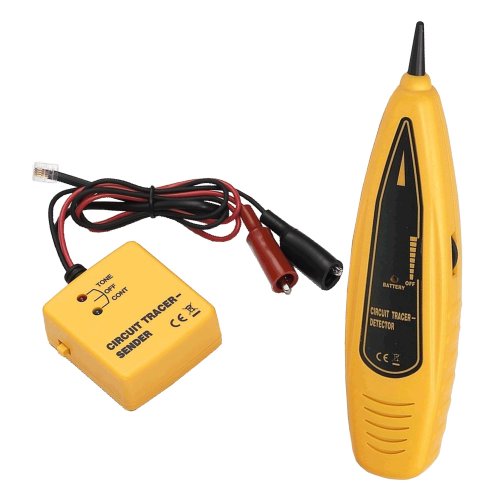
- Variable sensitivity isolates nearby wires
- Tests open and short circuits
- Includes RJ11 plug and alligator clips
Best For: Non-live wiring and close cable bundles
Advanced Circuit Tracing – Klein ET450 Wire Tracer Kit
For electricians comparing wire tracers for electricians, the Klein Tools ET450 is a versatile choice for energized and non-energized breakers, fuses, wires, and conduits. Adjustable sensitivity, voltage indicators, signal feedback, and an NCV function support detailed tracing work across common jobsite conditions.
Best For: Electricians who need one kit for circuit tracing, voltage identification, and isolating wires in bundles.
Pros:
- Traces energized or non-energized breakers, fuses, and wires.
- Adjustable sensitivity supports tracing through drywall, cement block, shielded cable, and underground applications when used as directed.
- Includes audible and visual signal-strength feedback, a flashlight, and NCV testing.
- Comes with multiple leads, clips, batteries, instructions, and a carrying case.
Cons:
- The kit is relatively bulky at about 2 pounds and includes many components to organize.
- Underground and shielded-cable tracing requires following the manual’s instructions.
The ET450 stands out when you want broad tracing capability rather than a basic tone probe. Its 12V-to-480V indicators and included adapters make it a practical all-around kit for service and troubleshooting tasks.
Network Tone Tracing – Fluke Pro3000 Tone and Probe Kit
Fluke Networks 26000900 Pro3000 Tone Generator and Probe Kit with SmartTone Technology
Check Price On AmazonThe Fluke Networks Pro3000 is a focused option among wire tracers for electricians who work with non-active network and cable runs. Its SmartTone technology provides five tones for distinguishing wire pairs, while the loud probe and headphone jack help in busy work areas.
Best For: Identifying individual pairs in non-active network cables and tracing long cable runs.
Pros:
- SmartTone provides five distinct tones for more precise pair identification.
- Can send a loud tone up to 10 miles in most cables, according to the supplied specifications.
- The probe has a loud speaker and 3.5 mm headphone jack for noisy locations.
- Includes a replaceable probe tip and 9V battery.
Cons:
- Designed for non-active networks rather than energized circuit tracing.
- It does not provide the broader voltage-indication and NCV features found on advanced circuit tracers.
The Pro3000 is a straightforward tone-and-probe solution for cable identification. Choose it when pair discrimination and audible tracing matter more than breaker finding or high-voltage testing.
High-Voltage Circuit Finding – Ideal SureTrace Plus Circuit Tracer
The Ideal SureTrace Plus is a feature-rich choice among wire tracers for electricians handling systems up to 600V AC/DC, including three-phase circuits. It combines breaker and conductor tracing with continuity testing, voltage information, NCVT, and displays designed for tight working spaces.
Best For: Professional troubleshooting where high-voltage coverage, built-in testing, and one-person circuit tracing are priorities.
Pros:
- Traces breakers, wires, conductors, fuses, dead shorts, and splice errors up to 600V AC/DC.
- Built-in continuity testing and NCVT can reduce the need for separate testers.
- Displays eight AC voltage levels from 24V to 600V and DC levels from 12V to 600V, with polarity indication.
- Rotating and bottom displays, work light, mute button, and drop protection support jobsite use.
Cons:
- At about 7 pounds, it is substantially heavier than simpler tone-and-probe kits.
- Its extensive features may be more than needed for basic low-voltage cable tracing.
- The supplied notes list no warranty.
SureTrace Plus is built for electricians who want a broad circuit-troubleshooting system in one package. Its high-voltage range and CertainCircuit one-person workflow make it especially compelling for panel and wiring fault work.
Low-Voltage Cable Tracing – Klein VDV500-820 Tone Probe Kit
The Klein Tools VDV500-820 is a practical pick among wire tracers for electricians working with low-voltage, non-energized wiring. It supports Ethernet, telephone, speaker, coax, video, and data cables, with tone cadences, continuity and polarity testing, and clips for secure connections.
Best For: Tracing accessible low-voltage cables and checking continuity or polarity in communication and data wiring.
Pros:
- Works with open-ended, non-energized wiring below 60V.
- Five tone cadences and transmission up to 1,000 feet support cable identification.
- RJ11 connectivity, RJ45 center-pin compatibility, and angled bed-of-nails clips simplify attachment.
- Provides continuity and polarity testing, plus a headphone jack for noisy areas.
Cons:
- Does not trace through drywall or other solid barriers.
- Intended for non-energized low-voltage wiring, not general high-voltage circuit tracing.
- Headphones are not included.
The VDV500-820 is best viewed as a dedicated low-voltage cable tool rather than a breaker finder. Its connector options and basic cable tests make it useful for accessible telecom, data, and speaker wiring.
Best Circuit Breaker Finder – Klein Tools ET310KIT
For electricians who need wire tracers for electricians focused on residential AC panels, the Klein Tools ET310KIT combines breaker identification with basic outlet and wiring checks. Its transmitter and receiver provide visual and audible signals on 90–120V AC circuits.
Best For: Locating breakers and checking compatible outlets, GFCI devices, lighting fixtures, or bare wires.
Pros:
- Visual and audible indications help identify the correct circuit.
- Built-in GFCI tester adds basic outlet-testing capability.
- Includes light-socket, grounding, and alligator-clip adapters.
Cons:
- Designed for 90–120V AC circuits rather than low-voltage cable tracing.
- Its breaker-finder design is less suited to tracing voice, data, or video wiring.
The ET310KIT is a practical choice when the main task is matching an energized residential circuit to its breaker, with useful adapters for common testing situations.
Best Professional Cable Toner – TEMPO Communications 701K-G
TEMPO Communications 701K-G Wire Tracer Electrical, Tone Generator and Probe Kit (701K Cable Toner)
Check Price On AmazonThe TEMPO Communications 701K-G is a professional-style option among wire tracers for electricians, built for identifying wires in voice, data, video, and security-alarm cabling. Its tone generator and probe can help locate pairs, check for breaks, and follow wiring through non-conductive walls and other structures.
Best For: Technicians tracing multi-pair low-voltage communication cables in challenging or noisy work areas.
Pros:
- Designed for voice, data, video, and security-alarm wiring.
- LED proximity indicator and work light support faster identification.
- Warbling tones, alligator leads, modular adapters, and carrying case are included.
Cons:
- Its specialized cable-tracing kit may be more equipment than needed for simple breaker finding.
- The supplied notes list a 150V operating range, so application-specific compatibility should be confirmed before testing.
With a dedicated tone generator, amplified probe, and broad communications-cabling accessories, the 701K-G is aimed at installers and service technicians who need more than basic wire continuity checks.
Best Low-Voltage Tone Probe Kit – Klein Tools VDV500-705
For low-voltage wire tracers for electricians, the Klein Tools VDV500-705 offers a straightforward analog tone generator and probe for open-ended, non-active wiring under 60V. It supports common Ethernet, telephone, speaker, coax, video, and data-cable tasks.
Best For: Tracing and mapping non-active low-voltage cables with RJ45, RJ11, RJ12, or alligator-clip connections.
Pros:
- Works with several common communications and data cable types.
- Includes alligator clips and an RJ45-to-RJ45 test cable.
- Offers pin-to-pin wire mapping, adjustable volume, headphone support, and a probe work light.
Cons:
- Limited to open-ended, non-active wires below 60V.
- Signal detection can improve when wires are separated and properly grounded.
The VDV500-705 is a sensible compact kit for structured-cabling and low-voltage troubleshooting, especially when wire mapping and dark-space visibility matter.
Best Budget Tone Kit – High-Accuracy 200EP Wire Tracer
If you need wire tracers for electricians for short-distance maintenance or low-voltage work, this tone generator kit offers a straightforward handheld setup. Its inductive amplifier, adjustable volume, and built-in speaker support cable identification, short-circuit testing, and circuit-status checks.
Best For: Low-voltage wire tracing, short-distance cable maintenance, and solo troubleshooting.
Pros:
- Supports line tracing, short-circuit testing, and clear, busy, or ringing identification.
- Recognizes same-group cables in about one second, according to the supplied notes.
- Includes an adjustable-volume probe, built-in speaker, and recessed termination port.
Cons:
- Requires two 9V batteries, which are not included.
- Intended mainly for short-distance or low-voltage conditions below 24V.
This is a practical choice when portability and basic tracing functions matter most. Its stated operating limits make it better suited to low-voltage service tasks than broader electrical diagnostics.
Best for Telecom Troubleshooting – TEMPO 601K-G Wire Tracer
For electricians working with voice, data, video, and telephone wiring, the TEMPO 601K-G is one of the more versatile wire tracers for electricians. The kit combines a tone generator and probe with continuity, polarity, voltage, and ringing indicators for structured troubleshooting.
Best For: Ethernet, telephone, coaxial, video, and data-cable identification and testing.
Pros:
- Traces voice, data, and video wiring, including wires through walls.
- Identifies wires in multi-pair cables and includes an adjustable gain control.
- LED indicators cover continuity, voltage, polarity, and ringing.
- Includes a modular plug and alligator test leads.
Cons:
- The supplied notes do not specify a battery or power source.
- Its feature set is oriented toward communications and low-voltage cabling rather than general high-voltage testing.
Choose this kit if you regularly diagnose mixed communications wiring and want more than basic tone tracing. The adjustable gain and multiple LED indicators can help organize troubleshooting in noisier or more complex installations.
Best Adjustable-Sensitivity Pick – PTE Wire Tracer & Circuit Tester
The PTE kit is a useful option among wire tracers for electricians when you need to isolate a cable near other routed wires. Its variable sensitivity dial, tone and continuity modes, RJ11 plug, and alligator clips support work on electrical, telephone, coaxial, and automotive cables.
Best For: Locating individual wires in close bundles and testing telephone, coaxial, automotive, or non-live wiring.
Pros:
- Variable sensitivity helps identify a single wire among nearby cables.
- Supports short- and open-circuit checks in continuity mode.
- Works with buried, single-strand, and broken wires, plus telephone systems through the RJ11 connector.
- Includes alligator clips and an RJ11 plug.
Cons:
- Not intended for live electrical wires.
- Wall thickness and building materials can affect signal transmission.
- Best tone-mode results require using only one alligator clip, according to the supplied notes.
This kit stands out for wire separation and flexible low-voltage troubleshooting. Keep its live-wire limitation in mind, and follow the recommended clip configuration when tracing in tone mode.
How We Picked the Best Wire Tracers for Electricians
We focused on the tasks electricians and technicians perform most often: locating circuit breakers, tracing wires through walls or cable bundles, identifying unlabeled conductors, and checking continuity. We compared each kit’s intended cable types, tracing method, probe and generator features, signal-control options, portability, and suitability for residential, commercial, low-voltage, or communications work.
Because no single tracer is ideal for every job, the selection includes dedicated breaker finders, general-purpose electrical tracers, and tone generators designed for network and telephone cabling. A clear match between the tool and the wiring system is more important than choosing the most feature-heavy kit.
Quick Comparison
- For breaker identification: Choose an AC circuit breaker finder designed to locate the correct panel breaker quickly.
- For energized electrical wiring: Look for a tool specifically rated and designed for electrical circuit tracing.
- For data, telephone, and coax cables: Use a tone generator and inductive probe kit with compatible connectors or adapters.
- For mixed service work: A versatile kit with continuity testing, multiple tone modes, and broad cable compatibility is usually the better choice.
- For frequent field use: Prioritize durable housings, an easy-to-hear signal, accessible controls, and replaceable batteries.
Key Buying Factors for Wire Tracers for Electricians
Application and Cable Compatibility
First determine whether you need to trace branch circuits, individual conductors, or low-voltage cables. Breaker finders are optimized for matching receptacles to panel breakers, while tone-and-probe kits are better for following disconnected or low-voltage wires. Ethernet, RJ11, RJ12, coax, speaker, and other cable types may require specific leads or adapters.
Signal Control and Tracing Range
Adjustable volume, selectable tones, and a probe that rejects some ambient noise can make it easier to isolate one cable in a crowded bundle. For longer runs or electrically noisy environments, prioritize a strong, stable signal and a sensitive probe.
Testing and Safety Features
Continuity testing is useful for confirming that both ends belong to the same conductor, but it should not be confused with voltage testing. Follow the manufacturer’s ratings and procedures, de-energize circuits when required, and use properly rated equipment for the installation.
Ergonomics and Included Accessories
Inspect the kit contents before buying. Alligator clips, modular plugs, coax adapters, remote terminators, carrying cases, and batteries can save additional purchases. A lightweight probe with clearly labeled controls is especially valuable during repetitive tracing work.
Who Should Buy Which Wire Tracers for Electricians?
Electricians identifying breakers should choose a dedicated circuit breaker finder for fast receptacle-to-panel matching. Service technicians tracing general electrical conductors should consider a purpose-built electrical tracer with a compatible generator and probe. Network, telephone, security, and AV installers will usually get better results from a tone generator kit that supports their cable connectors and includes continuity testing. Technicians handling mixed wiring systems should favor a versatile kit with multiple adapters and adjustable signal control. Before ordering, match the tool’s voltage limits, connector set, and intended application to the wiring you service most often.