Portable power stations make off-grid electricity easier, but the right solar panel determines how quickly and reliably you can recharge. Rigid panels can offer a durable, efficient alternative to softer folding blankets when you want dependable solar input for camping, RV travel, emergency backup, or remote work.
We selected 10 portable panel options ranging from compact 100W models to high-output 400W systems. The guide below explains how to compare them by wattage, efficiency, size, connectors, weather resistance, and real-world portability.
Best 10 Rigid Solar Panels for Portable Setups Picks for 2026
Best Lightweight 200W Pick
Renogy 200W Portable Solar Panel

- 25% efficient 16BB N-Type cells
- 13.9-pound folding design
- USB-C and dual USB-A outputs
Best For: Camping, RV travel, and compact backup charging
Best High-Output Option
BLUETTI 350W Portable Solar Panel

- 350W maximum power output
- 23.4% monocrystalline efficiency
- ETFE-coated and foldable
Best For: High-output solar-generator charging at campsites or outages
Best Bifacial Design
GEYOTO 200W Bifacial Solar Panel

- 26% N-Type cell conversion rating
- Bifacial front and rear light collection
- 10-foot cable and steel kickstand included
Best For: Reflective-surface campsite and RV charging setups
Best Permanent-Style Panel
Renogy 100W N-Type Solar Panel

- 25% efficient 16BB N-Type cells
- IP67 framed construction
- Long-term performance warranty coverage
Best For: RV, boat, trailer, and semi-permanent off-grid mounting
Rugged Folding Pick
BougeRV 200W N-Type Fiberglass Panel

- 25% N-Type conversion efficiency
- Fiberglass-reinforced foldable construction
- 8.2-foot cable and IP65 protection
Best For: Camping, RV travel, and portable backup power
Best for Everyday Use
Renogy 300W Portable Solar Panel

- 300W output with 25% N-Type efficiency
- IP67 waterproof and ETFE-coated
- Foldable suitcase with quick-deploy kickstands
Best For: RV power, camping, and blackout backup
Most Versatile Kit
ZOUPW 200W Foldable Solar Panel

- 23.5% monocrystalline-cell efficiency
- 5-in-1 cable for broad compatibility
- Built-in USB-A and USB-C charging ports
Best For: Multi-device off-grid and RV charging
High-Capacity Foldable Blanket

- 400W output for larger power stations
- Up to 23.7% SunPower cell efficiency
- Foldable 26.5-pound design with ETFE surface
Best For: High-output camping and RV charging
Rigid Suitcase Kit
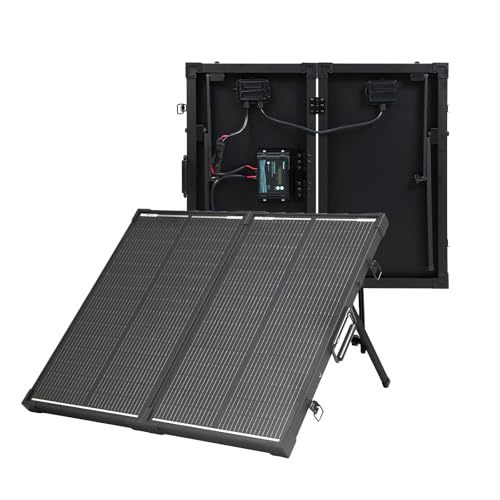
- 25% N-Type cell efficiency
- Includes 20A PWM controller and cables
- Tempered glass and aluminum frame
Best For: Portable 12V batteries and RV systems
Versatile 400W Charger
Foldable 400W Solar Panel for Power Stations

- 400W output with up to 23.4% efficiency
- MC4, DC, XT60, Anderson, and USB outputs
- ETFE surface with adjustable kickstands
Best For: Flexible outdoor power-station charging
Best Lightweight 200W Pick – Renogy 200W Portable Solar Panel
If you want rigid solar panels for portable setups without committing to a heavy, permanently mounted panel, the Renogy 200W model offers a practical middle ground. Its N-Type cells, folding design, kickstands, and built-in USB outputs suit camping, RV travel, and emergency charging.
Best For: Campers, RV owners, and backup-power users who want a relatively lightweight 200W panel with direct USB charging.
Pros:
- 25% efficiency from 16BB N-Type cells.
- Folds to 23.72 × 22.99 × 1.97 inches and weighs 13.9 pounds.
- Includes USB-C PD 45W and dual USB-A ports for charging devices.
- Four kickstands offer 40°, 50°, and 60° positioning options.
Cons:
- MC4 output is provided; a 4-in-1 adapter is sold separately.
- At 200W, it is less powerful than the 350W option in this roundup.
This is a versatile portable choice when storage space and device charging matter as much as panel output. Its 2-year material and workmanship warranty adds useful coverage for regular travel and backup use.
Best High-Output Option – BLUETTI 350W Portable Solar Panel
For portable setups that prioritize maximum rated output, the BLUETTI PV350 stands out with 350W of power and 23.4% conversion efficiency. Its MC4 connector and foldable format make it suitable for compatible solar generators, although its larger, heavier build is worth planning for.
Best For: Users with compatible BLUETTI or other solar generators who want the highest rated output among these portable panels.
Pros:
- 350W maximum power output.
- Converts sunlight at up to 23.4% efficiency.
- ETFE coating helps resist scratches and water splashes.
- Compatible with multiple BLUETTI power stations, including the AC70, AC180, AC240, and AC200L.
Cons:
- Weighs 30.6 pounds, making it the heaviest option here.
- Its folded dimensions are a substantial 35.6 × 24.1 × 2.5 inches.
- Compatibility should be confirmed with the intended power station before purchase.
The PV350 is a strong fit when faster solar input is more important than easy carrying. Its foldable design keeps it transportable, but the 30.6-pound weight makes it better for vehicle-based camping than backpack-style use.
Best Bifacial Design – GEYOTO 200W Bifacial Solar Panel
The GEYOTO S200 brings bifacial capability to rigid solar panels for portable setups, using its front side for direct sunlight and its rear side for reflected light in suitable conditions. A reflective carrying case, steel kickstand, and 10-foot cable make it particularly adaptable for campsite or RV layouts.
Best For: Outdoor users who can position a portable panel over reflective ground and want flexible cable reach for a compatible power station.
Pros:
- 26% N-Type cell conversion efficiency rating.
- Bifacial design can collect suitable reflected light from the rear.
- Includes a 10-foot MC4-to-XT60 cable and reflective carrying case.
- Y-shaped carbon-steel kickstand supports triangular ground setup.
Cons:
- Rear-side gains depend on placement, angle, shading, and ground reflectivity.
- The junction box is not waterproof and needs protection from direct water exposure.
- XT60 output compatibility should be checked with the intended power station.
This panel is more specialized than a standard folding model, but its bifacial construction and long cable can be useful when the panel and power station need separate placement. Treat the 26% figure as a cell conversion rating rather than a guaranteed everyday output.
Best Permanent-Style Panel – Renogy 100W N-Type Solar Panel
Although it is not a folding suitcase panel, this Renogy 100W model is a compelling option for rigid solar panels for portable setups that use an RV, boat, trailer, or other semi-permanent mounting location. Its aluminum frame, tempered glass, IP67 protection, and load testing favor durability over quick packability.
Best For: RV, marine, trailer, and off-grid installations where a compact 100W rigid panel will remain mounted rather than carried frequently.
Pros:
- 25% efficiency with 16BB N-Type cells.
- IP67 protection and corrosion-resistant aluminum framing.
- Tested for 2400Pa wind loads and 5400Pa snow loads.
- Includes a 10-year material and workmanship commitment plus a 25-year performance guarantee at 80% output.
Cons:
- At 100W, it provides less rated output than the portable 200W and 350W options.
- Its rigid 34.1 × 22.8 × 1.2-inch frame is not designed for folding storage.
- It does not list built-in USB charging ports.
This is the practical choice for a portable power system that lives on a vehicle or structure instead of moving between locations. Choose it when long-term weather resistance and mounting stability matter more than rapid setup.
Rugged Folding Pick – BougeRV 200W N-Type Fiberglass Panel
For shoppers comparing rigid solar panels for portable setups, the BougeRV 200W emphasizes durability without giving up portability. Its fiberglass-reinforced construction, N-Type cells, foldable design, and IP65 protection make it practical for camping, RV travel, and backup power.
Best For: Campers and RV users who want a rugged, foldable 200W panel with flexible placement.
Pros:
- N-Type cells provide up to 25% conversion efficiency.
- Fiberglass reinforcement helps resist cracking and abrasion.
- Includes XT60 and DC7909 connectors plus an 8.2-foot extension cable.
- Folds with built-in handles and carries an IP65 water- and dust-resistance rating.
Cons:
- At 13.8 pounds, it may still be substantial for backpacking.
- IP65 protection is below the IP67 rating offered by some alternatives.
The BougeRV is a balanced choice when portability and physical toughness matter more than maximum wattage. Its included cable length also makes it easier to place the panel in sunlight while keeping a power station nearby in shade.
Best for Everyday Use – Renogy 300W Portable Solar Panel
The Renogy 300W is a strong option for rigid solar panels for portable setups when higher output is the priority. It combines 25% N-Type efficiency with a foldable suitcase format, kickstands, IP67 waterproofing, and a stated 3-year output and workmanship warranty.
Best For: RV owners, campers, and emergency-preparedness buyers seeking the highest output in this group.
Pros:
- Delivers 300 watts with claimed 25% conversion efficiency.
- Folds to 23.2 x 29.3 x 3.2 inches and weighs 18.7 pounds.
- Rust-resistant kickstands support setup in about one minute.
- IP67 waterproofing, ETFE coating, and parallel wiring support demanding outdoor use.
Cons:
- Its 18.7-pound weight is heavier than the BougeRV option.
- The larger 300W format may be more than small power stations require.
Choose the Renogy when charging capacity and weather resistance outweigh minimum carry weight. Its suitcase design remains transportable, while the kickstands make positioning simpler than propping a panel against improvised supports.
Most Versatile Kit – ZOUPW 200W Foldable Solar Panel
For rigid solar panels for portable setups that need broad compatibility, the ZOUPW 200W stands out with a 5-in-1 charging cable and built-in USB ports. Its ETFE-coated surface, IP67 rating, four kickstands, and briefcase-style folding design suit camping, RV use, and off-grid charging.
Best For: Users with multiple power stations or small devices who want flexible connections and direct USB charging.
Pros:
- 23.5% efficiency from A+ grade monocrystalline cells.
- 5-in-1 cable supports XT60, Anderson, DC7909, DC8020, and DC5521 connections.
- Built-in USB-A QC3.0 and USB-C PD 60W ports can charge devices directly.
- Four adjustable kickstands, ETFE coating, and IP67 waterproofing support outdoor use.
Cons:
- At about 19 pounds, it is relatively heavy for a 200W panel.
- The junction box is water-resistant but not submersible.
- Its listed warranty is 12 months, shorter than the Renogy warranty.
The ZOUPW is especially practical for mixed-device charging because it can connect to many power stations and charge select electronics without one. Its heavier briefcase design is a trade-off for the kickstands, connection range, and integrated USB functionality.
High-Capacity Foldable Blanket – Renogy 400W Solar Panel
For shoppers comparing rigid solar panels for portable setups, this Renogy model takes a different approach with a high-output, foldable solar-blanket design. Its 400W rating and 36V output suit larger portable power stations, while the compact folded form helps simplify transport and storage.
Best For: Camping, RV travel, and off-grid charging with larger portable power stations such as the Phoenix1000.
Pros:
- 400W output can help shorten charging times for compatible large-capacity generators.
- SunPower cells provide up to 23.7% efficiency.
- Foldable design weighs 26.5 pounds and stores compactly.
- ETFE covering adds impact resistance for outdoor use.
Cons:
- Its blanket-style fabric construction is not a rigid-panel format.
- The 36V output may require compatibility checking before purchase.
- At 26.5 pounds, it is less convenient than smaller portable panels.
This is a strong option when charging capacity matters more than rigid construction. Confirm that your power station accepts the panel’s 36V, MC4-connected output before buying.
Rigid Suitcase Kit – Renogy 100W Solar Panel
Among rigid solar panels for portable setups, this 100W Renogy kit stands out for its suitcase format, tempered-glass construction, and included charge controller. It is designed for straightforward 12V battery and power-station charging rather than maximum wattage.
Best For: Campers, RV users, and off-grid setups needing a compact 12V charging kit with built-in connection hardware.
Pros:
- N-Type cells offer up to 25% efficiency and up to 500Wh per day under stated sunlight conditions.
- Includes a pre-installed 20A PWM controller, alligator clips, and four-stage charging.
- Low-iron tempered glass and aluminum framing provide a more rigid, weather-resistant build.
- Adjustable aluminum kickstand supports flexible positioning.
Cons:
- The 100W capacity is better suited to smaller systems than high-demand power stations.
- It weighs 17.42 pounds, which may be substantial for short hikes.
- MC4 output is included, but the 4-in-1 adapter is sold separately.
This is the closest fit here for buyers specifically seeking a rigid portable panel. Its plug-and-play accessories reduce setup work, but verify your battery or power station’s requirements and adapter needs first.
Versatile 400W Charger – Foldable 400W Solar Panel for Power Stations
For portable setups that prioritize high output and broad connectivity, this 400W foldable solar panel combines monocrystalline cells with adjustable kickstands and multiple cable options. It is a practical alternative to rigid solar panels for portable setups when packability and direct device charging are important.
Best For: Outdoor camping, RV use, and emergency backup with compatible portable power stations.
Pros:
- 400W maximum output with stated conversion efficiency up to 23.4%.
- MC4 connectors support compatibility with most portable power stations.
- Includes DC, XT60, and Anderson cable options plus QC3.0 USB outputs.
- ETFE-laminated surface is designed to resist dust, heat, and weather exposure.
Cons:
- Its foldable construction is not a rigid-panel design.
- Power-station compatibility still needs to be checked before use.
- The supplied notes do not specify the panel’s weight or folded dimensions.
This model is appealing when you want 400W capacity without giving up multiple connection options. Its adjustable kickstands should make positioning easier, but confirm the input limits and connector requirements of your power station.
How We Picked These Rigid Solar Panels for Portable Setups
We focused on panels designed to work with portable power stations, 12V battery systems, RVs, and camping equipment. The selection covers common output levels from 100W to 400W, including monocrystalline, N-type, bifacial, foldable, and portable-kit designs. We also considered stated conversion efficiency, connector options, construction, weather protection, included accessories, and how practical each panel is to transport and position.
Efficiency and rated wattage are useful starting points, but they are not guarantees of identical field performance. Shade, temperature, panel angle, cable losses, and the power station’s solar-input limits can significantly affect charging speed.
Quick Comparison
| Output range | Best suited to | Main advantage | Trade-off |
|---|---|---|---|
| 100W | Small power stations, phones, lights, and compact batteries | Lightest and easiest to position | Slower charging for large-capacity stations |
| 200W | General camping, weekend travel, and medium power stations | Strong balance of size and charging speed | May require more setup space |
| 300W–400W | Large power stations, RVs, and higher daily energy use | More usable energy during good sunlight | Heavier, larger, and more demanding of compatible inputs |
Key Buying Factors for Rigid Solar Panels for Portable Setups
Wattage and Daily Energy Needs
Choose wattage based on the battery capacity and devices you need to run. A 100W panel is suitable for small electronics and trickle charging, while 200W is a versatile middle ground. Larger 300W and 400W models make more sense when you regularly recharge high-capacity power stations or need faster daytime recovery.
Efficiency, Panel Type, and Conditions
Higher efficiency can provide more power from a smaller surface area, which matters when campsite space is limited. N-type and bifacial designs may improve performance in suitable conditions, but reflected light and installation angle affect bifacial gains. No panel produces its rated output continuously, especially in cloud, shade, heat, or poor positioning.
Compatibility and Connections
Check the panel’s operating voltage, connector type, cable length, and maximum solar-input specifications before buying. Common connections include DC, XT60, Anderson, and USB outputs, but adapters do not solve a voltage or amperage mismatch. Confirm that the panel can safely operate within the power station’s solar-input range.
Portability and Durability
Rigid or semi-rigid construction can improve longevity, while folding designs reduce storage volume. Compare packed dimensions and weight—not just the advertised wattage. For frequent travel, manageable setup and secure positioning may be more valuable than maximum output. Water resistance, reinforced corners, and durable frames are also important for outdoor use.
Who Should Buy Which Rigid Solar Panels for Portable Setups?
Choose a 100W model for lightweight emergency kits, day trips, and small power stations. A 200W panel is the safest all-around choice for campers and travelers who want useful charging without excessive bulk. Select 300W or 400W when you have a large compatible power station, ample setup area, and a clear need for faster charging. A bifacial panel may suit bright, reflective ground such as light gravel or snow, while a kit with a charge controller is more appropriate for users connecting directly to a 12V battery rather than only to a power station.