Indoor carbon dioxide levels can rise quickly in bedrooms, offices, classrooms, and other occupied spaces. A dependable monitor helps you spot poor ventilation before rooms feel stuffy or uncomfortable.
We selected 10 high-accuracy carbon dioxide monitors with features such as NDIR sensing, audible alerts, historical readings, portable designs, and temperature and humidity tracking.
Best 10 High-Accuracy Carbon Dioxide Monitors Picks for 2026
Best Overall
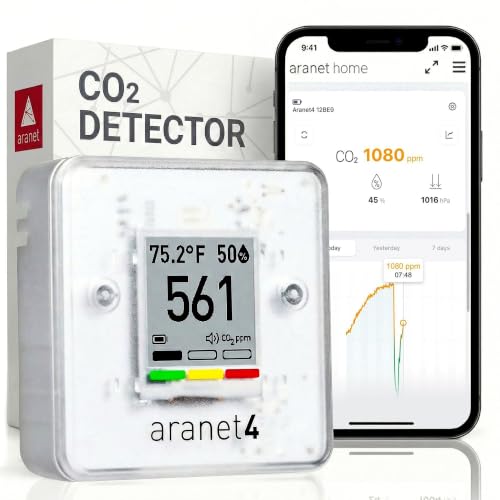
- NDIR sensor for precise CO2 measurements
- Up to four years of battery life
- App stores up to 90 days of history
Best For: Cable-free home and office monitoring
Best for Live Trends
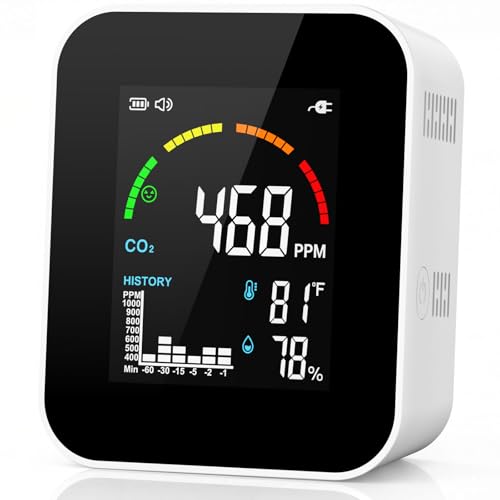
- 24-hour CO2 history bar chart
- Automatic or manual calibration
- Continuous USB-powered monitoring
Best For: Stationary rooms needing visible CO2 trends
Best Multi-Sensor Option
YNAK 16-in-1 Air Quality Monitor
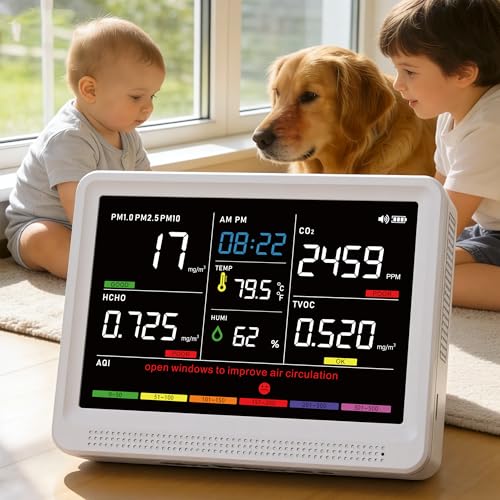
- Tracks CO2 and multiple pollutants
- Large 5.5-inch HD display
- USB-C charging with AC adapter
Best For: Broad indoor air-quality assessments
Best Portable Pick

- Compact NDIR CO2 monitor
- About 72 hours of battery life
- Customizable audible alarm
Best For: Travel and portable room-to-room monitoring
Reliable Sensirion Sensing

- Swiss Sensirion PASens CO2 sensor
- Customizable CO2 alerts
- Temperature, humidity, clock, and alarm
Best For: Multi-function monitoring in homes, RVs, and grow spaces
Fast Plug-In Accuracy
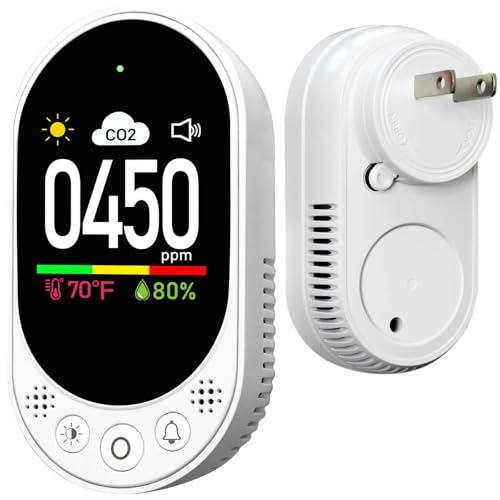
- ±5% CO2 accuracy from 400–5000 ppm
- Readings refresh every 2 seconds
- Manual calibration and threshold alerts
Best For: Bedrooms, offices, RVs, and enclosed rooms
Portable Accuracy Pick
Gain Express Handheld CO2 Meter

- NDIR sensor with 0–9,999 ppm range
- Measures temperature and humidity too
- Battery powered; 9V adapter optional
Best For: Portable IAQ surveys and shared indoor spaces
Long-Battery Pick
INKBIRD IAM-O2 Indoor Air Monitor

- Swedish CO2 sensor reads up to 9,999 ppm
- Runs 3–6 months per charge
- Tabletop or wall-mount placement
Best For: Low-maintenance home and room monitoring
Alarm-Focused Pick

- NDIR sensor measures up to 9,999 ppm
- Audible and visual high-CO2 alarms
- Large backlit display with three readings
Best For: Alert-driven monitoring in offices and grow rooms
Best Overall – Aranet4 Wireless CO2 Monitor
For shoppers seeking high-accuracy carbon dioxide monitors, the Aranet4 stands out with an NDIR sensor, a prominent display, and useful long-term portability. It tracks CO2, temperature, relative humidity, and atmospheric pressure in real time, while its color coding and optional buzzer make ventilation decisions straightforward.
Best For: Homes and offices needing cable-free, long-term CO2 monitoring.
Pros:
- NDIR technology is designed for precise, reliable CO2 measurements.
- E-ink display and two included AA batteries support up to four years of battery life.
- App provides graphs and up to 90 days of historical data.
- Measures temperature, humidity, and atmospheric pressure in addition to CO2.
Cons:
- Uses AA batteries rather than USB charging.
- Smartphone app is needed to review historical data in detail.
The Aranet4 is a strong pick when accuracy, low maintenance, and wireless convenience matter more than a large, multifunction display.
Best for Live Trends – YOWEXA NDIR CO2 Monitor
The YOWEXA CO2 monitor is one of the more practical high-accuracy carbon dioxide monitors for users who want both live readings and a quick view of daily trends. Its NDIR sensor supports automatic or manual calibration, while the 24-hour bar chart helps reveal recurring ventilation patterns.
Best For: Bedrooms, offices, nurseries, and other spaces where continuous USB-powered monitoring is useful.
Pros:
- NDIR sensor offers anti-interference features and automatic or manual calibration.
- 24-hour CO2 history bar chart makes fluctuations easy to spot.
- Color display has three adjustable backlight levels.
- Emoticons and a one-touch-mute alarm make readings accessible for families.
Cons:
- Continuous monitoring requires USB power.
- Battery mode is intended for emergencies and lasts up to 24 hours.
- Historical data is lost when the device restarts.
This model is best suited to a stationary setup where USB power is available and visual trend tracking is more valuable than a companion app.
Best Multi-Sensor Option – YNAK 16-in-1 Air Quality Monitor
If you want high-accuracy carbon dioxide monitors that also survey broader indoor conditions, the YNAK combines CO2 monitoring with readings for particulates, formaldehyde, TVOC, temperature, humidity, and AQI. Its 5.5-inch HD screen presents the information clearly, with multiple alert functions for changing air conditions.
Best For: Users who want a broad indoor air-quality overview in homes, offices, vehicles, or campsites.
Pros:
- Monitors CO2, PM2.5, PM1.0, PM10, HCHO, TVOC, temperature, humidity, and AQI.
- Large 5.5-inch HD display has three brightness levels.
- Seven AQI alert functions and a mute button provide flexible notifications.
- USB-C charging and included AC adapter support portable use.
Cons:
- Battery runtime is up to 10 hours.
- Its many readings may be more than shoppers seeking only CO2 data need.
- Sensors should be protected from perfumes and strong odors to help maintain accuracy.
The YNAK is a versatile choice for comparing several indoor air indicators at once, particularly when a large display and portability are priorities.
Best Portable Pick – INKBIRDPLUS Mini CO2 Detector
The INKBIRDPLUS PTH-10C is a compact option among high-accuracy carbon dioxide monitors, using an NDIR sensor in a travel-friendly body. Its lanyard, full-color display, customizable alarm threshold, and 72-hour battery life make it convenient for checking CO2 in different rooms or while traveling.
Best For: Travelers and users who want a small, rechargeable CO2 monitor for short-term checks.
Pros:
- NDIR sensor is designed for precision, stability, and strong anti-interference.
- Built-in 1,000mAh battery lasts about 72 hours and charges in roughly three hours.
- Three-color indicators make CO2 levels easy to interpret.
- Customizable audible alert can activate when readings exceed the selected threshold.
Cons:
- Monitors CO2 rather than a broader range of air-quality parameters.
- Automatically enters ECO mode after five minutes without operation.
This is a practical choice when portability and rechargeable operation matter more than historical data or multiple environmental measurements.
Reliable Sensirion Sensing – Newentor CO2 Monitor
For shoppers comparing high-accuracy carbon dioxide monitors, the Newentor C1 stands out for its Swiss Sensirion PASens CO2 sensor and broad indoor-use design. It combines CO2 readings with temperature, humidity, a clock, calendar, and programmable alarms in a compact corded unit.
Best For: Homes, RVs, grow tents, classrooms, cafes, and other indoor spaces where CO2, temperature, and humidity tracking are useful.
Pros:
- Uses a Swiss Sensirion PASens CO2 sensor for reliable measurements across a wide range.
- Allows customized CO2 concentration alert levels.
- Monitors temperature and humidity alongside CO2.
- Includes clock, calendar, and alarm-clock functions.
Cons:
- Uses corded electric power rather than a portable rechargeable design.
- The supplied information does not specify a stated CO2 accuracy percentage.
The C1 is a practical multifunction monitor for users who want a large-display CO2 tester with environmental readings and customizable alerts. Its main limitation is that the notes describe sensor technology but do not provide a numerical accuracy specification.
Fast Plug-In Accuracy – LSENLTY CO2 Detector
The LSENLTY L6088 is a convenient choice among high-accuracy carbon dioxide monitors when you want fast setup and clearly stated measurement specifications. Its plug-in wall design provides CO2, temperature, and humidity readings, with updates every two seconds and adjustable threshold reminders.
Best For: Bedrooms, offices, RVs, basements, hotel rooms, and other enclosed areas needing an always-connected monitor.
Pros:
- Lists CO2 accuracy of ±5% across a 400–5000 ppm range.
- Refreshes readings every two seconds.
- Measures CO2, temperature, and humidity in a compact 3-in-1 unit.
- Offers adjustable thresholds and a manual calibration process.
Cons:
- Plug-in operation limits placement flexibility.
- Detects carbon dioxide only and is not a smoke, carbon monoxide, or combustible-gas alarm.
- Manual calibration requires a 200-second cycle.
With its stated accuracy, rapid refresh rate, and threshold reminder, the L6088 is well suited to users who want straightforward ventilation guidance. Remember that it is an air-monitoring device, not fire-safety equipment.
Comprehensive Air Tracking – 10-in-1 Portable CO2 Monitor
For buyers seeking high-accuracy carbon dioxide monitors with broader air-quality coverage, this portable Lwyinp MT13S measures CO2 alongside particulate matter, formaldehyde, TVOC, temperature, humidity, and AQI. Its color display and Bluetooth time calibration make multiple readings easier to review in different locations.
Best For: Users who want portable, multi-pollutant monitoring for homes, offices, cars, schools, hotels, and other indoor environments.
Pros:
- Measures CO2, HCHO, TVOC, AQI, PM2.5, PM1.0, PM10, temperature, and humidity.
- Uses a high-definition color screen with three-color air-quality visualization.
- Portable design supports use in rooms, vehicles, campsites, and public spaces.
- Features smart calibration and a dedicated intelligent CO2 sensing system.
Cons:
- The supplied notes do not provide a numerical CO2 accuracy specification.
- Bluetooth is used for automatic time calibration, adding an extra setup step for that function.
- The many measurements and button controls may take time to learn.
The MT13S is the most comprehensive option here for monitoring more than CO2 alone, especially if portability and visual alerts matter. Choose it for broad air-quality awareness rather than a simple dedicated CO2 display.
Portable Accuracy Pick – Gain Express Handheld CO2 Meter
For shoppers comparing high-accuracy carbon dioxide monitors, this Gain Express handheld meter combines a stable NDIR sensor with a broad 0–9,999 ppm range. It also tracks temperature, humidity, dew point, and wet-bulb readings, making it useful for practical indoor-air-quality checks.
Best For: Offices, classrooms, hotels, and portable IAQ surveys where flexible environmental readings are useful.
Pros:
- Specified CO2 accuracy of ±50 ppm or ±5% from 0–2,000 ppm.
- Measures CO2, temperature, humidity, dew point, and wet bulb.
- Portable handle design and manual CO2 and humidity calibration.
- Runs on the included battery or a 9V adapter.
Cons:
- The 9V adapter is not included.
- The unit provides an audible alarm but does not list a visual alarm in the supplied details.
Its NDIR sensor, calibration options, and detailed environmental measurements make it a versatile choice when portability matters. The included battery adds convenience, while adapter operation is available separately for longer sessions.
Long-Battery Pick – INKBIRD IAM-O2 Indoor Air Monitor
The INKBIRD IAM-O2 is a convenient option among high-accuracy carbon dioxide monitors for ongoing indoor tracking. Its Swedish CO2 sensor reads up to 9,999 ppm, while the backlit display shows CO2, temperature, and humidity in real time.
Best For: Homes and rooms where low-maintenance monitoring, clear status lights, and flexible placement are priorities.
Pros:
- Measures CO2 from 0–9,999 ppm with a stated high-precision sensor.
- Temperature accuracy is listed up to ±0.2°C and humidity accuracy up to ±1.8%RH.
- Estimated battery life is 3–6 months on one charge.
- Can sit on a table or hang on a wall, with sound and color indicators.
Cons:
- The supplied notes do not specify a numerical CO2 accuracy tolerance.
- It is designed for indoor use rather than broad field-survey features.
This model stands out for convenience: long battery life, a backlit LCD, and quick green-yellow-red air-quality cues. Choose it when simple room monitoring is more important than extensive secondary measurements.
Alarm-Focused Pick – TEKCOPLUS COTK-57 CO2 Meter
For buyers seeking high-accuracy carbon dioxide monitors with clear alerts, the TEKCOPLUS COTK-57 offers a 0–9,999 ppm range, NDIR sensing, and an adjustable alarm threshold. Its large backlit display presents CO2, temperature, and humidity readings together.
Best For: Home offices, grow rooms, classrooms, and other spaces where audible warnings and at-a-glance readings are helpful.
Pros:
- Specified CO2 accuracy of ±50 ppm or ±5% from 0–2,000 ppm.
- NDIR sensor with readings up to 9,999 ppm.
- Audible and visual alarms help flag elevated CO2.
- Large backlit LCD shows CO2, temperature, and humidity simultaneously.
Cons:
- The supplied details do not list the included battery type or battery life.
- The stated temperature upper rating in the details is 50°C, despite the measurement range listing extending to 60°C.
With explicit low-range accuracy figures and both audible and visual alerts, the COTK-57 is well suited to users who want immediate notification when CO2 rises. Its large display also keeps core readings easy to review.
How We Picked These High-Accuracy Carbon Dioxide Monitors
We focused on monitors that measure carbon dioxide directly rather than relying only on broad air-quality scores. Preference went to models that specify an NDIR sensor, since nondispersive infrared sensing is the established approach for measuring CO2 in indoor environments. We also considered display readability, measurement range, alarm functions, portability, historical data, power requirements, and the usefulness of temperature and humidity readings.
Because specifications and real-world performance can vary, treat stated accuracy as a manufacturer claim and follow the recommended calibration, warm-up, and placement instructions. A monitor is most useful when it provides consistent readings in a location that represents the room.
Quick Comparison
- Best for connected home monitoring: Choose a wireless model with app access or long-term trend tracking.
- Best for simple room checks: Look for a clear screen, straightforward ppm readings, and an adjustable alarm.
- Best for travel: Select a compact rechargeable monitor with a battery indicator and portable design.
- Best for wall or outlet placement: A plug-in unit keeps the monitor continuously powered in a fixed location.
- Best for broader comfort data: Consider a multi-function model that also measures temperature and relative humidity.
Key Buying Factors for High-Accuracy Carbon Dioxide Monitors
Sensor Type and Stated Accuracy
Look for an NDIR CO2 sensor and review the stated accuracy, operating range, resolution, and calibration method. A wide 0–9,999 ppm range can be useful, but it does not automatically mean greater precision. Automatic baseline correction may help during normal use, while manual calibration is valuable when you need more control.
Display, Alerts, and History
A large, high-contrast display is easier to read across a room. Audible or visual alarms can warn you when ventilation is needed, but adjustable thresholds are preferable to fixed alerts. Historical charts or app data help reveal patterns caused by occupancy, cooking, sleeping, or closed windows.
Power and Placement
Battery models are flexible and convenient for checking multiple rooms, while plug-in monitors suit permanent locations. Place the device at breathing height, away from windows, vents, doors, direct sunlight, and exhaled breath. Do not hide it behind furniture or place it directly beside a supply vent.
Who Should Buy Which High-Accuracy Carbon Dioxide Monitors?
Homeowners and renters who want a practical everyday reading should choose a clearly labeled monitor with NDIR sensing, an easy-to-read screen, and a configurable alarm. Office managers, teachers, and facilities teams may benefit more from historical charts and continuous power so they can identify recurring ventilation problems.
Frequent travelers should prioritize small size, battery operation, and a quick-to-read display. Buyers who want one device for general comfort monitoring can choose a multi-sensor model with temperature and humidity readings. Whichever model you select, use rising CO2 readings as a prompt to improve ventilation—not as a substitute for professional indoor-air-quality testing when health, safety, or building problems are involved.