Choosing the right outlet tester can make field checks faster, safer, and easier to document. The best kits combine clear fault indicators with practical voltage-testing tools for the jobs you handle most.
We compared 10 popular electrical test kits for electricians, maintenance technicians, inspectors, and serious DIY users, focusing on usability, coverage, portability, and useful features.
Best 10 Electrical Outlet Testers for Field Work Picks for 2026
Best Overall Kit

- Combines GFCI outlet and AC/DC voltage testing
- Battery-free voltage tester covers multiple ranges
- CAT III 350V and IP44-rated tester
Best For: Field technicians needing outlet and voltage testing together
Best Simple Circuit Analyzer

- Tests outlets, GFCIs, and extension cords
- Checks seven common wiring conditions
- Compact 110–125V AC design
Best For: Quick receptacle and GFCI checks
Best Full Test Kit
Klein Tools 69149P 3-Piece Kit
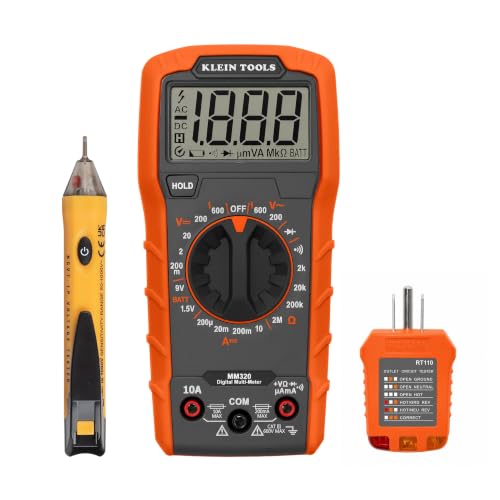
- Includes multimeter, NCVT, and outlet tester
- Measures up to 600V AC/DC and 10A DC
- Adds continuity and resistance testing
Best For: General electrical troubleshooting beyond outlets
Best Display Features

- Shows wiring status and voltage on a color LCD
- Tests seven common 120V wiring faults
- Adds GFCI testing and auto-hold
Best For: Clear 120V outlet inspections in tight spaces
Practical Starter Kit
Klein Tools 80025 Outlet Tester Kit

- GFCI and non-contact voltage testers included
- Identifies common outlet wiring problems
- Bright LEDs and audible voltage warning
Best For: Home inspections and routine outlet checks
Advanced Readout Pick
Klein Tools NCVT3P + RT250 Bundle

- LCD displays voltage, faults, and GFCI trip time
- Non-contact detection from 12 to 1000V AC
- CAT IV 1000V voltage tester with drop protection
Best For: Technicians needing detailed outlet-test information
Versatile Three-Piece Set
Klein Tools 80077 Voltage Test Kit

- Tests common AC and DC voltage levels
- Includes GFCI and non-contact testers
- LEDs indicate voltage type and level
Best For: Field work involving outlets and basic AC/DC checks
Versatile Field Testing
Multimeter and GFCI Outlet Tester

- Tests standard and GFCI receptacles
- Measures voltage, current, resistance, and continuity
- Backlit display and drop-resistant GFCI tester
Best For: Technicians needing outlet testing and multimeter functions
Full Electrical Coverage

- Includes GFCI tester with trip-time measurement
- Adds 400A AC/DC clamp-meter capability
- Includes non-contact and contact voltage testers
Best For: Field work requiring multiple electrical test methods
Portable Safety Checks

- Tests GFCI faults with an LCD readout
- Detects 12–1000V AC non-contact voltage
- Includes flashlight and breaker finder
Best For: Receptacle troubleshooting and circuit identification
Best Overall Kit – Klein Tools ET45VP Test Kit
For electrical outlet testers for field work, the Klein Tools ET45VP is a practical two-tool kit that combines receptacle testing with AC/DC voltage checks. The RT210 identifies common wiring problems in standard and GFCI outlets, while the battery-free ET45 tests multiple voltage ranges.
Best For: Field technicians who want outlet and voltage testing in one compact kit.
Pros:
- Tests standard and GFCI receptacles for common wiring faults.
- Measures AC from 24V to 240V and DC from 32V to 330V across four levels.
- Battery-free voltage tester is powered by the applied voltage.
- CAT III 350V, Class 2, double-insulated, and IP44-rated design.
Cons:
- It is a two-tool kit rather than a single all-in-one meter.
- The receptacle tester is intended for the included outlet-testing functions, not broad electrical measurements.
This is the most versatile choice here for routine field troubleshooting when you need both outlet diagnostics and basic voltage verification without relying on batteries.
Best Simple Circuit Analyzer – Gardner Bender GFI-3501
The Gardner Bender GFI-3501 keeps electrical outlet testers for field work straightforward: plug it into a standard receptacle or extension cord and read the LED sequence. It checks GFCI operation and indicates seven common wiring conditions on 110–125V AC circuits.
Best For: Electricians, inspectors, and maintenance workers who need a compact outlet-only tester.
Pros:
- Tests standard outlets, GFCI outlets, and extension cords.
- Indicates seven conditions, including open ground, open neutral, open hot, and reversed conductors.
- GFCI test trips between 6 and 9 mA.
- Compact design measures approximately 2 by 1 by 3.5 inches.
Cons:
- Limited to 110–125V AC receptacle testing.
- LED codes require interpreting the succession of yellow and red lights.
- Does not provide the broader voltage, current, or resistance measurements of a multimeter.
Choose this model when speed and simplicity matter more than measurement range. It is a focused tool for checking household-style receptacles and GFCI protection.
Best Full Test Kit – Klein Tools 69149P 3-Piece Kit
For field work that extends beyond receptacles, the Klein Tools 69149P adds a manual-ranging multimeter and non-contact voltage tester to its outlet tester. It can measure up to 600V AC/DC, 10A DC, and 2MΩ, while the included RT110 checks wiring configurations and common outlet faults.
Best For: Technicians who want outlet testing alongside general electrical measurements.
Pros:
- Includes a multimeter, non-contact voltage tester, and receptacle tester.
- Multimeter measures up to 600V AC/DC, 10A DC, and 2MΩ resistance.
- NCVT1P detects 50–1000V AC with an LED and audible tone.
- Continuity testing includes visual and audible indicators.
Cons:
- The kit is battery powered, so batteries must be available for use.
- The multimeter is manual-ranging rather than automatically ranging.
- It is larger and more involved than a dedicated plug-in outlet tester.
This kit makes sense when electrical outlet testers for field work are only part of the job. Its three tools cover receptacle faults, contactless voltage detection, continuity, and broader circuit measurements.
Best Display Features – KAIWEETS KT301T LCD Tester
The KAIWEETS KT301T adds a color LCD and real-time voltage display to the usual plug-in outlet checks. Designed for North American 3-wire 120V outlets, it identifies seven common wiring faults, tests GFCI operation with a button, and can hold results for hard-to-reach receptacles.
Best For: Inspectors and maintenance users who value clear visual feedback at 120V outlets.
Pros:
- Color LCD displays wiring status and real-time voltage.
- Detects seven common wiring conditions, including open conductors and reversed connections.
- One-click GFCI test and auto-hold function support practical inspections.
- Includes two AAA batteries and a three-year warranty.
Cons:
- Designed for North American 120V AC outlets rather than broad voltage testing.
- Battery powered and dependent on the included AAA cells.
- GFCI testing can trip a circuit and requires properly wired conditions for accurate results.
The LCD and auto-hold features make this a convenient choice for documenting or reading outlet results in cramped spaces. It is best treated as a specialized 120V receptacle diagnostic tool, not a replacement for a multimeter.
Practical Starter Kit – Klein Tools 80025 Outlet Tester Kit
For basic electrical outlet testers for field work, the Klein Tools 80025 combines a GFCI receptacle tester with a non-contact voltage pen. It is designed to identify common wiring problems in standard and GFCI outlets while also checking for voltage in cables, breakers, fixtures, and switches.
Best For: Home inspectors, maintenance work, and users who want two essential testers in one compact kit.
Pros:
- Includes both a GFCI outlet tester and non-contact voltage tester pen.
- Checks common wiring problems and confirms GFCI operation.
- Uses bright LED indicators, with a warning tone for voltage detection.
- Digital power button provides convenient control.
Cons:
- The outlet tester is specified for up to 125V AC.
- It provides basic tester functions rather than a detailed digital readout.
The 80025 is a sensible choice when convenience matters more than advanced measurement features. Its two-piece setup covers outlet and nearby voltage checks without requiring separate purchases.
Advanced Readout Pick – Klein Tools NCVT3P + RT250 Bundle
Among electrical outlet testers for field work, this Klein Tools bundle stands out for its combination of broad non-contact voltage detection and a receptacle tester with a backlit LCD. The RT250 displays voltage, wiring faults, and GFCI trip time for 120V outlets.
Best For: Electricians and field technicians who want clearer outlet-test results plus a CAT IV-rated voltage tester.
Pros:
- NCVT3P detects low voltage from 12 to 1000V AC with visual and audible indicators.
- RT250 provides a large backlit LCD for voltage, wiring faults, and GFCI trip time.
- Both testers include auto functions, including auto power-off or auto-hold.
- Both tools offer 6.6-foot drop protection; the NCVT3P is CAT IV 1000V rated.
Cons:
- The RT250 is specified for use on 120V outlets.
- This bundle is more specialized than a basic outlet tester.
The NCVT3P and RT250 pairing is a strong fit when field work calls for more information than indicator lights alone provide. Its LCD readout and GFCI trip-time display make the receptacle tester especially useful for documenting or troubleshooting outlet conditions.
Versatile Three-Piece Set – Klein Tools 80077 Voltage Test Kit
The Klein Tools 80077 expands the typical electrical outlet testers for field work setup with an electronic AC/DC tester, GFCI tester, and non-contact test pen. It covers several common AC and DC voltage levels while also checking standard and GFCI receptacles.
Best For: Field users who need outlet testing alongside basic AC/DC voltage checks in one three-piece kit.
Pros:
- Tests AC voltage from 12 to 240V at four levels.
- Tests DC voltage from 1.5V to greater than 17 to 24V at four levels.
- Includes a GFCI tester that detects common wiring problems and confirms GFCI operation.
- Non-contact pen detects voltage in cords, breakers, fixtures, switches, and wires.
Cons:
- It uses LED lights rather than a numeric display.
- The kit includes multiple tools, which may be more than needed for simple outlet checks.
The 80077 is the most versatile option here for users who work with both receptacles and basic AC/DC circuits. Its three-tool format offers broader testing coverage while keeping GFCI and non-contact voltage functions available.
Versatile Field Testing – Multimeter and GFCI Outlet Tester
For electrical outlet testers for field work, this Klein Tools combination gives you both receptacle testing and basic multimeter functions in one practical setup. The RT210 checks standard and GFCI outlets for common wiring problems, while the MM325 measures AC/DC voltage, DC current up to 10A, resistance, continuity, batteries, and diodes.
Best For: Field technicians who need outlet testing plus general-purpose electrical measurements.
Pros:
- Tests standard and GFCI receptacles and confirms GFCI operation.
- Multimeter measures up to 600V AC/DC, 10A DC current, and 2 MOhms resistance.
- Backlit display, lead-alert illumination, and low-battery indicator support field use.
- GFCI tester is built to withstand a 6.6-foot drop.
Cons:
- Its operating range is limited to 32°F through 140°F.
- The included tester is battery powered, so replacement batteries may be needed during extended work.
This is the strongest option here when you want one purchase to cover receptacle checks and several common multimeter tasks, rather than carrying an outlet tester alone.
Full Electrical Coverage – Clamp Meter and Tester Bundle
Klein Tools Electrical Tester Bundle with Clamp Meter, GFCI Outlet Tester, and Voltage Testers
Check Price On AmazonThis bundle is a broad choice for electrical outlet testers for field work when receptacle inspection is only part of the job. It combines a GFCI tester with a 400A AC/DC clamp meter, a dual-range non-contact voltage tester, and a voltage tester for commonly used AC and DC levels.
Best For: Field professionals who want outlet testing, current measurement, and multiple voltage-checking tools together.
Pros:
- Includes a GFCI tester that detects common 120V wiring faults and measures trip time.
- Auto-ranging clamp meter measures AC current and voltage, with AC/DC current capacity up to 400A.
- Non-contact tester detects 12–1000V AC.
- Voltage tester covers up to 240V AC and 24V DC at commonly used levels.
Cons:
- The larger kit may be more equipment than needed for simple receptacle checks.
- The supplied notes do not identify a drop rating for the included testers.
Choose this kit if your field workflow regularly moves from outlet diagnostics to current measurement and non-contact voltage checks; it offers the broadest measurement coverage of the three options.
Portable Safety Checks – Voltage Detector and GFCI Kit
Klein Tools Electrical Test Kit with Voltage Detector Flashlight and GFCI Outlet Tester
Check Price On AmazonFor electrical outlet testers for field work with an emphasis on quick safety checks, this kit pairs a GFCI receptacle tester with non-contact voltage detection and a circuit-identification tool. The included flashlight can illuminate the work area independently of voltage detection.
Best For: Electricians and maintenance workers who need receptacle testing, voltage detection, and breaker identification.
Pros:
- GFCI tester checks open neutral, open ground, and other common wiring faults.
- Clear LCD readout helps display GFCI test results.
- Non-contact voltage tester detects 12–1000V AC with visual and audible indicators.
- Breaker finder helps locate the correct circuit breaker using a transmitter and receiver.
Cons:
- This kit does not include a multimeter or clamp meter for current and resistance measurements.
- The supplied notes list it as corded electric rather than battery powered.
This kit is a focused choice for troubleshooting receptacles and identifying energized circuits, especially where a built-in work light and breaker finder are useful additions.
How We Picked the Best Electrical Outlet Testers for Field Work
We evaluated these kits by looking at the types of checks they support, how clearly they communicate results, and how useful they are outside a workshop. Priority went to products that test standard North American outlets and GFCI receptacles while adding practical tools such as non-contact voltage detection, multimeter functions, clamp measurement, or built-in lighting.
We also considered portability and kit value. A compact two-piece tester may be ideal for quick service calls, while a broader kit can reduce the number of separate tools you need to carry. These testers are diagnostic tools, not substitutes for safe lockout procedures, circuit identification, or a qualified electrician.
Quick Comparison
| Best For | Look For |
|---|---|
| Fast outlet screening | Simple receptacle tester with clear fault indicators |
| GFCI troubleshooting | Built-in GFCI test button and circuit analysis |
| Live-voltage checks | Non-contact voltage detector or two-pole voltage tester |
| Broader electrical work | Multimeter or clamp meter with suitable measurement ranges |
| Low-light jobsites | Backlit display, integrated flashlight, or illuminated indicators |
Key Buying Factors for Electrical Outlet Testers for Field Work
Test Coverage
A basic receptacle tester can identify common wiring conditions such as open ground, reversed polarity, or missing hot and neutral connections. If you regularly service bathrooms, kitchens, garages, or outdoor circuits, choose a model that includes GFCI testing. For panel-adjacent diagnostics or equipment checks, add a voltage tester, multimeter, or clamp meter rather than relying on an outlet tester alone.
Readability and Operation
Look for indicators that are easy to interpret in bright light and cramped spaces. LCD screens can provide more detail than LED patterns, while simple light combinations are often faster during routine inspections. A clear GFCI test control, audible alerts, and a compact plug design can also improve field efficiency.
Safety and Durability
Check the stated measurement category, voltage range, and intended use before working on a circuit. Prefer rugged housings, protected leads, secure probe storage, and designs that tolerate frequent transport. Always follow the manufacturer’s instructions and verify that a tester operates correctly on a known live circuit before use.
Portability and Kit Value
Choose the smallest kit that covers your normal workload. A two-piece outlet-and-voltage combination is convenient for inspections, while a three-piece kit or clamp-meter bundle is more useful for maintenance teams handling varied electrical tasks.
Who Should Buy Which Electrical Outlet Testers for Field Work?
Home inspectors and DIY users: Choose a straightforward outlet tester with GFCI testing and an easy-to-read fault display.
Electricians and service technicians: Select a bundle that adds non-contact voltage detection or a reliable voltage tester for faster preliminary checks.
Maintenance professionals: A kit with a multimeter or clamp meter offers more flexibility for troubleshooting equipment and circuits beyond receptacles.
Occasional users: A compact, durable tester is usually better value than a large bundle with functions you will rarely use.