The best emergency radios do more than broadcast AM/FM stations. They can provide NOAA weather alerts, backup power, lighting, and critical information when storms or outages disrupt normal communication.
We compared 10 emergency radios across portable crank models, solar-powered designs, rechargeable units, and dedicated alert receivers to help you choose the right fit for your emergency kit, vehicle, or home.
Best 10 Emergency Radios Picks for 2026
Best All-Around Crank Radio

- AM/FM radio with NOAA weather scan and alerts
- Multiple power sources with included AA batteries
- SOS flashlight and ultrasonic dog whistle
Best For: Household emergency kits and outdoor preparedness
Best Multimedia Emergency Radio

- Four-band reception including NOAA weather
- 1250mAh rechargeable battery and flashlight
- Bluetooth, TF-card, and USB MP3 playback
Best For: Portable entertainment and emergency preparedness
Best Rechargeable Crank Radio

- 2600mAh rechargeable battery
- Hand-crank and solar power options
- NOAA weather alerts with flashlight
Best For: Compact emergency kits needing rechargeable backup power
Best Pocket Emergency Radio

- AM/FM and NOAA weather-band reception
- Pocket-size design with LED display
- Battery powered by two AA batteries
Best For: Simple weather monitoring in an emergency bag or pocket
Best All-Around Emergency Radio
- 10,000 mAh power bank with USB charging
- Solar and hand-crank power options
- NOAA scan, flashlight, and rescue siren
Best For: Households and outdoor users wanting a feature-rich emergency radio
Best Home Weather Alert Radio

- NOAA alerts for 60+ hazards and emergencies
- S.A.M.E. programming for up to 25 counties
- Color-coded alerts and continuous backlighting
Best For: Home users wanting localized emergency weather notifications
Best Multi-Power Pick
Supersonic SC-1078ERN Guardian Emergency Radio

- AM/FM/NOAA reception with LED display
- 4000mAh battery, solar, crank, USB-C, and AAA power options
- Flashlight, lantern, SOS alarm, and headphone jack
Best For: Flexible home, camping, and outage preparedness
Best Home Alert System
Midland WR400 Deluxe Weather Radio
- Scans 10 NOAA channels automatically
- Programs up to 25 counties and 80 alert types
- Siren, voice, and visual LED warning options
Best For: Stationary home emergency monitoring
Best All-Around Crank Radio – Midland ER310
The Midland ER310 is a versatile choice for emergency radios, combining AM/FM reception with NOAA weather scan and alerts. Its multiple power sources, flashlight, and ultrasonic dog whistle make it useful for emergency kits, outdoor activities, and power outages.
Best For: Households and outdoor users who want a feature-rich emergency radio with several backup functions.
Pros:
- Supports multiple power sources, including solar power and six included AA batteries.
- Includes an SOS emergency flashlight and NOAA weather scan with alert.
- Features an ultrasonic dog whistle and USB connectivity for compatible devices.
Cons:
- Not water resistant.
- Its 9.61-inch length is less pocket-friendly than compact radios.
The ER310 stands out as a well-equipped emergency-radio option, especially for users who value preparedness features beyond basic broadcasting. Its larger body may be less convenient for pocket carry, but it offers a practical mix of lighting, alerts, and backup power.
Best Multimedia Emergency Radio – Bluetooth Shortwave Radio
This portable emergency radio combines four-band reception with Bluetooth, TF-card playback, USB MP3 support, and a large speaker. Its rechargeable battery, flashlight, digital display, clip, and wrist strap make it a flexible option for travel, camping, and emergency use.
Best For: Users who want an emergency radio that also functions as a portable music player and Bluetooth speaker.
Pros:
- Receives FM, AM, shortwave, and NOAA weather-band broadcasts.
- Includes a 1250mAh rechargeable battery with stated 10–12-hour playback time.
- Offers Bluetooth, TF-card playback, USB MP3 support, a 3.5mm headphone jack, and a flashlight.
- Back clip and wrist strap support portable use.
Cons:
- Relies on a rechargeable battery rather than replaceable AA batteries.
- The feature-rich controls may be more involved than those on a basic radio.
With broad band coverage and substantial entertainment features, this model is more versatile than a simple weather radio. It is a strong fit when portability and media playback matter alongside emergency alerts.
Best Rechargeable Crank Radio – Midland ER40
The Midland ER40 is a compact emergency radio with FM reception, NOAA weather alerts, and two backup charging options. Its 2600mAh rechargeable battery, hand-crank and solar power, flashlight, and USB connection make it a practical choice for keeping essential information available during outages.
Best For: Preparedness kits that need a rechargeable emergency radio with crank and solar backup power.
Pros:
- Includes a 2600mAh rechargeable battery.
- Supports hand-crank and solar power options.
- Provides NOAA weather alerts, an FM tuner, flashlight, and USB connectivity.
- Compact 6.8-inch design weighs about 14 ounces.
Cons:
- The supplied specifications list FM rather than AM/FM reception.
- It uses a rechargeable lithium-ion battery instead of replaceable standard batteries.
The ER40 is a focused emergency-radio choice for users who prioritize weather alerts and flexible recharging. Its compact size and large rechargeable battery make it easier to store and deploy than many bulkier preparedness devices.
Best Pocket Emergency Radio – T.TAOMI NOAA Weather Radio
The T.TAOMI portable radio is a straightforward option for emergency radios, covering AM, FM, and NOAA weather bands in a pocket-size body. It runs on two AA batteries and includes a headphone jack, making it suitable for monitoring alerts or listening to broadcasts at home and outdoors.
Best For: Users seeking a simple, lightweight weather radio for an emergency bag, commuting, or outdoor activities.
Pros:
- Receives AM, FM, and NOAA weather broadcasts.
- Compact 4.5-by-2.5-by-1-inch design fits easily in a pocket or emergency bag.
- Uses two AA batteries and includes a headphone jack.
- DSP chip is specified for stable reception and clear sound.
Cons:
- No crank, solar, or rechargeable power option is listed.
- Not water resistant.
- It has a simpler feature set and lacks an integrated flashlight.
This model prioritizes portability and uncomplicated operation over extra preparedness features. It is a sensible low-complexity pick for keeping AM/FM programming and NOAA weather coverage close at hand.
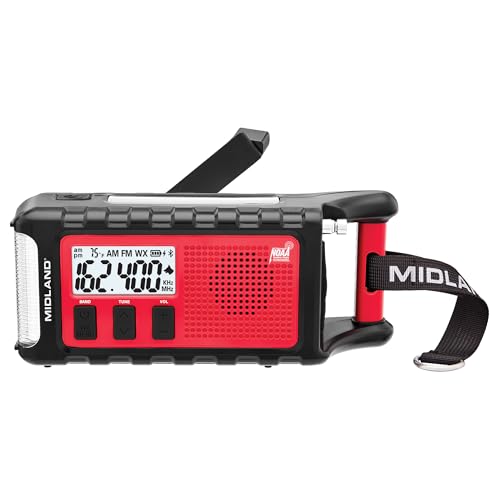
Best All-Around Emergency Radio – Midland ER310PRO
The Midland ER310PRO is a versatile choice among emergency radios, combining NOAA weather alerts with several ways to stay powered during outages or outdoor trips. Its large power bank, Bluetooth streaming, flashlight, and rescue features make it more capable than a basic broadcast radio.
Best For: Households and outdoor users who want an emergency radio that also serves as a power bank, Bluetooth speaker, and signaling device.
Pros:
- Offers solar and hand-crank charging for the internal lithium-ion battery.
- 10,000 mAh power bank can charge phones, tablets, and other portable devices.
- NOAA Weather Scan automatically searches seven weather channels and locks onto the strongest signal.
- Includes a 130-lumen CREE flashlight, Morse-code SOS beacon, and rescue dog siren.
Cons:
- Its larger feature set may be more than needed for shoppers seeking a simple radio.
- Solar charging requires direct sunlight.
The ER310PRO stands out when emergency preparedness includes communication, device charging, illumination, and signaling. Bluetooth streaming also gives it useful everyday value outside of emergencies.
Best Compact Budget Pick – Ywalxskk Wind-Up Radio
This compact wind-up radio is a straightforward option for emergency kits, cars, and camping bags. It supports AM, FM, and NOAA weather broadcasts, and its hand crank, solar panel, rechargeable battery, and USB-C input provide multiple charging methods.
Best For: Shoppers seeking a small, basic emergency radio with a light and backup charging options.
Pros:
- Charges through hand cranking, solar power, or a Type-C cable.
- Receives AM, FM, and NOAA weather bands.
- Built-in three-LED torch and SOS alarm add basic emergency utility.
- Compact design measures approximately 5.31 by 2.52 by 1.54 inches and has IPX3 splash resistance.
Cons:
- Solar charging is slow and depends on sunlight.
- IPX3 protection covers light spray and splashes, not submersion.
- Its mono 2W speaker is relatively basic.
The Ywalxskk focuses on portability and essential functions rather than advanced alert programming or a large power bank. It is a practical supplemental radio for a survival kit or travel bag.
Best Home Weather Alert Radio – Midland WR120B
The Midland WR120B is designed primarily for reliable in-home weather notifications rather than portable power or entertainment. Its NOAA Weather Scan, S.A.M.E. localized programming, and county-specific alert settings help focus warnings on the areas that matter to you.
Best For: Home users who want a dedicated NOAA emergency weather alert radio with localized notifications.
Pros:
- Can receive alerts for more than 60 weather hazards and emergencies.
- S.A.M.E. programming supports location-specific alerts for up to 25 counties.
- Color-coded indicators show alert type and severity.
- Alert override, continuous backlighting, and selectable alert tones support overnight monitoring.
Cons:
- Designed for corded home use, with six AAA batteries as backup power.
- Its feature set is focused on weather alerts rather than portable charging or outdoor signaling.
For a bedside table, kitchen, or home emergency station, the WR120B offers more targeted alert control than a general-purpose portable radio. Its localized programming is especially useful for avoiding irrelevant county warnings.
Best Multi-Power Pick – Supersonic SC-1078ERN Guardian Emergency Radio
For shoppers comparing emergency radios, the Supersonic SC-1078ERN stands out for its combination of AM/FM and NOAA weather reception, multiple charging options, and built-in lighting. Its rechargeable battery, solar panel, hand crank, USB Type-C input, and optional AAA battery support provide flexibility during outages or outdoor use.
Best For: Households and campers wanting one compact emergency radio with broad backup-power options, lighting, and an SOS alarm.
Pros:
- Supports AM, FM, and NOAA weather bands with a 360° antenna and LED display.
- Offers several power options, including a 4000mAh rechargeable battery, solar, hand crank, USB Type-C, and 3 AAA batteries.
- Includes both a flashlight and lantern, plus a loud SOS alarm with flashing light.
- A 3.5mm headphone jack allows private listening.
Cons:
- AAA batteries are not included.
- It is not the smallest option, weighing 1.2 pounds.
The Supersonic is a versatile choice when you want emergency communications, illumination, and several ways to stay powered in one portable unit.
Best Home Alert System – Midland WR400 Deluxe Weather Radio
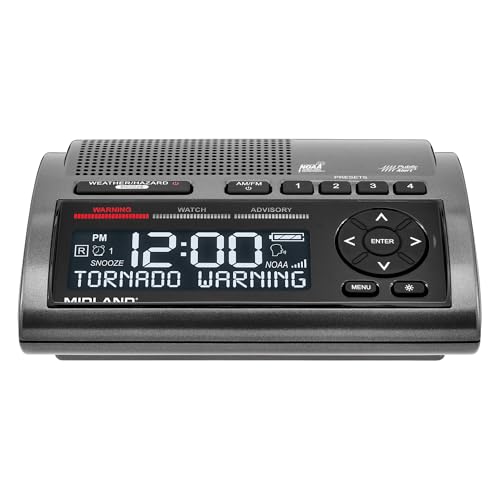
The Midland WR400 is designed primarily for home emergency awareness rather than off-grid portability. Among emergency radios, its NOAA scanning, county-based S.A.M.E. programming, and customizable alerts make it useful for receiving targeted warnings while also serving as an AM/FM clock radio.
Best For: Home users who want detailed, customizable local alerts and a radio that can remain plugged in with battery backup.
Pros:
- Scans 10 NOAA weather channels and locks onto the strongest signal.
- S.A.M.E. programming supports up to 25 counties and 80 emergency alerts.
- Offers an 85 dB siren, voice alerts, and visual LED flashing options.
- Includes a USB output, AM/FM radio, clock, alarm, and snooze function.
Cons:
- Four AA backup batteries are required but not included.
- It is corded-electric with battery backup, rather than solar- or crank-powered.
- The unit is not water resistant.
Choose the WR400 if precise local warning coverage matters more than rugged, self-generated power. Its alert customization is particularly useful for a stationary emergency setup.
Best Budget Backup Pick – Jauarta NOAA Emergency Weather Radio
The Jauarta NOAA emergency radio covers the core features many shoppers expect from emergency radios: AM/FM and NOAA broadcasts, hand-crank and solar charging, lighting, and an SOS alarm. Its 2000mAh power bank also provides a way to give a small tablet or phone an emergency charge.
Best For: Buyers seeking a straightforward emergency radio for power outages, basic outdoor use, and occasional device charging.
Pros:
- Receives AM/FM stations and NOAA emergency weather broadcasts.
- Uses a hand crank, solar panel, or AAA batteries for flexible power.
- Combines a flashlight with a four-LED reading light.
- Includes a 2000mAh power bank and high-decibel SOS alarm.
Cons:
- The supplied notes do not specify a display or headphone jack.
- The 2000mAh power bank is intended for emergency charging of small devices, so capacity is limited.
- AAA batteries are referenced as a power option, but are not stated to be included.
This Jauarta model is a practical essentials-first option: it provides weather information, light, backup charging, and signaling without relying solely on wall power.
How We Picked the Best Emergency Radios
We focused on features that matter when power, cell service, or reliable weather information may be limited. Each model was considered for NOAA alert support, AM/FM reception, power options, battery backup, portability, durability-focused design, and useful extras such as flashlights, USB charging, Bluetooth, or shortwave reception.
We also separated compact radios suited to grab-and-go kits from larger home units designed for continuous monitoring and programmable county alerts. Because emergency needs vary, no single radio is ideal for every buyer.
Quick Comparison
| Best For | Look For |
|---|---|
| Portable emergency kits | Hand crank, solar charging, rechargeable battery, and compact construction |
| Home weather monitoring | NOAA alerts, programmable locations, loud alarms, and AC or battery backup |
| Outdoor activities | Lightweight design, flashlight, weather-band reception, and simple controls |
| Extended outages | Multiple charging methods, replaceable batteries, and a larger battery capacity |
| Entertainment and communication | AM/FM, shortwave, Bluetooth, and USB device charging |
Key Buying Factors for Emergency Radios
Power Options
A hand crank is useful when batteries are depleted, while solar charging can help during longer outages. Rechargeable batteries are convenient, but a model that also accepts standard AA or AAA batteries gives you more flexibility. Check whether the radio can charge a phone; this feature is best treated as an emergency backup because small radios may provide limited output.
Weather Alerts and Reception
NOAA weather-band access is important for storm updates, but alert functionality varies. Some radios simply tune to weather broadcasts, while others remain in standby and sound an alarm for nearby warnings. Home-focused models may support county or location programming. AM/FM and shortwave bands can add useful local or international information, though reception depends on terrain, buildings, and antenna quality.
Usability and Size
Choose controls that are easy to operate in darkness or stressful conditions. A bright flashlight, readable display, strong speaker, and low-battery indicator can make a meaningful difference. Compact radios are easier to store and carry, while larger units may offer louder audio, better controls, and more dependable home monitoring.
Battery and Durability Considerations
Review the stated battery capacity and expected runtime, and keep spare disposable batteries where appropriate. A radio with several power methods is generally more useful than one relying on a single charging source. Store it in a dry, accessible location and test it periodically.
Who Should Buy Which Emergency Radios?
For a basic emergency or vehicle kit, choose a compact crank-and-solar radio with a flashlight and rechargeable battery. For a household that needs automatic warnings, a dedicated NOAA alert radio with location programming and battery backup is the better choice. Outdoor users should prioritize light weight, simple controls, and weather-band access. If you want one device for outages, travel, and everyday listening, consider a model combining AM/FM, NOAA, Bluetooth, multiple charging methods, and phone-charging support.