When power outages happen, having a reliable home battery backup can make all the difference. You want a solution that not only keeps your essential devices running but also provides peace of mind during unexpected blackouts. With various options available, each with unique features, it’s vital to know what to look for. Let’s explore the top contenders that can help you stay powered when it matters most.
Anker SOLIX C1000 Gen 2 Portable Power Station

If you’re looking for a reliable backup power solution during outages, the Anker SOLIX C1000 Gen 2 Portable Power Station is an excellent choice, especially for those who need to keep essential devices running. With a powerful output of 2,000W and a capacity of 1,024Wh, you can charge multiple devices simultaneously through its ten ports. Its ultra-fast recharging capabilities let you fully recharge in just 49 minutes, while solar options allow off-grid use. Compact and lightweight, it’s perfect for home or outdoor adventures. Plus, with durability features, it’s designed for daily use, ensuring you’re always prepared.
Best For: Those who require a reliable and efficient backup power solution for essential devices during outages or outdoor activities.
Pros:
- Ultra-fast recharging: Fully recharges in just 49 minutes with HyperFlash technology.
- High capacity and output: 1,024Wh capacity and 2,000W output allows for simultaneous charging of multiple devices.
- Durability: InfiniPower technology ensures at least 80% battery capacity after 4,000 cycles.
Cons:
- Initial cost: Higher upfront investment compared to basic power stations.
- Weight: While compact, it may still be heavier than some users prefer for portability.
- Dependence on solar conditions: Solar recharging efficiency can be affected by weather and sunlight availability.
CyberPower CP1500PFCLCD UPS Battery Backup and Surge Protector
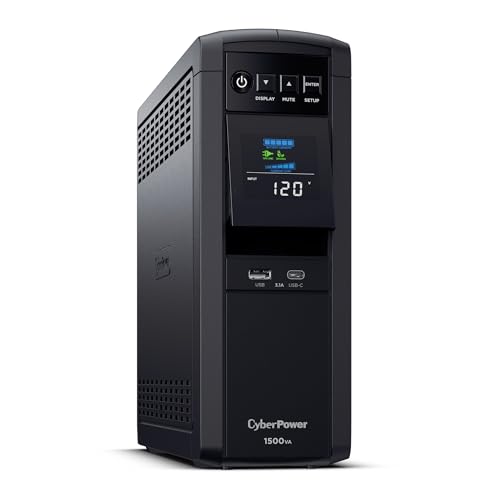
The CyberPower CP1500PFCLCD UPS Battery Backup and Surge Protector is an excellent choice for those who rely on sensitive electronics during power outages. With a capacity of 1500VA/1000W, it supports both active PFC and conventional power supplies. You’ll appreciate the 12 outlets, six with battery backup and surge protection, plus two USB ports for quick device charging. The multifunction color LCD panel keeps you informed about battery and power conditions, alerting you to potential issues. Enjoy the benefits of Automatic Voltage Regulation, which extends battery life, and rest easy with a 3-year warranty and $500,000 Connected Equipment Guarantee.
Best For: Individuals and businesses that rely on sensitive electronics and require reliable power backup during outages.
Pros:
- Offers 1500VA/1000W capacity, suitable for both active PFC and conventional power supplies.
- Includes 12 outlets and two USB ports, providing ample connectivity options for devices.
- Features a multifunction color LCD panel for real-time monitoring of battery and power conditions.
Cons:
- The unit may be bulky and take up significant space in a workstation setup.
- The price point may be higher compared to basic surge protectors without battery backup.
- Some users may find the LCD panel tilt feature limited in visibility based on installation location.
APC UPS Battery Backup and Surge Protector (BE600M1)
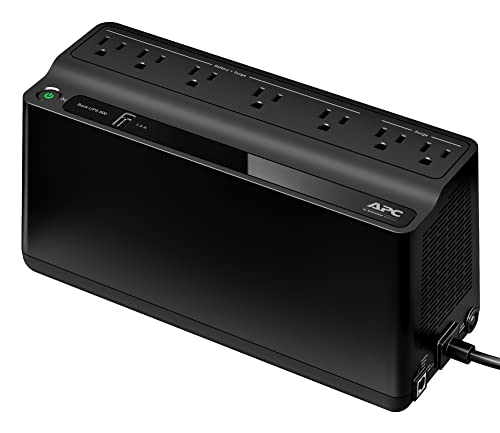
For those looking to protect essential electronics during power outages, the APC UPS Battery Backup and Surge Protector (BE600M1) stands out with its robust power capacity of 600VA and 330W. This unit features seven outlets, including five for battery backup and surge protection, plus a USB charger port for mobile devices. Weighing just 7.5 pounds and measuring 10.79 x 4.13 x 5.47 inches, it’s compact yet powerful. With a customer rating of 4.5 stars from over 36,000 reviews, it’s a top choice for reliability. Plus, its replaceable battery guarantees long-term usability. Protect your home today with this dependable backup solution.
Best For: Individuals and small businesses looking for reliable power backup and surge protection for their computers and essential electronics during outages.
Pros:
- Provides 600VA / 330W of power capacity, suitable for multiple devices.
- Features a USB charger port for convenient charging of mobile devices.
- Compact design and lightweight, making it easy to position in various locations.
Cons:
- Only two outlets are for surge protection only, limiting battery backup options.
- Requires a separate purchase for the replacement battery (APCRBC154).
- Limited to compatibility with specific operating systems for UPS management software.
Jackery Portable Power Station Explorer 300

Weighing just 7.1 pounds, the Jackery Portable Power Station Explorer 300 is an ideal choice for outdoor enthusiasts who need a reliable energy source during camping trips or unexpected power outages. With a 293Wh lithium-ion battery, it powers up to six devices simultaneously, from your MacBook to cameras. You can recharge it 80% in just two hours via a wall outlet or car outlet. Plus, it’s compatible with the Jackery SolarSaga 100 solar panel for off-grid adventures. The package includes an AC adapter, car charger cable, and user guide, making it easy to stay powered wherever you go.
Best For: Outdoor enthusiasts and travelers seeking a portable and reliable power source for their devices during camping trips or power outages.
Pros:
- Lightweight design (7.1 pounds) makes it easy to transport for outdoor use.
- Fast recharging options allow for 80% charge in just two hours via wall outlet or car outlet.
- Multiple device compatibility enables powering up to six devices simultaneously, including laptops and cameras.
Cons:
- Solar panel not included, requiring an additional purchase for solar charging.
- Limited power output (300W) may not support high-power devices or appliances.
- Price point may be higher compared to basic power banks or generators.
GOLDENMATE 1000VA/800W Lithium UPS Battery Backup and Surge Protector

Looking for a reliable power solution during outages? The GOLDENMATE 1000VA/800W Lithium UPS Battery Backup and Surge Protector is your answer. With a Lithium Iron Phosphate battery pack, it lasts over 10 years and offers more than 5000 charge cycles, cutting costs considerably compared to lead-acid batteries. You’ll enjoy eight NEMA outlets with surge protection, along with a user-friendly plug-and-play design. Its built-in Battery Management System guarantees safety, while the intelligent LCD panel keeps you informed. With advanced cooling and maintenance-free operation, this UPS assures dependable power when you need it most.
Best For: Those seeking a long-lasting and reliable battery backup solution for home or office use during power outages.
Pros:
- Long Lifespan: The Lithium Iron Phosphate battery lasts over 10 years with more than 5000 charge cycles.
- Cost-Effective: Total cost of ownership is over 40% lower than traditional lead-acid batteries, reducing frequent battery replacements.
- Advanced Features: Equipped with an intelligent LCD panel for real-time monitoring and a built-in Battery Management System for safety.
Cons:
- Initial Cost: Higher upfront cost compared to traditional lead-acid UPS systems.
- Limited Outlets: Only eight NEMA 5-15P outlets may not be sufficient for larger setups.
- Cooling Noise: Although the cooling system operates below 50 dB, it may still be noticeable during heavy usage.
Anker SOLIX C1000 Portable Power Station

The Anker SOLIX C1000 Portable Power Station stands out as an excellent choice for anyone seeking reliable energy during power outages or outdoor adventures. With a powerful 1800W output and a 1056Wh LiFePO4 battery, it’s perfect for home backup and camping. Its UltraFast recharging technology gets you 80% charged in just 43 minutes, while solar options can fully recharge in 1.8 hours. The device’s SurgePad technology powers 99% of appliances through 11 ports. Plus, it’s compact and 15% smaller than similar units, making it easy to transport. You can even customize charging via the Anker app.
Best For: Those in need of a reliable power source for home backup, outdoor camping, or during power outages.
Pros:
- UltraFast recharging technology allows for 80% charge in just 43 minutes, making it quick and convenient.
- Versatile power output with 2400W peak and 11 ports, capable of powering 99% of appliances.
- Compact design is 15% smaller than similar units, enhancing portability for adventures.
Cons:
- Higher initial cost compared to traditional generators or power sources.
- Limited operating temperature range (68–122°F) may restrict usage in extreme conditions.
- Dependency on solar conditions for optimal recharging may not suit all users.
DaranEner Portable Power Station (60,000mAh, 192Wh)

For anyone seeking a reliable power source during outages, the DaranEner Portable Power Station stands out with its impressive 60,000mAh capacity and 192Wh output. You can easily power devices like phones, tablets, and CPAP machines, thanks to its 300W output. This compact unit weighs just 5.73 lbs, making it easy to transport. With multiple charging options, including solar, you’ll stay connected off-grid. Its advanced LiFePO4 battery lasts over 3500 cycles, ensuring long-term reliability. Plus, the integrated LED flashlight adds extra convenience during emergencies. Just remember to recharge it every 1-2 months for peak performance.
Best For: Those in need of a portable power solution for low to medium power devices during outdoor activities, emergencies, or power outages.
Pros:
- High capacity: 60,000mAh and 192Wh output allows for powering multiple devices simultaneously.
- Durable battery: Advanced LiFePO4 technology offers over 3500 cycles, enhancing longevity compared to standard lithium-ion batteries.
- Compact design: Weighing only 5.73 lbs, it’s easy to transport and includes an integrated LED flashlight for emergencies.
Cons:
- Limited output: Not suitable for high-power appliances like rice cookers or hair dryers that exceed 300W.
- Solar panels not included: Requires additional purchase for solar charging capability.
- Maintenance needed: Requires recharging every 1-2 months to maintain optimal performance.
OUPES Mega 1 Portable Power Station 2000W

Ideal for anyone needing reliable power during outages, the OUPES Mega 1 Portable Power Station packs a powerful 2000W output with a surge capability of 4500W. Weighing just 27.8 pounds, its compact design makes it easy to transport. You’ll appreciate its fast charging capabilities, reaching 80% in just 36 minutes via AC. With a robust battery capacity of 1024Wh, you can expand it up to 5120Wh for even more power. The intelligent BMS guarantees your devices are safe, while smart app control lets you manage energy consumption remotely. Plus, it comes with a 5-year warranty for peace of mind.
Best For: Those seeking a reliable and powerful portable power solution for outdoor activities, emergency situations, or off-grid living.
Pros:
- Fast charging capabilities, reaching 80% in just 36 minutes via AC.
- Expandable capacity allows for up to 5120Wh, accommodating larger power needs.
- Smart app control for remote monitoring and management of energy consumption.
Cons:
- Weighs 27.8 pounds, which may be cumbersome for some users to transport.
- High initial cost compared to smaller, less powerful power stations.
- Limited solar input of 800W may require multiple panels for optimal performance.
GRECELL Portable Power Station 300W
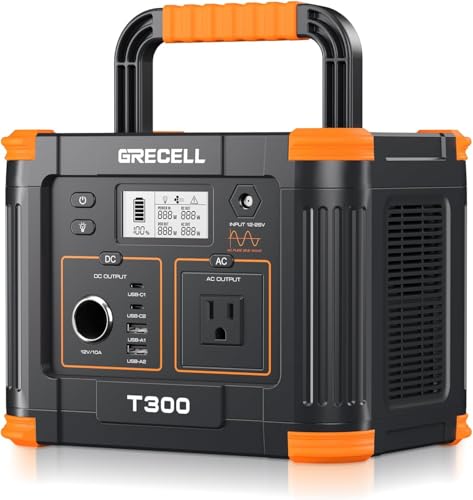
When you’re on the go, the GRECELL Portable Power Station 300W stands out as an essential companion for camping trips, car outings, or family adventures. With a 230.88Wh capacity and 330W output, it powers laptops, phones, and mini-refrigerators effortlessly. Its lightweight, compact design makes it easy to carry. Plus, the upgraded Battery Management System guarantees safety with overload and short-circuit protection. You can charge up to six devices simultaneously, including fast-charging options for your gadgets. Recharge it via AC, solar, or car outlet, and enjoy the included 40W solar panel for maximum efficiency. Stay powered wherever you are!
Best For: Outdoor enthusiasts and families looking for a reliable, portable power source during camping trips, road trips, or outdoor gatherings.
Pros:
- Lightweight and compact design makes it easy to transport and store.
- Multiple charging options including AC, solar, and car outlets provide flexibility for recharging.
- Fast charging capabilities with USB-C PD 60W and USB-A quick charge ports for efficient device charging.
Cons:
- Limited output capacity of 330W may not support high-power devices simultaneously.
- Solar panel included (40W) may take longer to recharge compared to traditional AC outlets.
- Not suitable for devices requiring more than 330W, limiting its use for heavy-duty applications.
VTOMAN FlashSpeed 300 Portable Power Station

The VTOMAN FlashSpeed 300 Portable Power Station stands out as a reliable solution for anyone seeking dependable power during outages or outdoor adventures. It delivers a solid 300W output and boasts a 230Wh capacity, thanks to its long-lasting LiFePO4 battery that supports over 3000 life cycles. You can recharge it quickly through various methods, including a 100W PD input that gets you to 80% in just two hours. With multiple outlets, it can power seven devices simultaneously, making it perfect for camping trips or emergencies. Plus, its lightweight design guarantees easy transport wherever you go.
Best For: Those who need a portable and reliable power source for outdoor activities, emergency situations, or off-grid living.
Pros:
- High capacity: 230Wh capacity and 300W output power suitable for multiple devices.
- Fast recharge: Can be charged to 80% in just 2 hours with the 100W PD input.
- Lightweight design: Only 7.4 lbs, making it easy to transport for outdoor adventures.
Cons:
- Limited output power: May not support high-demand devices that exceed 300W.
- Charging time for full capacity: Takes up to 2.5 hours via wall socket for a full recharge.
- Solar panel not included: Requires a separate purchase for solar charging capabilities.
Factors to Consider When Choosing a Home Battery Backup for Outages
When you’re choosing a home battery backup for outages, several key factors come into play. You need to think about your power capacity requirements, how quickly the battery recharges, and its portability. Additionally, consider device compatibility and the battery’s lifespan to guarantee it meets your needs.
Power Capacity Requirements
How can you guarantee your home battery backup meets your power needs during an outage? Start by calculating the total wattage of the appliances you want to power. Make certain the backup system can handle peak loads, typically measured in watts (W) or volt-amperes (VA). Next, evaluate the battery capacity in watt-hours (Wh); for example, a 1,024Wh system can run a 200W appliance for about 5 hours. Check the surge capacity, as many devices, like refrigerators, need extra power at startup. Don’t forget to take into account the number of outlets available to connect multiple devices without overloading. Finally, assess the efficiency of the battery management system to guarantee ideal performance and prolonged battery life.
Recharge Time Efficiency
Choosing a home battery backup for outages means paying close attention to recharge time efficiency, as faster recharging allows you to restore power quickly. Some systems can reach 80% charge in under an hour, making them ideal for emergencies. Look for advanced technologies like HyperFlash and MPPT controllers, which can fully recharge batteries in as little as 36 minutes using AC power. If you’re considering solar options, certain systems can recharge in about 1.8 hours with enough sunlight. Also, keep in mind that lithium-based batteries typically recharge faster than traditional lead-acid options. Finally, monitoring capabilities through apps can help you optimize recharge times, ensuring your backup system is always ready when you need it most.
Portability and Design
Fast recharge times are important, but portability and design also play a significant role in your home battery backup choice. You’ll want to take into account the weight and dimensions of the unit, as some models are designed to be 14% smaller and 11% lighter than similar options, enhancing transportability. Features like carrying handles or wheels can make moving your battery backup much easier, especially during power outages or outdoor use. A compact design is essential if you have limited storage space, allowing you to tuck it away discreetly. Additionally, look for durable construction that can withstand outdoor conditions. Some models even include integrated LED lights, adding functionality for outdoor activities and ensuring versatility beyond just backup power.
Device Compatibility Range
When selecting a home battery backup, it’s crucial to guarantee it meets the wattage needs of your essential devices. Consider the power consumption of items like computers, routers, and medical equipment, which can vary greatly. Look for models with multiple outlets—AC, USB, and DC—to charge several devices simultaneously; some can power up to six devices at once. Pay attention to the output capacity; for example, a unit with 1,024Wh can support devices needing a combined 2000W for a limited time. Choose units with pure sine wave output to protect sensitive electronics from damage. Finally, check the surge capacity, as some models can handle brief spikes in power demand, providing extra assurance during outages.
Battery Lifespan Considerations
While evaluating home battery backups, considering battery lifespan is essential for long-term reliability and cost-effectiveness. High-quality lithium batteries generally offer over 3,000 charge cycles, while traditional lead-acid batteries may only last 500-1,000 cycles. For durability, Lithium Iron Phosphate (LiFePO4) batteries can maintain at least 80% of their capacity after 4,000 cycles. Remember, environmental factors like extreme temperatures can affect a battery’s lifespan, so opt for stable conditions whenever possible. Regular maintenance, such as avoiding deep discharges and keeping the battery at a consistent charge level, can also enhance longevity. Choosing batteries designed for high cycle counts can considerably lower your total cost of ownership, as they require fewer replacements over time.
Safety Features Included
Safety features are essential when selecting a home battery backup system, as they protect both the equipment and your home. Look for systems with advanced features like overcharge protection, short-circuit protection, and thermal management to prevent overheating. A built-in Battery Management System (BMS) is vital; it monitors battery health, ensuring proper charging and discharging while extending the battery’s lifespan. Intelligent alarms or notifications are also beneficial, alerting you to abnormal conditions like overloads or battery issues, allowing for timely intervention. Additionally, a cooling mechanism, such as silent cooling fans, helps maintain safe operating temperatures during heavy usage. Integrated LED indicators or displays provide real-time information on battery status and alerts, ensuring you’re always informed about your system’s performance.
Monitoring and Control Options
Choosing a home battery backup system involves considering various monitoring and control options that can enhance your overall experience. Many modern systems come with smart app control, so you can manage power consumption remotely via Bluetooth or Wi-Fi. Real-time monitoring often includes multifunction LCD panels that show battery status, power output, and alerts for any issues, ensuring peak performance. Look for customizable settings that help you manage charging speeds and power usage, allowing you to avoid peak demand charges. Built-in Battery Management Systems (BMS) provide safety features like overcharge and overheating protection while offering real-time insights into battery health. Some units even include automatic transfer switch (UPS) functionality for seamless power backup during outages, minimizing disruption to critical devices.