A solar controller needs to match more than your panel wattage. For a LiFePO4 battery, charging settings, battery voltage, and input limits matter just as much—especially if you plan to expand your array.
These 10 options span compact PWM controllers, app-connected models, and higher-capacity MPPT units. Use the comparisons below to narrow the field by your system size, monitoring preferences, and budget.
Best 10 Solar Charge Controller for Lifepo4 Picks for 2026
Best Built-In Display
20A Bluetooth Solar Charge Controller

- 20A; auto-detects 12V/24V
- Built-in Bluetooth plus LCD
- LiFePO4 support and app voltage settings
Best For: Small systems needing on-device and phone monitoring
Best Compact MPPT
Victron SmartSolar MPPT 75V 15A

- 75V/15A MPPT for 12V/24V systems
- Bluetooth app with 30-day history
- Configurable battery presets
Best For: Compact arrays needing app-configurable charging
Best 12V PWM Option

- 30A PWM controller for 12V systems
- Manual lithium selection; LED status
- Bluetooth requires separate BT-1 module
Best For: Straightforward 12V RV and off-grid builds
Best Higher-Capacity MPPT
Victron SmartSolar MPPT 100V 30A

- 100V/30A MPPT for 12V/24V systems
- Bluetooth configuration and 30-day history
- Supports synchronized SmartSolar charging
Best For: Larger arrays needing configurable 30A MPPT charging
Best 20A PWM Pick
SUNAPEX 12V 20A PWM Controller

- 20A PWM for 12V batteries
- LCD, USB-C, and USB ports
- Supports LiFePO4, AGM, and Gel
Best For: 12V setups needing 20A PWM charging and on-unit monitoring
Best for App Monitoring
Victron SmartSolar MPPT 100/50

- 50A MPPT for 12V/24V systems
- Bluetooth data and 30-day history
- Synchronizes with other SmartSolar units
Best For: Configurable 12V or 24V systems needing app-based monitoring
Best Compact 10A Pick
SUNAPEX 12V 10A MPPT Controller
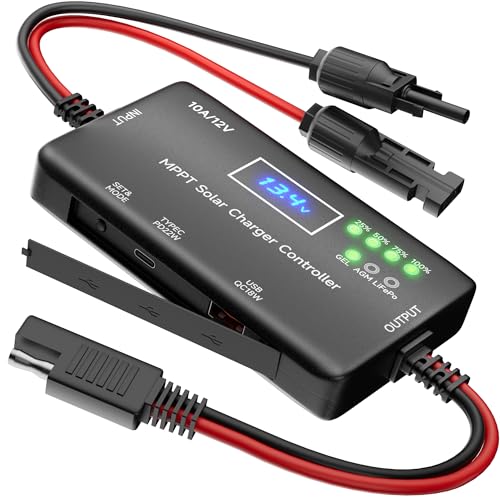
- Compact 10A controller for 12V systems
- LCD plus USB-C and USB ports
- Requires a panel without a built-in controller
Best For: Portable 12V setups with limited installation space
Bluetooth PWM Pick

- 30A PWM for 12V/24V systems
- Bluetooth app monitoring and LCD
- LiFePO4 support and dual USB
Best For: Bluetooth monitoring in a 12V/24V PWM setup
Wireless MPPT Pick

- 20A MPPT for 12V/24V batteries
- Wireless monitoring and custom USE mode
- 60V maximum PV input
Best For: MPPT charging with app-based parameter control
Custom-Setting PWM Pick

- LFP preset and custom charging mode
- 30-day generation data on LCD
- 30A PWM with dual USB ports
Best For: Adjustable PWM charging for RV or boating setups
Best Built-In Display – 20A Bluetooth Solar Charge Controller
If you want a solar charge controller for LiFePO4 with both on-device readings and phone monitoring, this 20A model offers an LCD and built-in Bluetooth. It auto-detects 12V or 24V systems when you connect the battery first, and its app allows custom charge-voltage settings.
Best For: Small RV, cabin, or shed systems where you want to check charging data without an extra Bluetooth dongle.
Pros:
- Built-in Bluetooth shows charging data and historical energy statistics in the LM Solar app.
- LCD displays PV voltage, battery voltage, charging current, and fault codes.
- Supports LiFePO4 and other listed battery types; includes a USB-A trickle-charge port.
Cons:
- Rated for 20A, so it is intended for smaller arrays.
- Requires battery-first connection for voltage auto-detection.
The combination of LCD and Bluetooth makes this a practical pick if you want two ways to inspect a modest solar setup. Confirm that its 20A rating fits your system before buying.
Best Compact MPPT – Victron SmartSolar MPPT 75V 15A
For a compact solar charge controller for LiFePO4, the Victron SmartSolar 75V/15A pairs MPPT tracking with configurable battery settings in the VictronConnect app. It supports 12V and 24V systems and provides real-time data plus a 30-day performance history.
Best For: Smaller 12V or 24V arrays whose owners prefer app-based configuration and monitoring.
Pros:
- MPPT tracking is designed to optimize output, including when panels are partially shaded.
- Bluetooth app offers battery presets, settings, alarms, and performance history.
- Multiple SmartSolar MPPT controllers can synchronize charging stages.
Cons:
- 15A output and 75V PV rating may limit larger system plans.
- Listed with only an LED or minimal display, so detailed readings rely on the app.
This is a strong fit when configurable charging matters more than a built-in screen. Check your panel voltage and charging-current requirements against its 75V/15A ratings.
Best 12V PWM Option – Renogy Wanderer Li 30A
The Renogy Wanderer Li is a 30A PWM solar charge controller for LiFePO4 users building a 12V system. Its lithium setting is selected manually, while LEDs provide a straightforward view of charging status.
Best For: 12V RV or off-grid setups that need a 30A PWM controller and do not require built-in Bluetooth.
Pros:
- Supports lithium, AGM, gel, and flooded battery types.
- 30A rating and LED charging-status indicators suit a straightforward 12V installation.
- Provides reverse-polarity, overcharge, overload, and short-circuit protections.
Cons:
- Limited to 12V systems, with a listed 25V PV-input limit.
- Bluetooth monitoring requires a separately sold BT-1 module.
- Uses PWM rather than MPPT charging.
Choose this for a simple 12V build where its input limits fit your panels. If phone monitoring is essential, account for the additional module.
Best Higher-Capacity MPPT – Victron SmartSolar MPPT 100V 30A
Victron Energy SmartSolar MPPT 100V 30 amp 12/24-Volt Solar Charge Controller (Bluetooth)
Check Price On AmazonIf your planned array calls for more capacity, this Victron SmartSolar is a 100V/30A solar charge controller for LiFePO4 setups that need configurable battery charging. It serves 12V or 24V systems and uses MPPT tracking to optimize solar output, including under partial shade.
Best For: 12V or 24V systems needing a 30A MPPT controller with Bluetooth-based setup and performance monitoring.
Pros:
- 100V PV and 30A ratings provide more headroom than the 75V/15A SmartSolar listed here.
- VictronConnect provides real-time data, 30-day history, battery presets, and settings.
- Multiple SmartSolar MPPT units can synchronize charging stages.
Cons:
- Larger and heavier than the 75V/15A model listed here.
- Its 100V PV and 30A output ratings still need to match your system design.
This is the capacity-focused Victron choice in this group. Its configurable settings are useful for a LiFePO4 installation, but verify your panel and battery specifications before wiring it in.
Best 20A PWM Pick – SUNAPEX 12V 20A PWM Controller
If you need a solar charge controller for LiFePO4 in a 12V setup, this SUNAPEX PWM model supports panels below 300W and lets you select a charging mode for LiFePO4, AGM, Gel, or lead-acid batteries.
Best For: 12V systems that need a 20A PWM controller with an on-unit display and device-charging ports.
Pros:
- LCD and LEDs show charging status; a button briefly displays current.
- SAE connectors simplify hookup, while USB-C and USB ports can power devices.
- Built-in safeguards cover overcharge, reverse current, short circuits, and overheating.
Cons:
- Not compatible with 24V or 36V batteries.
- PWM design does not offer the MPPT tracking found on other controllers here.
Choose it when 20A capacity and straightforward monitoring matter more than MPPT. Check polarity carefully during installation; the unit does not include a polarity converter.
Best for App Monitoring – Victron SmartSolar MPPT 100/50
The Victron SmartSolar MPPT 100/50 is a solar charge controller for LiFePO4 shoppers who want configurable charging in a 12V or 24V system. Its MPPT tracking and VictronConnect app make it a more configurable option than a basic on-unit controller; confirm the appropriate battery preset or settings for your battery.
Best For: 12V or 24V installations that need a 50A MPPT controller with Bluetooth setup and performance history.
Pros:
- MPPT tracking adjusts to changing conditions, including partial shade.
- VictronConnect provides real-time data, 30-day history, settings, firmware updates, and alarms.
- Multiple SmartSolar controllers can synchronize their charge stages.
Cons:
- No built-in display; monitoring is through the app.
- Battery-specific charging settings should be verified during setup.
This is the pick for buyers who will use its configuration and monitoring tools. Its 50A rating and 12V/24V compatibility also give it a different scope from the 12V-only SUNAPEX options.
Best Compact 10A Pick – SUNAPEX 12V 10A MPPT Controller
For a small 12V setup, this SUNAPEX solar charge controller for LiFePO4 offers a compact 10A MPPT option with selectable battery modes. It is intended for panels without a built-in controller and also supports AGM, Gel, and lead-acid batteries.
Best For: Portable or space-limited 12V systems using a panel without an integrated controller.
Pros:
- Compact design suits tight installation spaces.
- LCD and LEDs provide on-unit status, with USB-C and USB device outputs.
- SAE connectors and built-in protection support a straightforward installation.
Cons:
- Limited to 12V batteries and 10A charging.
- Not compatible with panels that already have built-in controllers.
It is a practical fit when a compact controller and local readout are priorities. Before connecting it, verify panel compatibility and polarity; no polarity converter is included.
Bluetooth PWM Pick – ECO-WORTHY 30A Controller
If you want a solar charge controller for LiFePO4 with phone monitoring, this ECO-WORTHY 30A PWM model supports 12V/24V systems and includes built-in Bluetooth. An LCD provides another way to check status and adjust settings.
Best For: Buyers who want Bluetooth monitoring in a 12V/24V PWM setup.
Pros:
- Built-in Bluetooth supports app monitoring within a stated open-field range of 98 feet.
- Supports lithium phosphate, lead-acid, and gel batteries.
- Includes an LCD, dual USB outputs, and short-circuit, reverse-polarity, and overload protection.
Cons:
- Uses PWM rather than MPPT charging.
- The load discharge rating is 10A, lower than the 30A controller rating.
This is a practical choice when Bluetooth and on-device controls matter more to you than MPPT. Connect the battery before the panel, and allow ventilation because the controller can heat up during use.
Wireless MPPT Pick – Bateria Power Sunrock 20Pro
For shoppers seeking an MPPT solar charge controller for LiFePO4, the 20A Sunrock 20Pro combines 12V/24V battery support with wireless app monitoring. Its app also offers a USE mode for custom charging parameters.
Best For: 12V/24V setups that need MPPT charging and app-based parameter control.
Pros:
- Supports LiFePO4 alongside AGM, gel, flooded, and other listed battery types.
- Wireless app provides monitoring and a customizable USE mode.
- Includes SAE connections and two 130mm SAE extension cables.
Cons:
- PV input must not exceed 60V.
- Designed for 12V/24V batteries, not higher-voltage battery banks.
The app controls make this the most flexible monitoring option of these three if you want MPPT rather than PWM. Check your panel voltage against its 60V PV limit and connect the battery before the panel.
Custom-Setting PWM Pick – ECO-WORTHY 30A Regulator
This ECO-WORTHY model is a solar charge controller for LiFePO4 buyers who prefer on-device setup: it pairs an LFP preset with a CUS mode for custom parameters. The 30A PWM controller auto-detects 12V/24V systems and shows readings on its LCD.
Best For: RV or boating setups needing LiFePO4 presets and adjustable PWM settings.
Pros:
- Offers LFP, flooded, sealed, and gel presets plus custom settings.
- Records 30 days of solar power generation data.
- Includes dual USB ports, an LCD, and a metal backplate for heat dissipation.
Cons:
- Uses PWM rather than MPPT charging.
- Monitoring is through the controller’s LCD; app connectivity is not listed.
Choose this one if local controls, charging presets, and generation history fit your setup. Its custom mode adds flexibility without requiring phone-based configuration.
How We Picked the Best Solar Charge Controller for Lifepo4
We compared the listed controllers by charging method, output-current rating, supported battery voltage, stated LiFePO4 compatibility, solar-input limits where specified, and monitoring options. The lineup covers small 12V systems, 12V/24V setups, and controllers with room for larger arrays. A listed battery-chemistry mode is a starting point, not proof that its default settings match every battery: check the controller specifications and your battery maker’s charging guidance before buying.
Quick Comparison
For a straightforward 12V setup, the Renogy Wanderer Li 30A and the 12V SUNAPEX models are worth comparing first. The ECO-WORTHY 30A PWM options and the 20A Bluetooth controller add choices for shoppers who want 12V/24V support or convenient monitoring, depending on the model.
For MPPT charging, compare the Victron SmartSolar 75V/15A and SUNAPEX 12V/10A for smaller systems. The 20A wireless MPPT model sits between those and the higher-current Victron SmartSolar 100V/30A and 100V/50A units. Confirm each model’s actual panel-voltage and charging limits rather than choosing by amperage alone.
Key Buying Factors for a Solar Charge Controller for Lifepo4
Battery Charging Settings
Look for a LiFePO4 preset or adjustable absorption and float settings that match your battery manufacturer’s requirements. Check whether equalization can be disabled; lead-acid equalization is generally unsuitable for LiFePO4. If your battery has a low-temperature charge cutoff, confirm how the battery management system and controller handle charging in the cold.
Panel Input and Charging Current
Match the controller to your battery’s nominal voltage and size the output-current rating for your array at that voltage. Also check the maximum solar open-circuit voltage, including the increase possible in cold weather. A controller rated for 100V input is not automatically a better fit than a 75V model if your panel configuration never approaches either limit.
MPPT, PWM, and Monitoring
MPPT is often the better choice when panel voltage is substantially above battery voltage or you need more flexibility in panel wiring. PWM can be a cost-conscious fit for a modest, appropriately matched array. Bluetooth and displays make it easier to check charging status, but verify what data and settings the specific app exposes.
Who Should Buy Which Solar Charge Controller for Lifepo4?
Choose a compact 10A or 15A MPPT controller for a small system after confirming its input and output ratings. Consider a 20A or 30A model for a mid-size RV or off-grid setup, sized to your panels and battery rather than the vehicle label. The Victron 100V/30A and 100V/50A models are candidates for larger or expanding arrays if their specifications fit your design. If low upfront cost matters most, compare the PWM options; if monitoring is a priority, narrow your shortlist to the Bluetooth-equipped models and check app compatibility before ordering.