A LiFePO4 battery can hold a fairly steady voltage while its charge level changes, so a voltage reading alone may not tell you how much energy remains. A properly configured shunt monitor tracks current flowing in and out to give you a more useful state-of-charge estimate.
These 10 options cover app-based smart shunts, monitors with dedicated screens, and simpler budget-friendly meters. The right choice depends on your system voltage, expected current, and how you want to check your battery.
Best 10 Battery Monitor for Lifepo4 Picks for 2026
Best for Custom Alerts
LiTime 500A Bluetooth Smart Shunt

- Bluetooth app shows live battery readings
- Adjustable capacity, temperature, voltage, and current alerts
- Tracks cycles and voltage history
Best For: App-based monitoring with customizable warnings
Best App-Free Display
LiTime 500A LCD Battery Monitor

- Backlit LCD works without a phone
- Low-voltage and low-capacity buzzer alerts
- Not waterproof or suited to marine use
Best For: Indoor RV and off-grid systems needing a physical display
Best for Victron Systems

- Detailed VictronConnect battery readings
- Shares data with compatible Victron devices
- 6.5–70V range and five-year warranty
Best For: Connected Victron marine and off-grid systems
Best for Remote LCD Placement
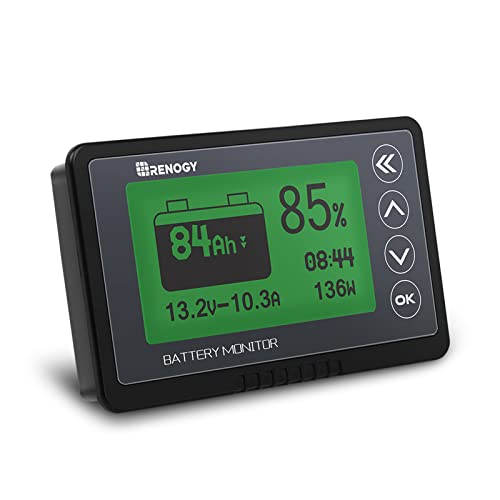
- Backlit LCD shows key battery readings
- 20-foot cable allows flexible display placement
- High- and low-capacity alarms
Best For: Physical readouts located away from the battery bank
Best for Easy Setup

- 300A shunt with Bluetooth app readout
- Tracks charge status and battery history
- VE.Smart, VRM, and DVCC integration
Best For: Dry-location Victron installations
Best Display Option for Smaller Systems

- Backlit display; no phone required
- Includes 100A shunt and 2-meter cable
- Supports 8–120V battery systems
Best For: Smaller systems needing an on-site display
Best for Damp Installations

- IP65 water- and dust-resistant design
- 300A shunt; specified 6.5–70V range
- Bluetooth app and Victron integrations
Best For: Moisture-prone Victron installations
Best for At-a-Glance Readings
LNEX 500A Color-Screen Battery Monitor

- 2.4-inch color display
- 16-foot shielded wire
- High- and low-voltage alarms
Best For: RV or boat setups needing a larger display
Best Compact Display
BINTA 500A Shunt Battery Monitor

- 8–120V battery compatibility
- 350A continuous, 500A peak
- Charge percentage and capacity readings
Best For: Compact RV, boat, or golf-cart monitoring
Best for Lower-Current Systems
DROK 100A Color-Screen Battery Meter

- 8–100V, 0.05–100A ranges
- 2.4-inch color LCD
- Configurable flashing backlight alarm
Best For: Lower-current RV, boat, or solar setups
Best for Custom Alerts – LiTime 500A Bluetooth Smart Shunt
If you want a battery monitor for LiFePO4 that puts readings on your phone, this LiTime smart shunt tracks voltage, current, power, and state of charge through its Bluetooth app. Its 8–120V range also accommodates several other battery chemistries.
Best For: RV or home-backup users who want app-based monitoring and adjustable alerts.
Pros:
- Adjustable alarms cover low capacity, temperature, voltage, and over-current.
- Historical data includes charge/discharge cycles and voltage highs and lows.
- 500A shunt supports 8–120V battery systems.
Cons:
- Readings are presented through a mobile app rather than a supplied LCD display.
- Comes with a one-year warranty.
Choose this model when customizable warnings and past-performance data matter more than having a dedicated screen at the battery bank.
Best App-Free Display – LiTime 500A LCD Battery Monitor
This battery monitor for LiFePO4 suits buyers who would rather check a backlit LCD than open an app. It displays voltage, current, power, capacity percentage, and estimated remaining charge or discharge time for 8–120V battery systems.
Best For: Indoor RV and off-grid setups needing an always-accessible physical display.
Pros:
- LCD provides key readings without a phone.
- Flashing display and buzzer warn when voltage or capacity falls below set values.
- Includes a 500A shunt, holder, and wiring for installation.
Cons:
- Not waterproof; the manufacturer says it is unsuitable for marine environments.
- Requires setup after the display is connected and powered on.
Its main advantage is straightforward, at-a-glance monitoring. Keep its non-waterproof design in mind when deciding where to mount it.
Best for Victron Systems – Victron SmartShunt 500A
For a battery monitor for LiFePO4 in a connected power system, the Victron SmartShunt offers detailed readings in the VictronConnect app. Its 500A shunt operates across a 6.5–70V supply range and can share battery data with other Victron equipment.
Best For: Victron-based marine, renewable-energy, or off-grid systems that can use connected battery data.
Pros:
- App shows state of charge, time remaining, current, amp-hours, and battery history.
- VE.Smart Networking shares sensor data with compatible Victron devices.
- Auxiliary connection supports a second battery, midpoint monitoring, or an optional temperature sensor.
- Includes a five-year warranty.
Cons:
- 70V maximum supply voltage is lower than the 120V range of several other monitors here.
- No separate display is listed among the included components.
The integration options make this a particularly strong fit when you already use Victron hardware; otherwise, consider whether you need those ecosystem features.
Best for Remote LCD Placement – Renogy 500A Battery Monitor
Renogy’s battery monitor for LiFePO4 pairs a 500A shunt with a backlit LCD and a 20-foot shielded cable, giving you flexibility to place the readout away from the battery. It supports 10–120V systems and several lithium and lead-acid battery types.
Best For: Installations where a physical battery display needs to sit some distance from the shunt.
Pros:
- Displays voltage, current, consumed power, and battery capacity.
- High- and low-capacity alarms provide visible and audible warnings.
- Includes a 20-foot shielded cable and a shunt holder.
Cons:
- Requires space and routing for a separate display and cable.
- Does not list Bluetooth or app monitoring.
This is a practical pick when you want an LCD within easy view but cannot mount it right beside the battery bank.
Best for Easy Setup – SmartShunt Bluetooth 300A
If you want a battery monitor for LiFePO4 in a Victron setup, this 300A SmartShunt puts charge status, current, voltage, and battery history in the VictronConnect app. It is a phone-based monitor rather than a model with a dedicated display.
Best For: Victron system owners who want Bluetooth battery data and device integration.
Pros:
- Shows state of charge, time remaining, amp-hours, and charge-cycle data in the app.
- Supports VE.Smart Networking and connection to a communication center for VRM and DVCC.
- Auxiliary connection can monitor a second battery or midpoint, or accept an optional temperature sensor.
Cons:
- Not water resistant, so placement matters in damp locations.
- Requires a smartphone for its stated in-app readout.
Choose this version when Victron integration is the priority and you can mount the shunt somewhere dry. For exposed installations, the IP65 version below is the more appropriate choice.
Best Display Option for Smaller Systems – AILI 100A Battery Monitor
For a battery monitor for LiFePO4 that you can read without a phone, the AILI pairs a backlit LCD with an included 100A shunt. It displays state of charge, voltage, current, and remaining capacity for systems within its current rating.
Best For: Smaller RV, boat, or off-grid battery systems that need a dedicated display.
Pros:
- Supports 8–120V monitoring across common 12V, 24V, 36V, and 48V systems.
- Includes the meter, 100A shunt, and 2-meter cable.
- Low standby draw and memory retention help preserve readings when power is off.
Cons:
- Its 100A shunt is not suited to systems that exceed 100A.
- No Bluetooth or app readout is listed.
This is the straightforward pick when an at-a-glance screen matters more than connected features. Check your system’s expected current before choosing the 100A model.
Best for Damp Installations – Victron SmartShunt IP65 300A
Victron Energy SmartShunt IP65 Battery Monitor (Bluetooth) - Victron Smart Shunt - 6.5V-70V, 300 amp
Check Price On AmazonIf your battery monitor for LiFePO4 will sit where dust or moisture is a concern, this IP65 SmartShunt adds a water- and dust-resistant enclosure to Victron’s Bluetooth monitoring. Its specified operating range is 6.5–70V, with a 300A shunt.
Best For: Victron-equipped systems that need a water- and dust-resistant shunt.
Pros:
- IP65 design is water and dust resistant.
- VictronConnect shows state of charge, time remaining, current, voltage, and battery history.
- Supports VE.Smart Networking and communication-center connections for VRM and DVCC.
Cons:
- Phone-based readout may not suit buyers who want a dedicated display.
- Its stated 70V maximum should be checked against higher-voltage systems.
Pick this over the standard 300A SmartShunt when environmental resistance matters. You still get the same app-led monitoring approach, so it makes the most sense for buyers comfortable checking battery data on a phone.
Best for At-a-Glance Readings – LNEX 500A Color-Screen Battery Monitor
If you want a battery monitor for LiFePO4 with a screen you can check quickly, the LNEX pairs a 2.4-inch color display with a 500A shunt. It supports 8–100V batteries and includes a 16-foot shielded wire for placing the display away from the battery.
Best For: RV or boat owners who want a large display and a longer monitor cable.
Pros:
- Color screen has an adjustable backlight.
- Programmable high- and low-voltage alarms draw attention to battery conditions.
- Automatically saves the latest testing data when the system shuts down.
Cons:
- The stated monitoring range tops out at 100V.
- The supplied notes do not specify a continuous-current rating for the 500A shunt.
The longer cable and readable display make this a practical choice when the battery is tucked away. Check your system voltage and current requirements before installation.
Best Compact Display – BINTA 500A Shunt Battery Monitor
The BINTA is a compact battery monitor for LiFePO4 systems that tracks state of charge, remaining capacity, voltage, and current. Its circular backlit display works with 8–120V batteries, while the included shunt is rated for 350A continuous and up to 500A peak.
Best For: Buyers who want a small display with state-of-charge readings for an RV, boat, or golf cart.
Pros:
- Shows charge percentage and remaining capacity alongside voltage and current.
- Detects current in both directions and saves the last recorded data at shutdown.
- Includes a 10-foot shielded cable and a 3.3-foot positive wire.
Cons:
- Its 500A rating is peak; continuous current is limited to 350A.
- The supplied notes do not describe a programmable low-capacity alarm.
Choose this model for its compact form and useful charge-status readings, but size the shunt against your system’s continuous current rather than its peak figure.
Best for Lower-Current Systems – DROK 100A Color-Screen Battery Meter
For a lower-current setup, this DROK battery monitor for LiFePO4 buying lists is worth considering if its 8–100V and 0.05–100A measurement ranges fit your system. Its 2.4-inch color screen displays electrical and capacity readings, and a mounting base is included.
Best For: RV, boat, or solar setups that need a 100A meter with a large color display.
Pros:
- Displays voltage, current, power, capacity, and time.
- Backlight can flash for low remaining capacity or low voltage when the alarm function is enabled.
- Includes a base for more stable mounting.
Cons:
- Its 100A current range is lower than the 500A-rated options here.
- The supplied notes do not explicitly confirm LiFePO4-specific settings or compatibility.
This is a measurement-focused option for systems within its stated ranges. If you need LiFePO4-specific capacity tracking, confirm the available battery settings before buying.
How We Picked the Best Battery Monitor for Lifepo4
We focused on practical differences buyers can check before ordering: supported voltage range, shunt current rating, Bluetooth or screen-based readout, installation layout, and whether the monitor can be configured for a LiFePO4 battery bank. Inclusion is not a claim that we independently tested accuracy or long-term reliability. Always confirm the current specifications and wiring instructions for the exact model you buy.
Quick Comparison: Which Type Fits Your Setup?
Bluetooth-first monitors, including the LiTime Bluetooth model and Victron SmartShunt options, suit buyers who prefer checking battery data on a phone rather than mounting a screen. Dedicated-display monitors, such as the LiTime LCD, Renogy, LNEX, AILI, BINTA, and DROK options, make sense when you want a readout visible without opening an app. Within either group, choose a current rating and voltage range that match your system—not just a familiar brand name.
The listed monitors span 100A, 300A, and 500A ratings. Higher capacity is useful for larger inverters or heavy combined loads; a smaller shunt may be sufficient for a modest setup if its rating covers the actual current. Check each listing for what is included, particularly the shunt, cables, and display or communication accessories.
Key Buying Factors for a Battery Monitor for Lifepo4
Shunt Rating and System Voltage
Size the shunt for the maximum continuous current your system may carry, including inverter demand and charging current. Verify how the manufacturer defines any peak rating. Then confirm the monitor supports your battery-bank voltage; the products here have different lower and upper voltage limits, so a monitor suitable for one 12V RV bank may not suit every higher-voltage installation.
State-Of-Charge Setup
A shunt estimates state of charge by counting current over time. For meaningful readings, enter the correct battery capacity and available LiFePO4 charging parameters, then synchronize the monitor as directed. Readings can drift if the settings are wrong or if current bypasses the shunt. A display that shows percentage is not, by itself, proof of an accurate estimate.
Display, App, and Installation
Choose a local display if several people need to see battery status at a glance. Choose Bluetooth if you want a cleaner installation and are comfortable using an app. Check screen-cable length, app compatibility, alarm options, and environmental protection where relevant. Shunts generally belong in the battery negative path so the monitor sees the loads and charging sources specified by its installation guide; plan around your existing busbars and wiring before buying.
Who Should Buy Which Battery Monitor for Lifepo4?
For an RV or off-grid setup where phone access is convenient, start with a compatible smart shunt and choose 300A or 500A based on your current needs. If you want a permanent bedside or control-panel readout, prioritize an LCD model with suitable cable length and a readable interface. For a small system, a properly rated 100A option can be economical; for high-draw inverter systems, look at 500A choices and verify the complete electrical design. Whichever you choose, compatibility and correct installation matter more than extra display features.