Solar panels can produce power on clear days, while a wind turbine may keep charging when the sun is down or the weather turns cloudy. The right combination depends on your site, battery bank, and how much of the system you already own.
These nine picks span complete kits and standalone hybrid charge controllers. Before choosing, check what is actually included: a controller alone will not power a cabin without compatible panels, a turbine, batteries, and possibly an inverter.
Best 9 Hybrid Wind and Solar Systems Picks for 2026
Most Complete Kit
880W Solar-Wind Kit With Two Batteries

- Four 120W panels plus a 400W turbine
- Two 100Ah LiFePO4 batteries included
- 2000W inverter and dual MPPT controller
Best For: Off-grid setups needing included battery storage
Compact Battery Kit
640W Solar-Wind Kit With 100Ah Battery

- Two 120W panels plus a 400W turbine
- 100Ah LiFePO4 battery with BMS
- 1000W inverter included
Best For: Smaller off-grid setups needing a battery-inclusive kit
Controller Upgrade
24V/48V Wind-Solar Charge Controller

- Controller only; no generation equipment
- Wind MPPT boost and solar PWM charging
- LCD and two DC load outputs
Best For: Custom 24V/48V systems needing a hybrid controller
Best Complete Kit
VEVOR 12V 400W Solar and Wind Kit
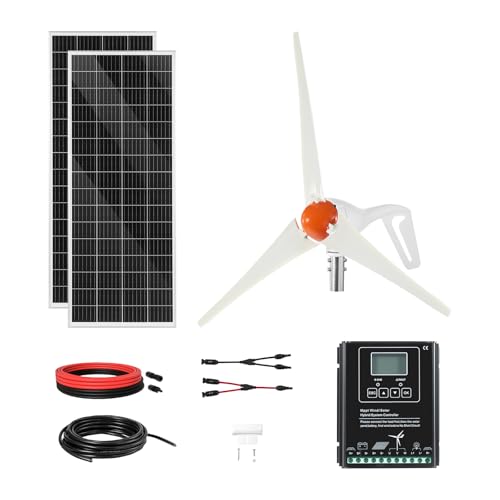
- Two 100W panels and a 200W turbine
- Includes hybrid MPPT controller and cables
- Built for 12V off-grid setups
Best For: Buyers seeking a packaged solar-and-wind setup
Best Wind-First Option
400W Turbine with 30A Hybrid Controller
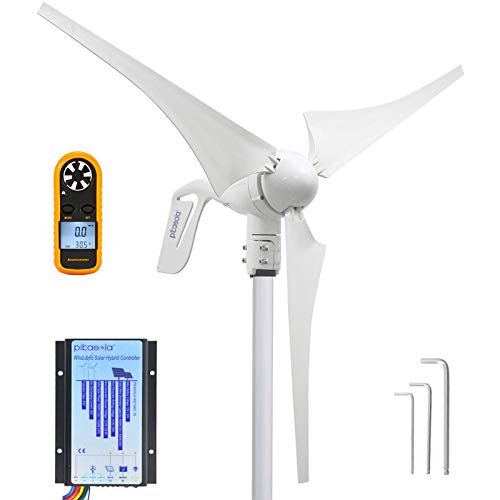
- 400W-rated turbine included
- 30A controller accepts up to 500W solar
- Solar panels sold separately
Best For: 12V setups adding wind before solar
Best for Everyday Use
2000W Wind/Solar Hybrid Controller
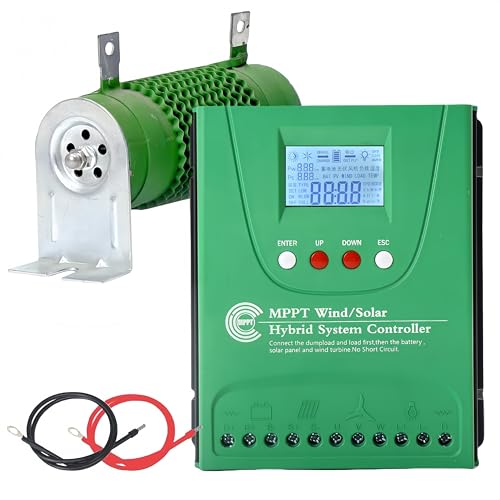
- 12V/24V battery support
- Up to 1000W each of wind and solar input
- Includes LCD and dump load resistor
Best For: Builders who already have turbine and solar hardware
Higher-Capacity Option
12000W Wind Solar Hybrid Controller

- 24V/12000W-listed variant
- Boost MPPT wind; PWM solar
- LCD and three DC-load modes
Best For: Buyers comparing higher-capacity wind-and-solar battery controllers
12V/24V Pick
Pikasola 1400W Hybrid Controller

- Up to 800W wind and 600W solar
- Boost MPPT wind; PWM solar
- LCD and included dump-load resistor
Best For: 12V/24V home, boat, or street-light setups within its input limits
Aluminum-Housing Pick

- Aluminum housing and LCD
- Up to 800W wind and 600W solar
- Dump-load resistor included
Best For: 12V/24V setups needing a metal-housed controller and included dump load
Most Complete Kit – 880W Solar-Wind Kit With Two Batteries
For shoppers comparing hybrid wind and solar systems, this 12V kit pairs four 120W rigid panels with a 400W wind generator. It also includes two 100Ah LiFePO4 batteries, a 2000W inverter, and a dual MPPT hybrid charge controller.
Best For: Off-grid cabins, sheds, or RVs needing a kit with substantial included battery storage.
Pros:
- Includes solar panels, a wind generator, two batteries, an inverter, and a hybrid charge controller.
- Panels have pre-drilled mounting and grounding holes.
- Five-blade turbine has a stated 2.5 m/s starting wind speed.
Cons:
- The listed 880W combines panel and turbine ratings; actual output depends on sun and wind.
- Check the supplied brackets against your intended mounting location.
This is the storage-heavy choice of the three, but plan the mounting and wiring around your specific site before buying.
Compact Battery Kit – 640W Solar-Wind Kit With 100Ah Battery
Among hybrid wind and solar systems with included storage, this 12V kit offers a smaller setup: two 120W rigid panels, a 400W turbine, one 12.8V 100Ah LiFePO4 battery, and a 1000W inverter. Separate solar and wind charge controllers are listed.
Best For: RVs, boats, or smaller off-grid setups where one included battery suits the planned loads.
Pros:
- Includes the battery and inverter alongside both generation sources.
- Battery has a built-in BMS.
- Six-blade turbine has a stated 2.5 m/s starting wind speed.
Cons:
- Includes one 100Ah battery and a 1000W inverter, so size your loads accordingly.
- Packages may arrive at different times.
The components cover the essentials for a modest off-grid installation; treat the stated daily energy figure as a claim, not a guarantee for your location.
Controller Upgrade – 24V/48V Wind-Solar Charge Controller
If you are assembling hybrid wind and solar systems from separate components, this is a 24V/48V charge controller rather than a complete power kit. It lists wind-side MPPT boost charging, solar-side PWM charging, an LCD, and external dump-load support.
Best For: Builders with existing or separately sourced wind, solar, and battery components who need a 24V/48V hybrid controller.
Pros:
- Supports 24V and 48V batteries, including lithium batteries.
- LCD display and configurable charging settings.
- Lists two DC load outputs and multiple protection functions.
Cons:
- Does not include panels, a turbine, a battery, or an inverter.
- Solar charging uses PWM rather than MPPT.
Consider this for controller selection, not as a shortcut to a finished system; confirm your generator, array, battery, and dump-load specifications before ordering.
Best Complete Kit – VEVOR 12V 400W Solar and Wind Kit
For buyers comparing hybrid wind and solar systems, this VEVOR kit puts the main generation components together: two 100W monocrystalline panels, a 200W wind turbine, and a wind/solar MPPT controller. Its 12V setup is aimed at off-grid uses such as RVs, boats, and camping.
Best For: Buyers who want solar panels, a wind turbine, and a matching controller in one package.
Pros:
- Includes 200W of rated solar capacity plus a 200W wind turbine.
- Includes an MPPT hybrid controller, connection cables, and assembly hardware.
- Wind turbine has a stated 2.5 m/s start-up speed.
Cons:
- Designed for 12V systems, so it is not a direct match for a 24V battery setup.
- Packages may arrive separately.
This is the most straightforward choice here if you need both power sources included. Treat the stated daily energy figure as a potential output rather than a guarantee; actual production depends on sun and wind conditions.
Best Wind-First Option – 400W Turbine with 30A Hybrid Controller
This wind-first option suits buyers building hybrid wind and solar systems around a 12V battery who already have, or plan to add, solar panels. It pairs a 400W-rated turbine with a 30A hybrid controller that supports up to 500W of solar panels; panels are not listed among the included components.
Best For: A 12V battery setup that needs a wind turbine now and room to add solar panels.
Pros:
- Includes a 400W-rated wind turbine and 30A hybrid charge controller.
- Controller supports adding up to 500W of solar panels.
- Yaw adjustment helps the rotor follow wind direction.
Cons:
- Solar panels are not included.
- Specified for 12V batteries, not 24V systems.
Choose this over a full kit when wind generation is your immediate priority. Budget separately for panels if you want to use the controller’s solar input.
Best for Everyday Use – 2000W Wind/Solar Hybrid Controller
If you already have generation hardware, this controller offers a way to manage hybrid wind and solar systems using a 12V or 24V battery. It supports wind-turbine and solar-panel inputs rated up to 1000W each, with boost MPPT charging for wind and PWM charging for solar.
Best For: Buyers assembling or updating a 12V/24V hybrid setup who need a controller rather than a turbine or panels.
Pros:
- Supports up to 1000W of wind input and 1000W of solar input.
- Includes a dump load resistor and an LCD for monitoring operating parameters.
- Offers two DC load outputs with lighting-oriented operating modes.
Cons:
- Wind turbine and solar panels are not included.
- Solar charging uses PWM rather than MPPT.
This is a component pick, not a ready-to-generate kit. Its display, load modes, and included dump load make it worth considering when those controls fit your planned system.
Higher-Capacity Option – 12000W Wind Solar Hybrid Controller
For larger hybrid wind and solar systems, this 24V/12000W-listed controller combines boost MPPT charging for the wind input with PWM charging for solar panels. Its LCD and adjustable settings give you ways to monitor and configure the setup.
Best For: Buyers comparing higher-capacity controllers for a combined wind-turbine and solar-panel battery setup.
Pros:
- Boost MPPT wind charging is designed to continue at low wind speeds.
- Includes stepless wind unloading with an external dump-load resistor.
- Offers three configurable DC-load output modes and an LCD display.
- Supports selectable battery settings, including lithium batteries, with automatic parameters or manual adjustment.
Cons:
- The listing identifies solar charging as PWM, not MPPT.
- The title lists 12V/24V/48V support but specifies the offered variant as 24V/12000W; confirm the exact configuration before ordering.
Its wind-charging features and output controls are worth considering, but check the variant and your system ratings rather than relying on the headline wattage alone.
12V/24V Pick – Pikasola 1400W Hybrid Controller
For hybrid wind and solar systems using a 12V or 24V battery, this Pikasola controller is specified for up to 800W of wind input and 600W of solar panels. It pairs boost MPPT charging on the wind side with PWM charging on the solar side.
Best For: Home, boat, or street-light setups that fit the stated 800W wind and 600W solar limits.
Pros:
- Boost MPPT wind charging is designed to work at low wind speeds.
- Includes an external dump-load resistor for stepless unloading.
- LCD display and three configurable DC-load output modes.
- Battery-type selection sets charging parameters automatically, with manual adjustment available.
Cons:
- Solar charging uses PWM rather than MPPT.
- Limited to the stated 12V/24V battery compatibility and 800W wind/600W solar input ratings.
This is a practical fit when your inputs fall within its published limits; check those limits against both generation sources before buying.
Aluminum-Housing Pick – 1400W Wind Solar Controller
Among 12V/24V hybrid wind and solar systems, this controller stands out for its aluminum housing and listed 800W wind and 600W solar input limits. It uses boost MPPT for wind charging and PWM for solar charging, with an LCD for viewing system status.
Best For: Buyers who want a metal-housed 12V/24V controller with an included dump-load resistor.
Pros:
- Full aluminum housing is intended to aid heat dissipation.
- Boost MPPT wind charging is designed for low-speed charging.
- Supports automatic battery-type settings or manual adjustment, plus three DC-load modes.
- Includes a dump-load resistor, two resistor cables, and a manual.
Cons:
- Solar-panel charging uses PWM, not MPPT.
- Specified for 12V/24V batteries, up to 800W wind and 600W solar.
If the published ratings match your equipment, the included unloading components and aluminum enclosure make this a straightforward controller to compare with other 1400W-listed models.
How We Picked These Hybrid Wind and Solar Systems
We compared the listed components, claimed power ratings, supported battery voltages, and intended use of each pick. The selection covers ready-to-build kits as well as controllers for buyers who already have generation hardware. A listed wattage is a component or controller rating, not a promise of continuous output: real production depends on sunlight, wind speed, siting, and losses. Check current seller specifications and manuals before buying, especially for battery compatibility and required turbine protection.
Quick Comparison: Kits Vs. Controllers
Want fewer parts to source? Look at the 880W and 640W kits, or the smaller VEVOR 400W kit. The 640W listing includes a LiFePO4 battery; the 880W listing includes an inverter. Confirm every included component, connection cable, and mounting accessory rather than assuming the kit is installation-ready.
Already own panels and a turbine? The five standalone controller listings and the 400W turbine-with-controller option may be better starting points. They differ substantially in advertised input limits and supported battery voltages. The 12,000W and 15,000W controllers are for appropriately sized systems, not a shortcut to generating that much power from smaller equipment.
Key Buying Factors for Hybrid Wind and Solar Systems
Start with Your Energy Use and Site
Estimate daily consumption in watt-hours, then size the battery for your desired backup time. Assess both resources before spending: panels need an unshaded location, and turbines need suitable, consistent wind with safe clearance from obstacles. A small roof-level turbine at a sheltered site may add little energy regardless of its nameplate rating.
Match Electrical Limits, Not Just Wattage
Verify nominal battery voltage, battery chemistry, charging profiles, and the controller’s separate wind and solar input limits. Check solar open-circuit voltage against the controller maximum, including in cold weather. Confirm turbine voltage, rated power, braking or diversion-load requirements, and whether the supplied dump load is adequate. Marketing terms such as “MPPT” or “boost” do not replace those checks.
Account for the Whole Installation
Budget for a properly sized battery, inverter if you need AC power, mounts or tower, wiring, disconnects, overcurrent protection, grounding, and weatherproof connections. Follow the manufacturer’s wiring instructions and local electrical rules; consult a qualified installer if you are unsure. Wind equipment also needs accessible maintenance and a safe way to stop or divert power during servicing.
Who Should Buy Which Hybrid Wind and Solar Systems?
Choose a kit if you are building a small off-grid setup and value a bundled starting point, but verify the parts still meet your loads. Choose the battery-included kit if you want to avoid sourcing a first battery separately. Choose a controller if your panels, turbine, and battery are already selected and its specifications match all three. For a sheltered location with weak wind, put your budget toward solar and storage first; a hybrid setup makes more sense when both resources can contribute.