A DC-DC charger helps your vehicle charge a LiFePO4 house battery at a controlled voltage, even when alternator output varies. The right model depends on your battery, wiring, alternator, and whether you also want solar charging.
These 10 options cover compact 20A units, higher-output chargers, Bluetooth-enabled models, and dual-input designs for RVs and vans.
Best 10 Dc Dc Charger for Lifepo4 Picks for 2026
Flexible 40A Charging

- 40A output with a 20A option
- LiFePO4 and lead-acid profiles
- Not waterproof
Best For: Dry-location RV and camper battery setups
Isolated 40A Option
LiTime 12V 40A Lithium Battery Charger
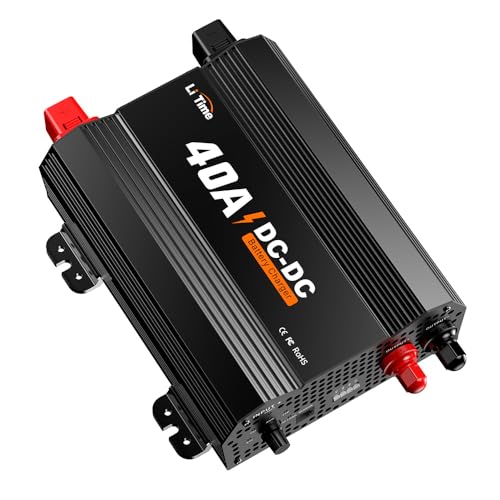
- Isolated input and output
- 40A or 20A charging option
- Requires a dry mounting location
Best For: RV or backup setups needing input/output isolation
Connected High-Output Pick
Victron Orion XS Smart 12/12V 50A

- Adjustable input and output currents
- Bluetooth data and 30-day history
- IP65 water-resistant housing
Best For: Monitored dual-battery alternator systems
Lower-Current Alternator Pick

- 20A alternator-powered charging
- LiFePO4 and lead-acid profiles
- Bluetooth requires a separate module
Best For: 12V auxiliary batteries in RVs and vans
Best for Mixed-Voltage Systems

- Converts between 12V and 24V
- 50A output; 98.5% rated efficiency
- Bluetooth and four-stage charging
Best For: Mixed-voltage dual-battery builds
Best Solar-and-Alternator Combo
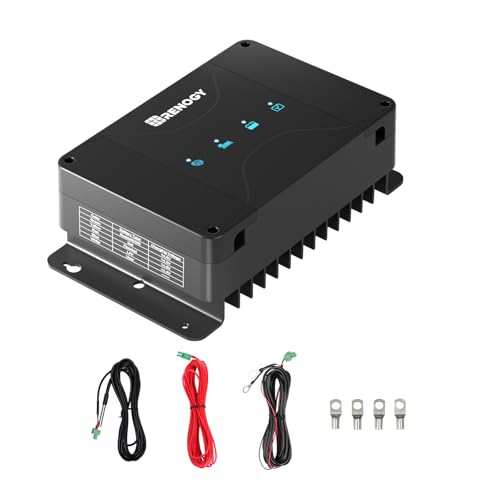
- Dual solar and alternator input
- Built-in MPPT with solar priority
- 30A output for 12V systems
Best For: 12V RVs and vans with solar panels
Best Isolated 12V Option

- Isolated 12V-to-12V charging
- 18A output with three-stage charging
- Built-in VictronConnect Bluetooth
Best For: Isolated 12V vehicle or boat systems
Quiet 20A Pick
VEBU 20A DC-DC Charger with Solar MPPT
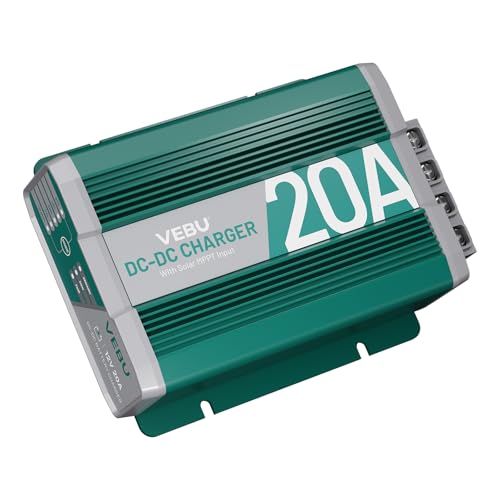
- Fanless 20A charging
- Alternator and MPPT solar inputs
- Selectable LiFePO4 profile
Best For: Quiet, smaller 12V auxiliary-battery setups
Higher-Output Quiet Pick
VEBU 40A DC-DC Charger with Solar MPPT
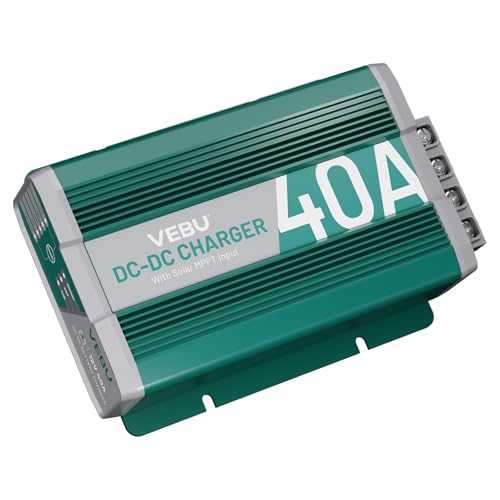
- Fanless 40A charging
- Solar MPPT and alternator inputs
- LiFePO4 and lead-acid profiles
Best For: Quiet setups needing a 40A charger with solar input
Weatherproof Pick
Schumacher SDC371 40A DC-DC Charger

- IP66 weatherproof rating
- 40A three-stage charging
- Solar-priority button
Best For: Weather-exposed 12V vehicle installations
Flexible 40A Charging – LiTime 12V 40A DC-DC Charger
If you need a dc dc charger for lifepo4 that can also handle lead-acid batteries, this LiTime model delivers up to 40A and offers a 20A low-current option. Its charging profile changes with the selected battery type.
Best For: Dry-location RV, camper, or trailer installations that need a choice of 40A or 20A charging.
Pros:
- Supports 12V LiFePO4, AGM, Gel, SLA, and Calcium batteries.
- Uses two-stage charging for LiFePO4 and three-stage charging for lead-acid batteries.
- Includes voltage, short-circuit, reverse-polarity, and temperature protections.
Cons:
- Not waterproof or suitable for marine environments.
- Weighs 4.9 pounds, so check mounting space and support.
The 20A option makes this a practical pick when full 40A output is more than your setup needs. Plan on a protected mounting location.
This LiTime dc dc charger for lifepo4 combines 40A output, a 20A low-current port, and a knob for selecting battery type. Its isolated input and output are a useful distinction for installations where voltage interference is a concern.
Best For: Dry RV, camper, or home-backup installations needing isolated input and output.
Pros:
- Knob selector switches between supported lithium and lead-acid charging profiles.
- Offers 40A output or a 20A low-current option.
- Includes BMS-shutdown lithium reactivation and multiple electrical protections.
Cons:
- Not waterproof; unsuitable for the listed marine environments.
- Its 4.9-pound body needs adequate mounting space.
Choose this listing if input/output isolation matters to your installation. Otherwise, compare its specifications carefully with the other LiTime 40A model, which shares the same listed manufacturer part number.
For shoppers comparing a dc dc charger for lifepo4 in a dual-battery system, the Victron Orion XS offers adjustable input and output currents, a 50A rating, and app-based configuration. Its engine-running detection is designed for alternator-fed charging, including systems with intelligent alternators.
Best For: Dual-battery builds that need adjustable charging and Bluetooth monitoring.
Pros:
- Rated for continuous 700W output, including at 40°C.
- VictronConnect provides configuration, live data, and 30-day history.
- IP65 water-resistant design and adjustable currents support varied installations.
Cons:
- Remote VRM management requires a separate communication center.
- Its numerous settings call for proper configuration to match the alternator and battery.
The Orion XS stands out when monitoring and current control are priorities. Verify your battery’s required charging settings before installation rather than assuming a preset lithium profile.
The Renogy REGO is a 20A dc dc charger for lifepo4 built for alternator-powered auxiliary batteries, not solar input. It also supports AGM, Gel, and flooded batteries, with a lithium charging sequence that omits float and equalization.
Best For: RV, van, or protected boat-cabin installs using an alternator to charge a 12V auxiliary battery.
Pros:
- Engine-running detection helps protect the starter battery; an IGN wire is included for smart-alternator vehicles.
- Battery-type selection supports LiFePO4 and several lead-acid chemistries.
- Optional BT-2 module enables monitoring and switching between 20A and 10A.
Cons:
- No solar input, and the BT-2 Bluetooth module is sold separately.
- Not waterproof; mount in a dry, shaded location.
- For 20A output, the notes specify 10 AWG cable no longer than 3m.
This is a sensible lower-current choice if its cable-length requirements fit your layout. For lithium use, the battery must have a built-in BMS.
Best for Mixed-Voltage Systems – Victron Orion XS 1400 50A
If you need a dc dc charger for lifepo4 in a vehicle with 12V, 24V, or mixed-voltage batteries, the Orion XS 1400 offers 50A charging and 12V-to-24V or 24V-to-12V conversion. Its compact housing is useful where mounting space is limited.
Best For: Dual-battery builds that need mixed-voltage support and high-output alternator charging.
Pros:
- Supports 12V and 24V systems, including voltage conversion.
- Rated at 98.5% efficiency and full output at 40°C/104°F.
- Bluetooth monitoring and adaptive four-stage charging.
- Engine-running detection helps prevent starter-battery drain.
Cons:
- VRM remote management requires an additional Victron communication center.
- No solar MPPT input is listed in the supplied specifications.
Choose this model when flexible voltage handling and a controlled load for the alternator matter more than combining solar and alternator inputs in one charger.
Best Solar-and-Alternator Combo – Renogy Smart 30A DC-DC MPPT
For an RV or van that charges from both rooftop solar and the alternator, this Renogy dc dc charger for lifepo4 combines a 30A battery charger with built-in MPPT. It prioritizes solar when both sources are available, making it a practical single-unit choice for a 12V house-battery system.
Best For: 12V RV and van systems that need solar and alternator charging in one device.
Pros:
- Accepts solar and alternator inputs, with solar priority.
- Supports lithium, AGM, gel, and flooded batteries.
- Built-in MPPT and three-phase charging.
- Provides multiple listed protections, including reverse polarity and over-temperature protection.
Cons:
- Charging output is limited to 30A.
- Bluetooth monitoring requires a separately sold BT-2 module.
This is the most directly solar-focused pick here. Check your panel input against its stated 30V/400W solar-input specification before planning the installation.
Best Isolated 12V Option – Victron Orion-Tr Smart 18A
The isolated Orion-Tr Smart is a dc dc charger for lifepo4 suited to a straightforward 12V-to-12V vehicle or boat setup. It takes power from the alternator and starter battery to charge a service battery, with Bluetooth access for checking status and adjusting settings.
Best For: 12V dual-battery installations that call for an isolated 18A charger.
Pros:
- Isolated 12V-to-12V design rated at 18A and 220W.
- Bluetooth monitoring and control through VictronConnect.
- Three-stage charging supports lithium and lead-acid batteries.
- Screw terminals simplify connections without specialized tools.
Cons:
- 18A output is lower than the other chargers in this selection.
- No built-in solar MPPT input is listed in the supplied specifications.
Pick this unit when isolation and app-based setup matter more than maximum charging current. Victron also specifies that multiple units can be connected in parallel if the system needs more output.
Quiet 20A Pick – VEBU 20A DC-DC Charger with Solar MPPT
If you need a dc dc charger for lifepo4 in a quieter RV or off-grid setup, this 20A VEBU model combines alternator charging with a solar input and built-in MPPT. Its fanless design and selectable battery profiles also suit installations that use different 12V battery types.
Best For: Smaller auxiliary-battery setups that need silent 20A charging from an alternator or solar panels.
Pros:
- Fanless operation avoids charger fan noise.
- Alternator and solar inputs, with built-in MPPT for solar charging.
- Selectable profiles for LiFePO4 and standard, gel, AGM, and calcium batteries.
- LED status indicators and labeled terminals help with monitoring and wiring.
Cons:
- 20A output is lower than the 40A options in this roundup.
- Ignition-control cable is not included.
Choose this one when quiet operation matters more than maximum charging current. Check your wiring and solar-panel specifications against the charger before installation.
Higher-Output Quiet Pick – VEBU 40A DC-DC Charger with Solar MPPT
For buyers seeking a dc dc charger for lifepo4 with more charging current, this VEBU model raises the rating to 40A while retaining a fanless design. It accepts alternator and solar inputs and includes MPPT charging for the solar side.
Best For: RV or off-grid systems that want quiet 40A auxiliary-battery charging and a solar input.
Pros:
- 40A rating provides more charging current than the 20A VEBU model.
- Fanless design keeps charger operation quiet.
- Built-in solar MPPT and alternator input offer two charging sources.
- Selectable profiles support LiFePO4 plus standard, gel, AGM, and calcium batteries.
Cons:
- Ignition-control cable is not included.
- A 40A installation calls for appropriately sized wiring and source capacity.
This is the stronger VEBU choice if your system can accommodate 40A charging. Its labeled connections and LED indicators are useful, but installation details still deserve careful attention.
Weatherproof Pick – Schumacher SDC371 40A DC-DC Charger
If your dc dc charger for lifepo4 may be mounted in a more exposed vehicle location, the Schumacher SDC371 stands out for its IP66 weatherproof rating. This 12V, 40A charger can draw from solar panels or a vehicle alternator, with a solar-priority button to select the preferred source.
Best For: Vehicle installations where weather resistance and 40A auxiliary-battery charging are priorities.
Pros:
- IP66 weatherproof rating supports installation in exposed vehicle locations.
- 40A output and boost, absorption, and float charging stages.
- Solar-priority button provides control over the charging source.
- Supports 12V lithium, standard, gel, AGM, and calcium batteries.
Cons:
- The supplied notes do not specify MPPT solar charging.
- Solar-priority selection requires pressing a button rather than relying on an automatic preference setting.
Pick the SDC371 for its documented weather protection and flexible mounting options. If MPPT is essential to your solar setup, verify that capability before buying.
How We Picked the Best Dc Dc Charger for Lifepo4
We focused on the specifications buyers can use to narrow a shortlist: stated LiFePO4 support, charging current, input and output voltage, solar-input capability, and installation features. The lineup includes 20A to 50A options, isolated and non-isolated designs, and chargers intended for different vehicle electrical systems. Specifications alone cannot establish real-world charging speed or durability, so verify the manufacturer’s current manual and warranty before buying.
Quick Comparison: Which Type Fits Your Setup?
For a straightforward 12V vehicle-to-12V battery installation, compare output current first: a 20A charger places a lower demand on the source electrical system, while 40A and 50A models can replenish a suitably sized battery faster when the alternator and wiring support them. If you want alternator and solar charging through one device, look at the Renogy Smart 30A dual-input model or the listed 20A and 40A MPPT-equipped chargers. If app-based setup matters, the Victron Orion XS Smart offers Bluetooth. For systems involving 24V, check the specific Orion XS 1400 configuration and its permitted input/output voltages rather than assuming every 12/24V listing supports your intended connection.
Key Buying Factors for a DC-DC Charger for LiFePO4
Battery Profile and Charging Voltage
Confirm that the charger has a LiFePO4-compatible profile and that its charge voltage matches your battery maker’s requirements. A stated 14.6V output is not automatically right for every 12V lithium battery. Check whether the profile is adjustable, whether float charging can be configured appropriately, and how the charger behaves when the battery management system disconnects.
Current, Alternator Load, and Wiring
Choose output current within the battery’s allowable charge rate and the vehicle’s available electrical capacity. Higher-output chargers may require heavier cable, appropriate fusing at both ends, and careful routing to limit voltage drop. Check the manufacturer’s input-current figures; output amperage alone does not tell you the full alternator load.
Inputs and Installation Details
MPPT solar input is useful if you want one charger to manage panels and alternator charging, but confirm panel voltage and wattage limits. Check ignition-trigger requirements, smart-alternator compatibility, terminal size, ventilation clearance, and environmental ratings. An isolated charger may be preferable where the installation calls for electrical separation between input and output grounds.
Who Should Buy Which Dc Dc Charger for Lifepo4?
Choose a 20A model for a modest battery bank or a vehicle with limited spare charging capacity. Consider 30A dual-input charging when solar integration is a priority. Look at 40A or 50A units for larger batteries and longer drives, provided your alternator, cabling, and battery can handle the load. Victron’s Bluetooth-enabled options suit buyers who value configurable settings; the isolated Orion-Tr Smart suits installations that specifically require isolation. Before ordering any Dc Dc Charger for Lifepo4, match its voltage configuration and charging profile to your exact battery and vehicle—not just the advertised amperage.