When it comes to securing your home against unexpected power outages, a reliable backup generator system with an Automatic Transfer Switch (ATS) is vital. These systems guarantee that your essential appliances stay powered, keeping your home comfortable and functional. In this guide, we’ll explore ten of the best options available, highlighting their features and advantages. You’ll want to take these into account carefully before making a decision that could affect your family’s comfort and safety.
Westinghouse 14500 Peak Watt Tri-Fuel Portable Generator

If you’re looking for a versatile and powerful solution for home backup power, the Westinghouse 14500 Peak Watt Tri-Fuel Portable Generator might be your best choice. This generator offers 14,500 peak watts and can run on gasoline, propane, or natural gas. Its heavy-duty 550cc engine guarantees durability while providing safe, clean power with low Total Harmonic Distortion. You’ll appreciate the remote electric start and portability, thanks to heavy-duty wheels. With a runtime of up to 19 hours on a full tank, it’s perfect for extended outages. Plus, it comes with a 3-year warranty for extra peace of mind.
Best For: Those seeking a reliable and versatile backup power solution for home use, especially during extended outages.
Pros:
- Versatile Fuel Options: Can run on gasoline, propane, or natural gas for flexibility in fuel choice.
- Long Runtime: Offers up to 19 hours of operation on a full 9.5-gallon tank, ideal for prolonged power outages.
- User-Friendly Features: Remote electric start and portability with heavy-duty wheels make it easy to operate and transport.
Cons:
- Weight: At 230 pounds, it can be cumbersome to move without assistance.
- Price Point: May be considered expensive compared to standard gasoline-only generators.
- Size: The dimensions may require significant storage space when not in use.
Westinghouse 12500 Watt Dual Fuel Portable Generator

The Westinghouse 12500 Watt Dual Fuel Portable Generator is an ideal choice for homeowners seeking reliable power during outages, thanks to its impressive 12,500 peak watts when running on gasoline. With a powerful 457cc engine, it delivers 9,500 running watts and offers up to 12 hours of run time on a 6.6-gallon fuel tank. You’ll appreciate the remote start feature, making it easy to operate. Plus, safety is prioritized with GFCI outlets and rubber covers. EPA compliant and backed by a 3-year limited warranty, this generator guarantees peace of mind during any power disruption.
Best For: Homeowners looking for a reliable, high-capacity generator for power outages and emergency situations.
Pros:
- Powerful dual fuel capability with high peak watts for versatile use.
- Convenient remote start feature for easy operation and minimal effort.
- Safety features including GFCI outlets and rubber covers to prevent electrical hazards.
Cons:
- The weight of the generator may make it difficult to transport.
- Requires periodic maintenance to ensure optimal performance.
- Limited runtime on propane compared to gasoline, which may affect usage preferences.
Anker SOLIX C2000 Gen 2 Portable Power Station
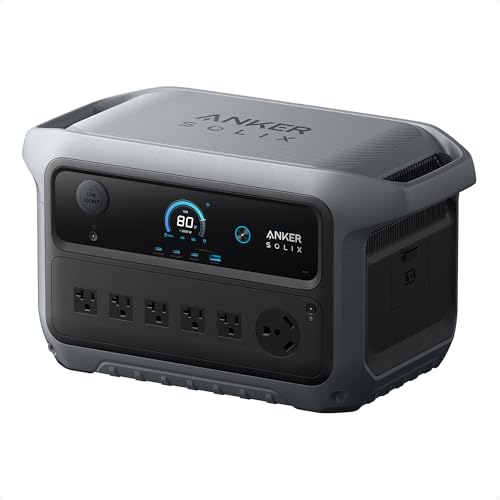
Looking for a versatile backup solution that’s perfect for both home use and outdoor adventures? The Anker SOLIX C2000 Gen 2 Portable Power Station offers a robust 2,400W rated power with a peak at 4,000W, ensuring you can run multiple appliances, including fridges and A/C units. With a massive 2048Wh LiFePO4 battery, it can power a dual-door fridge for up to 32 hours. Plus, it recharges quickly—100% in just 58 minutes via AC or solar. Lightweight and compact, it’s easy to transport. Enjoy peace of mind with a 5-year warranty and stellar customer reviews.
Best For: Individuals seeking a reliable power source for home backup, outdoor activities, and emergency situations.
Pros:
- Ultra-fast recharging: Fully recharges in just 58 minutes via AC or solar.
- High capacity: 2048Wh battery allows for extended usage, powering a fridge for up to 32 hours.
- Lightweight and compact: Weighs only 41.7 lb and is 25% lighter than competitors, making it easy to transport.
Cons:
- Price point: May be more expensive compared to standard power banks.
- Limited peak power: While 4,000W is substantial, it may not support all high-demand appliances simultaneously.
- Additional cost for solar panel: The optional solar panel is sold separately, adding to the overall investment.
Westinghouse 13500 Peak Watt Tri-Fuel Portable Generator

For homeowners seeking reliability and versatility, the Westinghouse 13500 Peak Watt Tri-Fuel Portable Generator stands out as an ideal choice. With peak power ranging from 10,000 to 13,500 watts, it accommodates gasoline, propane, and natural gas, guaranteeing you’re covered regardless of the situation. Enjoy up to 19 hours of runtime on a single tank, and stay safe with multiple outlets featuring rubber covers. The heavy-duty 500cc engine ensures robust performance, while convenient features like remote start and a digital hour meter enhance usability. Plus, it’s backed by a 3-year warranty, providing peace of mind for your power needs.
Best For: Homeowners looking for a reliable and versatile power solution during outages or for outdoor activities.
Pros:
- Powerful tri-fuel capability (gasoline, propane, natural gas) offers flexibility for various fuel sources.
- Long runtime of up to 19 hours on a single tank enhances usability for extended power needs.
- Convenient features like remote start and multiple safety outlets make it user-friendly and safe.
Cons:
- The initial cost may be higher compared to traditional gasoline-only generators.
- Being a larger generator, it may be less portable for some users.
- Requires regular maintenance to ensure optimal performance over time.
EF ECOFLOW Portable Power Station DELTA 2

With a powerful output of 1800W and a battery capacity of 1024Wh, the EF ECOFLOW Portable Power Station DELTA 2 is perfect for anyone needing reliable backup power at home or on the go. It charges 0-80% in just 50 minutes, letting you quickly get back to powering your devices. With 15 outlets, you can run 90% of your appliances effortlessly. Plus, its LFP battery guarantees longevity with over 3000 cycles. You can even expand its capacity up to 3kWh with additional batteries or charge it via solar panels for off-grid adventures. Enjoy a clean, quiet power solution for all your needs.
Best For: Anyone needing a reliable and portable power solution for home backup, camping, or RV adventures.
Pros:
- Fast Charging: Achieves 80% charge in just 50 minutes, making it convenient for quick power needs.
- High Capacity and Expandability: Starts at 1kWh with the option to expand up to 3kWh, accommodating various power demands.
- Multiple Outlets: With 15 outlets, it can power a wide range of appliances simultaneously.
Cons:
- Initial Cost: The upfront investment may be higher compared to traditional generators.
- Weight: Being a portable power station, it may be heavier than some users prefer for transport.
- Solar Panel Sold Separately: The option for solar charging requires an additional purchase of solar panels.
Anker SOLIX C1000 Gen 2 Portable Power Station

The Anker SOLIX C1000 Gen 2 Portable Power Station stands out as an excellent choice for anyone needing reliable backup power at home or on the go. With a powerful 2,000W output and a capacity of 1,024Wh, you can easily power up to 10 devices. Recharging is a breeze, taking just 49 minutes with the ultra-fast option. Its compact design makes it 14% smaller and 11% lighter than similar models, ensuring you can carry it anywhere effortlessly. Plus, with a 10 ms UPS backup, it’s perfect for emergencies, remote work, or off-grid living. Enjoy peace of mind with Anker!
Best For: The Anker SOLIX C1000 Gen 2 Portable Power Station is best for individuals seeking reliable and portable power solutions for emergencies, remote work, or off-grid living.
Pros:
- Powerful output of 2,000W and capacity of 1,024Wh allows for powering up to 10 devices simultaneously.
- Ultra-fast recharging in just 49 minutes makes it convenient for quick power needs.
- Compact and lightweight design makes it easy to transport and store for various activities.
Cons:
- Limited solar recharging time of 1.8 hours may not be ideal for all users.
- Higher price point compared to some lower-capacity portable power stations.
- Requires the Anker app for managing power with TOU mode, which may not appeal to all users.
Generac 12,500 Watt Tri-Fuel Portable Generator

Generac’s 12,500 Watt Tri-Fuel Portable Generator stands out as an exceptional choice for homeowners seeking reliable power during emergencies. With a powerful 500cc engine, it delivers 9,500 running watts and 12,500 starting watts. You can easily switch between gasoline, propane, or natural gas using the simple fuel selector dial. Safety features like COsense Technology guarantee your protection by monitoring carbon monoxide levels and automatically shutting down the generator if needed. Plus, the electric start makes it hassle-free to operate, especially in cold weather. With a rugged design and included accessories, this generator offers both durability and convenience for your power needs.
Best For: Homeowners looking for a reliable and versatile power source during emergencies and outdoor activities.
Pros:
- Tri-fuel capability allows for flexible fuel options, ensuring a reliable power supply.
- Safety features like COsense Technology provide peace of mind by monitoring carbon monoxide levels.
- Electric start functionality makes it easy to operate, especially in cold weather conditions.
Cons:
- Heavyweight design may make it cumbersome to transport for some users.
- Higher initial cost compared to standard gasoline-only generators.
- Maintenance may be required for the propane and natural gas conversion components.
Westinghouse 6500 Watt Dual Fuel Portable Generator
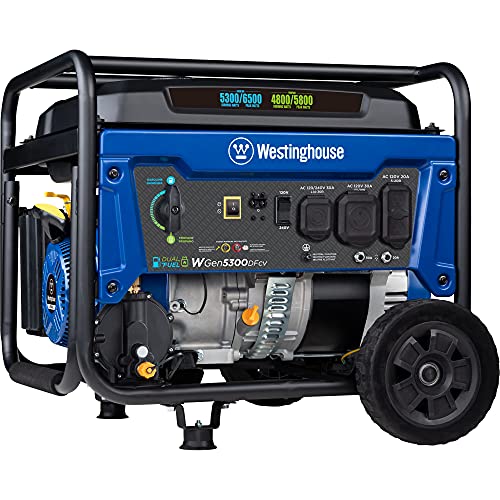
If you’re looking for a reliable backup power solution, the Westinghouse 6500 Watt Dual Fuel Portable Generator is an excellent choice for homeowners and RV enthusiasts alike. With 5300 running watts and 6500 peak watts on gasoline, or 4800 running watts and 5800 peak watts on propane, it offers versatility for any situation. The 4.7-gallon fuel tank provides up to 14.5 hours of runtime. Its user-friendly control panel features various outlets, including RV-ready options. Built for portability, the generator has never-flat wheels and a sturdy frame. Plus, it comes with a 3-year warranty for peace of mind.
Best For: Homeowners and RV enthusiasts seeking a reliable and versatile backup power solution.
Pros:
- Dual fuel capability allows for flexibility in fuel choice, using either gasoline or propane.
- Extended runtime of up to 14.5 hours on a full 4.7-gallon tank, ensuring prolonged power during outages.
- User-friendly design with a well-organized control panel and easy maneuverability thanks to never-flat wheels.
Cons:
- Weight of 135.6 pounds may make it challenging for some users to transport.
- Limited peak wattage on propane compared to gasoline, which may affect power needs for larger appliances.
- Noise level may be higher than desired, particularly in residential areas during extended use.
Westinghouse 28000 Peak Watt Portable Generator

Looking for a powerful solution to keep your home running during outages? The Westinghouse 28000 Peak Watt Portable Generator is your answer. With 28,000 peak watts and 20,000 running watts, it handles major appliances and sensitive electronics with ease. Its 999cc V-Twin engine offers up to 15 hours of runtime at 25% load, while the remote electric start adds convenience. You’ll find multiple outlets for all your needs, and safety features like a CO sensor guarantee peace of mind. Weighing 541.1 pounds, it’s built tough with a rugged steel frame, making it an ideal backup for any home.
Best For: Homeowners looking for a reliable and powerful generator to support major appliances and sensitive electronics during power outages.
Pros:
- High Power Output: Provides 28,000 peak watts and 20,000 running watts, suitable for heavy-duty appliances.
- Long Runtime: Offers up to 15 hours of operation at 25% load, ensuring extended use during outages.
- Convenient Features: Includes remote electric start, multiple outlets, and safety features like a CO sensor for added peace of mind.
Cons:
- Heavy Weight: Weighs 541.1 pounds, which may make transportation and setup challenging.
- Large Size: Its dimensions may require ample storage space and may not be suitable for smaller areas.
- Price Point: Higher initial investment compared to smaller generators, which may not be feasible for all budgets.
Jackery HomePower 3600 Plus Portable Power Station

The Jackery HomePower 3600 Plus Portable Power Station is an exceptional choice for anyone needing reliable backup power during emergencies or for off-grid adventures. With a powerful 3600W output and a massive 3584Wh capacity, it can easily support a 3-person household for over two weeks. Its safety features include high-temp resistant battery cells and a long cycle life of 6,000 cycles. You can recharge it fully in just two hours using hybrid AC+DC. Plus, it’s lightweight and portable, making it easy to take anywhere. Rated 4.5 stars by users, it’s an outstanding option for your power needs.
Best For: Individuals and families seeking a reliable and portable power solution for home backup, emergencies, or outdoor adventures.
Pros:
- Powerful Output: Provides 3600W AC power, sufficient for a 3-person household for over two weeks.
- Quick Recharge: Fully charges in just 2 hours using hybrid AC+DC charging.
- Lightweight Design: 34% smaller and 29.3% lighter than competitors, with a convenient luggage-style design for easy transport.
Cons:
- High Initial Cost: The upfront investment may be significant for some users.
- Limited Solar Charging Speed: Takes up to 4 hours to recharge via solar, which could be slower compared to other methods.
- Weight Considerations: While lighter than competitors, it may still be heavy for some users when fully loaded.
Factors to Consider When Choosing Home Backup Generator Systems With ATS
When you’re choosing a home backup generator system with an ATS, you need to take into account several key factors. Think about your power output requirements, the type of fuel you’ll use, and how long the generator will run on a full tank. Don’t forget to weigh the portability, weight, and safety features to guarantee it meets your needs.
Power Output Requirements
Choosing the right power output for a home backup generator can feel overwhelming, especially with so many factors to contemplate. First, assess the total wattage needed for essential appliances during an outage. For most households, this typically ranges from 3,000 to 10,000 running watts. Don’t forget about peak wattage; it’s vital for starting appliances and can range from 5,000 to 15,000 watts. Consider your generator’s runtime on a full tank and its efficiency, as this affects overall performance. Confirm it has enough outlets to support your appliances, including options for standard household connections and transfer switch-ready configurations. By evaluating these factors, you’ll find a generator that meets your power needs effectively.
Fuel Type Options
Evaluating your power output needs sets the stage for another important decision: selecting the right fuel type for your home backup generator. You’ve got several options, including gasoline, propane, and natural gas. Tri-fuel generators can run on all three, giving you flexibility during emergencies when one fuel might be scarce. Dual-fuel generators, on the other hand, allow you to choose between gasoline and propane, which can help manage costs. Keep in mind that fuel type can affect your generator’s maintenance and operational costs; some fuels require more frequent servicing. Additionally, propane generally provides longer run times than gasoline when comparing equal tank capacities, making it a smart choice for extended outages.
Runtime and Capacity
Runtime and capacity are essential elements to assess for your home backup generator system. Runtime determines how long your generator can keep the power flowing during an outage, with some models running up to 19 hours on a full gasoline tank. Capacity, measured in watts, indicates the maximum power output; for instance, a generator with 14,500 peak watts can support several essential appliances at once. Generally, a larger fuel tank, like a 17-gallon one, allows for longer runtimes, especially at lower loads. Additionally, the type of fuel can impact both runtime and capacity—tri-fuel generators offer flexibility by switching between gasoline, propane, and natural gas. Remember to evaluate running watts versus peak watts for continuous power needs.
Portability and Weight
Portability and weight are essential considerations when selecting a home backup generator system, especially if you plan to move it frequently or store it away when not in use. Many models come equipped with wheels and handles, making transport easier. Lighter generators, often weighing around 41.7 pounds, are typically simpler to maneuver, while heavier units can exceed 500 pounds and may require extra help. If you’re short on storage space, consider a compact design that allows for easier setup during emergencies. It’s also important to weigh the generator’s power output against its weight; some high-capacity models use lightweight materials to enhance portability without sacrificing performance. This balance guarantees you get both mobility and reliability when you need it most.
Safety Features Included
When choosing a home backup generator system, it’s essential to prioritize safety features to protect both your appliances and your household. Look for models equipped with CO sensors that detect harmful carbon monoxide levels, automatically shutting down the generator to prevent poisoning. Automatic low oil shutdown mechanisms are also vital, as they halt operation when oil levels drop too low, protecting the engine from damage. Overload protection features can save your generator by disconnecting power when the load exceeds its capacity. Additionally, rubber covers on outlets help reduce the risk of electrical shock during operation. Finally, advanced models with automatic voltage regulation maintain stable power output, minimizing the risk of damaging your sensitive electronics.
Starting Mechanism Efficiency
Efficient starting mechanisms are essential for any home backup generator system, especially those with an automatic transfer switch (ATS). Look for remote electric start systems that let you activate the generator quickly and conveniently, often with just a push-button or key fob. This feature is especially valuable during emergencies, eliminating the need for physical interaction in bad weather. Consider models with dual start options, like electric and recoil, for added reliability. Advanced features such as automatic low oil shutdown and carbon monoxide detection enhance safety. Finally, pay attention to startup speed; some generators can deliver power within seconds of activation, which is vital when every moment counts during a power outage.
Outlet Configuration Availability
Choosing the right home backup generator system involves more than just efficient starting mechanisms; outlet configuration plays a significant role as well. When you’re selecting your generator, think about the number and type of outlets it offers. Look for GFCI, standard household, RV-ready, and transfer switch-ready outlets. Multiple 120V outlets let you power various devices simultaneously, boosting efficiency during outages. Transfer switch-ready outlets make it easy to connect directly to your home’s electrical system, ensuring a seamless power transfer. If you have an RV or mobile equipment, RV-ready outlets add versatility. Don’t forget safety features like rubber covers on outlets to prevent accidental shocks, ensuring safe operation in different environments.
Warranty and Support Services
Warranty and support services are essential factors to evaluate before settling on a home backup generator system. Look for models that offer a 3-Year Limited Warranty, covering service, labor, and parts. Consider the availability of customer support; some manufacturers provide a nationwide network and lifetime technical assistance. Check for a 30-Day Return Guarantee, allowing you to return the generator if it doesn’t meet your needs. Make certain the warranty includes provisions for factory testing and compliance, which can indicate reliability. Additionally, seek out extra support services like detailed user manuals and online resources. These elements can greatly enhance your overall experience and guarantee you’re well-supported during any issues that may arise.