The best battery load testers with clear displays make it easier to spot weak batteries, charging faults, and starter problems before they leave you stranded. This roundup includes automotive testers and electronic load devices for different battery types and testing needs.
Use the comparison and buying advice below to match the tester’s voltage range, load capacity, display, and intended application to your vehicle, workshop, or battery project.
Best 10 Battery Load Testers with Clear Displays Picks for 2026
Best All-Around Automotive Pick
ANCEL BA101 12V Battery Tester

- Backlit display with adjustable contrast
- Tests battery, cranking, and charging systems
- Supports compatible 12V batteries from 100–2000 CCA
Best For: Routine testing of cars, trucks, boats, RVs, and other 12V vehicles
Best High-Power Electronic Load
150W 20A Color Display Load Tester

- 2.4-inch screen shows detailed electrical measurements
- Provides four constant-control operating modes
- Handles up to 150W and 20A
Best For: Bench testing power batteries and DC-output devices
Best Budget Automotive Analyzer

- Tests battery, alternator, starter, and charging systems
- Compact design fits a glove box or garage
- Supports 12V batteries rated from 100–2000 CCA
Best For: DIY vehicle owners wanting portable 12V diagnostics
Classic Analog Choice

- Readable analog meter for quick results
- Tests batteries, charging systems, and starter draw
- Supports 6V and 12V batteries up to 1,000 CA
Best For: Straightforward testing across cars, powersports vehicles, boats, and RVs
Digital Diagnostic Pick

- Clear display reports voltage, SOH, SOC, and resistance
- Tests 6V, 12V, and 24V batteries up to 3,000 CCA
- Analyzes cranking and charging systems
Best For: Detailed digital diagnostics on conventional automotive lead-acid battery types
Heavy-Duty Analog Value

- 100A load testing for 6V and 12V batteries
- Supports batteries up to 1,000 CCA
- Steel case, heavy-duty clamps, and carrying handle
Best For: Portable battery and alternator checks where rugged construction matters
Garage-Ready Choice
12V/6V 100A Battery Load Tester

- Tests 6V and 12V batteries up to 1000 CCA
- Also checks starter draw and charging systems
- Ventilated housing with insulated carry handle
Best For: Home garages testing multiple lead-acid vehicle batteries
Instant-Read Pick
12V LCD Battery and Alternator Tester
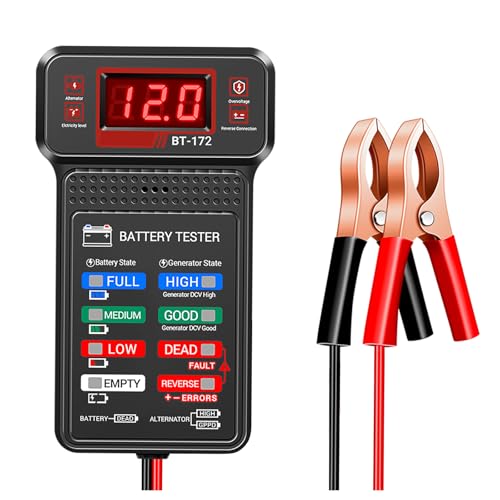
- LCD shows live voltage readings
- LEDs indicate battery and alternator status
- Reverse connection triggers light and audible alert
Best For: Clear, quick 12V checks in home garages
Rugged Scale Option
6V/12V Color-Coded Load Tester

- Green, yellow, and red zones simplify readings
- Works with 6V and 12V vehicle batteries
- Impact-resistant case with ventilated housing
Best For: Portable, at-a-glance battery checks across many vehicle types
Best All-Around Automotive Pick – ANCEL BA101 12V Battery Tester
If you want battery load testers with clear displays for routine vehicle diagnostics, the ANCEL BA101 combines readable results with battery, cranking, and charging-system tests. Its backlit monochrome screen, adjustable contrast, and one-handed operation make it practical in bright or dim conditions.
Best For: Car, truck, boat, RV, ATV, lawnmower, golf cart, and motorbike owners testing compatible 12V batteries over 30Ah.
Pros:
- Displays SOH, SOC, voltage, current, CCA, cranking, and charging results.
- Supports flooded, AGM, GEL, and EFB batteries from 100–2000 CCA.
- Uses vehicle-battery power, so it requires no charging or internal batteries.
- Includes protection against reverse polarity, short circuits, overcurrent, and overvoltage.
Cons:
- Designed for 12V batteries and is not compatible with lithium batteries.
- Not intended for motorcycles below 30Ah.
- Correct battery type, rating, and temperature entries are needed for the clearest results.
The BA101 is a well-rounded choice when readable testing and broad 12V vehicle compatibility matter more than a color screen or laboratory-style battery testing.
Best High-Power Electronic Load – 150W 20A Color Display Load Tester
For bench testing rather than vehicle diagnostics, this electronic load is among the battery load testers with clear displays that show a broad set of measurements at a glance. Its 2.4-inch color screen tracks voltage, current, power, energy, capacity, internal resistance, and discharge time.
Best For: Testing power batteries and DC-output devices up to 150W and 20A, with temperature monitoring through the included external NTC sensor.
Pros:
- Offers constant-current, constant-voltage, constant-power, and constant-resistance modes.
- Displays capacity, internal resistance, load, stop voltage, and operating mode.
- Supports power batteries up to 150V and 20A according to the supplied details.
- Includes overvoltage, overcurrent, and over-power protection.
Cons:
- It is a corded electronic load, not a portable automotive battery analyzer.
- Its 150W maximum power and 20A maximum current limit higher-demand testing.
This model makes the most sense for controlled DC discharge and capacity work where multiple operating modes and a colorful measurement display are more useful than vehicle-specific cranking tests.
Best Budget Automotive Analyzer – KONNWEI KW208 12V Tester
The KONNWEI KW208 is a compact option for shoppers seeking battery load testers with clear displays and straightforward vehicle testing. It evaluates 12V batteries, alternators, starters, cranking performance, and charging systems, and it can be used in or out of the vehicle.
Best For: Drivers and DIY users who want a glove-box-sized tester for compatible 12V flooded, AGM, or gel batteries rated from 100–2000 CCA.
Pros:
- Reports voltage, internal resistance, CCA, amp-hour capacity, battery health, and charge status.
- Performs battery, cranking, charging, alternator, and starter tests.
- Turns on when connected and can test batteries in-vehicle or out-of-vehicle.
- Supports up to eight languages.
Cons:
- Limited to 12V batteries and compatible vehicle systems.
- The supplied details do not specify a backlit or color display.
- Its stated battery coverage focuses on 100–2000 CCA models.
With its small footprint and wide range of automotive checks, the KW208 is a practical choice for basic maintenance and troubleshooting without moving to a larger bench-style electronic load.
Best Adjustable Bench Tester – 150W 20A TFT Electronic Load
This adjustable electronic load suits users who need battery load testers with clear displays for controlled discharge and capacity checks. Its 2.4-inch TFT color screen presents electrical readings and protection settings, while four operating modes provide flexibility for different DC testing tasks.
Best For: Testing power-battery capacity and monitoring supply temperature with an external NTC sensor.
Pros:
- Shows voltage, current, power, energy, capacity, internal resistance, and discharge time.
- Supports constant-current, constant-voltage, constant-power, and constant-resistance modes.
- Allows overvoltage, overcurrent, over-power, stop-voltage, and discharge-time settings.
- Uses a 2.4-inch TFT color display for at-a-glance monitoring.
Cons:
- Its maximum output is 150W and 20A.
- It is a bench-style electronic load rather than an automotive cranking or alternator tester.
- Temperature monitoring requires an external NTC sensor.
The adjustable controls and color interface make this a capable choice for repeatable DC load experiments, especially when discharge limits and multiple operating modes are important.
Classic Analog Choice – Schumacher BT-100
For shoppers comparing battery load testers with clear displays, the Schumacher BT-100 offers a straightforward analog meter that is easy to read while testing. It handles 6V and 12V batteries and combines battery, charging-system, and starter-motor checks in one tool.
Best For: Garage owners who want a simple tester for cars, motorcycles, boats, RVs, and other 6V or 12V vehicles.
Pros:
- Tests batteries, charging systems, and starter-motor draw.
- Supports 6V batteries up to 1,000 CA and 12V batteries up to 1,000 CA.
- Highly visible analog meter and top-mounted rocker switch simplify operation.
- Works with gas and diesel vehicles, including motorcycles, ATVs, boats, and RVs.
Cons:
- Analog readout may provide less detailed information than a digital analyzer.
- Its listed load tests are limited to 50 amps at 6V and 100 amps at 12V.
The BT-100 is a practical pick when quick, readable results matter more than advanced battery metrics. Its broad vehicle compatibility and three testing functions make it a useful general-purpose garage tool.
Digital Diagnostic Pick – VDIAGTOOL BT500
The VDIAGTOOL BT500 is a strong option among battery load testers with clear displays because its digital interface reports voltage, resistance, state of health, and state of charge. It also analyzes cranking and charging systems across 6V, 12V, and 24V applications.
Best For: DIYers and mechanics who want detailed digital battery and alternator diagnostics for cars, trucks, motorcycles, SUVs, ATVs, and boats.
Pros:
- Supports 6V, 12V, and 24V batteries with a 5–3,000 CCA testing range.
- Works with flooded lead-acid, AGM, GEL, and EFB batteries.
- Displays voltage, resistance, SOH, and SOC, plus cranking and charging results.
- Includes reverse-polarity and short-circuit protection, a shock-resistant case, and a 12-language interface.
Cons:
- Not designed for lithium, deep-cycle, or golf-cart batteries.
- Accurate results depend on selecting the correct battery type, standard, and CCA value.
The BT500 is the most information-rich choice in this group. Its clear digital display and broad voltage range suit users who want more than a basic pass-or-fail load reading.
Heavy-Duty Analog Value – QWORK 12V 100A Tester
For buyers seeking battery load testers with clear displays and a durable build, the QWORK 24338 combines a voltage readout with a 100A load test. It is designed for 6V and 12V batteries and adds alternator testing for common vehicles and golf carts.
Best For: Automotive professionals, RV owners, and golf-cart or ATV users who need a portable tester with heavy-duty clamps.
Pros:
- Tests 6V and 12V batteries up to 1,000 CCA.
- Includes battery, voltage, and alternator testing functions.
- Shock-resistant steel case and copper-plated clamps are built for rigorous use.
- Compact design and carrying handle make storage and transport convenient.
Cons:
- The supplied information does not specify a digital display or detailed battery-health metrics.
- Warranty details are not specified.
- Its compatibility is limited to 6V and 12V systems.
The QWORK is a practical, rugged option for basic load and voltage checks. Choose it when durability, portability, and alternator testing are priorities rather than advanced digital analysis.
Garage-Ready Choice – 12V/6V 100A Battery Load Tester
For shoppers comparing battery load testers with clear displays, this model offers a straightforward analog-style readout for both 6V and 12V lead-acid batteries. It supports 50A testing on 6V batteries and 100A on 12V batteries, with claimed voltage accuracy of ±0.2V.
Best For: Home garages and vehicle owners who need battery, starter-draw, and charging-system checks across cars, trucks, RVs, motorcycles, and boats.
Pros:
- Tests 6V and 12V batteries up to 1000 CCA.
- Checks battery condition, starter motor draw, and the complete charging system.
- Insulated handle, color-coded copper clips, and ventilated housing support practical use.
Cons:
- Uses a traditional scale-style display rather than a digital LCD.
- Designed for lead-acid batteries and compatible 6V/12V systems.
This is a versatile pick if you want a heavier-duty tester with broad vehicle compatibility and more than a simple voltage check. Its handle and ventilation also make it convenient for repeated garage use.
Instant-Read Pick – 12V LCD Battery and Alternator Tester
Among battery load testers with clear displays, this 12V model stands out for pairing a digital LCD voltage reading with color-coded LED status indicators. It tracks live voltage during starting and engine operation, helping make battery and alternator checks easier to interpret.
Best For: Drivers and home mechanics who want quick, readable 12V battery and alternator diagnostics for cars, motorcycles, RVs, boats, and tractors.
Pros:
- Combines precise LCD voltage readings with battery-health LEDs.
- Monitors voltage fluctuations while starting or revving the engine.
- Reverse-connection warning includes a red indicator and audible alarm.
- Offers separate battery and alternator testing modes.
Cons:
- Supports 12V systems only.
- Provides diagnostic readings rather than the higher-amperage load testing specified for some traditional testers.
This is a convenient choice when display clarity and quick interpretation matter most. The LCD and LED combination, along with reverse-polarity protection, makes routine 12V checks accessible for less experienced users.
Rugged Scale Option – 6V/12V Color-Coded Load Tester
This model is a practical option for shoppers seeking battery load testers with clear displays and simple status feedback. Its high-definition scale uses green, yellow, and red zones to indicate normal, potentially weak, or depleted battery condition across 6V and 12V vehicle systems.
Best For: Portable battery checks on cars, SUVs, motorcycles, RVs, boats, pickup trucks, and other vehicles using 6V or 12V batteries.
Pros:
- Color-coded scale makes battery status easy to read at a glance.
- Iron housing is described as impact-resistant and drop-proof.
- Copper-plated clips are designed for low-resistance contact.
- Ventilation holes help dissipate heat during testing.
Cons:
- Uses a color-coded scale instead of a digital LCD display.
- The supplied notes do not specify a maximum CCA or load-amperage rating.
- At 11.4 inches long, it may be less compact than handheld digital testers.
Choose this tester if durability, broad vehicle coverage, and fast color-based interpretation are priorities. Its handle, sturdy casing, and strong clips suit routine maintenance as well as emergency checks.
How We Picked the Best Battery Load Testers with Clear Displays
We selected models across common automotive and electronics use cases, including 6V, 12V, and 24V systems; handheld analog-style load testers; digital automotive analyzers; and adjustable electronic loads for capacity testing. We considered supported battery types, stated CCA or load ranges, charging and cranking diagnostics, display readability, operating modes, portability, and the practical needs of home users and technicians.
Because specifications vary, confirm the manufacturer’s supported battery chemistry, voltage, and maximum test current before connecting a tester. A car-battery analyzer is not automatically suitable for lithium cells, while an electronic load may not provide the same starter or alternator diagnostics as an automotive tester.
Quick Comparison
- Best for routine 12V vehicle checks: Choose a digital automotive analyzer with clear voltage, cranking, charging, and CCA results.
- Best for 6V/12V workshop use: A traditional high-current load tester offers straightforward results and simple operation.
- Best for 24V systems: Select a model explicitly rated for 24V vehicles rather than assuming two 12V batteries can be tested safely.
- Best for battery capacity experiments: An adjustable constant-current electronic load provides controlled discharge and a live color display.
- Best for occasional emergency testing: Look for a compact unit with insulated clamps, readable indicators, and minimal setup.
Key Buying Factors for Battery Load Testers with Clear Displays
Voltage and Battery Compatibility
Match the tester to the battery system first. Automotive products commonly support 12V batteries, while some cover 6V or 24V systems. Also check whether the device supports conventional flooded, AGM, gel, lithium, or other battery chemistries.
Load Range and Test Method
CCA and maximum current ratings determine what the tester can evaluate. A 100A load tester may suit many passenger vehicles, but larger batteries and commercial applications may require more capacity. Electronic loads are better for controlled discharge, not necessarily for simulating a starter motor.
Display Clarity and Useful Readings
Prioritize large digits, strong contrast, backlighting, or a color TFT screen if you work in dim engine bays. The most useful readings include resting voltage, loaded voltage, cranking voltage, charging voltage, current, elapsed time, and capacity or energy where supported.
Safety and Usability
Look for insulated clamps, reverse-polarity protection, over-temperature safeguards, adequate cable length, and ventilation. High-current load tests generate heat, so follow the recommended test duration and allow the unit to cool between tests.
Who Should Buy Which Battery Load Testers with Clear Displays?
Car owners and DIY mechanics should generally choose a simple 12V digital analyzer if they want quick battery, alternator, and starter checks. Repair shops and users working across older vehicles may prefer a 6V/12V or 6V/12V/24V model with a wider CCA range. RV, truck, and fleet owners should prioritize higher load capacity and broad vehicle compatibility.
Choose an adjustable electronic load when your goal is measuring battery capacity, testing USB power sources, or monitoring controlled discharge rather than diagnosing an automotive charging system. Whichever style you choose, verify ratings before testing and treat every battery as a high-current power source.