A dependable car battery tester can help you spot a weak battery, charging problem, or starting-system issue before your vehicle leaves you stranded. The best models make basic diagnostics accessible without requiring professional shop equipment.
This roundup compares 10 battery and alternator testers across 6V, 12V, and 24V applications, with options ranging from simple voltage checks to digital load, CCA, cranking, and charging-system analysis.
Best 10 Car Battery Testers for Home Garages Picks for 2026
Best Overall
ANCEL BA101 12V Digital Battery Tester

- Tests battery health, charge, CCA, cranking, and charging systems
- Supports 100–2000 CCA and common 12V battery types
- Built-in protection and multilingual operation
Best For: DIY users seeking detailed 12V battery diagnostics
Best Compact Load Tester
TOPDON BT100 12V Battery Tester

- Performs battery, cranking, and charging-system tests
- Supports 100–2000 CCA lead-acid batteries
- Compact body with LED indicators and menu controls
Best For: DIY users needing a portable 12V tester
Best for Simple Voltage Checks

- Plug-and-test design for quick battery checks
- 4-digit display reads voltage to 0.01V
- LED indicators show battery and alternator status
Best For: Car owners wanting straightforward 12V voltage testing
Best Traditional Load Tester
NEIKO 40510A 6V/12V Load Tester

- Provides 50A 6V and 100A 12V load tests
- Tests batteries up to 1000 CCA
- Durable analog meter with copper clamps
Best For: DIY mechanics wanting direct 6V and 12V load testing
Best All-Around Pick
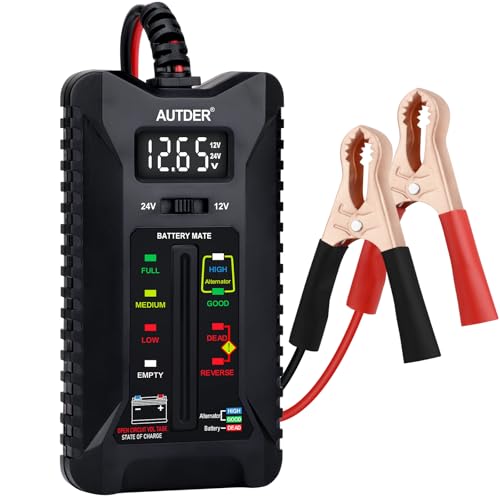
- Checks batteries and alternators
- LCD readout with LED status lights
- Supports 12V and 24V systems
Best For: Routine checks across cars, RVs, trucks, and motorcycles
Best for Everyday Use

- Tests 100-2000 CCA batteries
- Includes load, cranking, and charging tests
- Comes with storage bag and two-year warranty
Best For: Routine 12V automotive battery checks
Best for Detailed Battery Data
BR502 6V/12V/24V Digital Analyzer

- Measures SOH, SOC, CCA, and resistance
- Works with 6V, 12V, and 24V batteries
- Shows results on a 1.8-inch screen
Best For: Detailed battery-health checks across multiple vehicle types
Best Value Diagnostic Pick

- Tests common 12V lead-acid batteries
- Checks battery, starter, and alternator systems
- Compact plug-and-play design
Best For: Affordable 12V garage testing
Best for 12V/24V Coverage

- Supports 12V and 24V systems
- Performs four diagnostic test types
- Stores test records for trend tracking
Best For: Multi-vehicle home garages
Best Wide-Range Safety Pick

- Tests 6V, 12V, and 24V batteries
- Covers up to 3000 CCA
- Includes protective housing and safety features
Best For: Mixed-vehicle garages with varied voltages
Best Overall – ANCEL BA101 12V Digital Battery Tester
For home garages comparing car battery testers for home garages, the ANCEL BA101 offers a broad set of digital diagnostics. It checks 12V battery health, charge, voltage, CCA, cranking performance, and the charging system across several common battery types.
Best For: DIY users who want detailed 12V battery and alternator information in one compact tester.
Pros:
- Measures SOH, SOC, voltage, current, and CCA, with cranking and charging tests.
- Supports 100–2000 CCA and multiple standards, including JIS, EN, DIN, SAE, and BCI.
- Works with flooded, AGM, GEL, and EFB 12V batteries over 30Ah.
- Includes reverse-polarity, short-circuit, overcurrent, and overvoltage protection.
Cons:
- Not compatible with lithium, 6V, 8V, or 24V batteries.
- Not intended for motorcycles below 30Ah.
The BA101 is a strong all-around choice when you want more than a basic voltage reading. Entering the battery’s correct type and rating is important for the clearest results.
Best Compact Load Tester – TOPDON BT100 12V Battery Tester
The TOPDON BT100 is a practical pick among car battery testers for home garages, especially if storage space matters. Its menu-driven design provides battery, cranking, and charging-system tests for 12V lead-acid batteries.
Best For: Home mechanics and DIY users who want a compact tester for multiple vehicles.
Pros:
- Tests SOH, SOC, voltage, current, rating, battery condition, cranking, and charging performance.
- Compatible with 100–2000 CCA flooded, AGM, EFB, and GEL batteries.
- Three-color LED indicators and a menu system make results easier to interpret.
- Compact design fits conveniently in a glove box or center console.
Cons:
- Designed for 12V lead-acid batteries only.
- The vehicle ignition should be turned off during battery testing.
With passive testing, copper clamps, polarity-reversal prevention, and spark-proof features, the BT100 keeps routine testing straightforward. It is well suited to garages that check cars, trucks, boats, ATVs, and other 12V vehicles.
Best for Simple Voltage Checks – MOTOPOWER MP0514A 12V Tester
If you prefer a simple plug-and-test tool, the MOTOPOWER MP0514A is a useful option among car battery testers for home garages. It displays voltage clearly and uses LED indicators to help show battery and alternator status.
Best For: Car owners who mainly need quick 12V battery and charging-system checks.
Pros:
- Four-digit LCD provides voltage readings to 0.01V.
- Eight colored LEDs offer an at-a-glance indication of battery or alternator condition.
- 4–20V DC testing range accommodates 12V vehicle systems.
- Includes reverse-connection and over-voltage protection.
Cons:
- Its supplied specifications focus on voltage and charging analysis rather than CCA or load testing.
- Designed for vehicles with 12V batteries.
The MP0514A is a sensible choice for routine checks when you want fast, readable results without a more involved diagnostic menu. Its 50cm cable and compact rubberized body also make it convenient to keep in a vehicle or toolbox.
Best Traditional Load Tester – NEIKO 40510A 6V/12V Load Tester
NEIKO 40510A Car Battery Tester | 100 AMP 6 and 12 Volt Automotive Load Checker | CCA Analyzer
Check Price On AmazonThe NEIKO 40510A takes a traditional load-testing approach for car battery testers for home garages. Its fixed-load design checks both 6V and 12V automotive batteries and uses an analog meter to show the result.
Best For: DIY mechanics who want a straightforward high-current load check for 6V and 12V batteries.
Pros:
- Tests 6V and 12V batteries with 50A and 100A load settings.
- Handles batteries up to 1000 CCA.
- Analog meter has a protective casing and voltage accuracy of ±0.2V.
- Copper clamps, an insulated handle, and anti-sparking internal switchgear support practical garage use.
Cons:
- Load must be held for a maximum of 10 seconds.
- Uses an analog display rather than digital diagnostic readings.
- Does not provide the broader SOH, SOC, or charging-analysis data offered by digital testers.
Choose the NEIKO when you value direct load testing over menus and expanded data. It is portable and compatible with cars, trucks, boats, motorcycles, RVs, and other 6V or 12V applications.
Best All-Around Pick – AUTDER 12V/24V Battery Tester
For home garages needing a straightforward tool, the AUTDER is a versatile choice among car battery testers for home garages. It checks both battery voltage and alternator performance, supports 12V and 24V systems, and provides quick LCD and LED feedback.
Best For: Everyday testing across cars, motorcycles, RVs, trucks, and other 12V or 24V vehicles.
Pros:
- Tests battery condition and alternator performance in one device.
- Displays real-time voltage readings on a clear LCD screen.
- Uses color-coded status indicators and includes reverse-polarity and over-voltage protection.
- Compact, lightweight housing is easy to store in a garage or vehicle kit.
Cons:
- Designed for voltage and charging-system checks rather than detailed CCA or internal-resistance analysis.
- Its broad 12V/24V compatibility may be more than needed for owners with only one vehicle type.
The AUTDER is a practical garage tester when fast, uncomplicated battery and alternator checks matter more than advanced diagnostic data.
Best for Everyday Use – MOTOPOWER MP0515A 12V Tester
The MOTOPOWER MP0515A takes a traditional approach to car battery testers for home garages, combining 12V battery testing with load, cranking, and charging-system checks. Its compact format and included storage bag make it convenient for routine automotive use.
Best For: Home mechanics who want a dedicated 12V tester for automotive battery and charging checks.
Pros:
- Tests 12V batteries across a stated 100-2000 CCA range.
- Supports battery load, auto-cranking, and charging-system testing.
- Includes a storage bag and instruction manual.
- Backed by a two-year manufacturer warranty.
Cons:
- Limited to 12V battery systems.
- The supplied details do not specify a digital display or LED status indicators.
Choose the MP0515A if your garage work is centered on standard 12V car batteries and you prefer a focused tester with load and starting-system functions.
Best for Detailed Battery Data – BR502 6V/12V/24V Digital Analyzer
For shoppers who want more than a basic voltage reading, the BR502 is one of the more information-focused car battery testers for home garages. It covers 6V, 12V, and 24V batteries while reporting state of health, state of charge, CCA, internal resistance, and voltage.
Best For: Garage users who want battery-health information across cars, trucks, boats, motorcycles, and other compatible vehicles.
Pros:
- Tests 6V, 12V, and 24V batteries rated from 100-2000 CCA.
- Reports state of health, state of charge, CCA, internal resistance, and voltage.
- Displays Good, Normal, or Poor results on a 1.8-inch screen within two seconds.
- Includes reverse-connection protection and can test batteries in or out of the vehicle.
Cons:
- Requires correct clip placement; the supplied notes say the screen may flicker if the connection is improper.
- Its broader diagnostic readouts may be unnecessary for users seeking only a quick voltage check.
The BR502 is the strongest fit when comparing battery condition, charge level, and starting capacity is more useful than a simple pass/fail voltage test.
Best Value Diagnostic Pick – KONNWEI KW208
For shoppers comparing car battery testers for home garages, the KONNWEI KW208 is a compact 12V option focused on essential battery, starting, and charging-system checks. It supports several common lead-acid battery types and can be used with batteries in or out of the vehicle.
Best For: Home-garage users who want an affordable 12V battery and alternator tester for cars, trucks, motorcycles, boats, and similar equipment.
Pros:
- Tests 12V flooded, AGM flat-plate, AGM spiral, and gel batteries across a 100–2000 CCA range.
- Reports voltage, internal resistance, CCA, amp-hour capacity, battery health, and charge status.
- Also performs cranking, charging, alternator, and starter tests.
- Compact, glove-box-friendly design with updated galvanized alloy clips.
Cons:
- Designed for 12V systems rather than 6V or 24V batteries.
- The supplied notes do not indicate support for lithium batteries.
The KW208 makes a practical choice when you need broad 12V lead-acid coverage without a complicated setup. Its plug-and-play operation and multiple vehicle-system tests make it useful for routine garage maintenance.
Best for 12V/24V Coverage – AUTOOL BT460
The AUTOOL BT460 stands out among car battery testers for home garages when you need both 12V and 24V compatibility. Its four-in-one diagnostics cover battery health, cranking, charging, and load testing, while the color display and stored test records make repeated checks easier.
Best For: DIY users and mechanics who service cars, trucks, RVs, boats, motorcycles, or ATVs and want 12V/24V lead-acid testing with record keeping.
Pros:
- Tests 12V and 24V flooded, AGM, EFB, and gel lead-acid batteries from 30–2000 CCA.
- Provides SOH, SOC, internal resistance, voltage, cranking, charging, and load-test results.
- Bright color screen, intuitive menus, and reverse-polarity protection support straightforward operation.
- Stores test records and includes a three-year limited warranty for the tester.
Cons:
- Its broader features may be more than needed for someone checking only a single 12V car.
- The supplied information specifies lead-acid battery compatibility, not lithium support.
Choose the BT460 if voltage-system flexibility and historical test data matter in your garage. It offers a more diagnostic-focused feature set than a basic voltage checker while remaining handheld and portable.
Best Wide-Range Safety Pick – VDIAGTOOL BT500
For home garages handling different vehicle types, the VDIAGTOOL BT500 offers unusually broad 6V, 12V, and 24V coverage. It combines battery-load, cranking, and charging-system checks with a protective housing and simple interface for routine DIY diagnosis.
Best For: Garage owners who work on vehicles using different battery voltages, including cars, trucks, motorcycles, SUVs, ATVs, and boats.
Pros:
- Supports 6V, 12V, and 24V flooded, AGM, gel, and EFB lead-acid batteries from 5–3000 CCA.
- Measures voltage, resistance, state of health, and state of charge while testing cranking and charging systems.
- Includes reverse-polarity and short-circuit protection in a shock-resistant, anti-slip body.
- Clear interface, 12-language support, and a dedicated 6V motorcycle mode improve usability.
Cons:
- Not compatible with lithium, deep-cycle, or golf-cart batteries.
- Correct battery type, testing standard, and CCA value must be selected for accurate results.
The BT500 is a versatile pick for a mixed-vehicle garage, especially if 6V equipment or high-CCA batteries are part of your routine. Its stated battery exclusions are important, so confirm your battery chemistry before buying.
How We Picked the Best Car Battery Testers for Home Garages
We focused on testers that provide useful information for routine DIY maintenance, including battery voltage, starting performance, alternator output, charging behavior, and cold-cranking-amp estimates. We also considered supported battery voltages, CCA ranges, display readability, operating simplicity, portability, and whether the tester uses a practical load-test design.
Because home garages have different needs, this list includes compact digital analyzers as well as heavier-duty testers that support broader voltage or CCA ranges. Always confirm that a tester’s specifications match your battery type and vehicle before purchasing.
Quick Comparison
- Best for basic 12V checks: Choose a compact digital tester with a clear LCD or LED readout.
- Best for battery and alternator diagnosis: Look for dedicated cranking and charging-system test modes.
- Best for broader vehicle coverage: Select a 6V/12V/24V model if you service motorcycles, commercial vehicles, or multiple vehicle types.
- Best for high-capacity batteries: Check the tester’s supported CCA range, especially for larger trucks and performance vehicles.
Key Buying Factors for Car Battery Testers for Home Garages
Voltage and Battery Compatibility
Most passenger vehicles use 12V batteries, but a 6V/12V/24V tester offers more flexibility for motorcycles, older vehicles, RVs, trucks, and equipment. Verify compatibility with conventional lead-acid, AGM, gel, or other battery types when relevant.
Testing Functions
A voltage reading shows the battery’s current electrical state, but it does not tell the whole story. Load testing can reveal how the battery performs under demand, while cranking and charging tests help separate a weak battery from a starter or alternator problem.
CCA Range and Accuracy
Match the tester’s CCA range to the rating printed on your battery. A broad range is useful, but clear instructions and consistent connections matter just as much. Clean, secure clamps are essential for dependable readings.
Display and Ease of Use
For occasional home use, a bright LCD, simple controls, reverse-polarity protection, and straightforward result labels can be more valuable than advanced features. LED indicators may be faster to read, while LCD screens usually provide more detailed results.
Build Quality and Portability
Choose a tester with sturdy leads, insulated clamps, strain relief, and a case or compact body that is easy to store. A handheld design is especially useful if you keep the tool in your vehicle for roadside checks.
Who Should Buy Which Car Battery Testers for Home Garages?
Occasional DIY owners should prioritize an affordable 12V digital tester that quickly checks battery condition and alternator output. Home mechanics may prefer a load tester with cranking, charging, and CCA analysis for more complete troubleshooting. Owners of multiple vehicle types should consider a 6V/12V/24V model with a wide CCA range. Truck, RV, and equipment owners should choose a higher-capacity tester rated for the battery sizes they actually service.
Whichever model you choose, use the tester with the engine off and on as directed, follow the manufacturer’s connection sequence, and treat the results as diagnostic guidance rather than a substitute for professional testing when a fault remains unclear.