Basements can feel stuffy long before poor ventilation becomes obvious. A carbon dioxide monitor provides a measurable way to track air quality and decide when fresh-air exchange is needed.
We selected 10 CO2 monitors with useful combinations of NDIR sensing, real-time displays, historical data, temperature and humidity readings, and flexible placement options for basement spaces.
Best 10 Carbon Dioxide Monitors for Basements Picks for 2026
Best Premium Pick
- Precise NDIR CO2 sensing
- Up to four years of battery life
- App stores 90 days of history
Best For: Premium, cable-free basement monitoring
Best History Display
- Shows 24-hour CO2 trends
- USB supports continuous monitoring
- Includes alarm and adjustable display
Best For: Outlet-based monitoring with quick trend checks
Best Plug-In Option

- Plug-and-play AC operation
- Stores up to 140 days of history
- 85-decibel adjustable alarm
Best For: Continuous, outlet-powered monitoring
Best Portable Pick

- Compact rechargeable design
- About 72 hours of battery life
- Color indicators and customizable alarm
Best For: Moving between the basement and other rooms
Most Versatile

- Measures CO2 plus particles, gases, temperature, and humidity
- Color display and voice alerts flag abnormal readings
- Rechargeable design supports up to 20 hours
Best For: Portable, all-around indoor air monitoring
Best Dedicated Display

- Uses Swiss Sensirion PASens sensor technology
- Customizable CO2 concentration alerts
- Adds temperature, humidity, clock, and alarm functions
Best For: Continuous plug-in CO2 monitoring in an enclosed room
Best for Comfort
- Plug-and-play wall design for continuous power
- Refreshes CO2, temperature, and humidity readings every 2 seconds
- Includes adjustable thresholds and manual calibration
Best For: Simple, always-on monitoring near a basement outlet
Best Heavy-Duty Pick
Wall-Mounted CO2 Alarm Monitor

- Outlet-powered operation needs no batteries
- Two-second refresh with an NDIR sensor
- Customizable audible and visual CO2 alarm
Best For: Continuous monitoring near an outlet
Best Battery Life
Portable CO2 Monitor with Stand

- Up to 30 days of stated battery operation
- Tracks CO2, temperature, and humidity
- Foldable stand and alerts support flexible placement
Best For: Portable, rechargeable basement monitoring
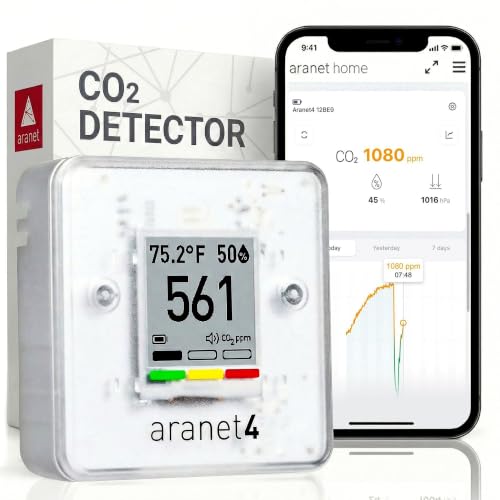
Best Premium Pick – Aranet4 Wireless CO2 Monitor
The Aranet4 is a strong choice among carbon dioxide monitors for basements when you want cable-free monitoring, a clear display, and long-term data tracking. Its NDIR sensor measures CO2, temperature, humidity, and atmospheric pressure, while the e-ink screen is designed for low-power operation.
Best For: Homeowners who want a premium, battery-powered monitor with app-based historical data.
Pros:
- NDIR sensor measures CO2 with a focus on precision and reliability.
- Wireless design and included AA batteries offer up to four years of battery life.
- App provides graphs and up to 90 days of historical data.
- Color coding, a prominent CO2 reading, and optional buzzer support quick checks.
Cons:
- Does not provide continuous USB-powered operation.
- Its premium feature set may be more than needed for basic CO2 monitoring.
Choose the Aranet4 if you want a refined, low-maintenance monitor that can be placed in a basement without adding another cable to the space.
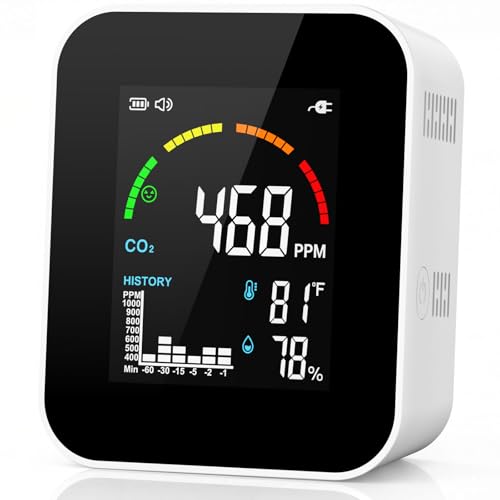
Best History Display – YOWEXA 24-Hour CO2 Monitor
The YOWEXA monitor suits shoppers comparing carbon dioxide monitors for basements who want visible short-term trends. Its 24-hour bar chart helps reveal CO2 fluctuations, while the NDIR sensor, adjustable color display, and alarm provide useful feedback during routine ventilation checks.
Best For: Users who want a tabletop monitor with a visual 24-hour history chart and continuous USB-powered operation.
Pros:
- NDIR sensor supports automatic or manual calibration and anti-interference performance.
- 24-hour bar graph helps identify daily CO2 patterns.
- Measures CO2, temperature, and humidity with a 4-second measurement interval.
- Alarm activates at 1,000 ppm and can be muted with the power button.
Cons:
- Continuous monitoring is intended for USB power, increasing power consumption.
- Backup battery mode lasts up to 24 hours and is not intended for daily monitoring.
- Restarting the device erases the historical data.
This is a practical pick when a basement monitor will stay near an outlet and you value an on-device trend view more than cordless placement.
Best Plug-In Option – BEVIU 5-in-1 CO2 Detector
The BEVIU CD08 is a convenient option among carbon dioxide monitors for basements when you prefer plug-and-play operation. It continuously monitors CO2, temperature, and humidity, displays readings on a color screen, and stores up to 140 days of historical data without requiring battery replacement.
Best For: Homeowners who want an AC-powered monitor with extended history storage and an audible alarm.
Pros:
- Plug-in design supports continuous monitoring without battery changes.
- Stores up to 140 days of historical readings.
- Measures CO2 from 400 to 4,000 ppm with a stated accuracy of ±5%.
- Includes an 85-decibel alarm and adjustable brightness and buzzer settings.
Cons:
- Requires access to an AC outlet.
- It detects CO2, not carbon monoxide, and cannot replace a CO alarm or smoke alarm.
- The supplied notes do not describe wireless or app connectivity.
If your basement has a convenient outlet, the CD08 offers straightforward continuous operation and considerably more built-in history than the shorter-term charting models.
Best Portable Pick – INKBIRDPLUS Mini CO2 Monitor
The INKBIRDPLUS PTH-10C is a compact choice for shoppers seeking portable carbon dioxide monitors for basements and other indoor spaces. Its NDIR sensor, color-coded indicators, customizable alarm, and rechargeable battery make it easy to move around while checking ventilation conditions.
Best For: Users who want a rechargeable monitor that can travel between the basement, office, and other rooms.
Pros:
- Portable design includes a lanyard for carrying between locations.
- NDIR sensor is described as precise, stable, and resistant to interference.
- Color indicators show good, medium, and danger CO2 ranges at a glance.
- Rechargeable 1,000mAh battery provides about 72 hours of use after charging.
Cons:
- Battery requires about three hours to fully charge.
- It automatically enters ECO mode after five minutes without operation.
- Its portable format may provide less long-term history functionality than larger plug-in models.
This model is a good fit when you want to spot-check several areas rather than permanently mount one monitor in a single basement location.
Most Versatile – 10-in-1 Air Quality Monitor
If you want carbon dioxide monitors for basements that also track broader indoor air conditions, this portable QXZFFF model covers CO2, particulate matter, formaldehyde, TVOC, temperature, and humidity. Its color display, voice alerts, rechargeable battery, and compact build make it practical for checking basement air as well as other rooms.
Best For: Households wanting one portable monitor for CO2 and multiple air-quality readings.
Pros:
- Tracks CO2, HCHO, TVOC, benzene, AQI, PM1.0, PM2.5, PM10, temperature, and humidity.
- Large color screen and voice alerts highlight abnormal readings.
- Rechargeable 2,000mAh battery supports up to 20 hours of monitoring.
- One-touch controls include auto-detection, voice-alert control, and calibration access.
Cons:
- Its many readings may be more than needed if you only want CO2 monitoring.
- Battery operation requires periodic recharging.
This is the most feature-rich option in the group and is well suited to buyers who want a portable overview of basement air rather than a dedicated CO2-only display.
Best Dedicated Display – Newentor CO2 Monitor
For shoppers comparing carbon dioxide monitors for basements, the Newentor C1 focuses on CO2 while adding temperature, humidity, time, and alarm functions. Its Swiss Sensirion PASens sensor technology and customizable CO2 alert levels make it a straightforward choice for monitoring an enclosed space.
Best For: Buyers who want a dedicated CO2 monitor with environmental readings and clock functions.
Pros:
- Uses Swiss Sensirion PASens sensor technology for CO2 measurement.
- Customizable CO2 concentration alerts help signal when ventilation may be needed.
- Also monitors temperature and humidity.
- Includes a clock, calendar, and programmable alarm-clock functions.
Cons:
- It is corded electric rather than battery powered.
- It does not provide the broader particulate and gas measurements offered by a 10-in-1 monitor.
The Newentor is a sensible fit for a basement desk, shelf, or utility area where continuous plug-in monitoring and a large multifunction display are more important than portability.
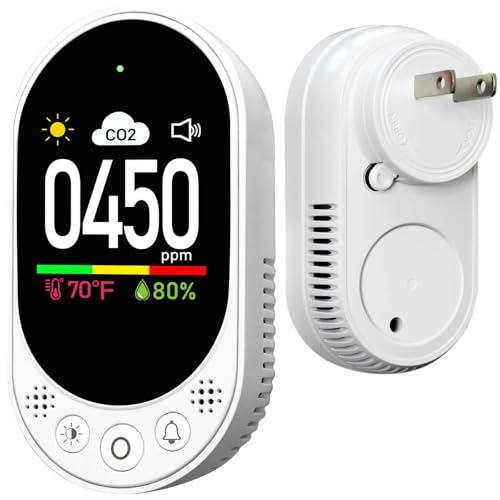
Best for Comfort – LSENLTY 3-in-1 CO2 Detector
The LSENLTY is a practical pick among carbon dioxide monitors for basements when you want a simple device that stays connected to a wall outlet. It measures CO2, temperature, and humidity, refreshes readings every two seconds, and provides an adjustable threshold reminder for ventilation.
Best For: Basement owners who prefer a compact, always-powered monitor with fast updates.
Pros:
- Plug-and-play design works with standard 110V–220V outlets.
- Measures CO2, temperature, and humidity with readings refreshed every two seconds.
- Lists accuracy of ±5% for CO2 and humidity, plus ±2.7°F for temperature.
- Offers adjustable thresholds and manual calibration.
Cons:
- It must remain plugged in, so placement is limited by outlet locations.
- It detects carbon dioxide only and is not a carbon monoxide, smoke, or combustible-gas detector.
- Manual calibration requires a 200-second cycle in a ventilated area.
This model keeps the setup simple and provides frequent updates, making it useful for a basement where you want an at-a-glance CO2 reading without managing a rechargeable battery.
Most Comprehensive – 10-in-1 Portable Air Quality Monitor
For shoppers comparing carbon dioxide monitors for basements, this portable model stands out by tracking CO2 alongside several additional air-quality indicators. Its color display, real-time readings, and compact design make it useful for checking basement conditions as well as other rooms.
Best For: Homeowners who want CO2 monitoring plus HCHO, TVOC, particulate matter, temperature, humidity, and AQI readings.
Pros:
- Measures CO2, HCHO, TVOC, PM1.0, PM2.5, PM10, temperature, humidity, and AQI.
- Three-color visualization helps identify changing air-quality conditions from a distance.
- Portable, rechargeable design is suitable for basements, bedrooms, offices, cars, and other spaces.
- Includes Bluetooth time calibration and selectable temperature units.
Cons:
- Its many measurements may be more than needed if you only want CO2 data.
- The supplied notes do not specify battery runtime or a stated CO2 measurement range.
This is the most versatile choice of the three for broader indoor-air monitoring. Choose it when understanding multiple potential air-quality factors in a basement matters more than having a simple, outlet-powered CO2 display.
Best Heavy-Duty Pick – Wall-Mounted CO2 Alarm Monitor
This plug-in model is a practical pick among carbon dioxide monitors for basements when you want continuous monitoring without charging batteries. It displays CO2, temperature, and humidity, while its audible and visual alarm can draw attention when levels exceed the selected threshold.
Best For: Users who prefer an always-powered monitor with a large display, customizable alarm, and quick refreshes.
Pros:
- Plugs directly into an outlet and starts monitoring without batteries.
- Tracks CO2, temperature, and humidity on a bright 1.83-inch color screen.
- NDIR sensor refreshes every two seconds and is rated for a five-year lifespan.
- Offers an adjustable alarm threshold, flashing red light, and 85dB buzzer.
Cons:
- Requires an available outlet, so placement is less flexible than a battery-powered monitor.
- It measures CO2, not carbon monoxide, and is not a replacement for smoke or CO alarms.
- The supplied notes do not list battery backup.
With its outlet-powered setup and configurable warning system, this is a strong fit for a basement where you want a monitor that can remain active continuously. Keep a separate certified carbon monoxide alarm in place for CO safety.
Best Battery Life – Portable CO2 Monitor with Stand
If you want carbon dioxide monitors for basements that can be moved between locations, this compact battery-powered unit is easy to place on a shelf or desk. It monitors CO2, temperature, and humidity and adds an alarm when CO2 reaches 1,500 ppm.
Best For: Users seeking a portable, rechargeable CO2 monitor with long stated battery life and a built-in stand.
Pros:
- Monitors CO2 from 0–9,999 ppm, temperature, and humidity in real time.
- 2000mAh battery provides up to 30 days of operation according to the supplied notes.
- Foldable stand and compact size make it easy to move around a basement or home.
- Audible and visual alerts activate above the 1,500 ppm threshold, with temporary mute control.
Cons:
- The preset alarm threshold may not suit every user or monitoring preference.
- It provides fewer air-quality measurements than a multi-sensor monitor.
- USB-C charging is still required when the battery needs replenishing.
This model balances portability, straightforward readings, and extended battery operation. It is especially convenient when basement monitoring is occasional or when you want to check several rooms without installing a device at a fixed outlet.
How We Picked the Best Carbon Dioxide Monitors for Basements
We focused on monitors that can display carbon dioxide levels clearly and work well in basement conditions. Key considerations included sensor type, readability, power or portability, measurement history, alarms, and whether the device also tracks temperature and humidity. Models using NDIR sensors received particular attention because this sensing method is widely used for non-dispersive infrared CO2 measurement and is generally preferable to less specialized alternatives.
We also considered practical placement. A basement monitor should be easy to position near a commonly used area without being obstructed, hidden in a corner, or placed directly beside a window, vent, heater, or dehumidifier.
Quick Comparison
| Type | Best for | Advantages | Potential trade-off |
|---|---|---|---|
| Portable monitor | Checking several rooms | Flexible placement and battery operation | Requires charging or battery replacement |
| Plug-in monitor | Continuous basement monitoring | Always powered and easy to read | Placement depends on an outlet |
| Multi-function monitor | Complete comfort tracking | CO2, temperature, and humidity in one display | More readings can make screens busier |
| Historical-data model | Finding ventilation patterns | Shows changes over time | May require more setup or menu navigation |
Key Buying Factors for Carbon Dioxide Monitors for Basements
Sensor Accuracy and Calibration
Look for a stated NDIR sensor and clear information about calibration. Automatic baseline calibration can be convenient, but it may be less suitable in a basement that stays elevated for long periods. Manual calibration and a documented outdoor reference procedure can provide more control.
Display, Alarms, and History
A large, high-contrast display is useful in dim basement rooms. Audible or visual alerts can draw attention when CO2 rises, while historical charts help reveal whether levels increase overnight, during gatherings, or when the space is occupied. Confirm whether the monitor shows actual CO2 values in parts per million rather than only a general air-quality score.
Power and Placement
Choose a plug-in design for a fixed monitoring station, or a rechargeable portable model if you want to compare the basement with upstairs rooms. Place it around breathing height in a representative occupied area, with unobstructed airflow. Temperature and humidity readings are valuable extras, especially in basements where dampness and condensation are common.
Who Should Buy Which Carbon Dioxide Monitors for Basements?
Choose a portable monitor if you want to investigate multiple rooms or move the device between a basement office, recreation area, and living space. A plug-in unit is the simplest choice for continuous readings in one finished basement, particularly when checking the room throughout the day. Buyers who also manage moisture should choose a model with temperature and humidity measurements. If you are trying to diagnose recurring stuffiness, prioritize a monitor with a history chart or trend display.
Regardless of which model you select, use the readings as a ventilation aid rather than a substitute for professional testing. A CO2 monitor measures carbon dioxide, not every indoor pollutant, and it does not replace smoke, carbon monoxide, radon, or humidity-specific safety equipment.