Carbon dioxide monitors make invisible ventilation problems easier to spot. By tracking indoor CO2 levels, these devices can help you decide when to open a window, improve airflow, or investigate a crowded room.
We selected 10 carbon dioxide monitors ranging from compact portable meters to desktop data loggers and dedicated alarm stations. The right choice depends on sensor accuracy, alarm features, battery life, display readability, and how you plan to use the readings.
Best 10 Carbon Dioxide Monitors Picks for 2026
Portable All-in-One Pick

- Measures CO2, AQI, temperature, and humidity
- Bright LED display with 400–5000 ppm range
- Rechargeable 1600mAh battery lasts up to 72 hours
Best For: Portable, multi-metric indoor air monitoring
Safety Alarm Pick

- Measures carbon monoxide from 0–1000 ppm
- Low and high alarms at 35 and 200 ppm
- Includes batteries and carrying pouch
Best For: Portable carbon monoxide safety checks
Long-Battery Wireless Pick
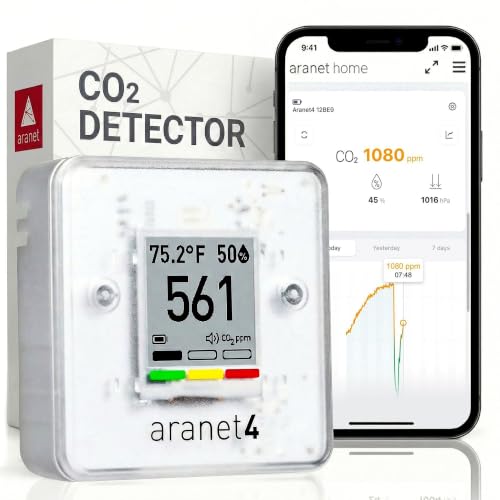
- Measures CO2 plus temperature, humidity, and pressure
- E-ink display offers up to four years of battery life
- App stores and graphs up to 90 days of data
Best For: Cable-free home and office monitoring
Commercial Alarm Station
TrolMaster AS-2 CO2 Alarm Station

- Provides LCD ppm readings with audio-visual alarms
- Green/yellow LEDs indicate below or above 800 ppm
- Connects to low, high, or both CO2 sensors
Best For: Mounted CO2 alerts in growing or commercial spaces
Best Data Logger
Extech CO210 Air Quality CO₂ Monitor

- Measures CO₂, temperature, and humidity
- Stores up to 5,333 entries per parameter
- Includes calibration options and audible alarms
Best For: Detailed indoor-air monitoring and historical data logging
Best Home Display
U UNNI Photoacoustic CO₂ Monitor
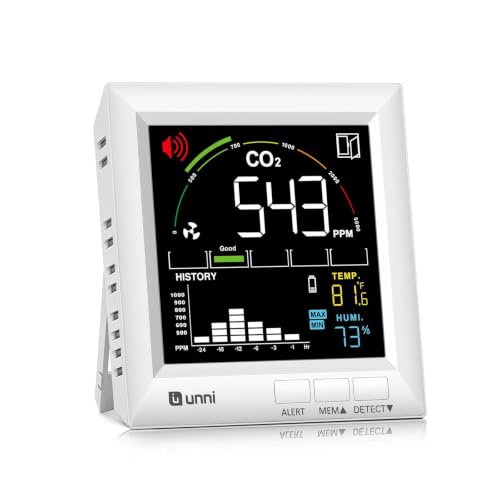
- Provides real-time CO₂, temperature, and humidity readings
- Includes history charts and adjustable alerts
- Supports USB power with AAA battery backup
Best For: Everyday monitoring in homes, RVs, and grow tents
Best Simple IAQ Monitor
Extech CO100 Carbon Dioxide Monitor

- Uses a maintenance-free NDIR CO₂ sensor
- Shows Good, Normal, or Poor air quality
- Includes adjustable high and low alarms
Best For: Straightforward indoor-air-quality checks
Best Portable CO2 Monitor
Temtop C1 CO2, Temperature & Humidity Monitor

- Measures CO2, temperature, and humidity
- NDIR sensor with five-second refresh rate
- Portable design with adjustable alerts and display
Best For: Portable monitoring in homes, offices, schools, and grow tents
Best Desktop CO2 Monitor
Extech CO220 Indoor Air Quality Monitor

- Measures CO2, temperature, humidity, dew point, and wet bulb
- Calculates TWA and STEL exposure values
- Stores 99 readings and includes high/low alarms
Best For: Fixed-location monitoring with logging and exposure calculations
Portable All-in-One Pick – Dienmern 5-in-1 CO2 Monitor
If you want carbon dioxide monitors that also track general comfort conditions, the Dienmern combines CO2, AQI, temperature, and humidity readings in one portable unit. Its bright display and rechargeable battery make it practical for home, office, travel, or grow-tent use.
Best For: Portable monitoring across rooms, offices, and other indoor spaces.
Pros:
- Tracks CO2, AQI, temperature, and humidity in real time.
- Uses a Swiss-made CO2 sensor with a 400–5000 ppm range and stated ±50 ppm accuracy.
- Bright, high-contrast LED display is designed for quick reading.
- 1600mAh battery provides up to 72 hours of operation per charge.
Cons:
- The manufacturer notes that readings may vary by approximately ±50 ppm.
- It requires USB charging when the battery is depleted.
The Dienmern is a flexible choice when you want more than a dedicated CO2 reading. Its combination of sensors, readable screen, and rechargeable design suits everyday indoor monitoring, though the stated sensor variation is worth keeping in mind.
Safety Alarm Pick – Klein Tools ET110 CO Meter
Among carbon dioxide monitors and related gas meters, the Klein Tools ET110 is specifically a carbon monoxide meter designed for exposure awareness. It provides numeric readings, two alarm thresholds, and a portable format for checking CO levels where immediate warnings matter.
Best For: Portable carbon monoxide measurement with audible and visual alerts.
Pros:
- Measures CO from 0 to 1000 ppm.
- Includes low-level 35 ppm and high-level 200 ppm alarms.
- Backlit display also shows temperature in Fahrenheit or Celsius.
- Includes four AAA batteries and a carrying pouch.
Cons:
- This is a carbon monoxide meter, not a carbon dioxide monitor.
- Auto-power-off activates after 20 minutes of inactivity.
The ET110 is a focused safety instrument rather than a general indoor-air monitor. Its threshold alarms and included accessories make it convenient for portable CO checks, but shoppers specifically seeking CO2 readings should choose a different product.
Long-Battery Wireless Pick – Aranet4 Indoor Air Monitor
The Aranet4 is one of the more convenient carbon dioxide monitors for continuous home or office use. Its wireless design, e-ink screen, NDIR sensor, and optional app history make it a strong fit for users who want clear readings without keeping the unit connected to a cable.
Best For: Long-term, cable-free CO2 tracking at home or in the office.
Pros:
- Measures CO2, temperature, relative humidity, and atmospheric pressure.
- Power-efficient e-ink display supports battery life of up to four years.
- Color coding, a prominent CO2 reading, and optional buzzer make elevated levels easier to notice.
- App provides up to 90 days of historical data with graphs.
Cons:
- Requires two AA batteries, although they are included.
- App history is limited to up to 90 days.
For buyers prioritizing low maintenance and historical trend review, the Aranet4 offers a polished monitoring experience. Its NDIR sensor and wireless operation are particularly useful when you want ongoing readings without a power cable.
Commercial Alarm Station – TrolMaster AS-2 CO2 Alarm Station
TrolMaster AS-2 CO2 Alarm Station (Audio/Visual) Plus LED Display Indicator with Cable Set
Check Price On AmazonThe TrolMaster AS-2 is a dedicated CO2 alarm station for spaces that need an externally visible status indicator. Rather than serving as a portable handheld monitor, it displays ppm levels through a mounted station with audio-visual alerts and color-coded LEDs.
Best For: Mounted CO2 status and alarm indication in controlled growing or commercial spaces.
Pros:
- Combines an audio-visual alarm with a color-coded LED indicator.
- LCD display shows the CO2 level in ppm.
- Green indicates levels below 800 ppm, while yellow indicates 800 ppm or higher.
- Can connect to low-level sensors, high-level sensors, or both for redundancy.
Cons:
- Designed for mounted use outside the monitored space rather than portable monitoring.
- Requires corded power and a compatible sensor connection.
- The supplied notes do not describe the station as an independent CO2 sensor.
The AS-2 makes the most sense as part of a larger CO2 monitoring setup. Its external display and clear green/yellow status system can help communicate room conditions at a glance, but it is less suitable for casual household use or travel.
Best Data Logger – Extech CO210 Air Quality CO₂ Monitor
For buyers who need more than a snapshot reading, the Extech CO210 is one of the more capable carbon dioxide monitors in this group. It measures CO₂ from 0–9,999 ppm while also recording temperature and relative humidity, with storage for thousands of readings and indoor air-quality status indicators.
Best For: Detailed indoor-air monitoring, offices, classrooms, and users who want historical data.
Pros:
- Measures CO₂, temperature, and relative humidity.
- Stores up to 5,333 entries per measured parameter.
- Offers automatic baseline calibration plus manual calibration.
- Includes visible and audible CO₂ alarms, USB/software, and an AC adapter.
Cons:
- Uses corded electric power rather than a battery-focused design.
- May be more feature-rich than needed for simple spot checks.
The CO210 stands out when logging and reviewing trends matter. Its broad measurement range, calibration options, and alarm functions make it a practical choice for ongoing air-quality oversight.
Best Home Display – U UNNI Photoacoustic CO₂ Monitor
The U UNNI monitor is a convenient choice for shoppers seeking carbon dioxide monitors for everyday home use. Its photoacoustic sensor provides real-time CO₂, temperature, and humidity readings, while the history chart, adjustable alerts, and backlight make changing room conditions easy to follow.
Best For: Homes, RVs, grow tents, and users who want a readable tabletop or wall-mounted monitor.
Pros:
- Uses a Swiss-made Sensirion photoacoustic CO₂ sensor.
- Displays real-time readings, history, temperature, and humidity.
- Offers three alarm-volume settings and three backlight levels.
- Can run by USB with AAA battery backup.
Cons:
- AAA backup batteries are not included.
- Its CO₂ detection range is 400–5,000 ppm, narrower than some models.
- Manual calibration requires a standard 400 ppm environment and a specific process.
This model balances useful home-focused features with flexible placement and power options. It is especially appealing if you want a continuously visible display and reminders to improve ventilation.
Best Simple IAQ Monitor – Extech CO100 Carbon Dioxide Monitor
The Extech CO100 is a straightforward option for buyers comparing carbon dioxide monitors for basic indoor-air-quality checks. It uses a maintenance-free NDIR sensor, displays CO₂ in ppm, and classifies readings as Good, Normal, or Poor for quick interpretation.
Best For: Simple indoor-air-quality monitoring in rooms, offices, and other everyday spaces.
Pros:
- Uses a maintenance-free non-dispersive infrared CO₂ sensor.
- Provides Good, Normal, and Poor air-quality indications.
- Includes user-adjustable high and low audible alarms.
- Also measures temperature and humidity.
Cons:
- Does not list data-logging capability in the supplied specifications.
- Its feature set is less extensive than the CO210 logger.
- Includes a universal AC adapter, while the listed power details also identify it as battery powered.
The CO100 is a sensible pick when clear IAQ status levels and adjustable alarms matter more than stored measurement history. Its NDIR sensor and simple status display keep routine monitoring uncomplicated.
Best Portable CO2 Monitor – Temtop C1 CO2, Temperature & Humidity Monitor
If you want a compact way to track carbon dioxide monitors readings alongside temperature and humidity, the Temtop C1 is a practical choice for rooms that need flexible placement. It measures CO2 from 400–5000 ppm, refreshes readings every five seconds, and offers adjustable alerts for home, office, school, nursery, or grow-tent use.
Best For: Portable room monitoring, especially where temperature and humidity readings are useful alongside CO2 data.
Pros:
- Measures CO2, temperature, and humidity in one compact device.
- Uses NDIR sensing with stated accuracy of ±40 ppm + 5% of the reading within 400–2500 ppm.
- Offers up to 70 days of standby battery life and customizable sound and display settings.
- Supports versatile mounting and includes a cable, manual, and bracket or accessory set.
Cons:
- For the most current real-time monitoring, the manufacturer advises keeping it plugged in.
- It detects carbon dioxide, not carbon monoxide.
The Temtop C1 stands out when portability and multiple basic measurements matter more than extensive pollutant tracking. Its sleep-friendly controls and long standby claim add convenience for continuous household monitoring.
Best Multi-Sensor CO2 Monitor – Lwyinp MT13S 10-in-1 Air Quality Monitor
Among carbon dioxide monitors, the Lwyinp MT13S is designed for shoppers who want a broader indoor air snapshot rather than CO2 alone. Its 10-in-1 setup tracks CO2, formaldehyde, TVOC, particulate matter, temperature, humidity, and AQI on a color display, with Bluetooth connectivity for time calibration.
Best For: Users who want one portable monitor for CO2, particulate matter, VOC-related readings, and basic environmental conditions.
Pros:
- Measures CO2, HCHO, TVOC, AQI, PM2.5, PM1.0, PM10, temperature, and humidity.
- Uses a three-color screen system to make changing air-quality conditions easier to notice.
- Provides portable use across homes, offices, cars, schools, hotels, and other listed spaces.
- Includes smart calibration features and Bluetooth time calibration through the MT13S connection.
Cons:
- The controls rely on specific button-press sequences that may take time to learn.
- The supplied notes do not specify a battery runtime or individual measurement ranges.
The MT13S is the more feature-packed option in this group, particularly for buyers who want particulate and chemical indicators alongside CO2. Its color visualization may also help users spot threshold changes at a glance.
Best Desktop CO2 Monitor – Extech CO220 Indoor Air Quality Monitor
The Extech CO220 is a desktop-focused option for buyers comparing carbon dioxide monitors with more formal exposure-tracking features. Along with CO2, it measures temperature, humidity, dew point, and wet-bulb temperature, while its NDIR sensor, alarms, memory, and TWA/STEL calculations support ongoing indoor assessments.
Best For: Desk-based monitoring where logged readings, exposure averages, and audible CO2 alarms are priorities.
Pros:
- Measures CO2 from 0–9,999 ppm with 1 ppm resolution, plus temperature and humidity.
- Calculates eight-hour TWA and 15-minute STEL values.
- Stores up to 99 manually logged readings with date and time.
- Includes high/low CO2 alarms, automatic baseline calibration, an AC adapter, and a stated two-year warranty when purchased through FLIR.
Cons:
- Its desktop design and included AC adapter make it less suited to portable monitoring.
- The supplied notes describe an audible alarm but do not mention a battery power option.
The CO220 is a strong fit for structured monitoring rather than casual spot checks. Its memory and TWA/STEL calculations give it an advantage for users who want historical context and exposure-oriented readings at a fixed location.
How We Picked These Carbon Dioxide Monitors
We focused on monitors with practical indoor-air-quality applications and considered the features that matter most in everyday use: CO2 sensing technology, measurement range, display clarity, portability, battery operation, alarms, data logging, and extra readings such as temperature and humidity. Models suited to different settings—including homes, offices, classrooms, workshops, and specialized growing environments—are represented.
We also separated CO2 monitors from carbon monoxide meters where possible. Carbon dioxide and carbon monoxide are different gases, so a CO2 monitor should not be treated as a substitute for a certified carbon monoxide alarm.
Quick Comparison
- Best for portable monitoring: Look for a rechargeable battery, compact design, and clear real-time display.
- Best for home or office use: Prioritize a reliable sensor, easy-to-read screen, and temperature or humidity readings.
- Best for classrooms and shared spaces: Choose visible alarms, simple operation, and optional data logging.
- Best for detailed analysis: Select a data logger with historical records, adjustable intervals, and export options.
- Best for fixed installations: Consider a dedicated alarm station with audio/visual alerts and suitable mounting or cabling.
Key Buying Factors for Carbon Dioxide Monitors
Sensor Type and Accuracy
NDIR sensors are widely used for indoor CO2 measurement and are generally preferred for dependable readings. Photoacoustic sensors are another option found in newer compact monitors. Check the stated accuracy, measurement range, calibration method, and whether the device supports automatic or manual calibration.
Alarms and Display
A large, continuously visible display is useful when you want to adjust ventilation quickly. Threshold alarms are more helpful in busy rooms, especially when an audible or visual alert can be noticed without checking the screen. Confirm whether alarm limits are adjustable and whether the alarm can be muted.
Portability, Power, and Logging
Battery-powered models are convenient for checking several rooms, while plug-in desktop units work well in a fixed location. For diagnosing recurring ventilation issues, data logging is often more valuable than portability. Consider memory capacity, sampling intervals, charging time, and whether readings can be reviewed or exported.
Extra Measurements
Temperature and humidity readings add useful context because comfort and ventilation decisions depend on more than CO2 alone. Some devices also calculate dew point or wet-bulb temperature. These extras are helpful, but they should not distract from the quality and usability of the CO2 measurement.
Who Should Buy Which Carbon Dioxide Monitors?
Choose a portable monitor if you want to compare bedrooms, offices, classrooms, or travel locations. A rechargeable model with a clear screen is the most flexible option.
Choose a desktop monitor for a home office, living room, or permanent workspace where continuous visibility matters more than battery operation.
Choose a data logger if you need to identify patterns over hours or days, such as CO2 increases during meetings, lessons, or overnight occupancy.
Choose a dedicated alarm station when immediate audio/visual warnings and fixed placement are more important than portability. Before buying, verify the intended environment, installation requirements, and any local safety standards.