Wondering which appliances are driving your electric bill? A circuit monitor with CT clamps measures current at the panel, helping you spot usage patterns without replacing outlets or appliances.
These six options range from simple two-channel meters to systems with 16 branch-circuit sensors. The right choice depends on what you need to measure, whether your panel has room for the hardware, and how much setup you can take on.
Best 6 Circuit Monitor with Ct Clamps Picks for 2026
Three-Circuit Pick
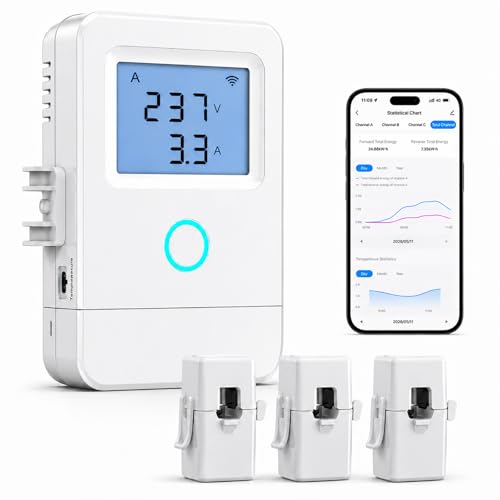
- Three included 80A CT clamps
- Smart Life/Tuya usage history
- Temperature alerts above 50°C
Best For: Monitoring three major household circuits
Multi-Circuit Pick

- Sixteen included 50A sensors
- Custom time-of-use cost tracking
- Optional LAN-only MQTT mode
Best For: Multi-circuit monitoring and rental cost allocation
Safety-Certified Pick

- UL and CE listed
- Eight circuit sensors included
- Solar and time-of-use features
Best For: Safety-conscious whole-home and eight-circuit monitoring
Best for Local Control
SEM-Meter 8-Circuit Energy Monitor

- Eight included 50A circuit sensors
- Expandable by up to eight sensors
- Local MQTT mode without cloud or app
Best For: Multi-circuit tracking with local-network control
Best for Extensive Circuit Coverage
Siemens Inhab 16-Circuit Monitor

- Sixteen 50A branch-circuit sensors
- Two 200A main sensors included
- Custom alerts and advanced energy features
Best For: Whole-home and detailed branch-circuit monitoring
Best for Two High-Load Channels
Tuya-Compatible Dual-80A Monitor

- Two independent 80A channels
- Bi-directional power tracking
- Tuya or Smart Life usage history
Best For: Two selected loads or directional power monitoring
Three-Circuit Pick – WiFi Monitor with 3 CT Clamps
If you need a circuit monitor with ct clamps for a few major loads rather than every breaker, this model includes three 80A clamps for selected circuits. The Smart Life or Tuya app displays voltage, current, power, and energy use over 2.4GHz WiFi.
Best For: Tracking up to three dedicated loads, such as HVAC, a water heater, or laundry equipment.
Pros:
- Includes three CT clamps for comparing selected circuits.
- Provides historical energy data and app-based channel switching.
- Includes a temperature sensor with alerts above 50°C.
Cons:
- Monitors only three selected circuits at once.
- Requires hardwired panel installation; a qualified electrician is recommended if you are unfamiliar with panel wiring.
Its limited channel count makes it a practical choice for targeted monitoring. It also supports remote on/off control for one connected circuit, subject to the relay’s 15A limit.
Multi-Circuit Pick – SEM-Meter with 16 Sensors
For buyers who need a circuit monitor with ct clamps across many branch circuits, the SEM-Meter includes sixteen 50A sensors. Its app shows real-time usage and costs, with customizable time-of-use rates for comparing rooms or circuits.
Best For: Monitoring multiple circuits in a home, rental property, or shared apartment.
Pros:
- Includes 16 sensors for circuit-level tracking.
- Supports cost allocation using peak, off-peak, and holiday pricing templates.
- Offers a LAN-only MQTT privacy mode for Home Assistant users.
- Supports solar and net-metering monitoring.
Cons:
- Requires installation inside the electrical panel.
- Panels with access only to busbars need separate flexible sensors from SEM-Meter.
- LAN-only operation requires Home Assistant with MQTT.
This is the more flexible choice here when circuit count and cost allocation matter. Its standard app connection uses 2.4GHz WiFi, while the MQTT mode offers an alternative for a compatible local setup.
Safety-Certified Pick – Emporia Vue 3 with 8 Sensors
The Emporia Vue 3 is a circuit monitor with ct clamps for buyers who want a UL-listed panel monitor with app-based energy management. This configuration includes eight circuit sensors and supports solar and net-metering monitoring.
Best For: Homeowners seeking UL-listed monitoring for whole-home use and up to eight circuits.
Pros:
- UL and CE listed.
- Includes eight circuit sensors in this configuration.
- App settings support time-of-use, peak-demand, and excess-solar energy management.
- Offers iPhone, Android, and web app access.
Cons:
- Requires 2.4GHz WiFi and an internet connection for monitoring.
- One-second data is available only while the app is actively open and is retained for three hours.
- Supported three-phase Wye setups require an additional 200A sensor, sold separately.
Vue 3 balances circuit visibility with automation features, but its cloud-connected data retention is worth checking against your reporting needs: minute data is kept for seven days, while hourly data is retained indefinitely.
Best for Local Control – SEM-Meter 8-Circuit Energy Monitor
If you want a circuit monitor with CT clamps and the option to keep energy data on your own network, the SEM-Meter is a strong fit. It includes eight 50A clamp-on sensors for individual circuits and supports monitoring through its app or a local MQTT server.
Best For: Homeowners who want multi-circuit monitoring with a local-network option for Home Assistant setups.
Pros:
- Includes eight 50A circuit sensors and supports up to eight additional sensors.
- Offers real-time readings, usage history, and solar/net-metering monitoring.
- Can run on a LAN using your own MQTT server without the manufacturer’s cloud or app.
Cons:
- Requires 2.4GHz Wi-Fi for the app-connected setup.
- Panels with access only to busbars need separately available flexible sensors.
The eight included clamps cover a useful set of major loads, while the MQTT option stands out if you prefer local data control. Check panel access and sensor requirements before ordering.
Best for Extensive Circuit Coverage – Siemens Inhab 16-Circuit Monitor
For a circuit monitor with CT clamps that measures both whole-home use and many individual loads, the Siemens Inhab includes two 200A main sensors and sixteen 50A circuit sensors. Its mobile app shows current and historical usage for homes in the USA and Canada.
Best For: Households that need direct measurement across the mains and up to 16 branch circuits.
Pros:
- Includes sensors for two mains and up to 16 branch circuits.
- Supports custom alerts for unusual usage or savings opportunities.
- Offers time-of-use, peak-demand, net-metering, and excess-solar features.
- UL Listed in the US and Canada.
Cons:
- The mobile app is specified for the USA and Canada only.
- Its larger sensor set calls for planning space and placement in the electrical panel.
Inhab is the most comprehensive included sensor package of these three choices. It makes particular sense when whole-home totals and detailed circuit readings are both priorities.
Best for Two High-Load Channels – Tuya-Compatible Dual-80A Monitor
If you need a circuit monitor with CT clamps for just two loads or power paths, this dual-channel model supplies two 80A clamp-style sensors. It reports real-time electrical data and usage history through the Tuya or Smart Life app.
Best For: Monitoring two major household circuits or tracking power flow in a solar or backup-power setup.
Pros:
- Two independent 80A sensing channels cover selected high-load circuits.
- Shows power, voltage, current, power factor, and historical records in the app.
- Bi-directional monitoring helps distinguish the direction of power flow.
Cons:
- Only two channels are included, limiting circuit-by-circuit coverage.
- Setup requires a 2.4GHz Wi-Fi connection and the Tuya or Smart Life app.
This is a focused choice rather than a panel-wide monitor: its appeal is tracking two selected circuits, particularly when directional power information matters.
How We Picked the Best Circuit Monitor with Ct Clamps
We focused on practical differences visible in the selected products’ descriptions: the number and stated ratings of included CT clamps, main-feed versus branch-circuit coverage, app-based tracking, and installation requirements. Those specifications help narrow the field, but they do not establish measurement accuracy, electrical compatibility, or app quality on their own. Verify those details against current manufacturer documentation before buying.
Quick Comparison: How Much Do You Need to Measure?
The two-channel 2×80A WiFi meter is a starting point for monitoring two conductors or loads, provided its wiring configuration matches your setup. The hardwired WiFi monitor with three 80A clamps offers one more measurement channel. The eight-sensor, 50A model suits buyers who want visibility into several branch circuits without filling the panel with 16 sensors.
For broader circuit-level tracking, compare the 16-sensor smart monitor with the Siemens Inhab, which lists sixteen 50A circuit sensors plus two 200A main sensors. The Emporia Vue 3 is another option for buyers interested in whole-home monitoring and smart-home features; check the exact bundle for its included sensors and supported integrations.
Key Buying Factors for a Circuit Monitor with Ct Clamps
Panel and Electrical Compatibility
Confirm that the monitor supports your service configuration, voltage, frequency, and panel layout. Check the CT opening against the diameter of the conductors you intend to measure—not the breaker size. CT amperage ratings also need to suit those conductors. Some systems require a compatible breaker for power, while others have different hardwired requirements.
Sensor Count and Placement
Decide whether you need total household usage, a few high-cost loads, or individual branch circuits. Count the conductors that require sensors, including any relevant solar or subpanel feeds. A 16-sensor kit can be useful for a busy panel, but extra clamps will not help if there is insufficient room to install and route them safely.
App Data and Ongoing Costs
Look for the history and cost estimates you will actually use. Ask whether the app supports your electricity rate structure, whether data can be exported, and what happens if WiFi or the vendor’s cloud service is unavailable. Check for subscription fees and confirm compatibility with any automation platform you rely on.
Who Should Buy Which Circuit Monitor with Ct Clamps?
Choose a two- or three-channel monitor if your goal is limited, clearly defined measurement and you do not need a circuit-by-circuit breakdown. An eight-sensor kit is a middle ground for tracking major loads. Consider a 16-sensor system if detailed panel coverage matters; the Siemens Inhab’s listed main sensors make it especially worth comparing when you also want whole-home totals. Consider Emporia Vue 3 if its verified bundle and integrations fit your existing setup.
Electrical panels contain hazardous live parts. Before ordering, confirm fit and installation requirements with the manufacturer and use a qualified electrician where required or appropriate. Renters should obtain permission before any panel installation.