Choosing the right clamp meter can make electrical checks faster, safer, and more informative during home inspections.
This 2026 roundup highlights the best options for measuring current, voltage, continuity, and more without slowing down your workflow.
Best 10 Clamp Meters for Home Inspectors Picks for 2026
Dual-Display Precision
Klein Tools CL490 AC/DC Digital Clamp Meter

- Dual front and bottom displays
- Measures AC/DC current plus many lead tests
- Backlit reverse-contrast LCD with TRMS
Best For: Home inspectors who want broad electrical testing in one meter
Compact Pro Pick
Fluke 362 200A AC/DC Clamp Meter

- Compact, thin body for one-hand use
- Measures 200A AC/DC and 600V AC/DC
- Includes resistance, continuity, zero, and data hold
Best For: Inspectors who want a compact, reliable clamp meter
Breaker-Finding Helper
Ideal 61-747 TightSight Clamp Meter

- Instant tracing for energized circuits
- Auto-maps breaker locations
- 400A AC/DC with 600V TRMS
Best For: Inspectors who need faster breaker and circuit identification
HVAC-Ready Choice
Klein Tools CL445 HVAC Clamp Meter

- Measures current, inrush, NCVT, and more
- Dual voltage/current display with TRMS
- Includes case, leads, clips, thermocouple, and batteries
Best For: Inspectors who want HVAC-focused functions and broad test capability
Commercial/Residential Pick
Fluke 323 400A AC True RMS Clamp Meter

- AC current to 400 A
- True RMS sensing for accurate readings
- CAT IV 300V / CAT III 600V safety rating
Best For: Home inspectors who need dependable AC-only clamp measurements and basic electrical troubleshooting.
Feature-Rich Choice
Klein Tools CL390 AC/DC Clamp Meter
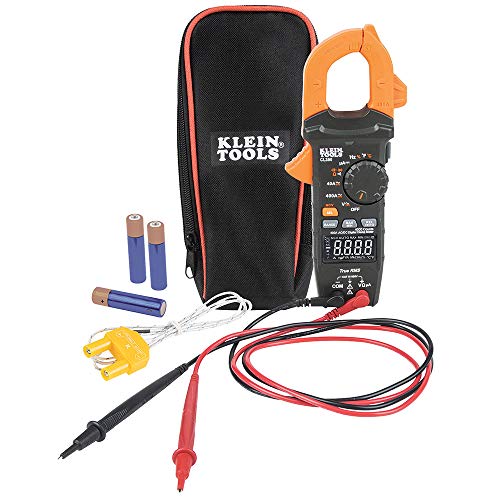
- AC/DC current up to 400 A
- NCVT plus multiple test functions
- Reverse-contrast display for better visibility
Best For: Inspectors who want a versatile clamp meter with broad test coverage and non-contact voltage checking.
Compact Value Pick
Fluke 302+ 400A AC Clamp Meter

- Compact 30 mm jaw design
- AC current to 400 A plus AC/DC voltage
- CAT IV 300 V / CAT III 600 V safety rating
Best For: Inspectors who want a compact, straightforward clamp meter for basic current and voltage checks.
Starter Pick
Klein CL120 Clamp Meter for Home Inspectors
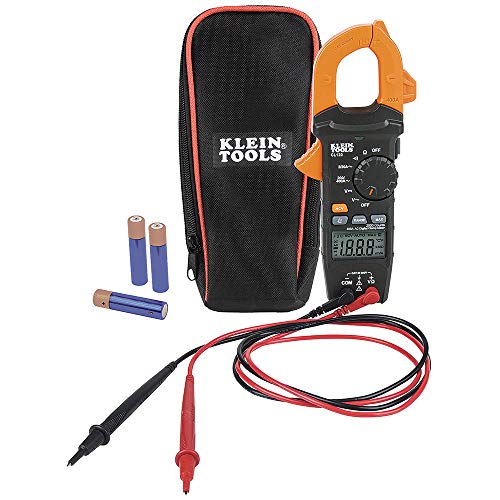
- AC clamp plus AC/DC voltage, resistance, and continuity
- Integrated non-contact voltage testing in the clamp jaw
- Backlit display with auto-ranging and data hold
Best For: Home inspectors who want a simple, reliable meter for basic electrical checks
Advanced Pick
Klein CL900 TRMS Clamp Meter for Home Inspections

- TRMS clamp meter with AC/DC current up to 2000A
- LoZ mode and inrush current capture for tougher diagnostics
- Also measures frequency, duty cycle, diode test, and capacitance
Best For: Home inspectors who need advanced measurement features and better diagnostic flexibility
Temperature Pick
Klein CL220 Clamp Meter for Home Inspectors

- AC clamp meter with voltage, resistance, continuity, and temperature
- Integrated NCVT and TRMS for practical field use
- Backlit display and auto-ranging for easier readings
Best For: Home inspectors who want basic electrical testing plus temperature measurement
Dual-Display Precision – Klein Tools CL490 AC/DC Digital Clamp Meter
For clamp meters for home inspectors, the Klein Tools CL490 stands out as a versatile everyday tester. It handles AC/DC current through the clamp and adds AC/DC voltage, resistance, continuity, frequency, duty cycle, DC microamps, diode test, capacitance, temperature, and NCVT detection through the leads and jaw, making it useful for a wide range of residential checks.
Best For: Home inspectors who want a feature-rich clamp meter with dual displays and broad test coverage.
Pros:
- Dual-display layout helps with visibility from different viewing angles.
- Auto-ranging TRMS support is built for more accurate measurements.
- Backlit reverse-contrast LCD improves readability in dim areas.
- Includes NCVT detection and a range of electrical test functions.
Cons:
- Magnetic hanger is optional and sold separately.
- More capable than a basic clamp meter, so it may be more tool than some users need.
The CL490 is a strong fit if you want one meter to cover inspection-day electrical checks without constantly swapping tools. Its combination of dual displays, TRMS accuracy, and broad function set makes it especially practical for general home inspection workflows.
Compact Pro Pick – Fluke 362 200A AC/DC Clamp Meter
The Fluke 362 is a compact choice in clamp meters for home inspectors when you want a simple, professional tool for current and voltage checks. It measures up to 200A AC/DC current and 600V AC/DC voltage, with resistance, continuity, zero function for DC readings, and data hold for quick troubleshooting.
Best For: Inspectors who prioritize a compact body, one-hand use, and trusted brand reliability.
Pros:
- Thin, light body with an 18mm triangular jaw for tight spaces.
- CAT III 600V rating supports demanding electrical environments.
- Large display is easy to read during quick checks.
- Useful basics like resistance, continuity, zero, and data hold.
Cons:
- More limited feature set than multifunction inspection-oriented meters.
- 200A clamp capacity may be enough for many tasks, but not the highest in this group.
If you want a straightforward meter that favors portability and dependable core readings, the Fluke 362 makes sense. It is a good match for inspectors who value access in tight panels and a no-nonsense layout over extra specialty functions.
Breaker-Finding Helper – Ideal 61-747 TightSight Clamp Meter
Among clamp meters for home inspectors, the Ideal Electrical 61-747 is aimed at speeding up electrical checks with instant tracing and breaker mapping. It offers 400A AC/DC and 600V TRMS performance, making it a practical option for residential and commercial troubleshooting where clear circuit identification matters.
Best For: Inspectors who want a clamp meter that helps trace energized circuits and reduce guesswork.
Pros:
- Instant tracing detects energized circuits quickly.
- Auto-maps breaker locations to cut down on guesswork.
- 400A AC/DC and 600V TRMS support broad testing needs.
- Rugged build is designed for jobsite durability.
Cons:
- Supplied notes focus on tracing features more than detailed measurement extras.
- May appeal most to users who specifically value breaker-location workflow tools.
This model stands out if your inspection routine includes a lot of circuit identification work. The combination of tracing support, breaker mapping, and rugged construction makes it a smart pick for faster electrical diagnosis.
HVAC-Ready Choice – Klein Tools CL445 HVAC Clamp Meter
The Klein Tools CL445 is a strong all-around option in clamp meters for home inspectors, especially if HVAC-related checks are part of the job. It measures AC current, inrush, and NCVT through the clamp, while also handling AC/DC voltage, resistance, continuity, frequency, duty cycle, DC microamps, diode test, capacitance, and temperature through the leads.
Best For: Inspectors who want HVAC-friendly functions plus a full set of electrical test capabilities.
Pros:
- Dual voltage and current display makes readings easier to track.
- TRMS auto-ranging supports accurate measurements.
- Includes inrush, max/min, data hold, and NCVT features.
- Comes with a carrying case, test leads, alligator clips, thermocouple, and batteries.
Cons:
- Built with HVAC professionals in mind, so it may be more specialized than a basic home-inspection meter.
- Optional magnetic hanger is sold separately.
The CL445 is the most feature-packed of the group for HVAC-style inspection work and general electrical testing. If you want a meter that can handle current, inrush, temperature, and broader lead-based measurements in one package, it is a very capable pick.
Commercial/Residential Pick – Fluke 323 400A AC True RMS Clamp Meter
If you need clamp meters for home inspectors that focus on core electrical checks, the Fluke 323 keeps things straightforward. It measures AC current up to 400 A, AC/DC voltage up to 600 V, and resistance with continuity detection, making it a practical choice for common troubleshooting tasks around residential and light commercial systems.
Best For: Home inspectors who want a simple, safety-rated clamp meter for AC current, voltage, and continuity checks.
Pros:
- Measures AC current to 400 A with a 30 mm jaw opening.
- True RMS sensing helps with linear and non-linear loads.
- Includes resistance measurement up to 4 kΩ plus continuity detection.
- CAT IV 300V / CAT III 600V safety rating with IEC 61010-1 compliance.
Cons:
- Does not measure DC current.
- Fewer advanced functions than multi-feature clamp meters.
For inspectors who mainly need reliable AC current and voltage readings, this Fluke model offers a focused toolset and strong safety ratings. It is a solid fit when you want accuracy and simplicity without extra complexity.
Feature-Rich Choice – Klein Tools CL390 AC/DC Clamp Meter
For home inspectors who want one of the more versatile clamp meters for home inspectors, the Klein Tools CL390 covers a lot of ground. It measures AC/DC current up to 400 A, AC/DC voltage, resistance, continuity, frequency, duty cycle, capacitance, temperature, and even DC microamps through the test leads, plus NCVT through the clamp jaw.
Best For: Inspectors who want a multi-function clamp meter with both clamp and lead-based testing options.
Pros:
- Measures AC/DC current up to 400 A with True RMS accuracy.
- Built-in NCVT in the clamp jaw adds convenient non-contact voltage testing.
- Supports a wide range of tests, including frequency, duty cycle, capacitance, and temperature.
- Reverse-contrast display improves visibility in different lighting conditions.
Cons:
- More features may be more than some basic inspection workflows require.
- Optional magnetic hanger is sold separately.
If you want broader diagnostic capability in one meter, the CL390 stands out as a flexible option. It is especially useful when you expect to handle more than basic current and voltage checks during an inspection.
Compact Value Pick – Fluke 302+ 400A AC Clamp Meter
If you prefer a compact option among clamp meters for home inspectors, the Fluke 302+ is built for straightforward electrical checks. It measures AC current up to 400 A, AC/DC voltage up to 600 V, and includes a 30 mm jaw, making it a practical fit for basic troubleshooting on larger conductors.
Best For: Inspectors who want a simple, compact clamp meter for essential current and voltage measurements.
Pros:
- Compact design with a 30 mm jaw for larger conductors.
- Measures AC current up to 400 A and AC/DC voltage up to 600 V.
- Includes 1.8% accuracy for troubleshooting tasks.
- CAT IV 300 V / CAT III 600 V safety rating.
Cons:
- AC current measurement only; no DC current reading.
- Less feature-rich than multi-function clamp meters.
The Fluke 302+ is a good fit when you want a smaller, easier-to-use meter that still covers the basics. It focuses on the measurements most commonly needed for quick inspection work and keeps the experience simple.
Starter Pick – Klein CL120 Clamp Meter for Home Inspectors
If you need clamp meters for home inspectors that cover the everyday electrical checks without getting overly complex, the Klein Tools CL120 is a practical starting point. It measures AC current with the clamp, while AC/DC voltage, resistance, and continuity are handled through the test leads. The built-in non-contact voltage tester in the clamp jaw adds quick convenience for routine inspection work.
Best For: Home inspectors who want a straightforward clamp meter for basic electrical checks, NCVT testing, and low-light use.
Pros:
- Measures AC current plus AC/DC voltage, resistance, and continuity
- Integrated NCVT in the clamp jaw for convenient testing
- Backlit LCD helps in dim spaces
- Auto-ranging and data hold add easy everyday use
Cons:
- Limited to 400A AC current measurement
- No temperature or advanced specialty functions listed
For inspections centered on basic electrical verification, the CL120 keeps the feature set focused and useful. It is a good fit when you want simple readings, a compact tool set, and the added convenience of non-contact voltage detection.
Advanced Pick – Klein CL900 TRMS Clamp Meter for Home Inspections
For home inspectors who want clamp meters for home inspectors with more measurement depth, the Klein Tools CL900 adds a wider feature set than a basic clamp meter. It measures AC/DC current, inrush current, and NCVT through the clamp, and supports AC/DC voltage, resistance, continuity, frequency, duty cycle, diode test, and capacitance through the test leads. TRMS, LoZ mode, and a 2000A rating make it a strong choice for more demanding electrical evaluations.
Best For: Home inspectors who need a feature-rich clamp meter with TRMS, LoZ, and inrush current capture.
Pros:
- Measures AC/DC current up to 2000A with TRMS accuracy
- LoZ mode helps eliminate ghost voltages
- Dedicated inrush current mode for motor-start checks
- Includes frequency, duty cycle, diode test, capacitance, and temp support via leads
Cons:
- More features than many basic inspection jobs require
- Larger feature set may take longer to learn
If you want one clamp meter that can handle both routine and more advanced inspection tasks, the CL900 stands out. Its combination of TRMS, LoZ, and inrush measurement makes it especially useful when troubleshooting uncertain readings.
Temperature Pick – Klein CL220 Clamp Meter for Home Inspectors
The Klein Tools CL220 is a balanced option for clamp meters for home inspectors who want the core electrical functions plus temperature capability. It measures AC current and NCVT through the clamp, while AC/DC voltage, resistance, and continuity are handled via the test leads. The included thermocouple adds temperature readings, which can be helpful when you want a little more utility from a single meter.
Best For: Home inspectors who want a clamp meter with basic electrical testing and temperature measurement in one tool.
Pros:
- Measures AC current, voltage, resistance, continuity, and temperature
- Integrated NCVT in the clamp jaw for quick checks
- TRMS and auto-ranging support accurate readings
- Backlit display helps visibility in low-light areas
Cons:
- AC current rating is limited to 400A
- No advanced modes like LoZ or inrush current listed
The CL220 makes sense if you want a practical inspection meter with a temperature feature added on top of the basics. It is a straightforward, versatile choice when you need core electrical checks and occasional temperature readings.
How We Picked These Clamp Meters for Home Inspectors
We focused on Clamp Meters for Home Inspectors that balance ease of use, safety, and broad measurement coverage. Priority went to models with auto-ranging, clear displays, non-contact voltage detection, and the ability to handle both basic and advanced diagnostic tasks. We also looked at jaw size, TRMS support, voltage range, and whether the meter includes helpful extras such as temperature, microamps, or low-impedance functions.
Quick Comparison: What Matters Most
If you want a simple inspection tool, a basic AC clamp meter with voltage and resistance may be enough. If you inspect HVAC equipment, look for temperature and microamp capabilities. For broader electrical troubleshooting, AC/DC support, TRMS, and NCVT can add flexibility. High-current and advanced troubleshooting models are better suited to inspectors who regularly evaluate panels, appliances, or mixed electrical systems.
Key Buying Factors for Clamp Meters for Home Inspectors
Measurement Range and AC/DC Support
Most home inspection work benefits from AC current, voltage, resistance, and continuity testing. AC/DC capability is useful when you need broader diagnostic coverage across modern electrical systems and accessories. Make sure the meter’s current range fits your typical use so you are not paying for capacity you will rarely need.
TRMS and Display Readability
TRMS is a strong advantage when checking non-linear loads, which can show up in real homes. A bright, easy-to-read display matters just as much, especially in panel spaces, crawl areas, and attics. Dual displays and backlighting can improve speed and confidence in the field.
Safety and Convenience Features
NCVT detection, auto-ranging, and sturdy jaw design help streamline inspections. Low-impedance or LoZ functionality can be valuable when you need to reduce ghost voltage confusion. Temperature measurement is especially helpful for HVAC-related inspections, while inrush current can aid motor and appliance checks.
Size, Jaw Opening, and Portability
Compact meters are easier to carry and maneuver around crowded electrical panels. Larger jaws help with thicker conductors and busier service equipment. For most inspectors, a comfortable mid-size meter offers the best balance of portability and capability.
Who Should Buy Which Clamp Meters for Home Inspectors?
If you want a straightforward everyday option, choose a basic 400A meter with voltage, resistance, and continuity. If you need stronger diagnostic depth, select a TRMS AC/DC model with NCVT and temperature. Inspectors who often work around HVAC systems or troubleshoot equipment should prioritize microamps, inrush, and temperature functions. If you need maximum versatility, a higher-capacity meter with LoZ and broader feature coverage is the most future-proof choice.
In short, the best Clamp Meters for Home Inspectors are the ones that match your inspection scope, improve speed, and provide trustworthy readings without adding unnecessary complexity.