A damp basement can encourage mold, musty odors, condensation, and damage to stored belongings before visible problems appear. A digital hygrometer gives you a simple way to track humidity and temperature so you can respond sooner.
We’ve selected 10 digital hygrometers for basements, including compact standalone meters, multipacks for monitoring several areas, and Bluetooth-enabled options for checking conditions from your phone.
Best 10 Digital Hygrometers for Basements Picks for 2026
Best Overall Value

- Dry/comfort/wet indicator
- High and low records
- Tabletop or magnetic placement
Best For: Simple, at-a-glance basement monitoring
Best Smart Monitoring
Govee H5075 Bluetooth Hygrometer
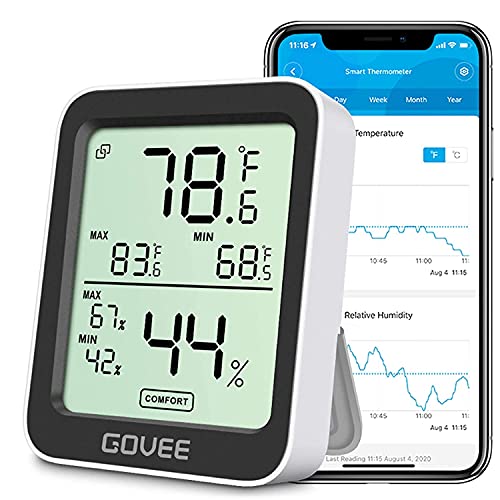
- Bluetooth app monitoring
- Alerts and historical graphs
- Two-year data export
Best For: Remote basement humidity tracking
Best Two-Pack

- Two monitors included
- High/low records
- Magnetic or tabletop placement
Best For: Comparing humidity in multiple locations
Best Compact Design
DOQAUS Mini Digital Hygrometer

- Five-second refresh rate
- Three mounting options
- 2.3-inch easy-read LCD
Best For: Flexible monitoring in small basement spaces
Flexible Placement Pick
2-Pack Room Thermometer Hygrometer

- Two monitors for separate indoor areas
- Large LCD with multiple mounting options
- Measures 10%–99% RH and -58°F to 158°F
Best For: Monitoring a basement and another room at the same time
Accuracy-Focused Choice

- Listed humidity accuracy of ±2% to 3% RH
- Updates readings every 10 seconds
- Comfort icons show dry, comfort, or wet conditions
Best For: Tracking basement humidity with faster, more precise readings
Multi-Location Value

- Six compact monitors for broad coverage
- Automatic updates every 10 seconds
- Includes LR44 batteries with up to eight months per set
Best For: Checking humidity across multiple basement and storage areas
Best Large-Display Pick
TempAir Touchscreen Hygrometer

- Large 4-inch backlit LCD
- 10-second refresh rate
- Tabletop, wall, or magnetic placement
Best For: Basements needing easy-to-read, frequently updated readings
Best Multi-Function Value
HTC-1 Temperature Humidity Meter

- Shows humidity, temperature, time, and date
- High/low readings are recorded
- Kickstand and hanging-hole installation
Best For: Basement monitoring with an integrated clock and calendar
Best Compact Option

- Small 2.6-inch form factor
- Dry, comfort, and wet icons
- Three placement options
Best For: Compact basement monitoring and multi-room placement
Best Overall Value – TempPro TP50
For shoppers comparing digital hygrometers for basements, the TempPro TP50 is a straightforward option for checking temperature and humidity at a glance. It refreshes readings every 10 seconds, records high and low values, and can sit on a surface or attach magnetically.
Best For: Homeowners who want a simple basement humidity monitor with comfort indicators and high/low records.
Pros:
- Displays dry, comfort, and wet air-condition indicators.
- Measures temperature within ±1°F and humidity within ±2 to 3%RH.
- Includes tabletop and magnetic placement options.
- Includes one AAA battery and supports Fahrenheit or Celsius.
Cons:
- Readings refresh every 10 seconds rather than continuously.
- Does not include app monitoring or remote alerts.
The TP50 suits a set-it-and-check-it approach. Its compact design and high/low memory make it useful for spotting changing basement conditions without adding smart-home features you may not need.
Best Smart Monitoring – Govee H5075 Bluetooth Hygrometer
The Govee H5075 stands out among digital hygrometers for basements when you want to monitor conditions from your phone. Its Bluetooth app provides alerts, graphs, and historical exports, while the display shows current readings and comfort status locally.
Best For: Users who want remote Bluetooth monitoring and long-term humidity data for a basement, wine cellar, or storage area.
Pros:
- Supports remote monitoring within a stated 164-foot Bluetooth connection.
- Provides alerts when temperature or humidity leaves a preset range.
- Stores up to two years of data for export and displays 20-day curve graphs.
- Offers a bright 3-inch LCD with large numbers and fast two-second refreshes.
Cons:
- Remote features depend on Bluetooth range.
- Uses a tabletop mounting design rather than listed wall or magnetic mounting.
Choose this model if basement humidity changes need tracking while you are elsewhere in the home. It offers more useful history and notification features than a basic standalone gauge.
Best Two-Pack – TempPro TempAir Two-Pack
The TempPro TempAir is a practical two-pack for comparing conditions in different basement areas. Each digital hygrometer provides dry, comfort, and wet indicators, high/low records, and readings refreshed every 10 seconds.
Best For: Households that want to monitor two basement locations or compare a basement with another room.
Pros:
- Includes two temperature and humidity monitors.
- Displays high and low temperature and humidity records.
- Uses tabletop stands and magnetic backs for flexible placement.
- Includes two AAA batteries and supports Fahrenheit or Celsius.
Cons:
- Does not offer app connectivity or remote alerts.
- Humidity accuracy is listed as ±2 to 3%RH, so it is intended for general monitoring rather than specialized measurement.
The two-unit format is its main advantage. Place one near a potentially damp area and another elsewhere to see whether basement conditions vary across the space.
Best Compact Design – DOQAUS Mini Digital Hygrometer
The DOQAUS digital hygrometer is a compact choice for shoppers seeking digital hygrometers for basements that can be placed almost anywhere. Its 2.3-inch LCD, five-second refresh rate, and three mounting options make it easy to position near storage, equipment, or a work area.
Best For: Buyers who need a small, flexible humidity monitor for a basement or other compact space.
Pros:
- Refreshes temperature and humidity readings every five seconds.
- Offers hanging, tabletop, and magnetic mounting options.
- Shows dry, comfort, and wet conditions with face icons.
- Compact design is easy to carry and position.
Cons:
- Humidity accuracy is listed as ±5%RH, less precise than some alternatives here.
- Does not list high/low memory, app connectivity, or remote alerts.
This model emphasizes convenience rather than advanced data logging. Its small footprint and multiple placement methods are useful when basement space is limited or the monitor needs to move between locations.
Flexible Placement Pick – 2-Pack Room Thermometer Hygrometer
For shoppers comparing digital hygrometers for basements, this two-pack provides a straightforward way to monitor humidity and temperature in more than one area. Its large LCD, separate sensors, and multiple mounting options make it practical for a basement, garage, utility room, or other indoor space.
Best For: Homeowners who want two readable monitors with tabletop, magnetic, or hanging placement.
Pros:
- Measures 10%–99% RH and -58°F to 158°F.
- Large digital display is designed for easy viewing from different angles and distances.
- Includes kickstands, magnets, hanging holes, and CR2032 batteries.
- Separate temperature and humidity sensors support consistent readings after stabilization.
Cons:
- Readings may fluctuate for 3–5 minutes after startup.
- Humidity accuracy is listed at ±5% RH.
This is a versatile, budget-conscious choice when you need simultaneous monitoring in two locations, though it is best to allow the sensors time to settle before relying on a reading.
Accuracy-Focused Choice – TempPro TP49 2-Pack
Among digital hygrometers for basements, the TempPro TP49 stands out for its listed sensor accuracy and quick refresh rate. The two compact units can help track changing conditions in a basement, cellar, or other indoor area while the comfort icons provide a quick visual humidity reference.
Best For: Users who prioritize more precise readings and fast updates in a compact two-pack.
Pros:
- Listed accuracy is ±1°F/°C and ±2% to 3% RH.
- Refreshes temperature and humidity readings every 10 seconds.
- DRY, COMFORT, and WET face icons offer at-a-glance context.
- Supports tabletop, magnetic, and hanging placement.
Cons:
- The compact display may be smaller than larger room monitors.
- The comfort icons provide general guidance rather than a detailed moisture diagnosis.
With two placement-ready units and stronger stated accuracy than many basic monitors, the TP49 is a sensible pick for keeping a closer eye on basement humidity changes.
Multi-Location Value – 6-Pack Mini Hygrometers
If you need digital hygrometers for basements in several locations, this six-pack offers broad coverage from a compact design. Each mini monitor measures temperature and humidity, making the set useful for checking a basement, cellar, storage area, greenhouse, or other indoor spaces.
Best For: Buyers who want multiple small monitors for widespread indoor humidity checks.
Pros:
- Six units make it easy to monitor multiple areas at once.
- Readings update automatically every 10 seconds.
- Measures 10%–99% RH and -58°F to 158°F.
- Includes LR44 batteries with a stated battery life of up to eight months per set.
Cons:
- Tabletop placement is the listed mounting option.
- Humidity accuracy is listed at ±5% RH.
- The mini display may be less suitable for reading from a distance.
This set is particularly useful when moisture conditions may vary across a larger basement or several storage locations, provided you have suitable flat surfaces for placement.
Best Large-Display Pick – TempAir Touchscreen Hygrometer
For shoppers comparing digital hygrometers for basements, the TempPro TempAir stands out with its large 4-inch LCD, fast updates, and flexible mounting options. It tracks indoor temperature and humidity while making readings easy to check at a glance.
Best For: Basement users who want a highly readable display, responsive readings, and multiple placement options.
Pros:
- Large 4-inch display with bold digits and backlight
- Advertised accuracy of +/-1°F and +/-2% RH
- Refreshes readings every 10 seconds
- Offers tabletop, wall-mount, and magnetic placement
Cons:
- Designed for indoor use only
- Its larger display may take more wall or shelf space than compact models
With max/min records, comfort icons, and front-touch controls, this model is a practical choice when convenient monitoring matters more than a minimalist footprint.
Best Multi-Function Value – HTC-1 Temperature Humidity Meter
This HTC-1 meter is a versatile option among digital hygrometers for basements, combining temperature and humidity readings with a clock and date display. Its kickstand and hanging hole allow it to sit on a surface or mount vertically.
Best For: Shoppers who want humidity monitoring plus time, date, and high/low records in one compact unit.
Pros:
- Displays temperature, humidity, clock time, and date
- Records high and low temperature and humidity
- Updates measurements every 10 seconds
- Supports 12/24-hour and °F/°C switching
Cons:
- AAA battery is required but not included
- Temperature range tops out at 122°F
- Fewer placement options than models with magnetic mounting
Its broad 10%–99% RH humidity range and straightforward display make it a useful everyday monitor, especially if you also want a clock and calendar readout.
Best Compact Option – TempAir Mini Hygrometer
For a small-space setup, this compact TempPro model is one of the more convenient digital hygrometers for basements. Its large digits, comfort icons, and three-way mounting design provide quick environmental checks without taking up much room.
Best For: Small basement shelves, utility areas, or multiple monitoring points where a compact meter is useful.
Pros:
- Compact 2.6-inch design with large, readable digits
- Comfort indicator identifies dry, comfort, and wet conditions
- Refreshes temperature and humidity every 10 seconds
- Supports tabletop, magnetic, and hanging placement
Cons:
- Smaller display than the 4-inch TempAir model
- Does not list max/min record storage in the supplied specifications
- Accuracy is listed as +/-2% to 3% RH rather than a single RH figure
This is a practical pick when footprint and placement flexibility matter most, while the face-icon indicator makes it easy to decide when a humidifier or dehumidifier may need attention.
How We Picked the Best Digital Hygrometers for Basements
We focused on practical features for basement monitoring: humidity-reading usefulness, temperature measurement, display readability, compact placement, convenience, and overall value. The selection includes single units for focused monitoring, multipacks for comparing rooms, and a Bluetooth model for users who want app-based access to historical readings.
Because basements can vary substantially from one corner to another, we also considered flexibility. A monitor that fits on a shelf, hangs on a wall, or can be placed near stored items is more useful than one limited to a single location. Where products are sold in packs, the extra sensors can help identify damp zones around foundations, utility areas, laundry spaces, and storage rooms.
Quick Comparison
- Best for app monitoring: Govee H5075 with Bluetooth connectivity.
- Best for simple everyday checks: TempPro TP50, TempPro TempAir, or DOQAUS meters.
- Best for monitoring multiple areas: The 2-pack, TempPro TP49 2-pack, and 6-pack options.
- Best for easy viewing: Models with larger LCD screens or touchscreen controls.
- Best for basic value: Compact single meters and multipacks with temperature and humidity readings.
Key Buying Factors for Digital Hygrometers for Basements
Humidity Accuracy and Useful Ranges
Look for a meter with a clearly stated humidity range and accuracy specification. For most household basements, the ability to track changing relative humidity matters more than laboratory-level precision. A reading that stays consistently reliable helps you decide when to run a dehumidifier or inspect for leaks.
Display and Placement
Choose a large, high-contrast display if you will check the unit from across the room. Compact meters are convenient for shelves and cabinets, while a stand, magnet, or wall-mount option can make placement easier. Keep the device away from direct sunlight, vents, radiators, and immediate contact with damp surfaces.
Single Unit, Multipack, or Bluetooth
A single monitor suits a finished basement or one problem area. Multipacks are better when humidity may differ between rooms or levels. Bluetooth monitoring is useful if you want to check conditions without walking downstairs, but it may cost more and depends on app compatibility and wireless range.
Temperature, Alerts, and Power
Temperature readings provide helpful context because cooler surfaces are more likely to develop condensation. Check whether the display includes comfort indicators, maximum and minimum records, alerts, or a clock. Also confirm the battery type, expected battery life, and whether replacements are easy to find.
Who Should Buy Which Digital Hygrometers for Basements?
Choose a basic single hygrometer if you need an affordable way to monitor one basement room. Choose a multipack if you want to compare humidity near walls, storage areas, laundry equipment, or separate rooms. Choose the Govee Bluetooth model if remote phone access and trend tracking are more important than the lowest price. For dark or frequently viewed spaces, prioritize a clear, readable display or touchscreen design.