Choosing the right tester can make solar troubleshooting faster, safer, and far more precise. Whether you are checking a small off-grid setup or validating panel output before installation, the right tool helps you confirm real performance instead of guessing.
These DIY solar panel testers are built for practical field use, with options for basic PV checks, MPPT power measurement, and higher-capacity testing for larger modules and arrays.
Best 10 DIY Solar Panel Testers Picks for 2026
Professional PV Diagnostic Pick
ZIBOO FT-2000W Solar Panel Tester MPPT Meter

- Measures up to 2000W, 150V Voc, and 35A Isc
- MPPT readings help spot shading and degradation
- CAT III/CAT IV rating with backlit data-hold display
Best For: Technicians and advanced DIY users needing detailed PV diagnostics
Budget-Friendly All-Rounder
1800W Solar Panel Tester MPPT Photovoltaic Multimeter

- Covers 5W to 1800W, 20V to 120V, and up to 60A
- Large LCD stays readable in direct sunlight
- No batteries needed; includes core safety protections
Best For: DIY installers and homeowners wanting simple routine solar checks
Portable MPPT Checkup Tool
Solar MPPT Power Tester SK-705S
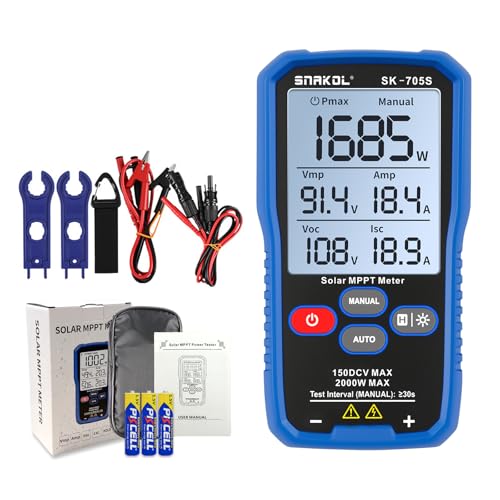
- Measures Pmax, Vmp, Imp, Voc, and Isc
- Auto and manual modes fit different test workflows
- 3.2-inch backlit LCD with included leads and pouch
Best For: Installers and users needing fast, portable PV verification
Rechargeable Field-Ready Choice
Rechargeable Solar Panel Tester MPPT Meter

- Supports up to 2000W, 3–90V, and 40A
- Rechargeable battery plus memory for stored datasets
- TPR anti-drop case and large LCD for field use
Best For: Field users wanting a durable rechargeable tester for regular monitoring
Professional-Grade PV Tester
ZIBOO FT-1000W Solar Panel Tester
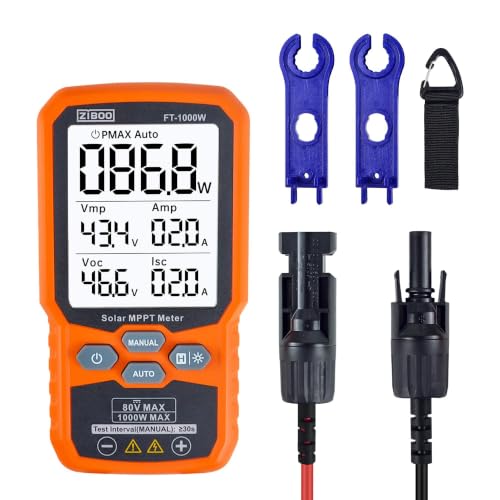
- Tests up to 1000W, 80V Voc, and 35A Isc.
- MPPT tracking helps find shading and degradation issues.
- Backlit LCD, data hold, and IP54 design support field use.
Best For: Solar professionals and advanced DIY users testing larger PV systems
Compact DIY Solar Tester
400W Solar Panel Tester Photovoltaic PV Multimeter

- Designed for 12V/24V panels up to 400W.
- Battery-free and powered directly by the panel.
- Includes MC4 connectors and alligator clips.
Best For: Homeowners and RV users testing smaller solar panels
High-Capacity Solar Meter
XUNTOP 2000W Solar Panel Tester

- Handles up to 2000W, 90V Voc, and 40A Isc.
- Built-in protection covers over-voltage, over-current, and polarity issues.
- Rechargeable battery supports long field sessions and data saving.
Best For: PV technicians and advanced users testing larger solar systems
Premium All-in-One MPPT
UNI-T UT673PV Solar Panel Tester

- Measures Pmax, Vmp, Imp, Voc, and Isc
- Large display shows multiple results at once
- Self-powered design with MPPT test modes
Best For: Photovoltaic manufacturers, installers, and end users needing broad panel diagnostics
Compact Installer Pick
LODESTAR LD673PV Solar Panel Tester

- Measures Pmax, Vmp, Voc, Isc, and Amp
- Backlit LCD shows key values on one screen
- Compact kit includes pouch, leads, and MC4 tool
Best For: Installers and DIY solar users who need a compact single-panel tester
Beginner-Friendly Budget Meter

- Measures Pmax, Voc, and Isc with MPPT tracking
- Plug-and-play MC4 setup with auto/manual modes
- Sunlight-readable LCD with multiple protections
Best For: Beginners and home solar users needing a simple portable PV tester
Professional PV Diagnostic Pick – ZIBOO FT-2000W Solar Panel Tester MPPT Meter
If you want DIY solar panel testers that lean more toward professional diagnostics than basic checks, this ZIBOO unit is built for detailed PV validation. It measures Pmax, Voc, and Isc, so you can spot performance issues during installation, maintenance, or hands-on R&D work.
Best For: Technicians and advanced DIY users who need higher-end PV testing for solar panels, combiner boxes, and field troubleshooting.
Pros:
- Measures up to 2000W, 150V Voc, and 35A Isc with stated ±0.8% accuracy
- MPPT-focused readings help identify shading issues and panel degradation
- CAT III 1000V / CAT IV 600V rating with double-insulated probes for safer high-voltage work
- Backlit LCD, data hold, auto-ranging, and IP54 resistance suit outdoor use
Cons:
- More capable than most casual DIY users need
- Best suited to PV-specific testing rather than general multimeter tasks
- Higher-end feature set may be overkill for small home projects
This is a strong pick if your priority is solar-specific measurement depth and safer field use. It is aimed at serious PV testing rather than occasional hobby checks.
Budget-Friendly All-Rounder – 1800W Solar Panel Tester MPPT Photovoltaic Multimeter
Among DIY solar panel testers, this 1800W model stands out as a straightforward option for checking panel output without adding much complexity. It covers common residential and commercial ranges and keeps the workflow simple with battery-free operation and an easy-to-read display.
Best For: DIY installers and homeowners who want a practical, portable PV tester for routine solar checks.
Pros:
- Measures 5W to 1800W, 20V to 120V, and up to 60A
- Large LCD is designed to stay readable in direct sunlight
- No batteries required; powers from the solar panel connection
- Includes overvoltage, overheating, overcurrent, and reverse polarity protection
Cons:
- Voltage ceiling is lower than some higher-end PV testers
- No backlight or advanced data functions mentioned
- Less specialized for deep diagnostic work than MPPT-focused premium units
This is a sensible choice if you want a practical tester for common solar jobs and don’t need a feature-heavy diagnostic platform. Its portability and simple setup are especially appealing for field use.
Portable MPPT Checkup Tool – Solar MPPT Power Tester SK-705S
If you’re comparing DIY solar panel testers for commissioning or maintenance, the SK-705S is aimed at quick MPPT-based performance checks. It measures Pmax, Vmp, Imp, Voc, and Isc, and it gives you both automatic and manual test modes for different work styles.
Best For: Installers and hands-on users who want a portable tester for fast PV module verification.
Pros:
- Measures Pmax, Vmp, Imp, Voc, and Isc for PV module checks
- Automatic and manual modes support both repeat testing and one-off measurements
- 3.2-inch backlit LCD with data hold improves outdoor readability
- Includes test leads, alligator clips, storage pouch, and manual for immediate use
Cons:
- Listed voltage and current range details are less consistent across the supplied notes
- Battery-powered design may require more upkeep than solar-powered testers
- Weight listing appears inconsistent in the supplied product data
For portable solar troubleshooting, this tester offers a useful mix of manual control and quick readouts. It makes the most sense when you want flexible PV testing in a compact kit.
Rechargeable Field-Ready Choice – Rechargeable Solar Panel Tester MPPT Meter
For DIY solar panel testers that need to travel well and handle routine field checks, this rechargeable MPPT meter emphasizes portability and protection. It supports automatic and manual testing, stores test data, and uses a rugged anti-drop casing for outdoor work.
Best For: Field users who want a rechargeable, durable tester for regular solar panel monitoring.
Pros:
- Measures up to 2000W with a 3–90V range and up to 40A current
- Automatic and manual MPPT modes offer flexible testing
- Rugged TPR anti-drop housing and large LCD suit outdoor use
- Internal memory stores up to 30 test datasets and a rechargeable battery supports portability
Cons:
- Lower voltage range than some other PV testers in this roundup
- Protection limits are relatively specific, so it’s not a universal high-voltage solution
- Best suited to field monitoring rather than advanced lab-style diagnostics
This model makes sense if durability and mobility matter more than maximum voltage coverage. It is a practical choice for recurring on-site checks where storage and battery power are useful.
Professional-Grade PV Tester – ZIBOO FT-1000W Solar Panel Tester
If you need a serious DIY solar panel tester for larger arrays, the ZIBOO FT-1000W is built for checking real-world PV performance, not just basic voltage. It measures Voc, Isc, Pmax, Vmp, and current, making it useful when you want to verify output, spot degradation, or confirm whether shading is affecting harvest.
Best For: Solar professionals, installers, and advanced DIY users testing higher-power panels and PV strings.
Pros:
- Measures up to 1000W with Voc up to 80V and Isc up to 35A.
- MPPT tracking helps identify performance loss from shading or panel aging.
- Backlit LCD and data hold make readings easier on rooftops or in low light.
- Built with CAT III 1000V / CAT IV 600V safety ratings and IP54 resistance.
Cons:
- More capability than most casual home solar owners need.
- Requires a more careful setup than a basic handheld meter.
Overall, this is a strong pick if you want a rugged tester that can handle demanding PV checks in the field. It leans toward professional use, but the clear display and auto-ranging help keep day-to-day testing manageable.
Compact DIY Solar Tester – 400W Solar Panel Tester Photovoltaic PV Multimeter
This DIY solar panel tester is a practical choice for checking smaller residential or RV setups without adding complexity. Designed for 12V and 24V panels up to 400W, it uses MPPT-style testing to help you quickly see whether a panel is delivering the output you expect.
Best For: Homeowners, RV users, and hobbyists troubleshooting smaller solar panels.
Pros:
- Works with 12V and 24V solar panels up to 400W.
- MPPT testing helps reveal power drops caused by shading or damage.
- Battery-free operation means it powers directly from the panel.
- Includes both MC4 connectors and alligator clips for flexible hookups.
Cons:
- Not intended for larger systems beyond 400W.
- Lower voltage and current range than heavier-duty testers.
For straightforward diagnostics, this model keeps things simple and portable. The clear LCD, reverse polarity protection, and included connection options make it an easy fit for quick checks around the house or on the road.
High-Capacity Solar Meter – XUNTOP 2000W Solar Panel Tester
For users who need a higher-capacity DIY solar panel tester, the XUNTOP 2000W model covers more demanding PV checks with MPPT measurement and built-in protection. It reads Pmax, Voc, Isc, Vmp, and current, so it can support performance verification and fault diagnosis across more serious solar workflows.
Best For: PV technicians and advanced users who want a feature-rich tester for larger solar systems.
Pros:
- Measures up to 2000W with Voc up to 90V and Isc up to 40A.
- Includes over-voltage, over-current, reverse-polarity, and over-temperature protection.
- Stores test data automatically and supports manual or auto measurement modes.
- Rechargeable battery, Type-C charging, and 15-hour runtime add convenience.
Cons:
- No backlight, which may make some readings harder in dim conditions.
- Best used when the panel is disconnected from other loads.
This is the most feature-packed option in the group if you value safety, logging, and longer runtime. The shock-resistant casing and portable kit make it a practical pick for field work, production, or final inspection.
Premium All-in-One MPPT – UNI-T UT673PV Solar Panel Tester
If you want a DIY solar panel tester that can show a fuller picture of panel performance, the UNI-T UT673PV is built for that job. It measures maximum power, peak power voltage, peak power current, open circuit voltage, and short circuit current, making it useful for troubleshooting and routine photovoltaic checks.
Best For: Photovoltaic manufacturers, installers, and end users who want a portable tester with broad measurement coverage.
Pros:
- Measures Pmax, Vmp, Imp, Voc, and Isc for comprehensive panel diagnostics
- Large screen displays multiple results at once, with automatic measurement support
- Manual and automatic MPPT test modes add flexibility for different testing scenarios
- Powered by the solar panel itself, so no batteries are needed
Cons:
- Uses MC4 test lead setup, so compatibility depends on your panel connections
- Most useful when you need more than a basic voltage/current check
- May be more than a casual user needs for very simple DIY troubleshooting
Overall, the UT673PV stands out as a practical, professional-leaning option for checking solar panel output and spotting abnormalities. Its broad measurement set and self-powered design make it especially appealing for field use.
Compact Installer Pick – LODESTAR LD673PV Solar Panel Tester
The LODESTAR LD673PV is a straightforward DIY solar panel tester for checking single-panel output during installation, troubleshooting, or maintenance. It measures Pmax, Vmp, Voc, Isc, and current, and its large backlit LCD keeps the key readings visible on one screen.
Best For: Installers, electricians, and DIY solar users who want a compact single-panel tester with clear on-screen readings.
Pros:
- Reads Pmax, Vmp, Voc, Isc, and Amp for practical panel checks
- Large backlit display shows all key parameters simultaneously
- Compact and lightweight, with pouch, test leads, and MC4 disconnect tool included
- Built-in reverse polarity protection adds a safety layer during testing
Cons:
- Only for single solar panel measurement, not series or parallel connected panels
- Maximum power rating is limited to 1000W
- Less suited to users who need broader system-level testing
For simple on-site panel checks, the LD673PV offers a clean balance of portability, readability, and core measurement functions. Its biggest limitation is also its clearest instruction: it is designed for one panel at a time.
Beginner-Friendly Budget Meter – Solar Panel Tester 2000W MPPT
This DIY solar panel tester is aimed at users who want a simple, portable way to check panel performance without a complicated setup. It measures Pmax, Voc, and Isc, uses MPPT tracking for reliable readings, and includes both auto and manual modes for flexible testing.
Best For: Beginners, RV owners, and home solar users who want a straightforward PV tester for installation and troubleshooting.
Pros:
- Measures Pmax, Voc, and Isc with built-in MPPT tracking
- Plug-and-play MC4 connection makes setup easy for beginners
- 3.2-inch LCD is designed to stay readable in direct sunlight
- Includes protection against over-voltage, over-current, reverse polarity, and overheating
Cons:
- Battery powered, so it is not self-powered from the panel
- Measurement range is narrower than higher-end testers for some use cases
- Most useful for basic field checks rather than deeper diagnostic workflows
As a practical entry-level option, this meter focuses on ease of use and clear readings. It is a sensible pick if you want a portable tester for RV, home, or off-grid solar checks without a steep learning curve.
How We Picked DIY Solar Panel Testers
We focused on measurement range, supported test functions, ease of use, portability, and protection features. For DIY buyers, the best models are the ones that clearly report Voc, Isc, Vmp, and Pmax without adding unnecessary complexity. We also looked for readable displays, automatic/manual test modes, and power ratings that match common rooftop, RV, and off-grid panels.
Quick Comparison
Higher-capacity models are better for modern panels and larger systems, while lower-watt testers can still be a smart choice for compact setups, bench testing, and smaller DIY installs. If you expect to work across different panel sizes, a wider voltage and current range is usually the safest bet.
Key Buying Factors for DIY Solar Panel Testers
Measurement Range
Check the maximum voltage, current, and power support first. If your panels can exceed the tester’s limits, you may get inaccurate results or risk damaging the device.
Supported Readings
The most useful DIY Solar Panel Testers typically measure open-circuit voltage, short-circuit current, maximum power, and operating voltage/current. More complete readouts make it easier to compare panel performance under real-world conditions.
Test Mode and Display
Auto and manual modes can help when you need quick confirmation or more controlled measurements. A clear LCD screen is especially helpful outdoors in bright light.
Protection and Build Quality
Look for reverse-polarity, overcurrent, and overvoltage protection if you will be testing panels frequently. A durable shell and good grip matter too, especially for field work, RV use, or rooftop checks.
Who Should Buy Which DIY Solar Panel Testers?
If you need simple, budget-friendly testing for smaller panels, a lower-capacity unit may be enough. If you work with residential modules, portable power setups, or mixed panel sizes, a mid- to high-capacity MPPT meter is usually the better fit. DIYers who want the broadest utility should prioritize models with strong protection, a wide input range, and straightforward readouts, since those features matter most when testing real-world solar equipment.