A breaker-panel energy monitor can show where your electricity goes, from whole-home demand to the circuits driving your bill. The right setup depends on your panel, the number of circuits you want to track, and how you plan to use the data.
These 10 selected listings include options for circuit-level monitoring, solar tracking, local integrations, and smart-plug control. Before choosing, check what each package includes and whether installation calls for a licensed electrician.
Best 10 Energy Monitor for Breaker Panel Picks for 2026
Best for Local Solar Automation

- Two 200A mains plus sixteen 60A branches
- Local access and Home Assistant integration
- Five-year data storage and custom alerts
Best For: Solar households seeking local circuit-level data
Best for Native Home Assistant
Refoss EM16P Local Energy Monitor

- Native Home Assistant integration
- Local web UI, MQTT, and Open API
- Two mains and sixteen branch sensors
Best For: Home Assistant users who prefer local data access
Best for Flexible Local Access
Refoss 16-Circuit Energy Monitor
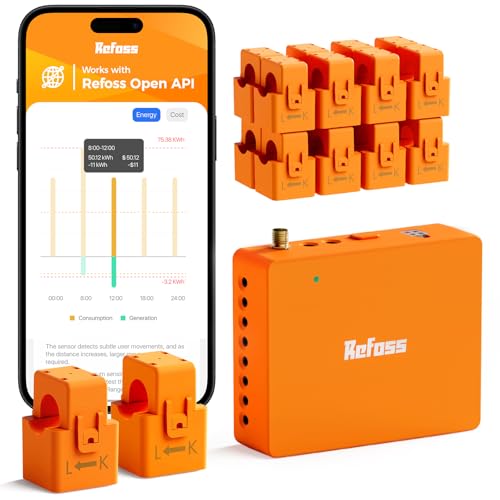
- Web UI, API, MQTT, and WebSocket
- Five years of daily data with CSV export
- App correction for reversed sensor readings
Best For: Buyers building local dashboards and circuit reports
Best for App-Based Management

- UL Listed with sixteen 50A branch sensors
- App automations for rates, peaks, and solar
- Requires internet-connected 2.4 GHz Wi-Fi
Best For: Households wanting app-led energy management
Best for Shared Properties
SEM-Meter 16-Circuit Energy Monitor

- Sixteen 50A circuit sensors
- Custom time-of-use rate templates
- Local MQTT option with Home Assistant
Best For: Rental and shared-home cost allocation
Best for Certified Monitoring
Emporia Vue 3 with 8 Circuit Sensors

- UL and CE Listed
- Eight circuit sensors included
- App-based solar and usage insights
Best For: Safety-conscious homeowners comfortable with cloud monitoring
Best for Comfort
Meross 18-Circuit Energy Monitor
- Two main and 16 branch circuits
- Local Home Assistant integration
- Solar-surplus automation support
Best For: Solar homes using Home Assistant
Ready-to-Install Circuit Kit
Siemens Inhab 16-Circuit Energy Monitor

- Includes two 200A main sensors and sixteen 50A circuit sensors
- Measures mains and up to 16 branch circuits
- App provides usage history and custom alerts
Best For: Main and circuit monitoring with sensors included
Expandable Whole-Home Pick

- Starts with whole-home monitoring
- Supports solar and net metering
- Up to 16 branch sensors can be added separately
Best For: Starting with whole-home data and expanding later
Monitoring and Plug Control Bundle
Emporia 16-Sensor Monitor + 4 Smart Plugs

- Includes 16 circuit sensors and four smart plugs
- Tracks panel and outlet-level usage
- Supports plug schedules and solar net metering
Best For: Combining circuit tracking with outlet-level control
Best for Local Solar Automation – Meross EM16 Energy Monitor
The Meross EM16 is an energy monitor for breaker panel installations that tracks two 200A mains and up to sixteen 60A branch circuits. It suits buyers who want detailed usage and cost charts without a subscription.
Best For: Solar households using Home Assistant to act on surplus generation while keeping energy data local.
Pros:
- Includes two 200A and sixteen 60A clamp-on current transformers.
- Tracks power, voltage, current, and power factor, with reported ±1% accuracy.
- Offers local data access, an Open API, alerts, and up to five years of stored data.
Cons:
- Does not support Delta electrical systems.
- Solar-surplus appliance automation requires a Home Assistant setup.
Its broad sensor kit and local-control features make it a practical choice for circuit-level monitoring. Check that your panel’s electrical system matches the supported configurations before buying.
Best for Native Home Assistant – Refoss EM16P Local Energy Monitor
The Refoss EM16P is an energy monitor for breaker panel use with sensors for two 200A mains and sixteen 60A branch circuits. Its built-in web interface, MQTT, and Open API provide ways to access readings on your home network without relying on a cloud service.
Best For: Buyers who want native Home Assistant integration and locally accessible circuit data.
Pros:
- Native Home Assistant integration requires no firmware flashing.
- Provides local access through a web UI, MQTT, and Open API.
- Includes per-circuit usage targets and alerts, plus exportable daily data stored for up to five years.
Cons:
- Stated ±1% accuracy applies within specified sensor current ranges; accuracy is ±2% at low current.
- Solar-surplus automations require setup in the Refoss app or Home Assistant.
This model stands out if local integration matters more to you than cloud-based convenience. The included sensors cover a substantial number of circuits, while the current-range specifications are worth checking for small loads.
Best for Flexible Local Access – Refoss 16-Circuit Energy Monitor
This Refoss energy monitor for breaker panel installations combines two 200A main sensors with sixteen 60A branch sensors. It offers several local interfaces for buyers who want to review circuit usage and build their own integrations.
Best For: Households that want multiple local data interfaces and detailed historical circuit reports.
Pros:
- Local web UI, Open API, MQTT, and WebSocket access are available without a subscription.
- Records usage across multiple time intervals; daily data is stored for up to five years and is CSV-exportable.
- Includes an external Wi-Fi antenna and app-based correction for reversed sensor readings.
Cons:
- Home Assistant integration uses Refoss_RPC, which may call for more configuration than a native integration.
- Does not support Delta systems; listed three-phase support is for four-wire Wye systems.
The wide range of local interfaces is the main reason to pick this version. It is especially useful when exportable history and installation flexibility matter, provided your panel uses a supported electrical configuration.
Best for App-Based Management – Emporia Vue 3 Energy Monitor
The Emporia Vue 3 is an energy monitor for breaker panel installations that pairs whole-home measurement with sixteen included 50A branch sensors. Its app emphasizes live usage, spending insights, and automation for time-of-use rates, peak demand, and excess solar.
Best For: Buyers who prefer app-based energy management and want a UL Listed monitor with sixteen branch sensors.
Pros:
- UL and CE Listed, with clamp-on sensors and a one-year warranty.
- Includes sixteen 50A branch sensors for monitoring individual loads.
- Offers solar and net-metering monitoring, notifications, and energy-management automations.
Cons:
- Requires 2.4 GHz Wi-Fi and an internet connection for monitoring.
- One-second data is available only while the app is open and is retained for three hours; minute data is retained for seven days.
- Supported three-phase four-wire Wye installations require an additional 200A sensor, sold separately.
Choose the Vue 3 for its app features and UL listing, rather than offline access. Its cloud data-retention rules and connectivity requirement are important trade-offs if you plan to analyze fine-grained history.
Best for Shared Properties – SEM-Meter 16-Circuit Energy Monitor
If you need an energy monitor for breaker panel circuits in a rental or shared home, this SEM-Meter bundle includes 16 clamp-on 50A sensors for tracking individual rooms or appliances. Its app calculates circuit-level costs using customizable peak, off-peak, and holiday rates.
Best For: Landlords or housemates who want clearer circuit-level electricity allocation.
Pros:
- Includes 16 branch-circuit sensors.
- Supports solar and net-metering monitoring.
- Offers a local MQTT mode without the manufacturer’s cloud or app when used with Home Assistant.
Cons:
- Requires 2.4 GHz Wi-Fi for app-based monitoring.
- Panels with access only to busbars need separate flexible sensors.
The rate templates make this a practical choice for comparing room or circuit costs. Check your panel layout before buying, particularly if standard clamp-on sensors cannot reach the conductors.
Best for Certified Monitoring – Emporia Vue 3 with 8 Circuit Sensors
The Emporia Vue 3 is an energy monitor for breaker panel installation that pairs whole-home monitoring with eight circuit sensors in this configuration. It is UL and CE Listed and provides app-based usage reports, solar and net-metering support, and energy-management settings.
Best For: Homeowners who prioritize a UL Listed monitor and app-based circuit insights.
Pros:
- UL and CE Listed.
- Includes eight circuit sensors.
- App settings support time-of-use, peak-demand, and excess-solar management.
Cons:
- Requires 2.4 GHz Wi-Fi and an internet connection.
- One-second readings are available only while the app is open and are retained for three hours.
This is a good fit if certification and energy-management features matter more than offline operation. Confirm that eight circuit sensors cover the circuits you want to track.
Best for Comfort – Meross 18-Circuit Energy Monitor
For a solar-equipped smart home, this Meross energy monitor for breaker panel use covers two 200A main circuits and 16 60A branch circuits. It works with Home Assistant for local energy data and solar-surplus automations.
Best For: Home Assistant users who want circuit-level tracking and local solar automation.
Pros:
- Monitors two mains and 16 branch circuits.
- Supports local data, an open API, and web control without a subscription.
- Provides custom usage alerts and up to five years of data storage.
Cons:
- Its stated system compatibility excludes Delta three-phase panels.
- Solar-surplus automation described in the notes depends on Home Assistant.
Meross stands out for its combination of broad circuit coverage and local integration. Check your electrical system’s compatibility before choosing it for a three-phase panel.
Ready-to-Install Circuit Kit – Siemens Inhab 16-Circuit Energy Monitor
If you want an energy monitor for breaker panel use that measures individual circuits rather than estimating appliance consumption, the Siemens Inhab includes two 200A main sensors and sixteen 50A circuit sensors. Its app shows current and historical usage and supports custom alerts.
Best For: Households that want main and 16-circuit monitoring with the sensors included.
Pros:
- Measures usage at the panel mains and up to 16 branch circuits.
- Includes sensors for both mains and branch circuits.
- Supports custom notifications, time-of-use management, and solar-related features.
Cons:
- Mobile app is available in the USA and Canada only.
- Its 16-circuit limit may not cover every branch circuit in a larger panel.
This is a strong fit when circuit-level measurement is the priority and you want the listed sensors in one package. Check which circuits matter most before installation.
The Emporia Vue 3 is an energy monitor for breaker panel installation that starts with whole-home tracking and can expand to circuit-level monitoring. Its clamp-on sensors, app reporting, and solar/net-metering support make it worth considering if you want to build out your setup over time.
Best For: Buyers who want whole-home monitoring now and the option to add circuit sensors later.
Pros:
- UL Listed and supports solar and net metering.
- App offers live reporting, notifications, and energy-management settings.
- Can add up to sixteen 50A branch sensors.
Cons:
- Branch-circuit sensors are sold separately.
- Requires 2.4 GHz Wi-Fi with an internet connection for app monitoring.
- One-second data is available only while the app is actively open and is retained for three hours.
Choose this version if whole-home data is enough to start; budget separately for branch sensors if individual circuits are central to your plans.
For an energy monitor for breaker panel use that also adds outlet-level control, this Emporia bundle pairs a Vue monitor and 16 circuit sensors with four Wi-Fi smart plugs. The app lets you review usage trends and set automations for compatible devices.
Best For: Households that want circuit monitoring and smart-plug control in one bundle.
Pros:
- Includes sensors to track the main panel and up to 16 individual circuits.
- Four smart plugs add outlet usage tracking, remote control, and scheduling.
- Supports solar net metering and app-based energy management.
Cons:
- Smart-plug control applies to devices connected through the included plugs, not every hardwired load.
- Monitoring is limited to up to 16 individual circuits.
This bundle makes the most sense if you will use both the panel sensors and the plugs; otherwise, the extra outlet controls may be unnecessary.
How We Picked the Best Energy Monitor for Breaker Panel
We focused on the practical differences shoppers can evaluate before buying: main-feed and branch-circuit sensor coverage, stated solar capabilities, access to usage data, integration options, and installation requirements. The selected listings include repeated Emporia Vue 3 entries, so treat similar-looking packages as listings to compare—not necessarily distinct monitor designs. Confirm each listing’s included sensors, accessories, and current specifications before ordering.
Quick Comparison: Which Type Fits?
For a broad view of household demand, prioritize a kit with sensors for the main feeds. To identify which loads are expensive to run, look for enough branch-circuit sensors to cover your priority breakers. The listed 16-sensor Refoss, SIEMENS, and other circuit-level configurations may suit larger tracking plans; the Meross listing advertises 18-circuit monitoring. Emporia’s monitor-and-smart-plug bundle adds a way to track or control compatible plug-in loads alongside panel data. If local access matters, compare the stated Refoss local-control and Open API options with each brand’s current integration details.
Key Buying Factors for an Energy Monitor for Breaker Panel
Panel Fit and Safe Installation
Check your electrical service type, panel space, sensor dimensions, and whether the kit supports your main-feed arrangement. Sensors usually clamp around individual conductors inside the panel; they do not simply clip onto breaker handles. Working in a panel can expose live components even when branch breakers are off. Follow the manufacturer’s instructions and hire a licensed electrician if you are not qualified to do the work.
Sensor Count and Circuit Layout
Count the circuits you actually need to distinguish, not just the breakers in your panel. A 240-volt appliance may use a double-pole breaker and require a specific sensor setup or configuration. Check whether the quoted circuit count includes main sensors, and verify sensor ratings against the conductors being monitored. If you have a subpanel, confirm how—or whether—the system accounts for it.
Data, Solar, and Connectivity
Real-time readings help spot active loads; historical charts and cost estimates help reveal patterns. Cost figures depend on entering an appropriate electricity rate and may not fully reflect time-of-use pricing, fees, or taxes. For solar, verify whether the kit can separately measure generation, consumption, and grid import or export in your wiring configuration. Also check Wi-Fi requirements, app features, data export, Home Assistant compatibility, and whether essential functions continue without cloud access.
Who Should Buy Which Energy Monitor for Breaker Panel?
Choose a basic whole-home setup if you mainly want to see when demand spikes. Pick a 16- or 18-circuit package if you want to compare major appliances and dedicated loads. Consider an explicitly solar-capable configuration if you need to assess self-consumption or surplus; verify its supported installation diagrams first. Refoss listings that specify local control or an Open API are worth a closer look for buyers prioritizing local integrations. The Emporia smart-plug bundle may appeal if you also want visibility into compatible plug-in devices. Whichever Energy Monitor for Breaker Panel you choose, match the exact package to your panel and monitoring goals before scheduling installation.