An energy usage data logger can show where electricity goes over time—but the right tool depends on whether you’re tracking household circuits or diagnosing a three-phase installation.
These 10 picks span connected home monitors, a general-purpose data logger, and professional power recorders. Start with your electrical setup and the data you need to collect, then compare installation and export options.
Best 10 Energy Usage Data Loggers Picks for 2026
Best for Solar Automation
Refoss EM16P Local Energy Monitor

- Two main and 16 branch sensors
- Local API, MQTT, and Home Assistant
- Five years of exportable daily data
Best For: Solar households building local, circuit-level automations
Best for Detailed Circuit Audits
Refoss 18-Circuit Energy Monitor
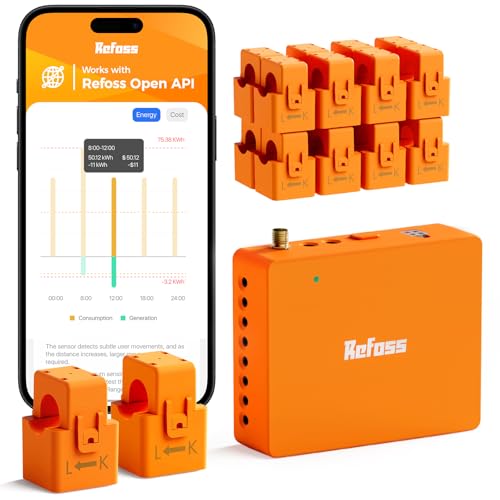
- Two 200A and 16 60A sensors included
- Five years of daily data with CSV export
- Local interfaces and app-based sensor correction
Best For: Homeowners comparing long-term usage across many circuits
Best for Professional Three-Phase Logging

- Logs single-, dual-, and three-phase systems
- Three current sensors included
- USB, Ethernet, Wi-Fi, and remote access
Best For: Professionals logging power and energy across multiple phases
Best for Plug-Load Profiles

- 0.5% specified measurement accuracy
- Time-stamped and totalized load records
- Battery backup preserves logged data
Best For: Detailed monitoring of individual plug loads
Best for On-Site Electrical Audits
Fluke 1732/B Three-Phase Energy Logger

- Logs voltage, current, power, and energy
- Supports on-device and Fluke Connect viewing
- CAT IV 600 V / CAT III 1000 V rated
Best For: Facility teams assessing three-phase power use
Best for Home Monitoring
Eyedro Smart Home Energy Monitor

- Real-time MyEyedro cloud monitoring
- Includes two 200A sensors
- Connects by 2.4 GHz WiFi or Ethernet
Best For: Homeowners monitoring electricity use and costs
Advanced Three-Phase Pick

- Industrial three-phase power logger
- Compatible with Fluke devices and software
- Listed as EU/US advanced version
Best For: Buyers specifying an industrial three-phase Fluke logger
Best for Whole-Home Monitoring
Emporia Vue 3 with 16 Circuit Sensors

- 16 included circuit sensors
- UL and CE Listed
- Exportable cloud data
Best For: Homeowners tracking whole-home and circuit-level use
Best for Three-Phase Diagnostics

- Records key three-phase measurements
- Up to 200,000 data groups
- USB transfer to PC software
Best For: Technicians diagnosing three-phase systems
Best for Shared-Property Cost Tracking

- 16 included 50A sensors
- Custom time-of-use rate templates
- Cloud-free MQTT LAN option
Best For: Shared properties allocating electricity costs by circuit
Best for Solar Automation – Refoss EM16P Local Energy Monitor
For households comparing energy usage data loggers, this Refoss EM16P pairs circuit-level monitoring with local access through a built-in web interface, Open API, and MQTT. Its Home Assistant integration makes it particularly useful when you want to act on solar production data, not just review it.
Best For: Solar households that want private, circuit-level data for local automations.
Pros:
- Includes two main-circuit sensors and 16 branch-circuit sensors.
- Provides real-time measurements and up to five years of exportable daily data.
- Supports native Home Assistant integration and surplus-solar automation.
Cons:
- Clamp-on sensors require access to the electrical panel for installation.
- The stated ±1% accuracy applies within specified current ranges; accuracy is ±2% at low current.
Choose this model if local control and solar-aware scheduling matter more than a simple whole-home total. Its circuit detail can help you identify which loads to shift when solar output is high.
Best for Detailed Circuit Audits – Refoss 18-Circuit Energy Monitor
Among energy usage data loggers for home audits, this Refoss kit stands out for its included two 200A main sensors and 16 60A branch sensors. It combines local access with detailed historical usage records, making it easier to compare individual circuits over time.
Best For: Homeowners auditing multiple circuits and exporting long-term usage records.
Pros:
- Logs usage at multiple intervals and retains daily data for five years with CSV export.
- Offers a local web interface, Open API, MQTT, WebSocket, and Home Assistant integration via Refoss_RPC.
- Includes an external Wi-Fi antenna and an in-app option to reverse a backward sensor reading.
Cons:
- Installing 18 clamp-on sensors requires substantial electrical-panel access.
- Home Assistant setup uses the specified Refoss_RPC integration.
This is a strong fit when the goal is a circuit-by-circuit audit rather than a single consumption figure. Check that your electrical system matches the listed single-phase, split-phase, or three-phase four-wire Wye support before buying.
Best for Professional Three-Phase Logging – AEMC PEL 113 Power Logger
If your search for energy usage data loggers involves single-, dual-, or three-phase systems, the AEMC PEL 113 is the professional option in this group. It has three voltage and three current channels and comes with three MA193-10-BK sensors.
Best For: Professional power and energy logging on single-, dual-, or three-phase systems.
Pros:
- Automatically recognizes connected current sensors and probes.
- Supports remote alerts and automatic reports.
- Offers USB, Ethernet, Wi-Fi, and DataViewSync remote-access connectivity.
Cons:
- Its professional, multi-channel feature set may be more than a basic household plug-load audit needs.
- At a listed 12 pounds, it is less compact than the plug-load logger in this roundup.
The PEL 113 is the most appropriate pick here when phase-specific measurements and multiple connection options are central to the job. Confirm that its included sensors suit your intended measurement points.
Best for Plug-Load Profiles – HOBO UX120-018 Data Logger
For buyers focused on individual plug loads rather than electrical-panel circuits, the HOBO UX120-018 is a targeted choice among energy usage data loggers. Its Meter Mode displays real-time plug-load variables, while logged records support closer analysis of usage patterns.
Best For: Time-stamped analysis of individual plug loads.
Pros:
- Specified 0.5% measurement accuracy for plug-load energy data.
- Records time-stamped and totalized load data.
- Large memory supports faster logging intervals, and battery backup protects logged data during an outage or load failure.
Cons:
- Designed for plug-load analysis rather than monitoring multiple panel circuits at once.
- Listed minimum operating voltage is 120 volts, so verify compatibility with your intended setup.
Pick the UX120-018 when a detailed profile of a plug load is more valuable than whole-home coverage. The live Meter Mode and retained time-stamped records give you both an immediate reading and a longer view.
Best for On-Site Electrical Audits – Fluke 1732/B Three-Phase Energy Logger
For facilities comparing energy usage data loggers, the Fluke 1732/B captures three-phase AC measurements including voltage, current, power, power factor, and energy. It is a practical choice when you need logged electrical data at the installation rather than a home-use dashboard.
Best For: Facility teams logging three-phase power and energy during on-site electrical assessments.
Pros:
- Automatically captures and logs key power and energy measurements.
- Data can be viewed on the instrument, through Fluke Connect, or via desktop software.
- Can draw instrument power directly from the measured circuit.
- Rated CAT IV 600 V and CAT III 1000 V.
Cons:
- The included unit is identified as the basic version; check what your project requires.
- Its three-phase focus may be more than a household monitoring project needs.
The combination of measurement logging, multiple viewing options, and stated safety ratings makes this a focused pick for professional three-phase work.
Best for Home Monitoring – Eyedro Smart Home Energy Monitor
The Eyedro is the home-focused option among these energy usage data loggers, offering real-time electricity monitoring through the MyEyedro cloud. Its two included 200A sensors and WiFi or Ethernet connection suit homeowners who want to examine consumption and costs.
Best For: Homeowners tracking household electricity use, including those planning a solar or net-metering setup.
Pros:
- Shows consumption in dollars, watts, amps, and volts through MyEyedro.
- Includes two 200A current sensors, an Ethernet cable, and a power adapter.
- Supports 2.4 GHz WiFi or wired Ethernet, with no MyEyedro subscription stated.
Cons:
- One EYEDRO-HOME cannot separately monitor grid use and solar generation at the same time; that breakdown requires two units.
- Designed for indoor use and 2.4 GHz WiFi rather than 5 GHz WiFi.
This is the more approachable choice for ongoing home energy visibility, provided you account for the extra meter needed to separate grid and solar data.
Advanced Three-Phase Pick – Fluke 1738/EUS Power Logger
The Fluke 1738/EUS is listed as an industrial, three-phase power logger and is worth considering when comparing energy usage data loggers for that type of system. The supplied product details identify it as the EU/US advanced version, though they provide limited information about its logging functions.
Best For: Buyers sourcing an industrial three-phase Fluke power logger who can verify the advanced version’s capabilities before ordering.
Pros:
- Specified as a three-phase power logger.
- Listed as compatible with Fluke devices and software.
- Supplied as the EU/US advanced version.
Cons:
- The supplied notes do not specify which measurements it records or how logged data is accessed.
- At 5 kg, it is heavier than the other listed products.
Its three-phase designation and Fluke compatibility establish its intended role, but confirm the measurement and software details against your requirements before buying.
Best for Whole-Home Monitoring – Emporia Vue 3 with 16 Circuit Sensors
Among energy usage data loggers for homes, the Emporia Vue 3 offers a useful breakdown: its 16 included 50A sensors track individual circuits, while the app shows live usage, spending, and solar or net metering.
Best For: Homeowners who want whole-home and circuit-level monitoring with app-based cost insights.
Pros:
- Includes 16 branch-circuit sensors for monitoring major loads.
- UL and CE Listed; specified sensor accuracy is ±2%.
- Exports cloud data, with hourly records retained indefinitely.
Cons:
- Requires installation in an electrical panel and 2.4 GHz Wi-Fi with internet access.
- One-second data is available only while the app is open and is retained for three hours.
The Vue 3 is a strong choice when circuit-level detail matters more than long-term high-resolution logging: minute data is retained for seven days, while hourly history remains available.
Best for Three-Phase Diagnostics – ETCR8430 Power Recorder
The ETCR8430 is aimed at technicians comparing energy usage data loggers for three-phase electrical work. It records voltage, current, frequency, active and apparent power, and power factor for later analysis on a PC.
Best For: Electricians and facility teams conducting three-phase troubleshooting or power-quality checks.
Pros:
- Measures up to 600V and 400A, with active and apparent power ranges up to 240kW.
- Stores up to 200,000 data groups at selectable intervals from one second to 99 minutes.
- Rechargeable battery supports up to 48 hours of operation; USB and PC software support data transfer.
Cons:
- Recording time on the rechargeable battery is limited to up to 48 hours.
- Data analysis relies on USB transfer and PC software rather than the phone-app workflow described for the home monitors here.
Choose this recorder for portable three-phase measurements and adjustable logging intervals, not for continuous household circuit-by-circuit tracking.
Best for Shared-Property Cost Tracking – SEM-Meter 16-Circuit Monitor
The SEM-Meter stands out among home energy usage data loggers when electricity costs need to be assigned by circuit or room. Its 16 included 50A sensors, usage history, and customizable time-of-use rates support tracking across shared spaces.
Best For: Landlords or residents tracking circuit-level usage and estimated electricity costs in shared properties.
Pros:
- Includes 16 sensors for monitoring individual circuits and major appliances.
- Supports peak, off-peak, and holiday pricing templates for circuit-level cost calculations.
- Offers an MQTT-based LAN mode without the vendor cloud or app when used with Home Assistant.
Cons:
- Requires electrical-panel installation; panels with access only to busbars need separate flexible sensors.
- Standard app monitoring uses 2.4 GHz Wi-Fi, while cloud-free operation requires Home Assistant with MQTT.
This is the more specialized home option if cost allocation and local MQTT access are priorities. Its hourly exported data is available for 90 days; exported daily, monthly, and yearly data is described as permanent.
How We Picked These Energy Usage Data Loggers
We focused on practical differences visible across the selected products: home versus three-phase use, whole-panel versus circuit-level monitoring, connectivity, and whether a device is intended for ongoing installation or a temporary measurement job. The lineup includes dedicated power loggers as well as a general-purpose data logger; those categories should not be treated as interchangeable. Product names and feature claims are a starting point, not a substitute for checking a current specification sheet.
Quick Comparison: Which Type Fits Your Job?
For household monitoring: Refoss, Eyedro, Emporia Vue 3, and the 16-circuit smart home monitor are the relevant starting points. Compare the number and rating of included current sensors, support for solar or net metering if applicable, and how you can access historical readings.
For three-phase surveys: AEMC PEL 113, Fluke 1732/B, Fluke 1738/EUS, and ETCR8430 are closer to the portable power-logging category. Check their supported wiring configurations, probes, voltage limits, and recorded measurements before choosing one.
For other sensor logging: The HOBO UX120-018 is a data logger, but verify its input configuration and required accessories if your goal is electrical energy measurement. A logger that records a sensor signal does not necessarily measure power or calculate energy by itself.
Key Buying Factors for Energy Usage Data Loggers
Electrical Fit and Safe Installation
Match the instrument to your service type, voltage, phase count, and expected current. Confirm that the supplied current transformers or probes fit the conductors and cover the required range. Panel-mounted monitors may require work inside an electrical enclosure; use a qualified electrician when appropriate. For professional surveys, check the instrument’s measurement category and voltage rating against the installation.
Measurements and Data Access
For bill analysis, look for recorded energy in kWh, a useful time interval, and an easy way to retrieve past data. For equipment diagnostics, you may also need demand, power factor, or power-quality measurements; do not assume every logger records them. If you need to combine readings with other systems, verify export formats, API availability, and whether local access works without a cloud service.
Deployment and Total Cost
Decide whether you need permanent circuit-by-circuit visibility or a portable recorder for short-term investigations. Count the channels you need, including future circuits, and check what sensors, leads, software, storage, subscriptions, and network connections are included. An inexpensive base unit may not be the least expensive complete setup.
Who Should Buy Which Energy Usage Data Loggers?
Choose a multi-circuit home monitor if your main question is which appliances or circuits drive household costs. Look at a whole-home monitor with suitable solar or net-metering support if you need to follow grid imports and exports. Choose a three-phase power logger for commercial equipment, facility audits, or temporary load studies, selecting the measurement depth your work requires. Pick a configurable data logger only when you already know which compatible sensors and calculations will produce the energy data you need.