Flexible marine solar panels are a smart choice when flat rooftop space is limited or your boat has curved, uneven mounting areas. They can help you build reliable charging without heavy framing or bulky hardware.
In this roundup, we focus on panel flexibility, weather resistance, efficiency, and real-world fit for marine-style installations so you can choose a setup that matches your power needs and mounting surface.
Best 10 Flexible Marine Solar Panels Picks for 2026
Ultra-Bend Marine Pick
Renogy 100W Flexible Solar Panel

- 240b0 ultra-flex design for curved surfaces
- 4 lb lightweight panel with 0.08 in profile
- IP68 rating plus wind and snow load testing
Best For: curved marine and RV installs needing a slim 100W panel
Expandable Multi-Panel Pick
DOKIO 400W Flexible Solar Panels

- Four 100W panels for scalable systems
- Series or parallel wiring for 12V/24V builds
- ETFE top layer with lightweight semi-flex design
Best For: buyers building a larger flexible array for RVs or boats
High-Output Shade Fighter
BougeRV Arch Pro 200W Flexible Panel

- 200W panel with up to 25% efficiency
- Anti-shading bypass diodes for steadier output
- Bends up to 270b0 with ETFE and IP68 protection
Best For: high-output marine and RV installs where shading is a concern
Lightweight Travel Pick
DOKIO 100W Flexible Solar Panel

- Only 2.3 lb and 0.03 in thin
- Flexible up to 30b0 for curved surfaces
- ETFE surface with MC4 connectors
Best For: portable boat, camper, and travel setups
Ultra-Thin Marine Fit
50W Flexible Solar Panel for RV, Boat, and Van
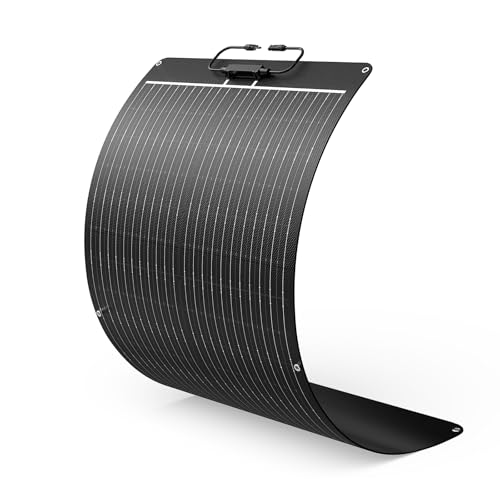
- Bends up to 240° for curved surfaces
- ETFE build resists saltwater wear and cracking
- All-black 0.1-inch profile stays low-key
Best For: Light-duty battery maintenance on boats, RVs, vans, and trailers
High-Output Curved Mount
VEVOR 100W Semi-Flexible Solar Panel

- 23%+ efficiency for stronger output
- IP67 protection for outdoor marine and RV use
- MC4 cable and pre-drilled holes simplify install
Best For: Off-grid charging on curved RV, boat, and cabin surfaces
Compact Off-Grid Choice
DOKIO 100W Flexible ETFE Solar Panel

- Only 2.3 lb for easy handling
- Flexible up to 30° for curved mounts
- ETFE surface and MC4 leads support simple wiring
Best For: Lightweight RV, boat, van, and trailer installs
Ultra-Flexible Marine Pick
100W 12V Semi-Flexible Panel for Uneven Surfaces

- 45cm minimum bend radius for curved installs
- 4.4 lb weight and 0.1-inch thickness
- Up to 23% efficiency with IP67 protection
Best For: Boat and RV owners mounting on irregular surfaces
Durable Coastal Choice
Solarapex 100W Fiberglass Flexible Panel

- Reinforced fiberglass structure for added durability
- IP68 waterproofing with ETFE coating
- 2.6mm thin and 4.85 lb for curved surfaces
Best For: Exposed marine and coastal installs needing tougher construction
Balanced All-Rounder
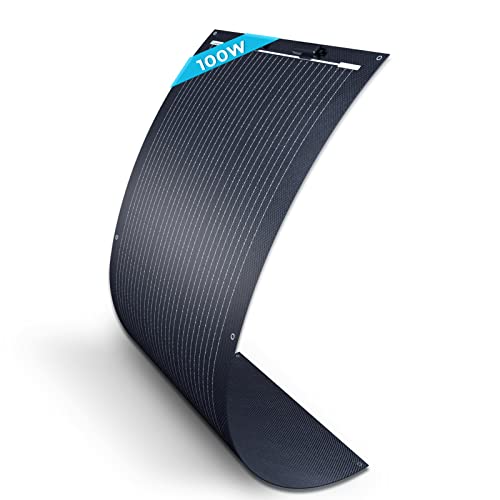
- Bends up to 240 degrees for curved surfaces
- Half-cut PERC cells for improved performance
- IP67 waterproof connectors and pre-drilled holes
Best For: Buyers seeking an easy-install all-around 100W panel
Ultra-Bend Marine Pick – Renogy 100W Flexible Solar Panel
If you need one of the more versatile flexible marine solar panels for curved decks, RV roofs, or boat surfaces, this Renogy 100W panel is built to adapt. It combines a 2400b0 ultra-flex design with a slim, lightweight construction, making it a practical choice when low-profile mounting matters.
Best For: Boat, RV, and off-grid buyers who want a thin 100W panel that can follow curved surfaces.
Pros:
- Bends up to 240b0 for curved and irregular mounting areas
- Lightweight 4 lb build with a very slim 0.08 in profile
- IP68-rated and tested for strong wind and snow loads
- 22% high-efficiency output with MC4 connector
Cons:
- Single-panel 100W output may be too small for larger systems
- Designed for flexible mounting, not rigid glass-panel performance
This is a strong fit if your priority is fitting solar into tight or curved spaces without adding much weight. The durability ratings and marine-friendly positioning make it a dependable pick for mobile off-grid setups.
Expandable Multi-Panel Pick – DOKIO 400W Flexible Solar Panels
For buyers building a larger solar array, this DOKIO 4-pack stands out among flexible marine solar panels because it scales into 12V or 24V systems. The semi-flexible design and ETFE surface make it a practical option for boats, RVs, and campers where lighter, bendable panels are easier to place than rigid modules.
Best For: Larger mobile solar setups that need multiple panels and flexible wiring options.
Pros:
- Four-panel 400W set for bigger system builds
- Can be wired in series or parallel for different system needs
- Semi-flexible design fits curved or irregular surfaces
- ETFE coating offers better light transmission and weather resistance than PET
Cons:
- Only bends up to 30b0, so it is less flexible than ultra-bend panels
- Requires good ventilation and careful installation to avoid heat buildup
This pack makes sense if you want a higher-wattage, modular setup rather than a single-panel solution. The main tradeoff is that installation needs to be planned carefully, especially around airflow and mounting surface material.
High-Output Shade Fighter – BougeRV Arch Pro 200W Flexible Panel
This BougeRV option is aimed at buyers who want more power and better performance in mixed conditions from flexible marine solar panels. Its N-type 16BB cell design, anti-shading bypass diode setup, and 270b0 bend capability make it well suited to curved boat or RV surfaces where output consistency matters.
Best For: Users who want a high-efficiency 200W flexible panel with strong anti-shading features.
Pros:
- 200W output with up to 25% conversion efficiency
- Anti-shading bypass diode technology helps stabilize output
- Can bend up to 270b0 for more curved mounting areas
- ETFE coating and IP68 resistance improve outdoor durability
Cons:
- Open-circuit voltage may not suit every power station
- At 7.9 lb, it is heavier than some 100W flexible alternatives
If you want a more advanced flexible panel for demanding mobile installs, this is a compelling choice. Just verify voltage compatibility before buying, especially if you plan to connect it to a power station.
Lightweight Travel Pick – DOKIO 100W Flexible Solar Panel
If you want a portable option in flexible marine solar panels, this DOKIO 100W model keeps things simple, light, and easy to move. Its thin ETFE-laminated design is aimed at travel, camping, boats, and temporary off-grid use rather than as a heavy permanent roof replacement.
Best For: Portable off-grid setups that need a very light 100W flexible panel.
Pros:
- Very light at 2.3 lb with a 0.03 in thin profile
- Flexible up to 30b0 for curved or irregular surfaces
- ETFE surface improves light transmission and wear resistance
- Pre-drilled grommet holes and MC4 connectors simplify setup
Cons:
- Best suited for travel or seasonal use, not permanent roof replacement
- Needs careful mounting and ventilation to avoid heat buildup
This panel is a strong fit when weight and portability matter more than maximum output. It is especially useful if you want a flexible panel you can hang, move, or mount quickly for mobile power needs.
Ultra-Thin Marine Fit – 50W Flexible Solar Panel for RV, Boat, and Van
If you need flexible marine solar panels that can disappear onto a curved roof or deck, this 50W ETFE model is built for low-profile installs. It bends up to 240° and is designed for RV roofs, teardrop trailers, boat bimini tops, and other tight spaces where a rigid panel would be awkward.
Best For: Trickle charging 12V batteries and topping off portable power stations on boats, RVs, vans, and other curved surfaces.
Pros:
- Up to 240° flexibility for curved RV roofs, trailers, and marine decks
- ETFE coating is made to handle heat, saltwater environments, hail, yellowing, and cracking
- Ultra-thin 0.1-inch profile keeps the installation discreet
- Works with EcoFlow, Jackery, Bluetti, and GoLabs power stations
Cons:
- 50W output is best suited to maintenance and light charging, not heavy loads
- Included connector length is short at 23.6 inches
- Best performance still depends on having usable sun exposure
Overall, this is a practical pick when fit, weight, and weather resistance matter more than raw output. It is especially appealing for stealthy installs and marine use where a slim, all-black panel makes sense.
High-Output Curved Mount – VEVOR 100W Semi-Flexible Solar Panel
For buyers comparing flexible marine solar panels with more output, this 100W semi-flexible panel offers a strong mix of bendable fit and weather-ready construction. It is designed for curved or uneven surfaces like RV roofs and boats, with IP67 protection and a tempered glass surface for outdoor use.
Best For: Off-grid charging on RVs, boats, cabins, and other curved surfaces where a 100W panel makes sense.
Pros:
- 23%+ monocrystalline efficiency for stronger energy production
- IP67 rating and tempered glass surface for all-weather durability
- Built-in MC4 cable simplifies setup to a controller and battery
- Pre-drilled mounting holes add installation flexibility
Cons:
- Controller, battery, and alligator clip are not included
- At 3.9 lb, it is not the lightest option in this group
- Its semi-flexible design is less extreme than ultra-bendable panels
This is the strongest all-around option here if you want more power than a small maintenance panel and still need curved-surface compatibility. The tradeoff is that the setup is a bit more involved because the rest of the system must be sourced separately.
Compact Off-Grid Choice – DOKIO 100W Flexible ETFE Solar Panel
This 100W option is a straightforward pick for flexible marine solar panels when you want a lightweight panel that can fit places rigid glass cannot. Its ETFE surface, MC4 leads, and 30° flexibility make it practical for RV, boat, van, and trailer installs where space and weight are major concerns.
Best For: Lightweight off-grid installs on RVs, boats, vans, and trailers with curved mounting needs.
Pros:
- Flexible up to 30° for curved van roofs, boats, and trailers
- ETFE top sheet improves light transmission and wear resistance
- Very light at 2.3 lb, making it easy to carry and mount
- MC4 connectors keep wiring simple
Cons:
- Flex range is lower than some ultra-bendable alternatives
- Safety guidance requires ventilation space and careful mounting on surface types
- No controller or battery is included
For mobile setups where portability matters, this panel balances manageable weight with enough flexibility for curved installations. It is a solid choice if you want a simple 100W panel without extra bulk.
Ultra-Flexible Marine Pick – 100W 12V Semi-Flexible Panel for Uneven Surfaces
If you want flexible marine solar panels that are easy to shape around curved or uneven installs, this 100W 12V option is built for that job. Its 45cm minimum bend radius, lightweight 0.1-inch profile, and IP67-rated junction box make it a practical fit for boats, RV roofs, cabins, and other off-grid surfaces where rigid panels are awkward.
Best For: Boat, RV, and other irregular-surface installs where flexibility and easy handling matter most.
Pros:
- Can bend to a 45cm minimum radius for more installation flexibility
- Lightweight at 4.4 lb and only 0.1 inches thick for easier handling
- 9BB monocrystalline cells are rated up to 23% conversion efficiency
- IP67 junction box and ETFE/TPT construction are designed for outdoor use
Cons:
- 100W output may be modest for larger marine power needs
- Performance will still depend on sun exposure and mounting conditions
- Flexible panels generally require more careful mounting than rigid glass panels
This is a strong all-around choice if your priority is a bendable panel that installs cleanly on irregular surfaces without adding much weight. The combination of high flexibility, outdoor protection, and quick-install hardware makes it especially appealing for compact marine setups.
Durable Coastal Choice – Solarapex 100W Fiberglass Flexible Panel
Among flexible marine solar panels, this Solarapex model stands out for durability-focused builds. The reinforced fiberglass laminate, IP68 waterproofing, and ETFE coating are aimed at harsh outdoor conditions, while the ultra-light 2.6mm profile helps it conform to RV roofs, van decks, and yachts without a heavy frame.
Best For: Long-term marine, coastal, and off-grid installs that need tougher construction and easy conforming.
Pros:
- Reinforced fiberglass laminate adds impact resistance and shatter protection
- IP68 waterproofing and ETFE coating are built for harsh outdoor conditions
- 97% light transmittance supports strong photovoltaic conversion
- Very slim at 2.6mm and 4.85 lb for easier flexible mounting
Cons:
- The product is positioned as a long-term solution, not the lightest option available
- Drill-free mounting still depends on the surface and adhesive quality
- 100W output may be limited for higher-demand battery banks
If durability is your top concern, this is one of the more convincing flexible marine solar panels in the group. The fiberglass build and IP68 rating make it a smart pick for exposed installs where weather resistance matters as much as flexibility.
Balanced All-Rounder – Renogy 100W Ultra-Flex Panel
This Renogy panel is a straightforward pick if you want flexible marine solar panels from a known brand with balanced specs. It bends up to 240 degrees, uses half-cut PERC cell technology, and keeps a low-profile all-black design that works well on curved boats, RVs, and other off-grid surfaces.
Best For: Buyers who want a flexible, easy-to-install 100W panel with solid all-around performance.
Pros:
- 240-degree flexibility helps it fit curved surfaces
- Half-cut PERC cell technology is designed to improve light capture and performance
- IP67 waterproof junction box and solar connectors for outdoor reliability
- Pre-drilled holes and 2.3-foot connector cables simplify installation
Cons:
- At 5.3 lb, it is not the lightest panel in this roundup
- Flexible panels still need careful mounting for best long-term results
- 100W output may be insufficient for bigger marine power systems
This is a practical middle-ground option if you want a familiar brand, good flexibility, and easy setup without chasing niche construction features. It looks especially appealing for curved installs where reliability and convenience matter more than maximum output.
How We Picked the Best Flexible Marine Solar Panels
We looked for panels that balance bend radius, durability, electrical output, and installation practicality. For marine use, the most important factors are UV- and water-resistant materials, strong adhesion or mounting compatibility, and stable performance in heat, spray, and vibration.
We also favored models that make sense for small boats, cabins, RVs, and other curved surfaces where rigid panels are harder to fit.
Quick Comparison
Higher-wattage options are best for larger battery banks or more demanding off-grid setups, while 50W to 100W panels are often better for topping up house batteries, running smaller loads, or expanding an existing array. Some panels emphasize maximum flexibility, while others prioritize higher efficiency or anti-shading performance.
Key Buying Factors for Flexible Marine Solar Panels
Flexibility and Surface Match
Check the stated bend angle and compare it with your mounting surface. More flexible panels are easier to install on curved decks, cabin tops, biminis, and irregular spaces, but you still need to avoid forcing a panel beyond its rated bend.
Materials and Weather Resistance
Look for ETFE or similarly durable surface layers, fiberglass backing, and waterproof sealing. On the water, panels face salt spray, sun exposure, moisture, and repeated temperature swings, so construction quality matters as much as wattage.
Electrical Output and System Compatibility
Match the panel voltage and connector type to your charge controller and battery system. Many Flexible Marine Solar Panels are designed for 12V systems, but some are better suited to 24V or mixed arrays. Confirm MC4 compatibility and check whether your controller can handle the panel’s open-circuit voltage and current.
Efficiency and Shading Tolerance
High-efficiency cells can help when surface area is tight. If your boat has rigging, masts, rails, or other partial obstructions, consider panels with better anti-shading performance so one shaded section does not reduce output as sharply.
Who Should Buy Which Flexible Marine Solar Panels?
If you need maximum flexibility for a curved roof or bimini, choose a panel built around bendable construction first. If your goal is the most power in the smallest footprint, prioritize higher-efficiency models. If you are building a budget-friendly starter system, a straightforward 100W panel is often the best balance of cost and output. For larger battery banks or heavier daily use, a multi-panel kit or higher-watt option may be the better long-term choice.
In short, the best Flexible Marine Solar Panels are the ones that fit your surface, match your electrical system, and hold up well in wet, salty, high-UV conditions.