Cloud cover does not make portable solar charging impossible, but it makes panel efficiency, usable surface area, and real-world compatibility more important. The right folding panel can help keep a power station topped up during overcast camping trips, road travel, emergencies, and backup-power use.
These 10 options span compact 100W chargers to high-output 450W folding systems. Below, we explain which specifications matter most in low-light conditions and how to match a panel to your power station, travel style, and charging goals.
Best 10 Folding Solar Panels for Cloudy Climates Picks for 2026
Most Compact 200W Pick
Renogy 200W 8-Fold Solar Blanket

- 25% N-Type cell efficiency
- 8.82-pound, eight-fold design
- USB-C, USB-A, and MC4 outputs
Best For: RVers and campers needing high output in tight storage spaces
Best Lightweight 100W Option
FlexSolar 100W Foldable Charger

- 23%+ monocrystalline efficiency
- Only 4.1 pounds
- IP67 protection with USB and DC outputs
Best For: Hikers and emergency kits needing a compact 100W charger
Best Angled 200W Panel
Renogy 200W Portable Solar Panel

- 25% N-Type cell efficiency
- Four adjustable kickstands
- USB-C PD and dual USB-A charging
Best For: RVers and campers who need flexible panel positioning
Best Accessory Bundle
200W Flexible ETFE Solar Charger

- 23.5% monocrystalline efficiency
- Includes five-in-one cable and adapters
- USB-C PD 60W plus dual USB-A
Best For: Campers needing broad power-station and device compatibility
High-Output Cloud-Weather Pick

- 450W output with 25% rated efficiency
- Designed for 40–60V power-station inputs
- IP68 protection and partial-shade bypass diodes
Best For: Large power stations and high-output off-grid charging
Lightweight Everyday Choice
EF ECOFLOW 160W Portable Solar Panel

- N-Type cells with 25% stated efficiency
- 12.3-pound foldable design
- Adjustable bracket and IP68 protection
Best For: Camping and road trips requiring easy portability
Compact Blanket Design
RENOGY REGO 400W Portable Solar Panel

- 400W output with 25% stated efficiency
- Compact 14-fold blanket-style design
- MC4 output and broad placement flexibility
Best For: Portable RV, SUV, marine, and off-grid setups
Best Connected Charging Option
Twelseavan 200W ETFE Foldable Solar Panel

- 24% claimed efficiency and 200W maximum output
- 60W USB-C, QC3.0, and USB charging ports
- 8-in-1 connectivity with four adjustable kickstands
Best For: Campers needing power-station and USB device charging
Best Durable 200W Value
SOKIOVOLA N-Type 16BB Solar Panel
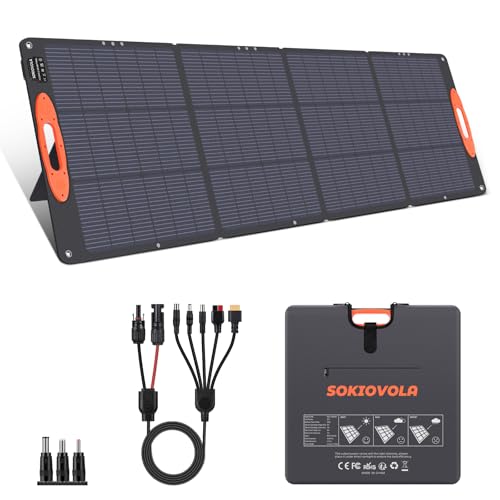
- 25% claimed efficiency in a foldable 200W design
- IP68 ETFE construction for outdoor durability
- 5-in-1 cable and four mounting holes
Best For: RV and campsite users wanting durability and compatibility
Most Compact 200W Pick – Renogy 200W 8-Fold Solar Blanket
For shoppers comparing folding solar panels for cloudy climates, this Renogy blanket stands out with 25% efficiency from N-Type cells and an unusually compact eight-fold design. Its 200W rating suits larger power stations, while USB-A and USB-C ports add convenient direct charging.
Best For: RVers, SUV campers, and off-grid users who prioritize high output and compact storage.
Pros:
- 25% efficiency may help capture more power in limited or cloudy conditions.
- Folds to approximately 16.14 x 15.35 x 3.07 inches and weighs 8.82 pounds.
- Offers USB-C, dual USB-A, and MC4 output options.
- Can be laid flat, hung, or positioned across a vehicle windshield.
Cons:
- MC4-to-power-station adapter cable is sold separately.
- A compatible solar charge controller is required for 12V battery systems.
This is a strong space-saving choice when cloudy-weather performance and portability matter. Verify your power station’s voltage, current, and connector requirements before buying.
Best Lightweight 100W Option – FlexSolar 100W Foldable Charger
This FlexSolar model is a practical option for folding solar panels for cloudy climates when low weight and flexible connectivity matter more than maximum wattage. Its monocrystalline cells are rated above 23% efficiency, and the panel includes USB and DC outputs for charging several device types.
Best For: Hikers, campers, and emergency kits that need a lightweight 100W panel.
Pros:
- Weighs 4.1 pounds and folds to approximately 12.99 x 10.43 x 2.17 inches.
- 23%+ conversion efficiency is designed for performance in low-light and overcast conditions.
- Includes PD 3.0 USB-C, USB-A, and 100W DC outputs.
- IP67 waterproof and dustproof construction suits changing outdoor weather.
Cons:
- Its 100W maximum output is lower than the 200W alternatives in this roundup.
- Actual charging speed will vary with available sunlight and connected equipment.
Choose this panel if portability, included adapters, and all-weather protection are your priorities. It is especially convenient for smaller power stations, phones, and power banks.
Best Angled 200W Panel – Renogy 200W Portable Solar Panel
For folding solar panels for cloudy climates, this Renogy 200W panel combines 25% efficiency with adjustable kickstands that make it easier to aim the cells toward available daylight. It also provides direct USB charging and broad compatibility with many portable power stations.
Best For: RV and campsite users who want a 200W panel with adjustable positioning.
Pros:
- 16BB N-Type cells are rated at 25% efficiency for stronger collection in limited or cloudy conditions.
- Four kickstands support 40°, 50°, and 60° positioning options.
- USB-C PD 45W and dual USB-A ports can charge devices directly.
- UL 61730 certified and supplied with reinforced grommets and an accessory pouch.
Cons:
- At 13.9 pounds, it is heavier than the eight-fold Renogy blanket.
- The MC4-to-4-in-1 adapter cable is sold separately.
This model is a good fit when stable positioning is more important than the smallest packed size. Its adjustable angles can help you make better use of intermittent daylight, but connector compatibility still needs checking.
Best Accessory Bundle – 200W Flexible ETFE Solar Charger
This 200W flexible charger is worth considering among folding solar panels for cloudy climates because its monocrystalline cells are rated at 23.5% efficiency and its ETFE laminate is specified for high light transmittance. The included multi-connector cable and USB ports make it adaptable to power stations and smaller devices.
Best For: Campers who want a lightweight 200W panel with extensive connector coverage.
Pros:
- 23.5% conversion efficiency and ETFE material with up to 95% light transmittance.
- Weighs 11.3 pounds and uses flexible fiberglass construction.
- Includes an 8.2-foot five-in-one cable and multiple DC adapters.
- Provides USB-C PD 60W, QC3.0 USB-A, and standard USB-A outputs.
Cons:
- Its IP65 rating protects against outdoor exposure but is below the IP67 rating of the FlexSolar option.
- The larger accessory set may add setup complexity.
This panel offers a useful balance of output, weight, and included connectivity. It is a practical choice for users with several power stations or USB devices, provided the supplied voltage and connector specifications match.
High-Output Cloud-Weather Pick – ZOUPW 450W N-Type Solar Panel
For shoppers comparing folding solar panels for cloudy climates, the ZOUPW 450W stands out for its N-Type 16BB cells, rated 25% efficiency, and claimed improvement in overcast, morning, and late-afternoon conditions. It is designed for larger power stations, with a 45.9V open-circuit voltage and support for 40–60V inputs.
Best For: High-capacity power stations, RV boondocking, overlanding, and emergency charging where higher wattage is a priority.
Pros:
- 450W output and 25% rated conversion efficiency.
- N-Type 16BB technology is designed to reduce resistance and support performance in cloudy conditions.
- IP68-rated construction, ETFE coating, reinforced kickstands, and bypass diodes.
- Includes extension and 4-in-1 adapter cables for several compatible power stations.
Cons:
- At 29.5 pounds, it is heavier than smaller portable panels.
- Not compatible with low-voltage power stations requiring less than 30V input.
- The manufacturer advises against long-term fixed, series, or parallel connections.
This is a strong option when cloudy-weather performance and fast charging a 2kWh-plus power station matter more than minimal carry weight. Check your power station’s voltage requirements before buying.
Lightweight Everyday Choice – EF ECOFLOW 160W Portable Solar Panel
The EF ECOFLOW 160W is a practical choice among folding solar panels for cloudy climates when portability matters. Its N-Type cells provide a stated 25% conversion efficiency, while the adjustable bracket and angle guide help you position the panel for available sunlight.
Best For: Camping, road trips, and users who want a compact panel for compatible portable power stations.
Pros:
- 25% stated conversion efficiency from N-Type solar technology.
- Lightweight 12.3-pound design with a quick setup.
- 30–60° adjustable bracket and solar angle guide support positioning.
- IP68-rated, ETFE-coated construction for water and dust resistance.
Cons:
- Its 160W capacity is lower than the other panels in this roundup.
- Compatibility depends on the power station’s connector and input specifications.
- The listed manufacturer warranty is 12 months.
This panel favors easy handling and fast deployment over maximum charging capacity. It can suit cloudy-day outings where a compact setup and careful angle adjustment are more useful than a larger, heavier panel.
Compact Blanket Design – RENOGY REGO 400W Portable Solar Panel
The RENOGY REGO 400W combines N-Type cells and 25% stated efficiency with a flexible blanket-style form. For folding solar panels for cloudy climates, its main appeal is a compact, portable design that can be laid on the ground, hung in a sunny spot, or positioned across a vehicle windshield while charging a compatible system.
Best For: RV, SUV, marine, and off-grid users who need 400W output in a highly portable blanket format.
Pros:
- 400W output with N-Type cells and 25% stated efficiency.
- Compact 14-fold design with carry handle and adjustable shoulder straps.
- ETFE-laminated case and operating range of -10°C to 65°C.
- Compatible with several listed power stations and 12V/24V systems using a suitable charge controller.
Cons:
- MC4 output cables are included, but the Renogy 4-in-1 adapter is sold separately.
- IP65 protection is lower than the IP68 rating listed for the other two options.
- A compatible solar charge controller is not included for 12V/24V battery systems.
The REGO 400W is a compelling fit when storage convenience and flexible placement are priorities. Confirm connector, voltage, and current compatibility before purchasing, especially if you plan to use a portable power station.
Top High-Output Pick – ZOUPW 230W Bifacial N-Type Solar Panel
For shoppers comparing folding solar panels for cloudy climates, the ZOUPW stands out with N-Type 16BB cells, a claimed 25% efficiency rating, and bypass diodes designed to help maintain output during partial cloud or tree shade. Its bifacial design can also benefit from reflective ground surfaces.
Best For: RV owners and off-grid users who want high rated output, broad power-station compatibility, and a lightweight tri-fold design.
Pros:
- 230W rated output and 25% claimed efficiency.
- Bifacial construction may add power on reflective surfaces such as snow or sand.
- Lightweight 12.6-pound composite construction with IP68 waterproofing.
- Includes a 5-in-1 cable, storage bag, and 36-month warranty.
Cons:
- The bifacial gain depends on suitable reflective conditions.
- Its 20V output and 11.5A capacity should be matched to the power station’s input limits.
The ZOUPW is the strongest fit here when maximizing panel output matters. Its cloudy-weather advantages are design-oriented rather than a guarantee of full production in overcast conditions, but the bypass diodes, bifacial cells, and high efficiency make it a compelling option for variable light.
Best Connected Charging Option – Twelseavan 200W ETFE Foldable Solar Panel
The Twelseavan is a practical choice among folding solar panels for cloudy climates when you also need to charge smaller devices. Its A+ monocrystalline cells are rated at 24% efficiency, while the ETFE laminate is described as having more than 95% light transmission.
Best For: Campers and emergency-kit owners who want power-station charging plus built-in USB-C and USB ports.
Pros:
- 24% claimed conversion efficiency with a 200W maximum output in ample sunlight.
- Built-in USB-C PD output up to 60W and QC3.0 output up to 18W.
- Includes an 8-in-1 connection setup for broad power-station compatibility.
- Four adjustable kickstands and a magnetic handle simplify positioning and carrying.
Cons:
- At 15.7 pounds, it is heavier than the ZOUPW option.
- Its IP65 rating is lower than the IP68 ratings of the other listed panels.
- Rated output depends on sunlight and the connected power station’s input limits.
This panel offers the most versatile direct-device charging in the group. The claimed light-transmission and efficiency specifications are useful on brighter or hazier days, but its main advantage is convenience: one foldable panel can feed a power station while also handling phones, cameras, or tablets.
Best Durable 200W Value – SOKIOVOLA N-Type 16BB Solar Panel
For a durable setup using folding solar panels for cloudy climates, the SOKIOVOLA combines N-Type 16BB cells with a claimed 25% efficiency rating and an ETFE coating. The foldable 200W panel is built for camping, RV use, blackout preparedness, and other off-grid applications.
Best For: Users who want a weather-resistant 200W panel with wide compatibility and mounting options for an RV or campsite.
Pros:
- 25% claimed efficiency from A+ monocrystalline cells.
- ETFE construction with an IP68 waterproof rating.
- 5-in-1 MC4 adapter cable supports Jackery, EcoFlow, Bluetti, Anker, and other stations.
- Four mounting holes, magnetic handle, and compact 21-by-23-inch folded size.
Cons:
- At 16.31 pounds, it may be cumbersome for extended hiking.
- The listed warranty is 12 months, shorter than the ZOUPW’s 36 months.
- Actual charging can be capped by a power station’s maximum solar-input limit.
The SOKIOVOLA is a solid middle-ground option: it matches the highest claimed efficiency in this lineup while offering IP68 protection and useful mounting flexibility. Confirm your power station’s input ceiling before buying, especially if you plan to pair it with another panel.
How We Picked the Best Folding Solar Panels for Cloudy Climates
We focused on panels that balance rated wattage with practical performance in changing weather. Higher-efficiency monocrystalline cells, newer N-type designs, multi-busbar construction, and bifacial formats can make better use of limited sunlight, although no panel can produce its full rated output under heavy cloud cover.
We also considered portability, folding design, protective materials, weather-resistance ratings, connection options, and likely compatibility with popular power stations. Because a panel’s advertised wattage is measured in ideal conditions, the most useful choice depends on both electrical specifications and how easily you can position, transport, and protect it.
Quick Comparison
| Best For | Recommended Type | What to Prioritize |
|---|---|---|
| Light travel and emergency charging | 100W–160W panel | Low weight, compact folding, USB outputs |
| Balanced camping power | 200W panel | Efficiency, manageable size, broad compatibility |
| Faster charging in weak sun | 230W–450W panel | Large collection area, input limits, sturdy hinges |
| Wet or demanding conditions | IP65–IP68 panel | Sealed construction and protected connectors |
Key Buying Factors for Folding Solar Panels for Cloudy Climates
Cell Efficiency and Usable Wattage
Look for high-efficiency monocrystalline cells, N-type technology, or 16BB construction when available. These features can improve energy capture per square foot, but panel placement still matters. Angle the panel toward the brightest part of the sky and reposition it as conditions change.
Rated Output Versus Power-Station Limits
A 200W panel is not automatically compatible with every 200W input. Check the panel’s operating voltage, amperage, connector type, and open-circuit voltage against your power station’s solar-input range. A panel that exceeds the station’s voltage limit may be unsafe or unusable, while an undersized panel may charge slowly.
Portability and Setup
More wattage generally means more weight and a larger footprint. Eight-fold designs can pack down efficiently, while flexible ETFE panels may be easier to handle. Consider whether you will carry the panel by hand, store it in a vehicle, or set it up daily.
Weather Resistance and Durability
For cloudy climates, rain protection is especially important. IP65, IP67, and IP68 ratings offer increasing levels of dust and water protection, but keep connectors elevated when possible and follow the manufacturer’s guidance. Reinforced handles, reliable kickstands, and durable hinges also matter for repeated outdoor use.
Who Should Buy Which Folding Solar Panels for Cloudy Climates?
Choose a 100W or 160W model if portability matters more than rapid charging. A 200W panel is the best all-around fit for many campers and power-station owners, offering a useful compromise between output and packability. Select a 230W, 400W, or 450W option if you have a high-capacity power station, enough setup space, and frequent overcast conditions where extra collection area can help.
For wet environments, prioritize a higher IP rating and protected connections. If you use multiple brands of power stations, verify adapters and electrical limits before buying. Ultimately, the best Folding Solar Panels for Cloudy Climates are the ones your power station accepts safely and that you will actually position correctly whenever daylight is available.