A bedroom air quality monitor can reveal conditions you cannot see, including elevated carbon dioxide, fine particles, humidity problems, and volatile organic compounds. The right device helps you decide when to ventilate, adjust a humidifier, or investigate a pollution source.
We compared 10 indoor air quality monitors for bedrooms across sensor coverage, readability, smart alerts, portability, and everyday usability. Use the guide below to narrow the choices based on your room, routines, and budget.
Best 10 Indoor Air Quality Monitors for Bedrooms Picks for 2026
Smart Home Pick
Amazon Smart Air Quality Monitor

- Tracks PM2.5, VOCs, CO, humidity, and temperature
- Alexa app scores, alerts, and color-coded status
- Supports Alexa routines for compatible devices
Best For: Alexa households wanting connected monitoring and automation
Large-Display Choice
16-in-1 7-Inch Air Quality Monitor

- Measures CO2, particles, HCHO, TVOC, and more
- 7-inch display with three brightness settings
- Rechargeable design with audible AQI alerts
Best For: Users wanting detailed readings on a large standalone screen
Connected PM Monitor
GoveeLife Smart Air Quality Monitor

- Tracks PM2.5, temperature, and humidity
- Two-second refresh with remote app monitoring
- Stores graphs and supports long-term data export
Best For: Govee users focused on PM2.5 trends and automation
Portable Family Monitor
16-in-1 Indoor Air Quality Tester

- Monitors CO2, particles, HCHO, TVOC, and climate data
- Seven-level AQI alerts and large display
- Rechargeable battery for portable use
Best For: Portable monitoring across bedrooms, nurseries, and travel spaces
Best Portable Pick

- Tracks particles, gases, temperature, and humidity
- Color-coded display with audible alerts
- Up to 96 hours of rechargeable battery use
Best For: Portable, app-free bedroom monitoring
Best for Data Tracking

- NDIR CO2, particle, VOC, and formaldehyde sensing
- Wi-Fi app with alerts and 90-day history
- CSV export and USB-C continuous operation
Best For: Trend analysis and remote bedroom monitoring
Best Quiet Nighttime Option

- Quiet sampling mode for bedroom use
- Large color display with 1.5-second updates
- Includes adapter, cable, and 12-month warranty
Best For: Simple, low-distraction nighttime monitoring
Most Versatile Pick
10-in-1 Portable Air Quality Monitor

- Tracks gases, particles, temperature, humidity, and AQI
- Three-color screen highlights changing conditions
- Portable design with Bluetooth time calibration
Best For: Portable bedroom and whole-home air-quality checks
Best Heavy-Duty Pick
16-in-1 Monitor with 7-Inch Screen

- Displays 16 monitored conditions on one large screen
- Adjustable brightness supports day and night use
- Audible alerts can be muted when needed
Best For: Users who want highly visible bedroom readings
Best Quiet Portable Pick
16-in-1 Color-Screen Air Monitor
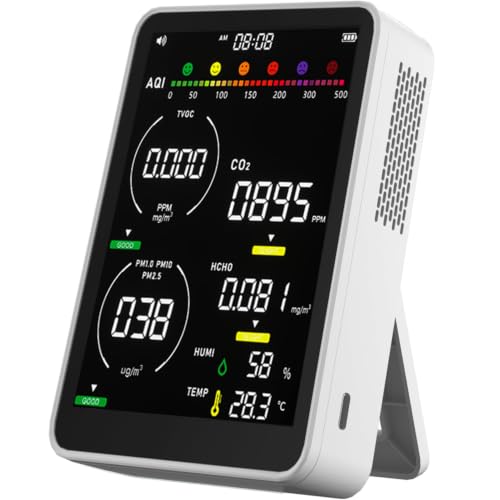
- Updates readings every 1.5 seconds
- Quiet sampling mode suits nighttime bedroom use
- USB-C charging with 4–5-hour stated runtime
Best For: Portable, low-distraction bedroom monitoring
Smart Home Pick – Amazon Smart Air Quality Monitor
For shoppers comparing indoor air quality monitors for bedrooms, the Amazon Smart Air Quality Monitor is a convenient choice if you already use Alexa. It tracks PM2.5, VOCs, carbon monoxide, humidity, and temperature, then presents an air quality score in the Alexa app.
Best For: Alexa households that want app notifications and smart-home automations.
Pros:
- Monitors five useful indoor air factors, including CO, PM2.5, and VOCs.
- Provides color-coded LED status, an Alexa app score, and phone notifications.
- Can trigger compatible air purifiers, dehumidifiers, fans, and other Alexa routines.
- Simple plug-in setup through the Alexa app.
Cons:
- Its smart features are centered on the Alexa ecosystem.
- It requires a power connection rather than offering portable battery operation.
This is a practical bedroom monitor for users who want air-quality readings tied to alerts and automated climate control, rather than a large standalone display.
Large-Display Choice – 16-in-1 7-Inch Air Quality Monitor
This 16-in-1 monitor is suited to shoppers who want a broad view of bedroom conditions without navigating an app. Its 7-inch display shows readings for CO2, particulate matter, HCHO, TVOC, temperature, humidity, AQI, and time, with real-time alerts.
Best For: Bedrooms, offices, or living spaces where a large at-a-glance display and audible AQI alerts matter.
Pros:
- Displays nine detectable measurements, including CO2, PM1.0, PM2.5, PM10, HCHO, and TVOC.
- Large 7-inch screen has three brightness settings.
- Offers seven AQI alert buzzer functions with a mute button.
- USB-C charging and up to eight hours of runtime support flexible placement.
Cons:
- Battery runtime is listed at up to eight hours, so extended use may require charging.
- The many readings and alerts may be more than shoppers seeking a simple monitor need.
Its standout advantage is visibility: place it where you can quickly check bedroom air conditions, while the rechargeable design lets you move it between rooms or other indoor locations.
Connected PM Monitor – GoveeLife Smart Air Quality Monitor
The GoveeLife H5106 is a focused option among indoor air quality monitors for bedrooms, measuring PM2.5, temperature, and humidity. Its two-second refresh rate, remote monitoring, and data history make it useful for tracking changes over time.
Best For: Govee users who want remote PM2.5 monitoring and historical graphs.
Pros:
- Refreshes PM2.5, temperature, and humidity data every two seconds.
- Supports Bluetooth or 2.4G Wi-Fi remote monitoring through the GoveeHome app.
- Provides 13-day online graphs and data export covering up to two years.
- Can coordinate with compatible Govee purifiers, humidifiers, and fans.
Cons:
- Measures three main indexes rather than CO2, VOCs, or carbon monoxide.
- Requires a power source and has no built-in battery.
- Wi-Fi functions require a 2.4G network.
This is a good fit when trend tracking and smart-device coordination are more important than measuring a wider range of pollutants or using the monitor away from an outlet.
Portable Family Monitor – 16-in-1 Indoor Air Quality Tester
This 16-in-1 monitor gives bedroom shoppers a portable way to check CO2, PM1.0, PM2.5, PM10, HCHO, TVOC, temperature, humidity, and AQI. Its large display and seven-level AQI indicator make changes easier to recognize at a glance.
Best For: Homes, nurseries, offices, RVs, and other spaces where rechargeable portability is useful.
Pros:
- Tracks CO2 and multiple particle and chemical indicators in real time.
- Uses a seven-level AQI color system for quick visual interpretation.
- Large display shows key readings and AQI status together.
- Built-in rechargeable battery supports portable monitoring, with up to 12 hours listed in the product details.
Cons:
- Temperature readings can have minor heat-related deviation during use.
- Charging heat can affect temperature readings, so precise temperature checks should be made unplugged.
- The compact product details provide limited information about display dimensions and charging specifics.
Choose this model if you want broad pollutant coverage and the flexibility to move a monitor between a bedroom, nursery, office, or travel space.
Best Portable Pick – 10-in-1 Color Display Monitor
For shoppers comparing indoor air quality monitors for bedrooms, this 10-in-1 model stands out for broad coverage and simple, screen-based operation. It tracks particles, gases, temperature, and humidity, while its color-coded display and audible alert make changing conditions easier to notice without an app.
Best For: Portable bedroom monitoring, households wanting many readings, and users who prefer no Wi-Fi or Bluetooth setup.
Pros:
- Measures PM0.3, PM2.5, PM10, CO2, CO, HCHO, TVOC, AQI, temperature, and humidity.
- Color-coded levels provide a quick visual interpretation of air quality.
- Rechargeable 2000mAh battery offers up to 96 hours of continuous monitoring.
- Samples readings every 1.2 seconds and includes an audible preset-level alert.
Cons:
- Does not offer app connectivity, Wi-Fi, or Bluetooth features.
- The supplied notes do not specify a warranty period.
This is a particularly flexible choice if you want to move one monitor between a bedroom, car, office, or other rooms. Its long stated battery life and straightforward controls are more focused on immediate, on-device awareness than historical data tracking.
Best for Data Tracking – BREATHE Airmonitor Plus Gen 2
Among indoor air quality monitors for bedrooms, the BREATHE Airmonitor Plus Gen 2 is a strong fit for anyone who wants to review patterns instead of relying only on live readings. Its 8-in-1 sensors pair with a 2.4 GHz Wi-Fi app for alerts, graphs, 90-day history, and data export.
Best For: Users who want remote monitoring, historical trends, and detailed tracking of bedroom air changes.
Pros:
- Uses NDIR CO2 measurement alongside particle, TVOC, and formaldehyde sensing.
- Measures CO2, PM1, PM2.5, PM10, TVOC, HCHO, temperature, and humidity.
- App supports configurable CO2 and PM2.5 alerts, graphs, 90-day history, and CSV export.
- Can run from USB-C power for continuous use and includes a two-year manufacturer warranty.
Cons:
- Portable battery operation lasts up to 6 hours, shorter than some dedicated portable monitors.
- App pairing requires a 2.4 GHz Wi-Fi connection.
This model makes the most sense when bedroom air quality is something you want to analyze over time—for example, to compare ventilation, occupancy, cleaning, or HVAC changes. It offers more connected insight than a basic standalone display, though setup is more involved.
Best Quiet Nighttime Option – 16-in-1 Color Screen Monitor
This 16-in-1 monitor is designed for shoppers seeking indoor air quality monitors for bedrooms with simple controls and a quieter nighttime experience. Its high-definition color screen provides frequent updates, while the audio prompt can be disabled for less disruption during sleep.
Best For: Bedroom users who want a readable display, quiet sampling, and handheld monitoring across several indoor spaces.
Pros:
- Tracks PM1.0, PM2.5, PM10, TVOC, HCHO, temperature, and humidity across its listed air-quality functions.
- Single-tap operation and adjustable audio prompt are convenient for nighttime use.
- Samples and processes readings every 1.5 seconds on a large HD color display.
- Includes Type-C charging cable, AC adapter, and a 12-month full-unit warranty.
Cons:
- Battery runtime is listed at approximately 4–5 hours per charge.
- The supplied notes do not mention app connectivity or historical data storage.
Choose this model if ease of use and reduced nighttime distraction matter more than connected features. Its shorter battery runtime makes it better suited to bedside or room-by-room checks when convenient power is available.
Most Versatile Pick – 10-in-1 Portable Air Quality Monitor
For shoppers comparing indoor air quality monitors for bedrooms, this portable 10-in-1 model provides a broad set of readings in a compact format. It tracks CO2, formaldehyde, TVOC, particulate matter, temperature, humidity, AQI, and time, while its color screen makes changing conditions easier to spot.
Best For: Bedrooms and other rooms where you want portable, multi-parameter monitoring with color-coded visual alerts.
Pros:
- Measures CO2, HCHO, TVOC, PM1.0, PM2.5, PM10, temperature, humidity, and AQI.
- Three-color display helps highlight air-quality changes from a distance.
- Bluetooth connection supports time calibration, and the device includes smart calibration features.
- Portable design suits bedrooms, offices, cars, kitchens, and other spaces.
Cons:
- The display and controls may require learning the multi-press button functions.
- Bluetooth is specified for time calibration rather than broader remote monitoring.
This is a practical choice if you want wide-ranging readings without committing to a larger desktop display. Its compact size and visual alerts are especially useful for checking bedroom conditions at a glance.
Best Heavy-Duty Pick – 16-in-1 Monitor with 7-Inch Screen
Among indoor air quality monitors for bedrooms, the Lecoolife AK22B stands out for its 7-inch full-view display. It presents CO2, particulate matter, HCHO, TVOC, temperature, humidity, AQI, and other readings together, making it suited to users who prefer an easy-to-read desktop monitor.
Best For: Bedrooms, home offices, and other spaces where a large, readable display and audible alerts are priorities.
Pros:
- 16-in-1 monitoring covers major gas, particle, and comfort indicators.
- Large 7-inch screen shows the data in one view with adjustable brightness.
- Built-in buzzer provides alerts when readings exceed set levels, with a mute option.
- Supports calibration along with 12/24-hour and Fahrenheit/Celsius settings.
Cons:
- At 1.47 pounds, it is less lightweight than the portable alternatives here.
- The manufacturer cautions users to avoid touching sensors or exposing them to strong odors.
The AK22B is the strongest fit for shoppers who value visibility over portability. Its adjustable brightness and mute function also make it easier to adapt for daytime or nighttime bedroom use.
Best Quiet Portable Pick – 16-in-1 Color-Screen Air Monitor
This 16-in-1 model is a flexible option for shoppers seeking indoor air quality monitors for bedrooms that can also travel between rooms or vehicles. Its high-definition color screen updates air data every 1.5 seconds, while quiet sampling and one-button controls help keep nighttime operation unobtrusive.
Best For: Bedroom users who want portable monitoring, quiet operation, and a straightforward interface.
Pros:
- Tracks PM1.0, PM2.5, PM10, CO2, TVOC, HCHO, temperature, and humidity.
- Samples and processes readings every 1.5 seconds for continuous updates.
- Quiet sampling mode and adjustable audio prompt are useful at night.
- USB-C charging, included adapter, and 4–5 hours of stated runtime support flexible placement.
Cons:
- Continuous runtime is listed at only 4–5 hours per full charge.
- The supplied notes describe core readings but do not specify a formaldehyde or CO2 alert function.
Choose this model when portability and low-distraction bedroom use matter most. It offers a broad selection of readings in a lightweight package, though frequent users may need to recharge it during extended monitoring sessions.
How We Picked the Best Indoor Air Quality Monitors for Bedrooms
We focused on the measurements that matter most in sleeping spaces: carbon dioxide (CO2), particulate matter such as PM2.5, temperature, and relative humidity. Models that also measure VOCs, formaldehyde, carbon monoxide, or PM10 received consideration for broader household monitoring, but extra readings are useful only when their sensors and alerts are clearly presented.
We also compared display size and readability, real-time updates, notification features, power requirements, portability, and setup. Because bedrooms are often monitored overnight, quiet operation, dependable connectivity, and easy-to-understand thresholds matter as much as the number of advertised parameters.
Quick Comparison
| Feature | Why It Matters in a Bedroom |
|---|---|
| CO2 monitoring | Helps identify inadequate ventilation and stale overnight air. |
| PM2.5 detection | Tracks fine particles from smoke, cooking, outdoor pollution, and some household activities. |
| Temperature and humidity | Supports comfort and can help identify overly dry or damp conditions. |
| VOCs or formaldehyde | Useful for investigating odors, new furnishings, paints, and cleaning products. |
| Smart alerts | Lets you respond without constantly checking the display. |
| Large or color display | Makes readings easier to check from bed or across the room. |
Key Buying Factors for Indoor Air Quality Monitors for Bedrooms
Choose the Right Sensors
CO2 is especially valuable for bedrooms because levels can rise overnight with closed windows and doors. PM2.5 is a priority if you live near traffic, experience wildfire smoke, or use candles. Humidity readings are useful year-round, particularly when using a humidifier or dehumidifier. Treat broad “10-in-1” or “16-in-1” claims as a starting point: verify exactly what is measured and whether the sensor type is specified.
Consider Accuracy and Placement
Look for a true NDIR CO2 sensor when accurate CO2 tracking is important. Place the monitor at breathing height, away from windows, vents, humidifiers, direct sunlight, and your face. Allow it time to stabilize before judging readings, and avoid placing it behind furniture.
Match Alerts and Connectivity to Your Routine
App notifications are helpful when the monitor supports reliable Wi-Fi or Bluetooth connections. A standalone color screen may be preferable if you want simple, local monitoring without an account or app. Check whether the unit stays powered continuously, retains readings, and alerts for the specific pollutants you care about.
Who Should Buy Which Indoor Air Quality Monitors for Bedrooms?
Choose a compact, portable monitor if you want to test several bedrooms, a nursery, or a home office. Pick a large-screen multi-parameter model if readings must be visible from across the room. A smart monitor with phone notifications suits people who want alerts while away, while a straightforward wired display is often better for users who prefer low-maintenance operation.
If CO2 is your main concern, prioritize a model with a clearly identified NDIR sensor rather than selecting solely by parameter count. For allergy or smoke concerns, make PM2.5 a must-have. For comfort-related concerns, temperature and humidity may provide more actionable information than less familiar measurements. Finally, remember that these devices are monitoring tools—not substitutes for certified smoke or carbon monoxide alarms.