Choosing the right insulation tester can make troubleshooting safer, faster, and more reliable. Whether you need a compact field unit or a higher-voltage megohmmeter, the best option depends on your testing range and workflow.
Below, we break down 10 of the best insulation resistance testers for 2026, then explain how to compare them by voltage, resistance range, and practical features.
Best 10 Insulation Resistance Testers Picks for 2026
Versatile TRMS Tester

- Insulation testing up to 4000MΩ
- TRMS multimeter with AC/DC voltage, resistance, and continuity
- Backlit display with warning alarm and high-voltage icon
Best For: Technicians who want insulation testing plus everyday electrical measurement
Fast Field Tester

- Five test voltages from 50V to 1000V
- PASS/FAIL comparator in about 0.8 seconds
- AC/DC voltage meter with rugged 1 m drop protection
Best For: Technicians who need quick insulation results in the field
Industrial Calibration Pick

- Five test voltages from 50V to 1000V
- Includes NIST-traceable calibration certificate
- Remote probe and live-circuit detection above 30V
Best For: Industrial testing where calibration and safety matter
Grounding-Focused Alternative
HIOKI FT3151 Analog Earth Tester

- Three-electrode and two-electrode methods
- Wide range up to 1150Ω with EN standard basis
- Switchable frequency and easy cord winding
Best For: Grounding and earthing resistance checks
Pro-Grade All-in-One
KAIWEETS 3MΩ–100GΩ 1000V Megohmmeter
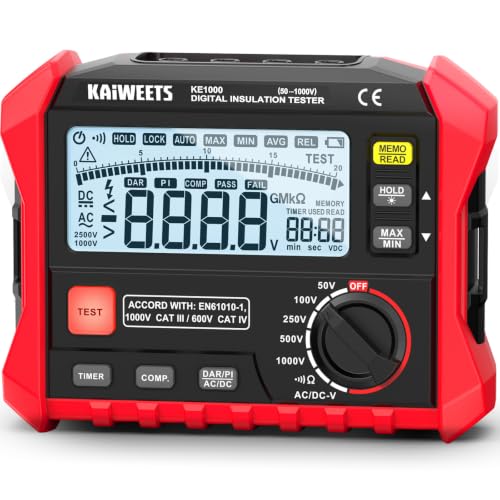
- 3.00 MΩ to 100.0 GΩ range
- Five test voltages plus DAR/PI
- Stores readings and adds multimeter functions
Best For: Technicians who want one tester for insulation checks, diagnostics, and reporting
Industrial Fast-Read
Fluke 1535 250V–2500V Insulation Tester

- Measures up to 500 GΩ
- Supports 250 V to 2500 V testing
- Auto PI and DAR with fast, stable readings
Best For: Industrial electricians and maintenance crews needing high-voltage insulation testing
Compact Combo Tester

- Up to 100 GΩ insulation measurement
- Five voltages plus PI/DAR
- Compact combo meter with auto discharge
Best For: Users who want a compact insulation tester with multimeter-style versatility
Heavy-Duty Shop Pick
NJTY T6125 2500V Digital Insulation Tester

- 0.01MΩ to 200GΩ range
- 250V to 2500V outputs
- Measures AC voltage and low resistance
Best For: Transformers, motors, power cables, and rough jobsite use
High-Voltage Max Range Pick
BTMETER BT-6688B 5kV Megohmmeter

- 0.1MΩ to 200GΩ range
- 100V to 5000V test voltage
- AC high-voltage measurement with warning
Best For: High-voltage testing on cables, switches, and industrial gear
Budget-Friendly Multimeter Combo

- 250V, 500V, and 1000V testing
- 0.1MΩ to 2GΩ insulation range
- Also measures AC/DC voltage and continuity
Best For: General electrical troubleshooting with insulation testing
Versatile TRMS Tester – Klein Tools ET600
The Klein Tools ET600 is a practical insulation resistance tester for users who want a handheld tool that does more than one job. It measures insulation resistance up to 4000MΩ at 125V, 250V, 500V, and 1000V DC, while also covering voltage, resistance, and continuity checks for broader electrical diagnostics.
Best For: Electricians and technicians who need a versatile insulation tester with TRMS multimeter functions.
Pros:
- Tests insulation resistance up to 4000MΩ at four DC test voltages.
- Auto-ranging TRMS multimeter adds AC/DC voltage, resistance, and continuity measurements.
- Backlit display, bar graph, and status icons improve readability and usability.
- Safety-focused features include voltage detection, warning alarm, and high-voltage icon.
Cons:
- Battery-powered design means periodic battery replacement is part of maintenance.
- At 1.4 pounds, it is not the lightest option in the group.
For buyers comparing insulation resistance testers, the ET600 stands out as a multi-function option with straightforward controls and useful safety feedback. It is especially appealing if you want one tester for insulation checks plus general electrical measurements.
Fast Field Tester – HIOKI IR4056
The HIOKI IR4056 is aimed at fast insulation resistance testing where speed and visibility matter. It offers five test voltages from 50V to 1000V and supports insulation resistance measurement from 100MΩ to 4000MΩ, with comparator PASS/FAIL results in about 0.8 seconds.
Best For: Field technicians who want quick insulation checks with live-circuit and voltage monitoring.
Pros:
- Five test voltages from 50V to 1000V cover a wide range of insulation tests.
- Fast comparator PASS/FAIL decision in about 0.8 seconds.
- Built-in AC/DC voltage meter lets you check live circuits or solar modules without switching devices.
- Rugged design with 1 m drop protection and bright LED/backlit display.
Cons:
- Its strengths are focused on testing workflow rather than multi-tool measurement breadth.
- The supplied notes emphasize field use, but do not list a large feature set beyond core testing functions.
If you want insulation resistance testers built for speed, the IR4056 is a strong fit. Its quick decision-making, voltage meter, and rugged build make it well suited to on-the-go electrical work.
Industrial Calibration Pick – Fluke 1507 Megohmmeter
The Fluke 1507 is a digital megohmmeter built for advanced industrial and electrical testing, with test voltages from 50V through 1000V. It is designed for repeatable insulation resistance testing and includes a remote test probe for awkward or hard-to-reach jobs.
Best For: Industrial users who want a calibrated insulation tester with remote probing and live-circuit protection.
Pros:
- Offers five test voltages: 50V, 100V, 250V, 500V, and 1000V.
- Comes with a NIST-traceable calibration certificate with data.
- Remote test probe helps with repetitive or hard-to-reach testing.
- Live circuit detection blocks insulation tests if voltage above 30V is detected.
Cons:
- At 500 g, it is still a dedicated tester rather than a broad multi-meter style tool.
- The notes focus on calibration and core testing features, so extras are limited.
Among insulation resistance testers, the Fluke 1507 is the most clearly positioned for professional workflows that value calibration and safety. If you need documented accuracy and a practical remote probe, this model is easy to justify.
Grounding-Focused Alternative – HIOKI FT3151 Analog Earth Tester
The HIOKI FT3151 is an analog earth tester for grounding and earthing checks rather than a standard insulation resistance tester. It uses three-electrode and two-electrode methods, with a wide measurement range up to 1150Ω and switchable measurement frequency to help reduce the effects of power supply harmonics.
Best For: Users who need an analog grounding tester for earthing resistance checks.
Pros:
- Supports three-electrode and simple two-electrode measurement methods.
- Wide measurement range up to 1150Ω based on EN standard.
- Switchable measurement frequency helps reduce power supply harmonic effects.
- Improved grounding rods and cord winders speed up setup and cleanup.
Cons:
- This is an earth tester, not a dedicated insulation resistance tester.
- Analog design may be less convenient for users who prefer digital displays.
If your buying goal is specifically insulation resistance testers, this model is better viewed as a grounding-focused alternative. It makes sense when your job centers on earthing resistance and you want a classic analog tester with simple handling.
Pro-Grade All-in-One – KAIWEETS 3MΩ–100GΩ 1000V Megohmmeter
If you want insulation resistance testers that can handle both routine checks and more advanced diagnostics, this KAIWEETS megohmmeter is built for the job. It covers a wide 3.00 MΩ to 100.0 GΩ range, offers five selectable test voltages, and includes DAR/PI calculations, so it suits electrical testing where repeatable readings matter.
Best For: Technicians who need a versatile insulation tester with DAR/PI, data storage, and multimeter functions in one tool.
Pros:
- Measures insulation from 3.00 MΩ to 100.0 GΩ with 50V, 100V, 250V, 500V, and 1000V test options
- Auto-calculates DAR and PI in real time for faster diagnostics
- Stores and recalls readings, with custom PASS/FAIL thresholds for reporting
- Also works as a 3-in-1 multimeter for DC voltage, AC voltage, and continuity
Cons:
- Requires 8 AA batteries for operation
- Larger and heavier than compact handheld testers
- May be more tool than needed for simple one-off checks
This is a strong pick for users who want broader testing capability and documentation features without carrying separate tools. Its safety rating and rugged housing make it a practical choice for industrial settings.
Industrial Fast-Read – Fluke 1535 250V–2500V Insulation Tester
Among insulation resistance testers, the Fluke 1535 stands out for frontline industrial work where speed and reliability matter. It measures up to 500 GΩ, supports test voltages from 250 V to 2500 V, and adds PI/DAR calculation, making it suited for checking cables, motors, transformers, and other electrical equipment.
Best For: Industrial electricians and maintenance teams that need a fast, high-voltage tester for demanding insulation checks.
Pros:
- Test voltages from 250 V to 2500 V support a wide range of applications
- Measures insulation resistance up to 500 GΩ
- Automatically calculates PI and DAR for condition assessment
- Fast-measurement design is built for efficient, stable readings
Cons:
- No multimeter functions are listed in the supplied details
- High-voltage capability may be more than needed for basic jobs
- Premium industrial tool may be excessive for occasional users
If your work centers on serious electrical maintenance, this model’s wider voltage range and faster reading design are the main advantages. It is a focused insulation tester rather than a general-purpose combo tool.
Compact Combo Tester – PM1508 50V–1000V Megohmmeter
This compact megohmmeter is a practical option if you want insulation resistance testers that also cover everyday electrical checks. It measures insulation up to 100 GΩ, includes 50V to 1000V test voltages, and combines megohmmeter and multimeter functions for work on transformers, motors, generators, cables, and other electrical equipment.
Best For: Users who want a compact insulation tester with combo-tool convenience and built-in safety features.
Pros:
- Insulation measurement up to 100 GΩ with five test voltages
- Includes PI/DAR functions for better insulation assessment
- Auto discharge for capacitive loads adds safety and convenience
- Combines megohmmeter and multimeter functions in one compact tool
Cons:
- Lower safety rating than the other two models listed here
- Supplied details do not mention a storage or recall feature
- Compact design may come with fewer advanced workflow features
For users who want broad utility without stepping up to a larger industrial tester, this model offers a useful middle ground. It keeps the core insulation testing features while adding extra measurement capability and auto-discharge protection.
Heavy-Duty Shop Pick – NJTY T6125 2500V Digital Insulation Tester
If you need insulation resistance testers for general field work, the NJTY T6125 is built around flexibility and ease of use. It covers a wide 0.01MΩ to 200GΩ range, offers 250V, 500V, 1000V, and 2500V output options, and also measures AC voltage plus low resistance for broader electrical checks.
Best For: Testing transformers, motors, power cables, and other electrical equipment in tough environments.
Pros:
- Wide insulation range from 0.01MΩ to 200GΩ
- Four selectable test voltages up to 2500V
- Measures AC voltage and low resistance too
- Shockproof, dustproof, and moisture-proof design with protective case
Cons:
- Battery-powered design means ongoing battery management
- Best suited to users who want a more feature-rich tester
Overall, the T6125 stands out as a practical all-around option if you want one meter that can handle insulation, voltage, and resistance checks in demanding jobsite conditions.
High-Voltage Max Range Pick – BTMETER BT-6688B 5kV Megohmmeter
Among insulation resistance testers, the BTMETER BT-6688B is aimed at users who need higher test voltage and a broad measurement range. It measures from 0.1MΩ to 200GΩ, supports 100V through 5000V output options, and also adds AC high-voltage measurement for insulation checks on demanding electrical systems.
Best For: High-voltage insulation testing on transformers, cables, switches, and industrial electrical equipment.
Pros:
- Very wide voltage selection from 100V to 5000V
- High insulation range up to 200GΩ
- Includes AC high-voltage measurement with LED warning
- Insulative protective case and IEC-1010 double insulation
Cons:
- Safety note limits test duration when resistance is under 5MΩ
- Bulkier than lighter handheld testers
If your priority is maximum test voltage, the BT-6688B is the most aggressive option here and fits well when you need one meter for a wide span of high-voltage diagnostic work.
Budget-Friendly Multimeter Combo – BTMETER 1000V Megohmmeter
This BTMETER model is a practical choice if you want insulation resistance testers that also double as a digital multimeter. It offers 250V, 500V, and 1000V DC test voltages, measures insulation resistance from 0.1MΩ to 2GΩ, and adds AC/DC voltage and continuity testing for everyday troubleshooting.
Best For: Home, field, and maintenance users who want insulation testing plus basic multimeter functions in one tool.
Pros:
- Three insulation test voltages: 250V, 500V, and 1000V
- Measures insulation resistance from 0.1MΩ to 2GΩ
- Also tests AC voltage, DC voltage, and continuity
- Lightweight body with backlit LCD, data hold, and included leads/clips
Cons:
- Lower maximum insulation range than the more heavy-duty models
- Fewer voltage options than higher-end megohmmeters
For buyers who want a simpler, more versatile tester, this model makes sense as an insulation meter and general troubleshooting tool without adding unnecessary complexity.
How We Picked These Insulation Resistance Testers
We focused on models that offer the most useful mix of measurement range, test voltages, display clarity, and jobsite practicality. For Insulation Resistance Testers, that means looking beyond maximum ohms and checking whether the tool supports the voltages and functions you actually need, such as auto-ranging, DAR/PI testing, backlighting, and robust build quality.
Quick Comparison: What Sets Them Apart
The main differences come down to test voltage and resistance ceiling. Lower-voltage models are often better for general electrical maintenance and troubleshooting, while 1,000V and higher options are more appropriate for industrial equipment, motors, cables, and higher-demand applications. Some testers combine multimeter functions with insulation testing, which can save space in a field kit. Others emphasize higher resistance limits, faster workflows, or more advanced diagnostics.
Key Buying Factors for Insulation Resistance Testers
Test Voltage Range
Match the voltage settings to the equipment you service. Common choices include 250V, 500V, and 1,000V, while some industrial testers go to 2,500V or 5,000V. Higher voltage is not automatically better; it should fit the asset and the applicable test procedure.
Resistance Range and Resolution
Look for a range wide enough for both basic checks and high-resistance insulation evaluation. If you work on modern motors, cables, or switchgear, a higher top-end reading can be important. Resolution also matters when you need to spot small changes over time.
Diagnostic Functions
Features like DAR and PI help identify moisture, contamination, and insulation aging. These are especially valuable for preventive maintenance and condition-based programs.
Usability and Safety
Backlit displays, clear controls, rugged housings, and good lead management all matter in the field. Safety ratings, probe quality, and automatic discharge functions can also make testing more efficient and safer.
Who Should Buy Which Insulation Resistance Testers?
Choose a simpler mid-range model if you want straightforward troubleshooting for buildings, panels, or general electrical maintenance. Pick a higher-voltage, feature-rich tester if you handle industrial systems, motors, or predictive maintenance. If portability matters most, a combo unit may be the best fit. If your work demands deeper analysis, prioritize Insulation Resistance Testers with DAR/PI capability and broader voltage selection.
In short, the best choice is the one that matches your test procedures, environment, and reporting needs—not just the highest specs on the box.