A kWh submeter helps you track electricity use for a rental unit, RV hookup, outbuilding, or piece of equipment without relying on a whole-property utility bill. The right choice depends less on the display and more on whether the meter fits your electrical service and installation.
These 10 options cover direct-connected single-phase meters, 200A CT-based kits, three-phase systems, and models with RS485 communications. Use the guide below to narrow the field before checking product-specific details.
Best 10 Kwh Submeter Picks for 2026
Best for Connected Monitoring

- 120/240V single-phase Form 2S fit
- Import/export energy readings
- RS485 Modbus and pulse output
Best For: Socket-based submetering with external data collection
Best for Rental Spaces
CL200 Digital Landlord Submeter

- Form 2S four-jaw socket design
- LCD kWh readings for individual spaces
- Modbus, pulse output, and EEPROM
Best For: Rental units, RV pads, garages, and workshops
Best for Basic Socket Metering
- 240V CL200 Form 2S meter
- LCD register and test LED
- Tested for ANSI C12 compliance
Best For: Compatible home or RV sockets needing a local reading
Best for Three-Phase Billing
DAE P254-200-S CT Submeter Kit

- Three-phase 120–480V kit with three CTs
- Stated revenue-grade 0.5% accuracy
- RS485; optional gateway-based reports
Best For: Three-phase tenant usage and billing workflows
Flexible Wiring Pick
Universal Single-Phase 100A kWh Meter

- Supports listed two- and three-wire circuits
- Rated up to 100A
- LCD and pulse-output readings
Best For: Flexible single-phase circuit monitoring
Best for Everyday Use
DAE P204-200-S 200A Submeter Kit

- Three-phase, three- or four-wire support
- Three 200A solid-core CTs included
- 0.5% listed revenue-grade accuracy
Best For: Indoor three-phase billing-oriented metering
Compact Pass-Through Pick

- Pass-through single-phase design
- Up to 100A and 13.5mm conductors
- LCD plus pulse output
Best For: Compact single-phase pass-through metering
Compact 50A Pick

- 50A, 120/240V single-phase three-wire
- Internal CT and RS485
- CC2030 gateway needed for cloud reports
Best For: Indoor 50A circuits needing RS485 connectivity
Connected Revenue-Grade Pick

- 200A with two solid-core CTs
- 0.5% accuracy; UL/cUL and CTEP
- RS485; cloud reports require CC2030
Best For: Indoor 200A metering with RS485 and revenue-grade accuracy
Non-RS485 200A Pick

- 200A with two 1.02-inch-inner-diameter CTs
- 0.5% accuracy; UL/cUL and CTEP
- Specified without RS485
Best For: Indoor 200A metering without an RS485 requirement
Best for Connected Monitoring – CL200 Form 2S Modbus Submeter
This kwh submeter fits compatible ANSI Form 2S four-jaw sockets on 120/240V single-phase, three-wire systems. It pairs an LCD reading with RS485 Modbus communication, making it a practical choice when you want to collect usage data beyond the meter itself.
Best For: Landlords or facility operators monitoring individual spaces through a compatible Form 2S socket and an external data system.
Pros:
- Measures accumulated kWh plus imported and exported active energy.
- RS485 Modbus and pulse output support compatible monitoring equipment.
- Backlit LCD and reverse-current LED provide on-site visibility.
Cons:
- Requires a compatible Form 2S meter socket.
- Remote data collection requires separate compatible equipment.
Choose this model when bidirectional readings and integration options matter more than a basic standalone display.
Best for Rental Spaces – CL200 Digital Landlord Submeter
This kwh submeter is aimed at separating electricity usage for rental units, RV pads, garages, and workshops. Its 120/240V single-phase, three-wire design fits a compatible ANSI Form 2S four-jaw socket, with an LCD for local kWh readings.
Best For: Property owners tracking consumption across separately metered residential or RV spaces.
Pros:
- Tracks kWh for individual spaces to support usage-based cost allocation.
- Pulse output and Modbus communication allow connection to compatible monitoring systems.
- EEPROM memory helps retain readings through power outages.
Cons:
- Needs a compatible Form 2S socket installation.
- Connected monitoring requires additional compatible equipment.
It is a sensible pick for straightforward space-by-space tracking, especially if you may add remote data collection later.
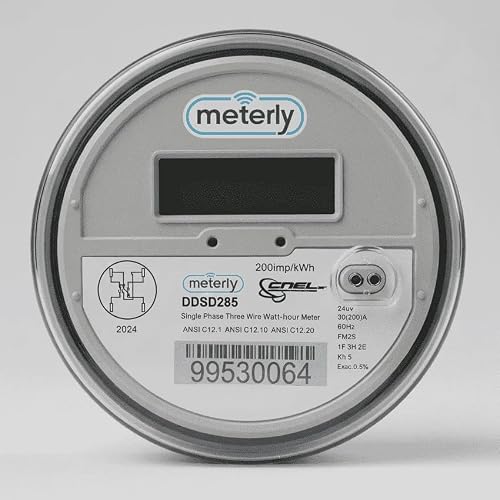
Best for Basic Socket Metering – Meterly Centron SSEM CL200
Meterly Centron SSEM CL200 KWH Meter, Type C1S, Form 2S, 240v RV or Home Meter - Certified
Check Price On AmazonIf you need a straightforward socket-style kwh submeter, this Meterly Centron SSEM is a 240V, CL200, Form 2S meter with a solid-state design and LCD register. The supplied details emphasize its basic meter hardware rather than connectivity features.
Best For: Home or RV installations that call for a compatible 240V Form 2S meter and local LCD readout.
Pros:
- Form 2S, four-terminal configuration for compatible sockets.
- LCD register and test LED support local reading and checks.
- Listed as tested for ANSI C12 compliance and supplied zeroed.
Cons:
- Supplied notes do not specify remote communication or pulse output.
- Socket compatibility needs to be confirmed before purchase.
Consider this one when a conventional LCD meter meets your needs; look elsewhere if connected reporting is essential.
Best for Three-Phase Billing – DAE P254-200-S CT Submeter Kit
DAE P254-200-S KIT, UL CTEP kWh Smart Submeter, 3 Phase, 200A, 120-480V, 3 CTs, RS485
Check Price On AmazonThis three-phase kwh submeter kit is built for more demanding property and panel monitoring. The DAE P254-200-S covers 120–480V systems, includes three CTs, and provides RS485 connectivity, with stated revenue-grade 0.5% accuracy.
Best For: Property managers who need three-phase kWh tracking and documented metering specifications for tenant billing workflows.
Pros:
- Supports three-phase, three-wire and four-wire configurations.
- UL/cUL listed, California CTEP approved, and stated to conform to ANSI C12.1 and C12.20.
- Can feed cloud-based usage and billing reports when paired with a separate CC2030 gateway.
Cons:
- Indoor use only unless placed in a suitable outdoor enclosure.
- Cloud reporting requires the separate CC2030 gateway.
This is the specialized option in the group: its three-phase CT setup and approvals are useful when a simpler Form 2S socket meter will not fit the job.
Flexible Wiring Pick – Universal Single-Phase 100A kWh Meter
Universal Single Phase kWh Meter, 2 or 3-Wire, 120V up to 120/240V, 100A, 60Hz
Check Price On AmazonThis kwh submeter suits buyers who need one meter for several common single-phase wiring arrangements. The EKM-25IDS supports 120/240V three-wire circuits and the listed two-wire 120V or 208–240V configurations, with readings on its LCD or through a pulse output.
Best For: Single-phase circuits where wiring flexibility and a local display matter.
Pros:
- Supports the listed two- and three-wire single-phase configurations.
- Handles up to 100A and wire diameters up to 13.5mm.
- Offers both an LCD readout and pulse output.
Cons:
- Specified for single-phase circuits, not three-phase service.
- Remote readings require using the pulse output with a suitable receiving setup.
Check the circuit configuration and conductor diameter before buying. If they match, this is a compact option for tracking usage without relying solely on a remote readout.
Best for Everyday Use – DAE P204-200-S 200A Submeter Kit
For a three-phase kwh submeter, the DAE P204-200-S kit pairs a 120–480V meter with three 200A solid-core current transformers. Its listed 0.5% revenue-grade accuracy, UL/cUL listing, and California CTEP approval make it worth considering when documented metering credentials are important.
Best For: Indoor three-phase metering where a 200A CT kit and billing-oriented accuracy are needed.
Pros:
- Supports both three-phase, three-wire and three-phase, four-wire connections.
- Includes three solid-core CTs with 1.02-inch inner diameters.
- Listed as 0.5% revenue-grade accurate and compliant with ANSI C12.1 and C12.20.
- Can be used for cloud metering with a separate DAE CC2030 gateway.
Cons:
- Specified for indoor use; outdoor installation calls for a separate enclosure.
- The CC2030 gateway is needed for the described cloud access and reports.
- Solid-core CTs should be checked against the installation’s conductor layout.
This kit is the strongest fit of the three for three-phase billing applications. Budget for the gateway if remote reports are part of the plan, and verify that the supplied CTs fit the conductors.
Compact Pass-Through Pick – EKM-25XDSE Single-Phase Meter
EKM Metering Single Phase kWh Meter, Pass-Through, 2 or 3-Wire, 120V up to 120/240V, 100A, 60Hz
Check Price On AmazonThe EKM-25XDSE is a pass-through kwh submeter for the listed single-phase two- and three-wire arrangements. It measures up to 100A, displays readings locally on an LCD, and provides a pulse output for remote reading.
Best For: Single-phase installations seeking a compact pass-through meter with local and pulse-output readings.
Pros:
- Supports 120/240V three-wire and listed 120V or 208–240V two-wire setups.
- Rated for up to 100A and conductor diameters up to 13.5mm.
- Provides an LCD and pulse output in a 3.94 × 3.44 × 2.55-inch housing.
Cons:
- Not specified for three-phase metering.
- Remote reading through the pulse output requires a compatible receiving setup.
Choose this model when its pass-through layout and dimensions suit the installation. Confirm the wiring arrangement and conductor size before ordering.
Compact 50A Pick – DAE DEM730P RS485 Submeter
DAE DEM730P Electric kWh Submeter, RS485, 1P3W (2 Hot wire, 1 Neutral), 120/240V, 50A, Internal CT
Check Price On AmazonThe DAE DEM730P is a kwh submeter for 120/240V, single-phase three-wire circuits up to 50A. Its internal CT and RS485 connection make it a practical choice when those specifications match your installation.
Best For: Indoor 50A circuits where RS485 connectivity is needed.
Pros:
- Internal CT is specified, rather than a separate pair of CTs.
- RS485 supports connection to a compatible DAE CC2030 gateway for cloud-based energy and billing reports.
- Conforms to IEC61036.
Cons:
- Indoor use only without a separate suitable enclosure.
- Cloud access requires additional gateway hardware.
Choose this model for its 50A rating and RS485 interface; if UL/cUL listing or California CTEP approval is required, DAE directs buyers to its Polaris 1500 series instead.
Connected Revenue-Grade Pick – DAE P153-200-S KIT
The DAE P153-200-S KIT is a 200A, 120/240V kwh submeter for single-phase three-wire service. It pairs two solid-core CTs with RS485 and carries UL/cUL listing and California CTEP approval.
Best For: Indoor 200A installations that need revenue-grade accuracy and an RS485 connection.
Pros:
- Specified 0.5% revenue-grade accuracy and conformity to ANSI C12.1 and C12.20.
- UL/cUL listed and California CTEP approved.
- RS485 can connect to a compatible CC2030 gateway for remote readings and billing reports.
- Includes a lower cover with two 3/4-inch conduit knockouts and an inline fuse holder.
Cons:
- CC2030 gateway is needed for the described cloud features.
- Indoor use only unless paired with a suitable separate enclosure.
This is the stronger fit of the two 200A Polaris options here when RS485 matters. Confirm that the included solid-core CTs suit the conductors and installation plan.
Non-RS485 200A Pick – DAE P103-200-S KIT
The DAE P103-200-S KIT is a 200A, 120/240V kwh submeter for single-phase three-wire service. This Polaris 1000 configuration includes two solid-core CTs and is specified without RS485.
Best For: Indoor 200A metering where UL/cUL listing and California CTEP approval matter, but RS485 is not required.
Pros:
- Specified 0.5% revenue-grade accuracy and conformity to ANSI C12.1 and C12.20.
- UL/cUL listed and California CTEP approved.
- Includes two CTs with a stated 1.02-inch inner diameter.
- Lower cover provides two 3/4-inch conduit knockouts.
Cons:
- This configuration is specified without RS485.
- Indoor use only unless a suitable separate enclosure is used.
Pick the P103 when its certifications and 200A rating fit the job and an RS485 connection is unnecessary. The supplied notes discuss cloud metering in reference to the P153, so do not assume this P103 kit offers the same connectivity.
How We Picked These Kwh Submeters
We organized the 10 selected meters around the specifications that determine whether they can be used in a given installation: phase and wire configuration, voltage, current rating, direct-connected versus current-transformer (CT) measurement, and stated communications features. We also considered listings that identify UL or CTEP credentials. A listing’s claims are a starting point, not a substitute for checking the exact model’s documentation and local requirements.
Quick Comparison by Installation Type
For a typical 120/240V single-phase, three-wire service, start with the CL200 Form 2S meters, the DAE DEM730P, or the DAE single-phase 200A CT kits. The universal and pass-through 100A meters are alternatives when their current limit and wiring method suit the circuit. For three-phase service, compare the DAE P254 and P204 kits; both are listed with 200A CTs and 120–480V ranges. If a building-management system needs meter data, narrow the list to models specifying RS485, then verify the protocol before purchase.
Key Buying Factors for a Kwh Submeter
Match the Electrical Service First
Confirm whether you have single-phase or three-phase power, then check the voltage and number of wires at the measurement point. A 120/240V single-phase, three-wire meter is not interchangeable with a three-phase meter. Also confirm the meter’s frequency rating where specified.
Size the Meter and CTs Correctly
Check the circuit’s maximum current against the meter’s rating. Direct-connected and pass-through designs carry the measured current through the meter; CT-based systems sense current through separate transformers. For a CT kit, verify the number of CTs, conductor fit, CT ratio, and whether the installation requires solid-core CTs. The listed 1.02-inch inner diameter on some kits is worth checking against the actual conductors.
Check Data Access and Billing Requirements
A local kWh display may be enough for occasional readings. For automated collection, confirm the RS485 protocol, available register documentation, and compatibility with your monitoring equipment; RS485 alone does not guarantee a plug-and-play connection. If readings will be used to charge tenants or customers, check applicable rules and the exact meter’s required approvals, sealing provisions, and installation conditions. UL and CTEP claims address different requirements; neither should be assumed to make every billing use permissible.
Who Should Buy Which Kwh Submeter?
Landlords with standard single-phase service: Compare the CL200 Form 2S options with the 200A DAE single-phase CT kits, based on panel layout, reading needs, and local billing rules. RV or home users: Consider the Meterly Centron listing if its Form 2S configuration matches the planned socket and service. Smaller monitored circuits: Look at the 50A DAE DEM730P or 100A universal and pass-through meters, provided the current rating is adequate. Three-phase facilities: Focus on the DAE P254 and P204 kits and confirm CT fit. Have a qualified electrician verify the wiring plan and installation requirements before ordering.