A home solar battery needs to do more than store energy: it must work with your inverter, support the loads you care about, and leave room for your plans to grow. The 10 options here range from individual 48V LiFePO4 batteries to packages with inverters and solar panels.
Start by deciding whether you need a battery for an existing system or a more complete setup. Then compare usable capacity, output power, compatibility, and installation requirements before choosing.
Best 10 Lifepo4 Battery System for Home Solar Storage Picks for 2026
Large-Capacity Rack Bank

- Six batteries included
- UL9540, UL1973 and CEC listed
- Listed weight: 600 lb
Best For: High-capacity battery-bank installations
Two-Battery Starter Bank
- Two 51.2V, 100Ah batteries
- CAN/RS485 inverter communication
- Bluetooth and WiFi monitoring
Best For: Two-module rack battery setups
Single-Module Pick
- One 5,120Wh rack battery
- Installation accessories included
- CAN/RS485 and app monitoring
Best For: Starting with one expandable rack module
Inverter-and-Battery Bundle
ECO-WORTHY Powermega 314Ah + 10kW

- Battery and 10kW inverter included
- 16.1kWh usable energy listed
- Pallet truck delivery required
Best For: Buying a battery and hybrid inverter together
Most Storage

- 7,080W of included solar panels
- 32.15kWh stated battery storage
- Compatible 48V inverter needed
Best For: Large-capacity off-grid storage with a separately selected inverter
Inverter-Ready Backup
ECO-WORTHY 10.24kWh Backup Kit

- 10.24kWh battery capacity
- 5,000W inverter with built-in MPPT
- Solar panels sold separately
Best For: Backup builds that need an inverter and batteries, but not panels
Complete Split-Phase Kit
ECO-WORTHY 10kW Off-Grid System

- 5,310W of included solar panels
- 20.48kWh battery storage
- 10kW inverter with 120V/240V output
Best For: Professionally installed off-grid homes needing a bundled system
Best Standalone Battery

- 16.07kWh battery; no inverter or panels
- UL 1973 certified with 10-year warranty
- 200A active-balancing BMS and remote monitoring
Best For: Adding storage to a compatible 48V-class solar setup
Best Kit With Panels
ECO-WORTHY 3.54kW Solar and 32kWh Battery Kit

- Six 590W panels plus a 10kW hybrid inverter
- Two 314Ah batteries; 30kWh+ stated usable energy
- 120V and 240V output options
Best For: Starting a solar-and-storage home-backup setup
Best Battery-and-Inverter Bundle
ECO-WORTHY Powermega 2-Pack with 10kW Inverter
- Two UL 1973 batteries; 30kWh+ stated usable energy
- Includes 10kW hybrid inverter, not panels
- WiFi and Bluetooth battery monitoring
Best For: Pairing large backup storage with separately sourced panels
Large-Capacity Rack Bank – ECO-WORTHY Cubix100 48V 600Ah
If you need a large LiFePO4 battery system for home solar storage, this Cubix100 listing offers six included batteries and a stated 48V, 600Ah configuration. It is a substantial purchase that calls for planning around its listed 600-pound weight.
Best For: Buyers planning a high-capacity rack battery bank with suitable installation space and handling arrangements.
Pros:
- Six batteries are included in the listed configuration.
- The listing states UL9540 and UL1973 certifications and CEC listing.
- Comes with a stated 10-year warranty.
Cons:
- At a listed 600 pounds, delivery and installation will require careful planning.
- An inverter is not listed among the included components.
The six-battery configuration makes this the capacity-focused choice here, but confirm the installation requirements and inverter pairing before ordering.
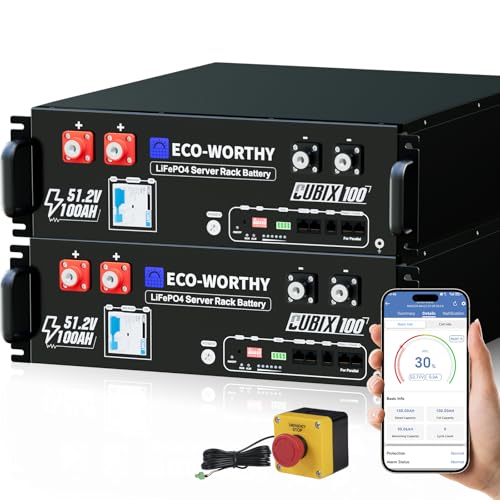
Two-Battery Starter Bank – ECO-WORTHY Cubix100 48V 200Ah
This two-pack is a practical middle ground when choosing a LiFePO4 battery system for home solar storage: it includes two 51.2V, 100Ah rack batteries rather than a single module or a larger bank. Each battery supports inverter communication through CAN/RS485 and status monitoring through the ECO-WORTHY app.
Best For: Buyers who want two rack batteries for home backup or an off-grid solar setup.
Pros:
- Includes two 51.2V, 100Ah batteries.
- CAN/RS485 interfaces support communication with compatible solar inverters.
- Built-in Bluetooth and WiFi enable app-based monitoring.
- The listing states UL9540 and UL1973 certifications and CEC listing.
Cons:
- The two-pack has a listed item weight of 206 pounds.
- An inverter is not listed among the included components.
Choose this package if two rack modules match your capacity plan; check inverter compatibility before relying on closed-loop communication.
Single-Module Pick – ECO-WORTHY Cubix100 48V 100Ah
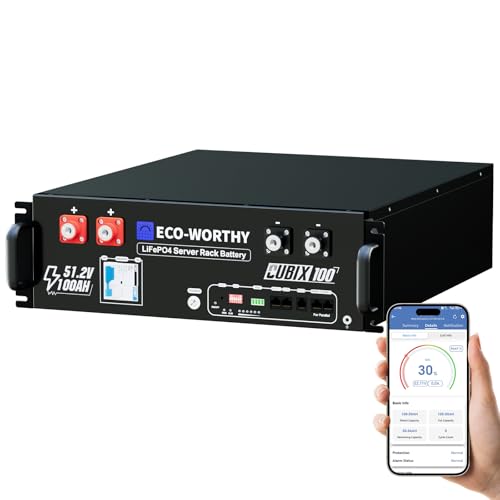
For a smaller starting point in a LiFePO4 battery system for home solar storage, this single Cubix100 rack battery is rated at 51.2V and 100Ah, or 5,120Wh as listed. Its included installation accessories and app monitoring make it worth considering for a one-module setup.
Best For: Buyers starting with one rack battery for backup power or an off-grid solar installation.
Pros:
- Single 5,120Wh module can be paralleled with additional units, according to the listing.
- Includes parallel and communication cables, grounding wires, terminal covers, screws, and a manual.
- CAN/RS485 communication plus Bluetooth and WiFi monitoring.
- The listing states UL9540 and UL1973 certifications and CEC listing.
Cons:
- One 100Ah battery provides less capacity than the multi-battery options here.
- An inverter is not listed among the included components.
This is the clearest choice for starting with one rack module and expanding later, provided your planned inverter supports the battery’s communication options.
Inverter-and-Battery Bundle – ECO-WORTHY Powermega 314Ah + 10kW
Unlike the battery-only picks, this LiFePO4 battery system for home solar storage pairs a 51.2V, 314Ah battery with a 10kW hybrid inverter. The listing specifies 16.1kWh of usable energy and 120V single-phase or 240V split-phase output, making it a more complete option for a planned installation.
Best For: Buyers who need both a large battery and a hybrid inverter for home backup or off-grid solar.
Pros:
- Includes one 10kW hybrid inverter and one 314Ah LiFePO4 battery.
- The battery has a UL 1973 certification, active-balancing BMS, built-in breaker, and aerosol fire suppression module.
- LCD, Bluetooth, and WiFi provide battery-status monitoring.
- Inverter supports 120V single-phase and 240V split-phase output.
Cons:
- The battery ships by pallet truck freight, so the delivery address must accommodate a truck.
- The listing states that either of two externally different inverter versions may ship.
This bundle removes the need to source a separate inverter from the products listed here, but confirm the electrical design and freight arrangements before purchase.
Most Storage – ECO-WORTHY 7080W Solar Kit
If you want a LiFePO4 battery system for home solar storage with substantial capacity, this kit pairs twelve 590W panels with two 48V 314Ah batteries for a stated 32.15kWh of storage. It is aimed at off-grid power and home backup, but you will need a compatible inverter.
Best For: Buyers prioritizing large battery capacity who already have, or plan to select, a compatible 48V off-grid inverter.
Pros:
- Includes 7,080W of N-type bifacial solar panels and 32.15kWh of stated storage.
- Batteries feature active cell balancing, a 200A smart BMS, and integrated aerosol fire protection.
- Supports expansion to as many as 15 batteries in parallel.
Cons:
- No inverter is listed among the included components.
- Panels and batteries ship separately by truck and may arrive on different dates.
This is the storage-heavy option of the three. Check inverter compatibility and plan for the delivery and installation of twelve large panels before ordering.
Inverter-Ready Backup – ECO-WORTHY 10.24kWh Backup Kit
This LiFePO4 battery system for home solar storage bundles two 51.2V 100Ah batteries with a 5,000W pure sine wave off-grid inverter. Its 10.24kWh of storage makes it a practical starting point for backup power, while the inverter’s built-in MPPT controller accommodates a compatible solar array purchased separately.
Best For: Buyers who want batteries and an inverter together but intend to source solar panels separately.
Pros:
- Includes 10.24kWh of battery storage and a 5,000W inverter with a 100A MPPT controller.
- Battery communication interfaces and app connectivity support system monitoring.
- Specified expansion supports up to 32 batteries and six parallel inverters.
Cons:
- Solar panels are not listed in the kit contents.
- A single inverter supplies 120V output; 120V/240V support requires multiple parallel inverters.
Choose this kit if you prefer to build the solar array around an included inverter and battery bank. Match any proposed panels to its stated 120–500V DC PV input range.
Complete Split-Phase Kit – ECO-WORTHY 10kW Off-Grid System
For a LiFePO4 battery system for home solar storage that includes the major generation and power-conversion components, this package combines nine 590W panels, four batteries totaling 20.48kWh, and a 10kW inverter. Its 120V/240V split-phase output makes it the more direct fit here for a planned off-grid household installation.
Best For: Buyers planning a professionally installed off-grid system with included panels, storage, and 120V/240V inverter output.
Pros:
- Includes 5,310W of solar panels, 20.48kWh of storage, and a 10kW inverter.
- Inverter supports 120V/240V split-phase output and has dual MPPT controllers.
- Batteries offer CAN/RS485 communication and Bluetooth/WiFi app monitoring.
Cons:
- Professional installation is recommended; the seller advises against novice installation.
- Large panels require palletized truck delivery, with other components shipped separately.
This is the broadest bundled system of the three, though “complete” does not mean a simple DIY setup. Confirm truck access and discuss the installation with a qualified professional.
Best Standalone Battery – ECO-WORTHY Powermega 16.07kWh
If you already have compatible solar equipment, this 16.07kWh Powermega is a high-capacity building block for a LiFePO4 battery system for home solar storage. It is a battery, not a complete solar kit.
Best For: Buyers adding substantial storage to an existing or planned 48V-class system.
Pros:
- UL 1973 certified, with a stated 10-year manufacturer warranty.
- 200A BMS with active balancing, an external two-pole breaker, and integrated aerosol fire-suppression modules.
- Touchscreen, WiFi and Bluetooth monitoring, plus RS485 and CAN ports; supports up to 15 batteries in parallel.
Cons:
- Inverter and solar panels are not included; check system compatibility before buying.
- At 293.2 pounds, it requires pallet delivery and a truck-accessible address.
Choose this one when you need storage capacity rather than an entire generation-and-inverter package. Its monitoring and protection features are useful, but the weight and equipment requirements make installation planning important.
Best Kit With Panels – ECO-WORTHY 3.54kW Solar and 32kWh Battery Kit
For buyers starting with fewer components, this LiFePO4 battery system for home solar storage bundles six 590W panels, two 48V 314Ah batteries, a 10kW hybrid inverter, and cables. The two batteries provide approximately 32kWh of nominal capacity; the listing describes more than 30kWh of usable energy.
Best For: Buyers who want panels, battery storage, and an inverter in one home-backup package.
Pros:
- Includes a 3.54kW panel array, two batteries, a 10kW hybrid inverter, and cables.
- Inverter supports 120V single-phase and 240V split-phase output.
- Battery app monitoring, active-balancing BMS, built-in breakers, and aerosol fire-suppression modules.
Cons:
- Large components ship by pallet truck; confirm delivery access and plan for panel installation.
- Either of two inverter exterior versions may ship, although the listing says their specifications and performance are the same.
This is the most complete package here if you need solar generation as well as storage. Check whether the six-panel array and included equipment match your site and energy goals before committing.
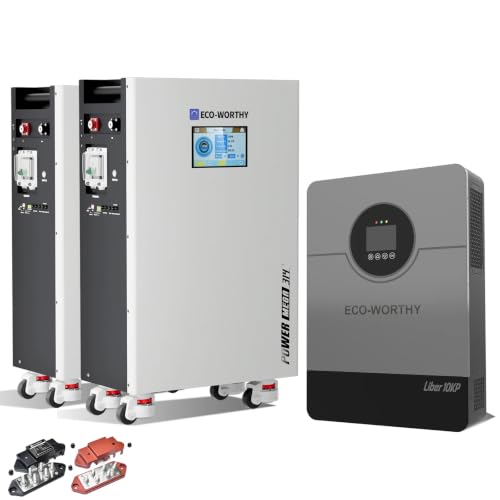
Best Battery-and-Inverter Bundle – ECO-WORTHY Powermega 2-Pack with 10kW Inverter
This LiFePO4 battery system for home solar storage pairs two UL 1973 Powermega 48V 314Ah batteries with a 10kW hybrid inverter. It is a practical middle ground if you need substantial storage and an inverter but plan to source solar panels separately.
Best For: Buyers building a high-capacity backup setup who already have, or will separately buy, solar panels.
Pros:
- Two batteries provide approximately 32kWh of nominal capacity; the listing states more than 30kWh usable.
- 10kW hybrid inverter supports 120V single-phase and 240V split-phase output.
- Battery monitoring via LCD, Bluetooth, and WiFi, with active-balancing BMS, breakers, and aerosol fire-suppression modules.
Cons:
- Solar panels are not included.
- Batteries require pallet-truck delivery, and components may arrive in separate packages.
Pick this bundle over the panel-inclusive kit when you want flexibility in selecting your solar array. Confirm the inverter configuration and delivery arrangements as part of your installation plan.
How We Picked the Best Lifepo4 Battery System for Home Solar Storage
We organized these 10 options around the decisions that matter most for home solar storage: battery capacity, whether an inverter or panels are included, expansion potential, and the amount of equipment a buyer still needs to source. The list includes rack batteries, larger-format batteries, battery-and-inverter packages, and solar kits. Listed specifications and certification claims are starting points, not substitutes for checking current documentation and local installation requirements.
Quick Comparison: Battery or Complete System?
The Cubix100 48V 100Ah, 200Ah, and 600Ah listings suit buyers comparing rack-battery capacities. At a nominal 48V, those ratings correspond to roughly 4.8, 9.6, and 28.8kWh; actual usable energy depends on the battery specifications and operating limits. The Powermega 48V 314Ah options represent a larger battery format, with listings for a standalone battery and packages paired with a Liber 10KP hybrid inverter. Other selections bundle batteries with an inverter or add solar panels. Compare the included-equipment list carefully: a battery alone is not a functioning home backup system.
Key Buying Factors for a Lifepo4 Battery System for Home Solar Storage
Capacity and Backup Goals
Estimate the watt-hours your essential loads use over the backup period you want, then allow for conversion losses and the battery’s usable capacity. A refrigerator, lighting, and internet equipment call for a different plan than air conditioning or whole-home backup. Check both continuous output and surge requirements for motor-driven appliances.
Inverter and Solar Compatibility
Confirm battery voltage, supported charge and discharge currents, and any required battery-management-system communication with your inverter. If you are buying a package, verify its AC output and whether its split-phase configuration matches your home’s 120V/240V loads. For a panel kit, check array voltage, solar-input limits, and whether the included components cover your intended installation.
Installation, Safety, and Expansion
Review the exact model’s certification documentation rather than assuming every listing carries the same approvals. Check enclosure location, operating-temperature limits, overcurrent protection, disconnects, permits, and utility rules with a qualified installer. If you may add storage later, verify the manufacturer’s rules for paralleling batteries and mixing capacities or purchase dates.
Who Should Buy Which Lifepo4 Battery System for Home Solar Storage?
Choose a standalone Cubix100 or Powermega battery if you already have, or plan to select, a compatible inverter and want control over the rest of the system. Consider a battery-and-inverter package if you want fewer major components to match yourself, while still checking the full installation bill of materials. Look at the solar-panel kits if you are building a new array as well as storage; confirm that roof space, mounting hardware, and electrical work fit the plan. For any choice, size the system to your actual loads first—not the largest advertised capacity.