A modular solar setup can start with a portable battery and panels or grow into a wired system for a cabin or home. The right choice depends on what you need to run, for how long, and whether you can install a permanent system.
These 10 picks span plug-in backup bundles and larger off-grid kits. Compare their usable storage, inverter output, solar capacity, and expansion options before deciding how much system you need.
Best 10 Modular Solar Power Systems Picks for 2026
Expandable Home Backup

- 3,584Wh capacity; 3,600W AC output
- Includes two 200W solar panels
- Expandable storage; rollable design
Best For: Expandable, portable household backup
UPS-Ready Essentials

- 3,072Wh capacity; 3,600W AC output
- UPS switchover rated at 20ms or less
- Includes two 200W panels and TT-30 port
Best For: Backup for household essentials and RV hookups
High-PV Off-Grid Kit
ECO-WORTHY 10kW System with 20.48kWh Storage

- Nine panels total 5,310W
- Four batteries provide 20.48kWh
- 10kW split-phase inverter
Best For: Professionally installed off-grid homes needing a larger array
Single-Battery Off-Grid Kit
ECO WORTHY 10kW Kit with 16.1kWh Battery

- One wheeled 16.1kWh battery
- Five panels total 2,950W
- 10kW split-phase inverter
Best For: Off-grid builds starting with one expandable battery
High-Capacity Pick

- 3,120W of panels and approximately 12kWh of storage
- 12,000W inverter with 120V/240V output
- Parallel inverter and battery expansion supported
Best For: Larger off-grid or home-backup installations
Expandable 240V Pick

- 2,340W of bifacial panels
- 10,000W split-phase inverter
- Two 48V 100Ah lithium batteries
Best For: Off-grid setups needing 120V/240V output
Compact Cabin Pick

- Six 195W bifacial panels
- 3,500W inverter with 110V/120V output
- 48V 100Ah rack-mountable battery
Best For: Smaller cabins, sheds, and 120V backup loads
Compact Battery Kit
ECO-WORTHY 1560W Solar Kit with 5kWh Battery

- 1560W of solar panels
- 48V 100Ah LiFePO4 battery included
- 3500W inverter with Wi-Fi monitoring
Best For: Small off-grid homes, cabins, and sheds
Whole-Home Capacity
ECO-WORTHY 10.62kW Solar Kit with 32.2kWh Storage

- 10,620W total panel capacity
- 32.2kWh battery storage included
- 10kW inverter with 120V/240V output
Best For: Large off-grid home installations
Expandable Inverter Kit
ECO-WORTHY 2340W Solar Kit with 5000W Inverter
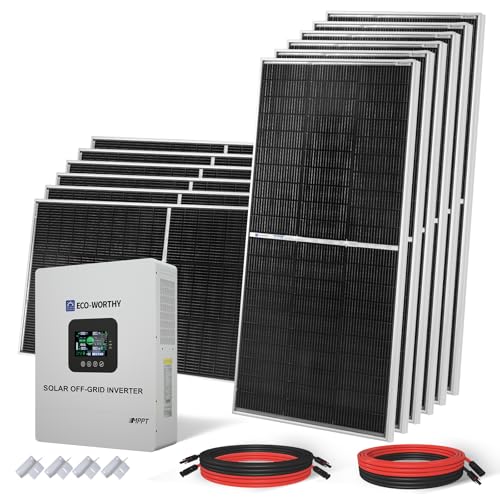
- Twelve panels total 2340W
- 5000W inverter with 100A MPPT
- Battery not listed as included
Best For: Off-grid builds with separately chosen storage
Expandable Home Backup – Jackery HomePower 3600 Plus
Among modular solar power systems, this Jackery bundle suits buyers who want portable backup now and room to add battery capacity later. It pairs a 3,584Wh power station with two 200W solar panels and delivers 3,600W AC output.
Best For: Households seeking a rollable backup unit with expandable storage.
Pros:
- Storage is expandable to 21kWh per unit, according to Jackery.
- Wheels and a telescopic handle help move the 77.2-pound station.
- Supports AC, solar, generator, and combined AC/DC charging.
Cons:
- 240V output requires a parallel configuration, not the single unit alone.
- Two 200W panels may limit solar replenishment compared with a larger array.
This is a flexible starting point for home backup, but check the configuration and accessories needed before planning around 240V appliances or expanded capacity.
For buyers comparing modular solar power systems for outage essentials, the HomePower 3000 offers a 3,072Wh battery, 3,600W AC output, and two included 200W panels. Its stated UPS switchover of 20ms or less is a useful distinction when backup continuity matters.
Best For: Keeping refrigerators, networking equipment, and other essentials powered during outages.
Pros:
- UL-certified UPS with a stated switchover of 20ms or less.
- Includes a TT-30 RV port and dual 100W USB-C PD ports.
- Weighs 59.5 pounds, less than the HomePower 3600 Plus in this roundup.
Cons:
- Its 3,072Wh capacity is smaller than the HomePower 3600 Plus.
- Jackery estimates up to nine hours to reach 80% charge with the included panels.
Choose this bundle if UPS functionality and varied outlets outweigh the need for the larger Jackery model’s stated storage expansion.
This ECO-WORTHY kit is a more installation-focused choice among modular solar power systems. It combines nine 590W panels, four rack-style LiFePO4 batteries totaling 20.48kWh, and a 10kW inverter supporting 120V/240V split-phase output.
Best For: Buyers planning a professionally installed off-grid system with substantial solar input and storage.
Pros:
- 5,310W of included panel capacity provides a larger solar array than the other kits here.
- Four batteries provide 20.48kWh of stated storage.
- Inverter includes dual MPPT controllers and Wi-Fi monitoring.
Cons:
- Large panels ship by pallet truck and require suitable delivery access.
- The seller recommends professional installation rather than novice setup.
The strong panel-to-storage combination makes this compelling for a planned off-grid build; account for mounting, site conditions, and installation work beyond the listed components.
For shoppers weighing modular solar power systems with fewer initial battery units, this ECO WORTHY kit combines one 16.1kWh wheeled LiFePO4 battery, five 590W panels, and a 10kW inverter with 120V/240V split-phase support.
Best For: A professionally installed off-grid setup built around one high-capacity, expandable battery.
Pros:
- The 48V 314Ah battery offers approximately 16.1kWh of stated storage and supports parallel expansion.
- Battery has wheels, handles, a color display, and remote monitoring options.
- Included panels total 2,950W of rated solar capacity.
Cons:
- The included solar array is smaller than the nine-panel ECO-WORTHY kit’s.
- Pallet-truck delivery and professional installation should be planned for.
Its single-battery layout may appeal if you want sizable storage with a path to add batteries later, but size the 2,950W array against your expected daily energy use.
High-Capacity Pick – 12kW Split-Phase Solar Kit
For buyers comparing modular solar power systems for substantial off-grid or backup needs, this kit pairs 26 rigid panels totaling 3,120W with a 12,000W split-phase hybrid inverter and an approximately 12kWh LiFePO4 battery.
Best For: Homes or cabins that need 120V/240V output, sizable battery storage, and room to expand.
Pros:
- The inverter supports up to six units in parallel, while the battery supports up to 16.
- Dual 200A MPPT controllers and four charging modes offer setup flexibility.
- WiFi monitoring, a battery touchscreen, and CAN/RS485 communication help with system oversight.
Cons:
- The listed kit weighs 910 pounds, making delivery and placement a significant consideration.
- Installation should be performed by a qualified electrician.
This is the most expansive package here for inverter output and included storage, but plan the installation around its substantial size and 3,120W panel array.
Expandable 240V Pick – ECO-WORTHY 10kW Off-Grid Kit
Among modular solar power systems, this ECO-WORTHY kit is a strong option when 120V/240V appliance support matters. It includes twelve 195W bifacial panels, two 48V 100Ah lithium batteries, and a 10,000W off-grid inverter.
Best For: Off-grid homes or cabins that need split-phase output and want the option to add inverter capacity later.
Pros:
- The 2,340W panel array is paired with an advertised 9.36kWh daily yield under four hours of full sunshine.
- The inverter supports up to six units in parallel and includes a WiFi module.
- Battery status can be monitored by app over Bluetooth or WiFi.
Cons:
- The 10kW figure describes maximum continuous inverter output, not the panel array’s production capacity.
- The manufacturer recommends professional installation rather than novice setup.
Choose this kit for its split-phase output and expansion path, while sizing your energy budget around the 2,340W of included panels and available sunlight.
Compact Cabin Pick – ECO-WORTHY 3.5kW Solar Kit
For smaller modular solar power systems, this ECO-WORTHY package combines six 195W bifacial panels, a 48V 100Ah LiFePO4 battery, and a 3,500W off-grid inverter. Its 110V/120V output suits buyers who do not need split-phase 240V power.
Best For: Cabins, sheds, or smaller backup setups serving 110V/120V appliances.
Pros:
- The six included panels total 1,170W, with an advertised yield of about 4.68kWh per day under four hours of full sunlight.
- The 3,500W inverter includes an 80A MPPT controller and WiFi monitoring.
- The 48V 100Ah battery has a slim, 3U rack-mountable design and supports CAN/RS485 communication.
Cons:
- Its inverter outputs 110V/120V, not the 120V/240V split-phase power offered by the larger kits here.
- The system ships in multiple packages, so verify that every component arrives.
This is a more manageable starting package for modest AC loads; check appliance running and startup requirements against the inverter’s 3,500W rating and 7,000W peak.
Compact Battery Kit – ECO-WORTHY 1560W Solar Kit with 5kWh Battery
For shoppers comparing modular solar power systems for a cabin, shed, or small off-grid home, this kit pairs eight 195W panels with a 48V 100Ah LiFePO4 battery and a 3500W inverter. Its estimated 6.24kWh daily production assumes four hours of full sunlight, so actual output will depend on conditions.
Best For: Smaller off-grid setups that need panels, battery storage, and 120V AC output in one kit.
Pros:
- Includes 1560W of panels, a 48V 100Ah battery, and a 3500W inverter.
- Inverter has a built-in 80A MPPT controller and Wi-Fi monitoring.
- Battery supports charging down to -4°F and offers touchscreen, Bluetooth, and Wi-Fi monitoring.
Cons:
- 3500W rated inverter output may limit how many high-draw appliances can run at once.
- Ships in multiple packages, so buyers should verify that every component arrives.
This is a practical all-in-one starting point if its inverter capacity suits your expected loads. Check your site’s sunlight and appliance requirements before relying on the stated daily production estimate.
Whole-Home Capacity – ECO-WORTHY 10.62kW Solar Kit with 32.2kWh Storage
Among modular solar power systems aimed at larger off-grid homes, this kit stands out for its 18 panels totaling 10,620W, two batteries totaling 32.2kWh of storage, and a 10kW inverter with 120V/240V split-phase output. The stated production of up to 39.36kWh per day is an optimal-conditions estimate, not a guaranteed daily yield.
Best For: Larger off-grid home projects that need substantial battery storage and 120V/240V output.
Pros:
- Includes 10,620W of panels and 32.2kWh of battery storage.
- 10,000W continuous inverter output supports 120V/240V split-phase loads.
- Battery monitoring includes a display, Bluetooth, Wi-Fi, and PC connectivity.
Cons:
- Professional installation is recommended; this is not a novice setup.
- Panels and batteries ship by truck on a pallet, requiring a suitable delivery address.
Choose this option when the space, delivery access, installation plan, and load calculations match its scale. The included storage and split-phase output make it more suitable for a substantial home system than a small cabin build.
Expandable Inverter Kit – ECO-WORTHY 2340W Solar Kit with 5000W Inverter
If you are comparing modular solar power systems and want panels plus an inverter without an included battery, this kit combines twelve 195W panels with a 5000W off-grid inverter, mounting brackets, and accessories. Its advertised 9.36kWh daily output assumes four hours of full sunshine.
Best For: Off-grid projects where the buyer wants to select battery storage separately and may expand inverter capacity later.
Pros:
- Provides 2340W of solar panels and a 5000W pure sine wave inverter.
- Built-in 100A MPPT controller supports solar charging.
- Inverter supports parallel operation with up to six units.
Cons:
- No battery is listed among the included components.
- Professional installation is recommended.
This is the more flexible pick for buyers planning their own storage arrangement. Although the inverter supports parallel expansion, additional units would be needed to use that feature.
How We Picked the Best Modular Solar Power Systems
We looked for a range of system sizes and use cases: portable power stations bundled with panels, mid-size 48V off-grid kits, and larger split-phase systems. We compared stated battery capacity, inverter output, included solar equipment, and whether each package suits plug-in backup or a permanent installation. Listed specifications are a starting point, not a guarantee of runtime or a complete installation; verify the exact bundle contents and current specifications before ordering.
Quick Comparison: Portable Vs. Installed
The Jackery bundles pair roughly 3kWh to 3.6kWh of storage with 3,600W AC output and two 200W panels. They are the simpler choice when portability and quick setup matter. The ECO-WORTHY kits and the 12,000W hybrid kit are aimed at wired solar installations, with options ranging from smaller 48V systems to high-output split-phase packages with substantially more listed battery storage.
Do not compare inverter watts with battery watt-hours as if they measure the same thing. Watts indicate how much equipment can run at once; watt-hours indicate how long it can run. Likewise, a larger inverter does not make a small solar array charge faster.
Key Buying Factors for Modular Solar Power Systems
Size the Loads Before the Kit
List the appliances you want to power, their running watts, startup surge, and daily watt-hours. Allow for inverter losses and reserve capacity, especially for overnight use or cloudy days. Check that the inverter supports your required 120V or 240V circuits; a 120V-only output will not replace a split-phase home supply.
Check Solar Input and Expansion Limits
Compare included panel wattage with the inverter or power station’s supported solar input. Panel output varies with sunlight and installation conditions. For future expansion, confirm allowable panel voltage and current, charge-controller limits, compatible batteries, and whether additional components must match the original system.
Account for Installation and Safety
Portable bundles generally need less setup but are not a substitute for a professionally connected home backup system. Permanent off-grid and hybrid kits may require mounting hardware, cabling, overcurrent protection, disconnects, grounding, permits, and a qualified electrician. Confirm what the kit includes and follow local electrical rules; never backfeed a household outlet.
Who Should Buy Which Modular Solar Power Systems?
Choose a Jackery bundle if you want movable power for selected appliances, trips, or short outages without planning a fixed installation. Consider a smaller ECO-WORTHY 48V kit for a cabin or modest off-grid loads when you can mount panels and wire a dedicated system. Look at the larger 10kW ECO-WORTHY or 12kW hybrid packages if your load plan calls for higher simultaneous output, 120V/240V split-phase service, or more battery storage. Before buying any large kit, have an installer check your load calculations, site, and compatibility: the best modular solar power systems leave room to expand without forcing you to replace core components.