A good MPPT controller can help your solar array charge a LiFePO4 battery efficiently, but the right amp rating is only part of the decision. Battery-voltage support, adjustable charging settings, and solar input limits matter just as much.
These 10 options span compact 10A controllers, app-connected models, and higher-current units for larger systems. Use the guide below to narrow your choices before checking the detailed product sections.
Best 10 Mppt Charge Controller for Lifepo4 Picks for 2026
Best for RV Versatility

- Auto-detects 12V/24V systems
- LCD and adjustable battery settings
- Bluetooth needs optional BT-2 module
Best For: Flexible RV, cabin, or marine charging
Best for App Monitoring
Victron SmartSolar MPPT 100/30

- 30A charging for 12V/24V systems
- Built-in Bluetooth and 30-day app history
- Can synchronize with other SmartSolar units
Best For: App-managed 12V/24V solar setups
Best for High-Voltage Flexibility

- 120A rated charging current
- Auto-senses listed 12V–96V systems
- LCD displays charging data and warnings
Best For: Larger, higher-voltage solar installations
Best for 50A Expansion
Victron SmartSolar MPPT 100/50

- 50A capacity for 12V/24V systems
- Bluetooth app with 30-day history
- No built-in display
Best For: Higher-current, app-managed 12V/24V setups
Portable 12V Pick
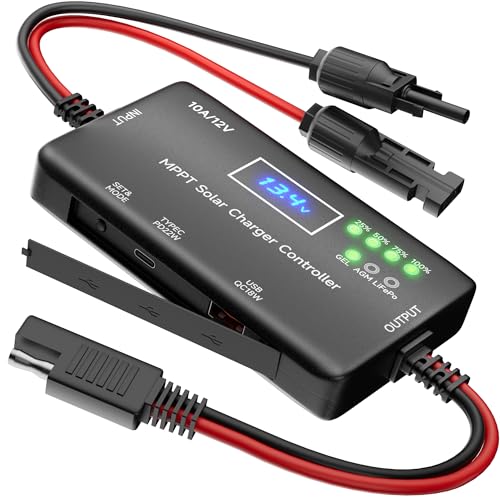
- 10A charging for 12V batteries
- LCD status plus USB and Type-C outputs
- Not for 24V or 36V batteries
Best For: Compact, portable 12V solar setups
Connected System Pick

- 12/24V, 15A controller
- Built-in Bluetooth and 30-day app history
- Configurable low-voltage load disconnect
Best For: App-monitored 12V or 24V solar systems
Dongle-Ready Victron Pick

- Explicit LiFePO4 compatibility
- 12/24V, 15A controller
- Bluetooth requires a separate dongle
Best For: Victron charging without built-in Bluetooth
High-Voltage Pick
120A MPPT Controller for 12V–96V Banks
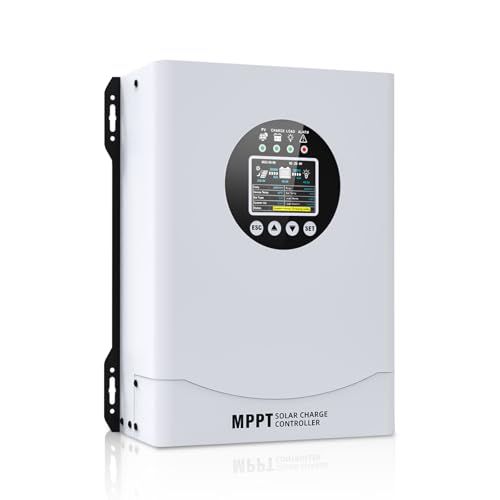
- 120A rating; up to 230V PV input
- Supports LiFePO4 and 12V–96V systems
- LCD and multiple stated protections
Best For: Higher-voltage LiFePO4 solar systems
Compact Monitoring Pick
Renogy Rover 2 20A with Bluetooth

- Built-in Bluetooth and LCD
- 20A for 12V/24V battery banks
- Up to 100V Voc PV input
Best For: Compact systems needing phone monitoring
Timed-Load Pick
100A-Rated Controller with LCD and USB

- LiFePO4 support; 12V–48V systems
- Timed modes, LCD, and dual USB
- Seller says MPPT may be limited
Best For: Timed load control with on-device readouts
Best for RV Versatility – Renogy Rover 30A MPPT
The Renogy Rover 30A is an MPPT charge controller for LiFePO4 buyers who want a 12V or 24V option for an RV, cabin, or marine setup. It supports lithium and several lead-acid battery types, with an LCD for checking settings locally.
Best For: Mixed-battery or changing 12V/24V setups that need adjustable charging and a built-in display.
Pros:
- Automatically detects 12V or 24V systems; rated for up to 400W or 800W of solar input, respectively, with a 100V maximum PV open-circuit voltage.
- Includes lithium reactivation, load scheduling, and protection against reverse polarity and overload.
- Optional BT-2 module enables app monitoring and alerts.
Cons:
- Bluetooth monitoring requires a separately sold module.
- Its 30A rating may be too small for higher-current charging plans.
Choose this Rover if local controls and battery-type flexibility matter more than built-in connectivity. Check panel voltage and wattage against its input limits before buying.
Best for App Monitoring – Victron SmartSolar MPPT 100/30
Victron Energy SmartSolar MPPT 100V 30 amp 12/24-Volt Solar Charge Controller (Bluetooth)
Check Price On AmazonThe Victron SmartSolar 100/30 is an MPPT charge controller for LiFePO4 systems whose owners want charging settings and performance data in an app. Its 30A, 12V/24V design suits a system where Bluetooth access is more useful than a controller-mounted screen.
Best For: Buyers who want built-in Bluetooth monitoring and configurable charging on a 12V or 24V setup.
Pros:
- VictronConnect provides real-time data, 30-day history, battery presets, settings, firmware updates, and alarms.
- Multiple SmartSolar controllers can synchronize their charging stages.
- MPPT tracking is designed to maintain output when panels are partially shaded.
Cons:
- 30A charging capacity offers less room to expand than a 50A controller.
- Use the app to confirm the appropriate battery preset and settings for your LiFePO4 battery.
This is the connected choice for a moderate-size array, particularly if you may coordinate multiple controllers later. Confirm your panel configuration fits the 100V input class.
Best for High-Voltage Flexibility – POWLAND 120A MPPT
The POWLAND 120A is an MPPT charge controller for LiFePO4 buyers planning beyond a typical 12V or 24V system. Its listed auto-sensing range extends from 12V to 96V, and its 120A rating targets substantially higher charging current.
Best For: Larger or higher-voltage installations that need a configurable controller with an on-unit LCD.
Pros:
- Automatically detects listed system voltages from 12V through 96V.
- Supports LiFePO4, AGM, gel, and flooded batteries, with battery customization options.
- LCD shows PV readings, charging stage, and system warnings; listed maximum solar input voltage is 230V.
Cons:
- The supplied specifications do not state PV wattage limits for each battery voltage; verify sizing before installation.
- No app or Bluetooth monitoring is listed.
Its wide voltage range is the main reason to consider it. Before committing to a high-current build, match your array, wiring, and battery charging requirements to the controller’s full specifications.
Best for 50A Expansion – Victron SmartSolar MPPT 100/50
The Victron SmartSolar 100/50 is an MPPT charge controller for LiFePO4 buyers who want more charging-current headroom than a 30A model in a 12V or 24V system. Built-in Bluetooth gives you access to settings and performance data through VictronConnect.
Best For: 12V/24V setups needing a 50A controller with app-based configuration and monitoring.
Pros:
- 50A rating provides more charging-current capacity than the 30A SmartSolar option.
- App offers real-time data, 30-day history, battery presets, firmware updates, and alarms.
- Supports synchronized charging with other SmartSolar controllers; the supplied listing notes UL1741 certification.
Cons:
- Has no built-in display, so on-site readings rely on the app.
- Confirm your array stays within the 100V input class and select settings appropriate for your battery.
Pick this model over the 100/30 when your planned charge current calls for the extra capacity. Its strengths are connected configuration and coordinated charging, not a front-panel readout.
Portable 12V Pick – SUNAPEX 10A MPPT Controller
If you need an mppt charge controller for lifepo4 in a small 12V setup, this SUNAPEX unit combines 10A charging, an LCD status display, and SAE connectors. It also supports 12V AGM, Gel, and lead-acid batteries.
Best For: Portable 12V solar setups that need a compact controller with visible charging status and USB device outputs.
Pros:
- LCD shows battery voltage and briefly displays charging current; LEDs indicate charging status.
- USB and Type-C ports can power compatible devices.
- Reverse-current protection is designed to prevent battery drain when solar input is unavailable.
Cons:
- Not suitable for 24V or 36V battery packs.
- Requires correct polarity and a solar panel without a built-in controller.
Choose this for its compact form and accessible status display, but check your panel and battery voltage before connecting it.
For buyers comparing an mppt charge controller for lifepo4, the Victron SmartSolar 75/15 offers a 12/24V controller with built-in Bluetooth for configuration and monitoring through VictronConnect. The app provides real-time data and 30-day performance history.
Best For: 12V or 24V solar systems where app-based monitoring and adjustable charging settings matter.
Pros:
- Built-in Bluetooth supports app-based settings, alarms, and firmware updates.
- MPPT tracking is designed to optimize output when panels are partially shaded.
- Configurable load output can disconnect devices when battery voltage falls too low.
Cons:
- No full on-unit screen is listed; detailed monitoring is handled through the app.
- The supplied notes do not explicitly identify a LiFePO4 charging preset, so verify the settings required for your battery.
This is the more connected Victron option here. Confirm your battery’s required charge settings before commissioning a LiFePO4 system.
The Victron BlueSolar 75/15 is an mppt charge controller for lifepo4 with explicit LiFePO4 compatibility in its listed multi-stage charging options. It supports 12V and 24V systems and is designed to track available solar power even with partial panel shade.
Best For: Buyers who want a 12/24V Victron controller with stated LiFePO4 support and do not need Bluetooth built in.
Pros:
- Listed as compatible with LiFePO4, AGM, Gel, and flooded lead-acid batteries.
- 75V, 15A model supports 12V and 24V systems.
- Can be monitored and controlled through VictronConnect with an optional Bluetooth dongle.
Cons:
- Bluetooth dongle is sold separately.
- No built-in display is listed.
BlueSolar makes sense when stated LiFePO4 compatibility is the priority; choose SmartSolar instead if built-in Bluetooth is essential.
High-Voltage Pick – 120A MPPT Controller for 12V–96V Banks
If you need an mppt charge controller for lifepo4 in a higher-voltage battery system, this 120A model supports automatic recognition from 12V through 96V and lists a maximum PV input of 230V. It also supports several lead-acid battery types.
Best For: LiFePO4 installations that need a wide range of supported battery voltages and high stated PV capacity.
Pros:
- Supports 12V, 24V, 36V, 48V, 60V, 72V, 84V, and 96V battery systems.
- Lists PV capacities from 1,440W at 12V to 11,520W at 96V.
- Includes an LCD and stated protections for overcurrent, overvoltage, overload, and temperature.
Cons:
- Its broad voltage and power range may be more than a small 12V setup needs.
- The supplied notes do not specify app monitoring or a user-defined charge profile.
The wide voltage support is the main reason to consider it. Before sizing an array, confirm that your panels and battery settings fall within the controller’s stated limits.
Compact Monitoring Pick – Renogy Rover 2 20A with Bluetooth
The Renogy Rover 2 is an mppt charge controller for lifepo4 shoppers who want monitoring in a compact 12V or 24V setup. Its built-in Bluetooth and LCD let you check charging data without adding an external dongle.
Best For: Space-conscious RV, van, boat, or cabin systems that benefit from phone-based monitoring.
Pros:
- Built-in Bluetooth, an LCD, and an RS485 port provide monitoring options.
- Accepts arrays up to 100V Voc, with stated limits of 300W at 12V or 600W at 24V.
- Supports lithium and lead-acid batteries, plus user-defined charge profiles.
Cons:
- Limited to 20A and 12V/24V battery banks.
- Its stated PV wattage limits may be too low for a larger array.
This is the practical choice when installation space and easy status checks matter more than a high current rating. Match your panel array to its voltage and wattage limits.
Timed-Load Pick – 100A-Rated Controller with LCD and USB
This controller offers LiFePO4 compatibility, a backlit LCD, timed operating modes, and two USB ports. If you are shopping for an mppt charge controller for lifepo4, note the seller’s important qualification: it combines MPPT and PWM charging technologies and may not provide full MPPT functionality.
Best For: Buyers prioritizing timed load control and on-device readouts who can accept the stated MPPT limitation.
Pros:
- Recognizes 12V, 24V, 36V, and 48V battery systems and lists LiFePO4 support.
- LCD shows operating data, including battery voltage and PV charging current.
- Offers timed control modes, two 5V USB ports, and a factory-reset option.
Cons:
- The seller says it may not offer full MPPT functionality despite the MPPT branding.
- Maximum PV input is stated as 100V.
Its controls and display are useful differentiators, but the MPPT caveat is decisive if maximizing solar harvest is your priority. The supplied instructions also say to connect a powered battery before connecting the panel.
How We Picked the Best Mppt Charge Controller for Lifepo4
We organized these 10 controllers around the specifications that most affect a LiFePO4 installation: supported battery voltage, charging-current rating, maximum solar open-circuit voltage, battery-profile flexibility, and monitoring options. The lineup includes compact 10A–15A models, midrange 20A–50A choices, and several high-current listings. A large advertised amp rating alone does not establish that a controller is suitable for your array or battery.
Quick Comparison
For a small 12V setup, start with the SUNAPEX 10A or a Victron 75V/15A model, then check the panel’s electrical specifications against the controller limits. The Renogy 20A Bluetooth model, Renogy Rover 30A, and Victron SmartSolar 100V/30A offer steps up for appropriately sized 12V or 24V systems. The Victron SmartSolar 100V/50A suits buyers needing a higher charge-current rating within a 100V solar input limit. The listed 100A and 120A units target larger systems or wider battery-voltage ranges, but warrant especially careful verification of their documentation, ratings, and seller support.
Key Buying Factors for an Mppt Charge Controller for Lifepo4
Battery Charging Settings
Confirm the controller explicitly supports LiFePO4 or lets you set the bulk/absorption voltage, float behavior, and any other charging stages to your battery manufacturer’s instructions. An AGM or gel preset is not a substitute. Equalization should be disabled for LiFePO4 unless your battery maker specifically directs otherwise. If charging in freezing conditions is possible, check how the controller works with your battery’s low-temperature charge protection or external temperature control.
Solar Input and Charge-Current Limits
Add the panels’ open-circuit voltages in each series string and allow for the voltage increase in cold weather; the result must remain below the controller’s maximum PV input voltage. Also compare total array wattage with the manufacturer’s limit for your battery voltage. Size the controller’s output current for both the array and the battery’s permitted charging current, accounting for other charging sources where relevant.
System Voltage and Monitoring
Check whether the controller supports your specific 12V, 24V, or higher-voltage battery bank. Automatic voltage detection is not a reason to skip setup instructions, particularly when connecting a lithium battery with a battery-management system (BMS). Bluetooth can make it easier to check charging history and change settings, while an LCD may be enough if you only need on-device readings. Note that the Victron SmartSolar and BlueSolar listings should not be assumed to have the same connectivity.
Who Should Buy Which Mppt Charge Controller for Lifepo4?
Choose a 10A–15A controller for a modest array only after confirming its PV and charging limits. Look at 20A–30A models for mid-size systems where adjustable lithium settings and straightforward monitoring matter. Consider the 50A option when the array and battery can make use of its capacity. For 100A–120A listings, verify the full manual, wiring and fuse requirements, compatible battery voltages, and independent seller support before buying. In every case, the best Mppt Charge Controller for Lifepo4 is the one whose documented settings and electrical limits match your actual equipment.