When it comes to selecting a natural gas generator system, you want reliability and efficiency. In 2026, you’ll find some of the best models designed to meet your power needs, whether for home or business. These generators not only focus on performance but also prioritize eco-friendliness and safety. Let’s explore which models stand out and what factors you should consider to guarantee you make the right choice for your power solutions.
Westinghouse 13500 Peak Watt Tri-Fuel Portable Generator

If you’re looking for a versatile power solution, the Westinghouse 13500 Peak Watt Tri-Fuel Portable Generator is an excellent choice. With 13,500 peak watts and the ability to run on gasoline, propane, or natural gas, it adapts to your needs. You’ll enjoy up to 19 hours of runtime on a 9.5-gallon tank. Its safety features include multiple GFCI outlets and rubber covers, while the heavy-duty engine guarantees long-lasting performance. Plus, remote start and a plug-and-play setup make it convenient to use. Backed by a 3-year limited warranty, this generator delivers reliable power when you need it most.
Best For: Those seeking a reliable and flexible power source for home backup, outdoor activities, or job sites, with the option to use multiple fuel types.
Pros:
- Versatile fuel options: can run on gasoline, propane, or natural gas.
- Long runtime of up to 19 hours on a single tank, ensuring extended use.
- Convenient features such as remote start and plug-and-play setup for easy operation.
Cons:
- The generator may be heavier and bulkier compared to traditional single-fuel generators.
- Initial setup may require some assembly and understanding of safety features.
- Higher price point compared to generators with fewer power options and features.
DuroMax XP13000HXT Portable Generator

The DuroMax XP13000HXT Portable Generator stands out as an excellent choice for anyone seeking versatile and reliable power solutions, especially for outdoor enthusiasts and homeowners preparing for emergencies. This tri-fuel generator delivers a powerful 13,000 watts peak and 10,500 watts running, using gasoline, propane, or natural gas. With features like push-button and remote start, you’ll appreciate the convenience it offers. The generator includes seven total power outlets and a digital display for easy monitoring. Weighing 240 pounds, it’s durable yet manageable. Plus, it comes with a 3-year warranty, ensuring you’re covered for the long haul.
Best For: Those seeking a versatile power solution for outdoor activities or as a reliable backup during emergencies.
Pros:
- Tri-fuel option allows flexibility in fuel choice, accommodating gasoline, propane, or natural gas.
- Convenient features such as push-button and remote start make operation easy.
- Impressive power output of 13,000 watts peak ensures enough energy for multiple appliances.
Cons:
- Heavy weight of 240 pounds may make portability challenging for some users.
- Runtime of 8 hours on a full tank might require frequent refueling for extended use.
- Best Sellers Rank indicates it may not be as widely recognized compared to other brands in the market.
Generac 12,500 Watt Tri-Fuel Portable Generator

For those seeking versatility in power solutions, the Generac 12,500 Watt Tri-Fuel Portable Generator stands out with its tri-fuel capability, allowing you to operate it on gasoline, liquid propane, or natural gas. With 12,500 starting watts and a powerful 500cc engine, you’ll enjoy reliable performance. The user-friendly fuel selector makes switching fuels a breeze. Safety is paramount, featuring COsense Technology that detects carbon monoxide and automatically shuts down the unit if hazardous levels are detected. Plus, the electric start guarantees hassle-free operation, especially during emergencies. With durable construction and included accessories, you’re all set for any situation.
Best For: Individuals and families looking for a versatile and reliable portable generator that can operate on multiple fuel types for home backup or outdoor use.
Pros:
- Tri-Fuel Capability: Operates on gasoline, liquid propane, or natural gas, providing flexibility based on availability and preference.
- Safety Features: Equipped with COsense Technology for carbon monoxide detection and automatic shutdown to ensure user safety.
- Ease of Use: Electric start system allows for quick and easy activation without the hassle of manual pull-cord cranking.
Cons:
- Weight: The generator may be heavy and cumbersome to transport for some users despite the included wheels.
- Runtime on Gasoline: While it has a good runtime, it may not last as long on gasoline compared to propane or natural gas options.
- Initial Cost: The upfront price may be higher compared to basic generators without tri-fuel capabilities.
Westinghouse 12500 Watt Dual Fuel Portable Generator

Designed for those who need versatile power solutions, the Westinghouse 12500 Watt Dual Fuel Portable Generator is an exceptional choice for homeowners and outdoor enthusiasts alike. With 9500 running watts and 12500 peak watts on gasoline, it guarantees you’ll have ample power. You can also switch to propane, offering 8500 running watts and 11200 peak watts. Enjoy up to 12 hours of runtime with its 6.6-gallon tank. Its remote start feature, electric and recoil options, and minimal assembly make it user-friendly. Safety is a priority with GFCI outlets and rubber covers, providing a reliable, powerful experience.
Best For: Homeowners and outdoor enthusiasts seeking a reliable and versatile power source for various applications.
Pros:
- Powerful dual fuel capability with high wattage output for gasoline and propane.
- User-friendly design featuring remote start and minimal assembly requirements.
- Safety-focused design with GFCI outlets and rubber covers for added protection.
Cons:
- Heavier than some portable generators, which may affect portability.
- Requires regular maintenance to ensure optimal performance and longevity.
- Initial fuel odor may be present due to factory testing, which could be off-putting for some users.
Westinghouse Dual Fuel Portable Generator

When you need a dependable power source for your home or outdoor activities, the Westinghouse WGen11500DFc Dual Fuel Portable Generator stands out with its impressive peak wattage of 14,500 watts on gasoline and 13,500 watts on propane. This generator runs up to 19 hours on a 9.5-gallon gas tank, ensuring you stay powered longer. With a push-button electric start and remote key fob, starting it is a breeze. Safety features like CO sensors and low oil shutdown give you peace of mind. Weighing 230 pounds and equipped with heavy-duty wheels, it’s easy to transport wherever you need reliable power.
Best For: Those seeking a powerful and reliable portable generator for home backup or outdoor use.
Pros:
- Dual fuel capability allows flexibility to use gasoline or propane, providing options based on availability and preference.
- Long runtime of up to 19 hours on gasoline ensures extended power supply for various needs.
- Safety features such as CO sensors and automatic shutdown provide peace of mind during operation.
Cons:
- Weighing 230 pounds, it may be challenging to move for some users without assistance.
- Higher initial cost compared to some single fuel generators may be a consideration for budget-conscious buyers.
- Limited runtime on propane, with only up to 7 hours on a 20 lb. tank, may require frequent refueling for extended use.
Westinghouse 12000 Peak Watt Tri-Fuel Portable Inverter Generator

The Westinghouse 12000 Peak Watt Tri-Fuel Portable Inverter Generator stands out as an ideal solution for those who prioritize versatility and reliability in their power sources. With peak wattage of 12,000W and a running time of up to 19 hours, it seamlessly runs on gasoline, propane, or natural gas. Its quiet operation at 64 dBA and inverter technology guarantees safe usage for sensitive electronics. You’ll appreciate the convenience of electric start and remote key fob. Plus, with a 3-year warranty and lifetime technical support, you can trust Westinghouse to keep you powered, wherever you go.
Best For: Those seeking a versatile and reliable power source for camping, emergency backup, or job sites who need a generator that runs on gasoline, propane, or natural gas.
Pros:
- Tri-fuel capability allows for flexible fuel options depending on availability and preference.
- Quiet operation at 64 dBA makes it suitable for residential areas and sensitive environments.
- Long runtime of up to 19 hours at 25% load ensures extended use without frequent refueling.
Cons:
- Heavy weight of 191 pounds may hinder portability for some users.
- Higher initial cost compared to traditional single-fuel generators.
- Requires maintenance to ensure optimal performance over time.
Westinghouse 12500 Peak Watt Tri-Fuel Portable Generator

For homeowners seeking versatile and reliable power solutions, the Westinghouse 12500 Peak Watt Tri-Fuel Portable Generator stands out with its impressive ability to run on gasoline, propane, or natural gas. With a peak output of 12,500 watts and a runtime of up to 15 hours, it efficiently powers major appliances simultaneously. Its 457cc engine features electronic fuel injection for enhanced performance and lower emissions. Equipped with multiple outlets, including a 50A outlet, it’s ready for home or RV use. Plus, with heavy-duty wheels and a foldable handle, transporting this 222-pound generator is a breeze. Enjoy peace of mind with a 3-year warranty.
Best For: Homeowners and RV enthusiasts looking for a versatile and reliable power source that can operate on multiple fuel types.
Pros:
- Tri-fuel capability allows for flexibility in fuel choice, accommodating gasoline, propane, or natural gas.
- Long runtime of up to 15 hours on a full tank, making it ideal for extended power outages or outdoor use.
- Multiple outlet options including a 50A outlet, enabling the simultaneous powering of major appliances.
Cons:
- Heavy weight of 222 pounds may make it difficult to transport for some users.
- Initial cost may be higher compared to single-fuel generators, which could be a consideration for budget-conscious buyers.
- Maintenance requirements could be more complex due to the electronic fuel injection system compared to simpler models.
Westinghouse 18000 Peak Watt Tri-Fuel Portable Generator

Ideal for homeowners seeking versatile power solutions, the Westinghouse 18000 Peak Watt Tri-Fuel Portable Generator offers unmatched flexibility with its ability to run on gas, propane, or natural gas. With a powerful 713cc V-Twin engine, it delivers 18,000 peak watts on gas and can run for up to 16 hours at 25% load. Safety features like a CO sensor and low THD guarantee your electronics stay protected. Plus, its push-button remote start and multiple outlets make operation a breeze. Weighing in with reinforced handles, it’s easy to transport, guaranteeing reliable power whenever you need it.
Best For: Homeowners seeking a versatile and powerful backup power solution for emergencies or outdoor use.
Pros:
- Tri-fuel capability allows for flexible energy sourcing with gas, propane, or natural gas.
- Extended runtime of up to 16 hours at 25% load on a single tank, ensuring long-lasting power.
- User-friendly features such as push-button remote start and multiple outlet options for convenience.
Cons:
- Heavy weight may make it difficult to transport for some users.
- Operating noise level of 74 dBA might be considered loud for residential areas.
- Initial cost may be higher compared to standard generators without tri-fuel options.
DuroMax XP11000iHT Portable Tri Fuel Inverter Generator
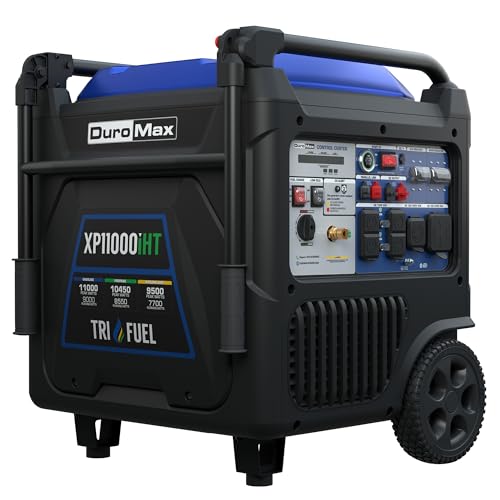
Offering the flexibility of tri-fuel technology, the DuroMax XP11000iHT Portable Tri Fuel Inverter Generator is perfect for those who need reliable power solutions for a variety of situations, whether it’s whole-home backup during outages, RV adventures, or jobsite demands. With 11,000 peak watts and 9,000 running watts, it runs on gasoline, propane, or natural gas. Its inverter power, featuring low THD, protects your sensitive electronics. Safety is prioritized with CO Alert Technology and low oil shutdown. Enjoy the convenience of electric start with a remote fob and a digital control center, making setup a breeze for all users.
Best For: Individuals and families seeking versatile power solutions for home backup, RV travel, or jobsite use.
Pros:
- Tri-fuel capability allows users to choose between gasoline, propane, or natural gas for greater flexibility.
- Inverter technology provides clean power, ensuring the safety of sensitive electronics.
- User-friendly features like electric start with a remote and a digital control center simplify operation and setup.
Cons:
- Weight of 216 pounds may make it less portable for some users.
- Initial setup may require additional components such as a transfer switch for home use.
- Higher price point compared to traditional generators without inverter technology.
Westinghouse 6500 Watt Dual Fuel Portable Generator

The Westinghouse 6500 Watt Dual Fuel Portable Generator stands out as an excellent choice for homeowners seeking a reliable backup power solution during outages or emergencies. With 5300 running watts on gasoline and 4800 on propane, it provides ample power for your needs. The 4.7-gallon fuel tank guarantees up to 14.5 hours of runtime, while its hardened steel frame and never-flat wheels make it portable. You’ll appreciate features like automatic voltage regulation and a CO sensor for safety. Plus, with a 3-year warranty and lifetime technical support, you can trust this generator to keep your home powered through any situation.
Best For: Homeowners looking for a reliable and versatile backup power solution for emergencies and outages.
Pros:
- Dual Fuel Capability: Operates on both gasoline and propane, providing flexibility in fuel choice.
- Extended Runtime: The 4.7-gallon fuel tank allows for up to 14.5 hours of continuous operation.
- Safety Features: Equipped with a CO sensor and automatic low oil shutdown for enhanced safety during use.
Cons:
- Weight: At 135.6 pounds, it may be challenging for some users to transport.
- Noise Level: Like many generators, it can be relatively loud during operation.
- Limited Outlets: Only a few outlet options may not be sufficient for larger power needs.
Factors to Consider When Choosing Natural Gas Generator Systems
When choosing a natural gas generator system, you’ll want to take into account several key factors. Think about your power output requirements, fuel efficiency ratings, and noise levels that fit your environment. Additionally, don’t overlook engine durability features and safety mechanisms to guarantee reliable performance.
Power Output Requirements
Choosing the right natural gas generator system hinges on understanding your power output requirements. First, determine the peak and running wattage needed for your appliances, as this guarantees the generator can handle the load during outages. Most natural gas generators offer outputs ranging from 7,500 to over 14,500 running watts. Pay special attention to starting wattage for high-demand appliances like refrigerators or air conditioners, which may need 2 to 3 times their running wattage. Additionally, consider how long you’ll need to use the generator; some models can run for up to 19 hours on a single tank. Finally, make certain the generator’s output matches your home’s voltage requirements, typically 120V or 240V.
Fuel Efficiency Ratings
Understanding fuel efficiency ratings is essential for selecting the right natural gas generator system, as these ratings directly impact your operational costs and environmental footprint. Look for generators measured in running watts per gallon; higher efficiency means less fuel consumption for the same power output. Generators featuring inverter technology can cut fuel consumption by up to 50% compared to traditional models. Pay attention to the runtime, which can range from 8 to 19 hours on a single tank, depending on load conditions. Additionally, consider the peak and running wattages, as higher peak capacities may consume fuel more quickly. Finally, check the Total Harmonic Distortion (THD) rating, since lower THD indicates cleaner power and improved fuel efficiency when powering sensitive electronics.
Noise Level Considerations
While evaluating natural gas generator systems, it’s crucial to take into account noise levels, especially if you plan to use them in residential areas. Most models operate between 60 to 75 dBA, which can be disruptive. Look for generators with noise-reducing features like insulated enclosures or low-noise engines, as these can greatly lower operational sound. Positioning the generator at least 20 to 50 feet from structures can also help mitigate noise impact. Consider models using inverter technology, known for quieter operation and cleaner power. Additionally, verify your choice complies with local regulations, which often cap noise levels between 55 to 65 dBA during specified hours. By prioritizing noise levels, you’ll maintain a peaceful environment while enjoying reliable power.
Engine Durability Features
Generator systems not only need to be quiet but also built to last. When choosing a natural gas generator, look for heavy-duty engines with cast iron sleeves, as these enhance durability and extend the unit’s lifespan. Automatic low oil shutdown is a must; it protects the engine by halting operation when oil levels drop. Additionally, consider generators with rugged steel frames and advanced materials to endure regular wear and tear. High-performance engines, like 4-stroke OHV designs, offer reliability and efficiency across various conditions. Finally, while evaluating options, remember that CO sensors and other safety features not only protect users but also contribute to the engine’s longevity by preventing hazardous situations.
Safety Mechanisms Included
Safety is an essential factor when choosing natural gas generator systems, and several mechanisms can greatly enhance user protection. Many generators now feature automatic shutdown capabilities that activate when hazardous carbon monoxide (CO) levels are detected, ensuring you stay safe during operation. Low oil shutdown is another vital mechanism, automatically turning off the generator to prevent engine damage when oil levels drop below safe thresholds. Overload protection prevents the generator from exceeding its rated capacity, safeguarding both the unit and your connected appliances. Additionally, advanced COsense technology alerts you to rising carbon monoxide levels and can trigger an emergency shutdown. Outlets often come with rubber covers to protect against accidental contact and short circuits, further enhancing safety during use.
Portability and Weight
When choosing a natural gas generator, portability and weight are essential factors that can greatly impact your experience. Many models weigh between 135 to 240 pounds, affecting how easily you can transport and set them up. Generators with heavy-duty wheels and foldable handles enhance mobility, allowing you to maneuver them to your desired location without hassle. Compact dimensions, typically around 27 to 30 inches in length, also make storage and transportation easier. Generally, if a generator weighs less than 200 pounds, you can handle it alone, but heavier models may require extra help or equipment. The design, including the frame and wheel configuration, considerably influences portability and usability in various settings, whether for home backup or job sites.
Warranty and Support Options
Selecting the right natural gas generator isn’t just about portability and weight; warranty and support options play an essential role in your decision-making process. Look for a warranty that offers at least a 3-year limited coverage on service, parts, and labor to guarantee you have reliable support. Many manufacturers provide nationwide customer service networks, which can enhance your confidence in your purchase. Be sure to review the specifics of the warranty, including what’s covered and what’s excluded. Additionally, some generators offer lifetime technical support, giving you peace of mind. Finally, checking for functional testing and compliance with standards can help indicate the quality of the warranty support from the manufacturer.