If you’re looking to power your home independently, understanding off-grid inverter systems is vital. These systems can transform how you use energy, providing flexibility and self-sufficiency. From high-capacity options for heavy appliances to budget-friendly models for essentials, there’s a solution for every need. But what features should you prioritize? Let’s explore the top options and key factors that could influence your decision.
12000W Solar Hybrid Inverter for Home On/Off-Grid Systems

If you’re looking for a powerful solution to harness solar energy for your home, the 12000W Solar Hybrid Inverter is an excellent choice. It converts 48V DC to 120V/240V AC, providing a continuous output of 12,000W and a peak output of 24,000W. With two MPPT solar charging inputs, it maximizes solar energy harvesting by up to 30%. You can connect up to six units in parallel for a whopping 72kW total output. Featuring a smart LCD for real-time monitoring and robust protection against electrical issues, this inverter is perfect for various applications, from RVs to home emergencies.
Best For: Homeowners seeking a reliable and powerful solar energy solution for off-grid or backup power applications.
Pros:
- High continuous output of 12,000W with the ability to peak at 24,000W, accommodating heavy power demands.
- Built-in MPPT controller enhances solar energy efficiency, boosting harvesting by up to 30%.
- Versatile output modes and parallel connection capability allow for scalability and customization based on energy needs.
Cons:
- Requires a significant initial investment, which may be cost-prohibitive for some users.
- Installation may require professional assistance, adding to overall costs.
- Limited to specific battery voltages and configurations, which could restrict compatibility with existing systems.
ECO-WORTHY 10KW Off Grid Solar System Complete Kit

The ECO-WORTHY 10KW Off Grid Solar System Complete Kit is perfect for homeowners seeking a reliable energy solution without reliance on the grid. With 12 powerful 195W solar panels, a robust 10KW inverter, and two 48V lithium batteries, this system delivers an impressive 9.36KWh per day under ideal conditions. You’ll appreciate its WiFi monitoring capabilities, allowing you to track performance remotely. The system’s versatility includes multiple charging modes, ensuring you optimize your energy usage. Built with durable materials, it’s designed to last over 30 years, making it an excellent investment for energy independence in homes, cabins, or farms.
Best For: Homeowners, cabin dwellers, and farmers seeking energy independence without reliance on the grid.
Pros:
- Robust 10KW inverter capable of powering high-demand appliances.
- Remote monitoring through WiFi for real-time performance tracking.
- Durable design with a 30-year lifespan, ensuring long-term investment.
Cons:
- Initial setup cost may be high for some customers.
- Requires adequate space for installation of solar panels.
- Performance may vary based on geographical location and weather conditions.
3000W 24V Off-Grid Hybrid Inverter with WiFi Monitoring

For homeowners seeking a reliable and efficient energy solution, the 3000W 24V Off-Grid Hybrid Inverter with WiFi Monitoring stands out as an ideal choice. This inverter delivers pure sine wave output with a 100A MPPT solar charger, ensuring maximum efficiency and high conversion rates. You can easily monitor your system via the SmartESS app, allowing real-time tracking of power usage and battery status. With multiple operating modes and adjustable charging options, it adapts to your needs seamlessly. Plus, its safety features, including overload protection and remote adjustments, give you peace of mind while living off the grid.
Best For: Homeowners looking for a reliable and efficient off-grid energy solution with advanced monitoring capabilities.
Pros:
- High efficiency with 97% conversion rate and pure sine wave output for optimal appliance performance.
- Multiple operating and charging modes for flexibility and adaptability to varying energy needs.
- Built-in WiFi monitoring via the SmartESS app for real-time tracking and remote adjustments.
Cons:
- Requires specific voltage for No-Battery Mode, limiting operational flexibility without a battery.
- Overload shutdown may be restrictive for users with high power demand or fluctuating loads.
- Potential complexity in configuration for non-communicating Li-ion batteries to avoid BMS conflicts.
SUMRY Hybrid Solar Inverter (4000W DC 24V to AC 120V)

Looking for a reliable power solution for your off-grid home? The SUMRY Hybrid Solar Inverter is a fantastic choice, offering 4000W DC to AC 120V conversion. With a peak output of 8000W, it supports various battery types or even operates without one. Its pure sine wave output guarantees minimal interference, making it ideal for sensitive appliances. The user-friendly LCD display and touchable buttons make operation a breeze. Plus, with built-in protections and a 140A MPPT charge controller, it optimizes both performance and battery life. Whether for emergencies or daily use, this inverter’s flexibility makes it a top contender.
Best For: Those seeking a versatile and efficient off-grid power solution for homes or emergency backup.
Pros:
- Supports a variety of battery types or can operate without a battery, providing flexibility.
- Pure sine wave output ensures the safe operation of sensitive appliances.
- High efficiency of 98% maximizes energy conversion and minimizes waste.
Cons:
- Initial investment may be higher compared to standard inverters.
- Requires proper installation and configuration for optimal performance.
- Limited maximum PV input may restrict scalability for larger solar setups.
12000W Hybrid Solar Inverter (48V DC to 120V/240V AC)
Homeowners seeking reliable power solutions will find the 12000W Hybrid Solar Inverter (48V DC to 120V/240V AC) an excellent choice. With a continuous output of 12,000W and a peak output of 24,000W, it efficiently converts DC power for your home. The built-in MPPT controller enhances solar energy harvesting by up to 30%, ensuring faster charging. You can easily expand your system by connecting up to six units for a maximum output of 72kW. Its durable design withstands various conditions, making it perfect for diverse applications. Plus, smart monitoring keeps you informed about your power usage and battery status.
Best For: Homeowners and outdoor enthusiasts seeking a reliable and scalable power solution for various applications.
Pros:
- High Efficiency: Built-in MPPT controller boosts solar charging efficiency by up to 30%.
- Scalable Power: Supports parallel connection of up to 6 units for maximum output of 72kW, accommodating future power needs.
- Versatile Applications: Suitable for use in RVs, boats, and home emergencies, powering a wide range of appliances.
Cons:
- Initial Cost: Higher upfront investment compared to traditional inverters.
- Complex Installation: May require professional installation for optimal performance, especially when connecting multiple units.
- Limited Integration: Compatibility with specific battery types may restrict options for some users.
PowMr 2400W Solar Inverter with 50A PWM Charge Controller

The PowMr 2400W Solar Inverter with a 50A PWM Charge Controller is an excellent choice for those seeking a reliable off-grid solution, especially if you want to power essential appliances like refrigerators and air conditioners without relying on the grid. This inverter converts 24V DC to 110V/120V AC, offering pure sine wave output for safety. With up to 95% charging efficiency and four selectable charging modes, it adapts to your needs seamlessly. Its thorough protection features, including overload and short circuit protection, guarantee your electrical systems remain safe and secure, making it perfect for home or office applications.
Best For: Those looking for a reliable off-grid solar solution to power essential home or office appliances without grid dependency.
Pros:
- High charging efficiency of up to 95% ensures effective energy usage.
- Pure sine wave output provides safe operation for sensitive electronic devices.
- Versatile with four selectable charging modes and multiple output modes to suit various needs.
Cons:
- Limited to a maximum PV array open circuit voltage of 80V, which may restrict some setups.
- Requires compatible 24V lead-acid batteries, limiting battery options.
- Installation may require some technical knowledge for optimal performance.
ECO-WORTHY 48V Off Grid Solar System Complete Kit 1200W

Ideal for those seeking reliable energy independence, the ECO-WORTHY 48V Off Grid Solar System Complete Kit delivers a robust 1200W solution for any off-grid setting, whether it’s a home, shed, or cabin. This kit includes six high-efficiency bifacial solar panels, a 3500W inverter with WiFi monitoring, and a 48V 50Ah lithium battery. Generating around 4.68KWh daily under peak sunlight, it guarantees you have ample power. With advanced safety features and the ability to expand up to 32 batteries, you can enjoy a seamless, independent energy solution tailored to your needs. Power your life with confidence!
Best For: Individuals or families looking for a reliable and efficient off-grid solar power solution for homes, sheds, or cabins.
Pros:
- High-efficiency bifacial solar panels with 25% conversion efficiency for optimal energy generation.
- Built-in WiFi monitoring allows for easy control and oversight of the system.
- Expandable battery capacity supports up to 32 batteries, enabling significant energy storage options.
Cons:
- Initial investment may be high for some users.
- Requires adequate space for solar panel installation to maximize sunlight exposure.
- Limited to off-grid applications, not suitable for grid-tied systems without additional components.
Ampinvt 5000W Off Grid Solar Inverter with MPPT Charge Controller

For those seeking a reliable energy solution in remote locations, the Ampinvt 5000W Off Grid Solar Inverter stands out with its robust features. This pure sine wave inverter operates on 48Vdc to 120V, ensuring high transfer efficiency of over 92%. With an inbuilt 100A MPPT charge controller, it maximizes solar input up to 5500W and supports various battery types. You can choose from multiple operating modes, including PV load priority and mains hybrid charging. The communication ports allow for easy monitoring and adjustments, while safety protections guard against common issues like short circuits and overheating.
Best For: Those in need of a reliable off-grid power solution for remote locations, capable of supporting various battery types and maximizing solar energy input.
Pros:
- High transfer efficiency of over 92%, ensuring effective energy use.
- Inbuilt 100A MPPT charge controller for optimized solar charging.
- Multiple operating modes and charging options for flexibility in energy management.
Cons:
- Maximum PV input limited to 5500W, which may not suffice for larger setups.
- Requires specific drivers for USB configuration, potentially complicating setup for some users.
- Supports only resistive loads for dry contact control, limiting its compatibility with certain applications.
Hybrid Solar Inverter 48V 12000W with Dual MPPT

Designed to meet the needs of energy-conscious homeowners, the Hybrid Solar Inverter 48V 12000W with Dual MPPT is an excellent choice for those looking to maximize solar energy efficiency. With a peak power of 18,000VA, this inverter supports both lead-acid and lithium batteries, making it versatile for your energy needs. The built-in WiFi allows you to monitor performance via a mobile app. Plus, its four charging modes and flexible output configurations guarantee you can adapt to any scenario, whether off-grid or grid-backed. Enjoy peace of mind with multiple layers of protection for your investment.
Best For: Homeowners looking for an efficient and versatile solar energy solution with advanced monitoring capabilities and flexible configurations.
Pros:
- Built-in WiFi for real-time performance monitoring via a mobile app.
- Multiple charging and output modes allow for adaptability in various energy scenarios.
- Expandable capacity with the ability to connect up to 6 units for increased power needs.
Cons:
- Higher initial investment compared to standard inverters.
- Complex installation may require professional assistance.
- Limited compatibility with certain battery types and brands.
ECO-WORTHY 9.36KWH Off Grid Solar Power System Kit
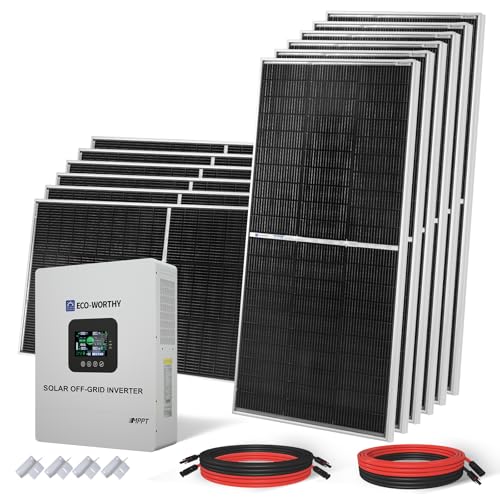
The ECO-WORTHY 9.36KWH Off Grid Solar Power System Kit is perfect for homeowners seeking reliable energy independence. With a 2340W output, it powers essential AC devices like refrigerators and microwaves. This kit includes 12 high-efficiency 195W solar panels that withstand the elements and promise a 30-year lifespan. The robust 5000W inverter guarantees uninterruptible power and features four charging modes for flexibility. You can even connect up to six units for a maximum of 30 kW, making it adaptable to your growing energy needs. Installation is straightforward, and all necessary components are included for your convenience.
Best For: Homeowners seeking reliable energy independence and off-grid power solutions.
Pros:
- High-efficiency 195W solar panels with a 30-year lifespan ensure durability and longevity.
- The 5000W inverter provides uninterruptible power and multiple charging modes for flexibility.
- Supports parallel operation of up to six units, making it scalable for growing energy needs.
Cons:
- Initial investment cost may be high for some homeowners.
- Requires adequate space for installation of 12 solar panels.
- Potential complexity in installation may require professional assistance for some users.
Factors to Consider When Choosing Off Grid Inverter Systems for Homes
When you’re choosing an off-grid inverter system for your home, there are several key factors to keep in mind. You’ll want to assess the power output capacity, battery compatibility options, and charging efficiency features to guarantee it meets your needs. Additionally, don’t overlook the importance of monitoring and control, along with safety protection mechanisms, for a reliable setup.
Power Output Capacity
Power output capacity is a crucial factor in selecting off-grid inverter systems for your home, as it dictates how much continuous wattage can be supplied to your appliances. Typically, residential systems range from 2,400W to 12,000W. Keep in mind that inverters often have peak output ratings, allowing them to handle short bursts of power for appliances like refrigerators or power tools, sometimes doubling their continuous output. You can also combine multiple units to considerably boost capacity, potentially reaching up to 72 kW. To guarantee your system runs smoothly, match the inverter’s output capacity to the total wattage of your appliances, confirming it can handle peak demands without overloading. Efficiency in converting DC to AC power is also essential, with top inverters achieving up to 98%.
Battery Compatibility Options
Selecting the right off-grid inverter system means ensuring it’s compatible with various battery types, which greatly impacts both performance and longevity. You’ll want to contemplate options like AGM, Gel, Lead-acid, Lithium-ion, and LiFePO4 batteries, as each has unique characteristics. Many systems support multiple configurations, letting you choose capacities and chemistries that fit your energy needs. Look for inverters with integrated communication protocols like RS485 or CAN to monitor battery performance in real time. It’s also crucial to check that the inverter’s maximum charging current and voltage align with your battery’s specifications to avoid damage. Some inverters even offer battery-free operation modes, allowing you to harness solar power directly, enhancing your energy management flexibility.
Charging Efficiency Features
Battery compatibility is just one aspect to contemplate; charging efficiency features play an essential role in optimizing your off-grid inverter system. Look for high-efficiency Maximum Power Point Tracking (MPPT) controllers, which can enhance solar energy harvesting by up to 30% compared to traditional systems. Inverters with adjustable charging modes—like Solar Only, AC Priority, and Hybrid Charging—allow you to maximize energy usage based on available resources. Consider models with a maximum PV input voltage of up to 500VDC for faster charging. Systems that deliver up to 220A battery charging current can greatly speed up energy storage. Aim for inverters with charging efficiency rates as high as 98% to minimize energy loss during the conversion process.
Monitoring and Control
When choosing off-grid inverter systems for your home, it is crucial to evaluate how well you can monitor and control your energy usage. Look for inverters with smart LCD screens or mobile app integration for real-time insights on power input/output and battery status. Adjustable settings for charging current and voltage thresholds will help you customize the system to meet your specific energy needs. Opt for models with built-in WiFi or communication ports for remote monitoring and control, allowing you to manage energy usage flexibly. Additionally, choose inverters that provide fault alerts and diagnostics through notifications, ensuring you can quickly address issues like overloads. Finally, consider systems that support various operational modes for optimized energy management in off-grid scenarios.
Safety Protection Mechanisms
Choosing the right off-grid inverter system means prioritizing safety protection mechanisms to guarantee your home’s energy setup is secure and reliable. Look for systems with multi-layer protection against overvoltage, undervoltage, and short circuits to safeguard your electrical circuits. Many inverters feature overload protection that automatically shuts down the system if the load exceeds a certain threshold, preventing damage to both the inverter and your appliances. Built-in over-temperature protection monitors the inverter’s temperature, disconnecting it when it exceeds safe limits, thereby reducing fire risks. Additionally, systems with battery low and high voltage alarms alert you before reaching critical levels, while reverse polarity protection ensures incorrect battery connections won’t damage your inverter. These features enhance your system’s safety considerably.
Installation Flexibility
Understanding installation flexibility is essential for optimizing your off-grid inverter system, as it can greatly influence both performance and cost. Look for inverters that support parallel connections, allowing you to link multiple units for increased power output—up to 72kW with six units. Many inverters offer various output modes, such as single-phase and split-phase configurations, to suit your home’s wiring setup. Built-in smart monitoring features simplify installation by providing real-time data, making troubleshooting easier. Some inverters can operate without batteries during the day, cutting down on installation complexity and costs associated with battery storage. Finally, verify compatibility with different battery types, like lead-acid or lithium, to choose the best fit for your needs and budget.