A shed workshop needs more than a panel that can charge a phone. Lights and a few small devices are easy to power; saws, compressors, and other motor-driven tools demand much more from the inverter and battery.
These 10 kits span compact starter setups and larger systems with substantial storage. The right choice depends on what you run, how long you run it, and how much sun your installation gets.
Best 10 Off Grid Solar Kit for Shed Workshop Picks for 2026
Best Compact AC Kit
240W Solar Kit with LiFePO4 Battery

- 240W panels and 100Ah LiFePO4 battery
- 1000W pure sine wave inverter
- MPPT controller and mounting accessories included
Best For: Small workshops needing modest 120V loads
Best 5kW Workshop System

- Twelve panels total 2340W
- 5000W off-grid inverter included
- One 51.2V 100Ah LiFePO4 battery
Best For: Larger workshops with ample panel space
Best for Basic Shed Lighting

- 100W panel and 12V 20Ah AGM battery
- 10A PWM controller with LCD
- No AC inverter included
Best For: Basic shed lighting and small 12V loads
Best High-Output Setup

- 10kW split-phase 120V/240V inverter
- 2340W panel array
- Two batteries total 10.24kWh listed storage
Best For: Professionally installed large workshop systems
Best 120V Workshop Kit
SUNGOLDPOWER 5,000W Off-Grid Kit

- 5,000W pure sine wave, 120V output
- 1,200W of panels and 5.12kWh battery
- Optional Wi-Fi module sold separately
Best For: 120V shed workshops needing substantial battery storage
Best Small-Shed Kit

- Four 100W bifacial panels
- 2,000W pure sine wave inverter
- Two 12V 100Ah lithium batteries
Best For: Modest sheds with 110V devices under 2,000W
Best 120/240V Kit
SUNGOLDPOWER 6,500W Off-Grid System

- 6,500W inverter with 120/240V output
- 2,220W of rated solar panels
- 51.2V 100Ah LiFePO4 battery
Best For: Workshops needing both 120V and 240V output
Best Battery-Included Kit
ECO-WORTHY 1560W 48V Solar System

- 1560W panels and 48V 100Ah battery
- 3500W inverter with 7000W peak rating
- Touchscreen, Bluetooth, and Wi-Fi monitoring
Best For: Sheds or workshops needing included battery storage
Best Modular 24V Setup
1440W Solar Kit with Combiner Box
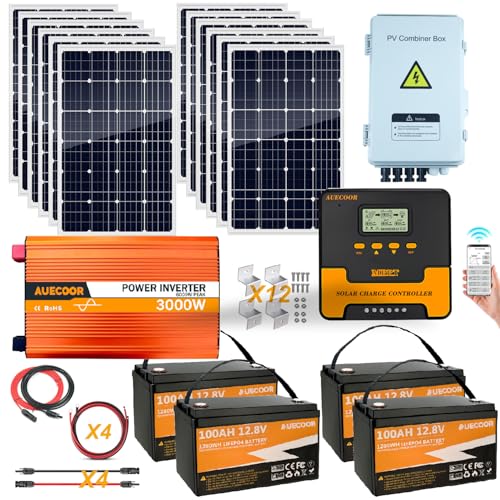
- Twelve panels total 1440W
- 3000W pure sine wave inverter
- Verify conflicting battery specifications
Best For: Modular installations with organized panel wiring
Best High-Output Panel Kit
ECO-WORTHY 2340W 48V Solar Kit
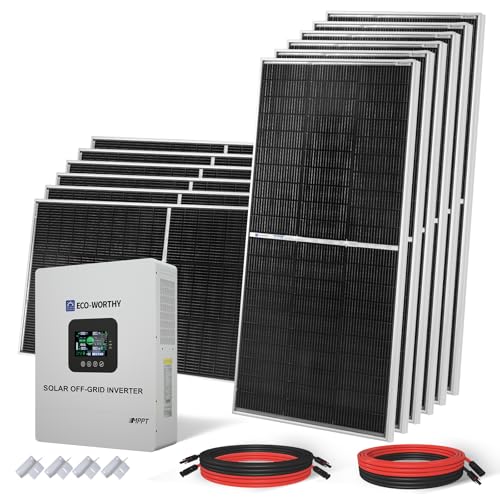
- Twelve panels provide 2340W rated capacity
- 5000W inverter with 100A MPPT controller
- Battery not listed; professional installation recommended
Best For: Larger installations with separately chosen storage
Best Compact AC Kit – 240W Solar Kit with LiFePO4 Battery
If you need an off grid solar kit for shed workshop lights, electronics, and occasional AC use, this package pairs 240W of panels with a 100Ah LiFePO4 battery and a 1000W pure sine wave inverter. It also includes a 20A MPPT controller, cables, and panel brackets.
Best For: A small shed or workshop that needs battery-backed 120V power for modest loads.
Pros:
- Includes panels, battery, inverter, charge controller, cables, and brackets.
- Pure sine wave inverter provides 1000W continuous output and 2000W peak output.
- MPPT controller and LiFePO4 battery make this a well-rounded 12V setup.
Cons:
- The 240W array limits how quickly solar can replenish the battery.
- The 1000W continuous inverter rating rules out higher-draw tools.
This is a practical middle ground when you want AC outlets without moving up to a large 48V system. Check your tools’ running and startup wattage before choosing it.
Best 5kW Workshop System – ECO-WORTHY 2340W Solar Kit
For a larger off grid solar kit for shed workshop use, this ECO-WORTHY package supplies twelve 195W panels, a 5000W off-grid inverter, and a 51.2V 100Ah LiFePO4 battery. Its 2340W solar array is a substantial step up from small shed kits.
Best For: Larger workshops or cabins with space for twelve panels and a need for higher inverter capacity.
Pros:
- 2340W of rated panel capacity across twelve monocrystalline panels.
- Includes a 48V-class battery and 5000W off-grid inverter.
- Comes with cables and Z-brackets for the supplied panels.
Cons:
- Twelve panels require considerable mounting space.
- The listed kit has one 51.2V 100Ah battery, so storage capacity may be the limiting factor for extended use.
Choose this if your shed project calls for a full-size solar installation rather than a compact lighting system. Plan panel placement and estimate overnight energy use before buying.
Best for Basic Shed Lighting – ExpertPower 100W AGM Kit
For a simple off grid solar kit for shed workshop lighting, the ExpertPower bundle combines a 100W panel, 12V 20Ah AGM battery, and 10A PWM controller. It includes mounting brackets and both solar and battery cables, making it a compact starting point for a 12V DC setup.
Best For: Basic shed lights and other small 12V DC loads.
Pros:
- Includes the panel, battery, controller, brackets, and cables.
- Controller LCD shows charging and battery information.
- Panel is rated to withstand 2400Pa wind and 5400Pa snow loads.
Cons:
- No AC inverter is listed, so it will not power standard wall-plug tools as supplied.
- The 20Ah AGM battery provides much less storage than larger workshop kits.
This kit makes the most sense when your power needs are small and primarily 12V. If you need AC outlets or longer runtime, look at a kit with an inverter and a larger battery.
Best High-Output Setup – ECO-WORTHY 10kW Inverter Kit
If your off grid solar kit for shed workshop needs to support substantial 120V/240V loads, this ECO-WORTHY system combines a 10kW off-grid inverter with twelve 195W panels and two 48V 100Ah lithium batteries. The panels total 2340W, while the batteries are listed at 10.24kWh combined capacity.
Best For: A large workshop or cabin project requiring split-phase output and substantial battery storage.
Pros:
- 10kW inverter supports 120V/240V split-phase output.
- Two lithium batteries provide a listed 10.24kWh of storage.
- Includes twelve 195W panels, Z-brackets, and accessories.
- Battery monitoring supports an app via Bluetooth and Wi-Fi.
Cons:
- The 2340W panel array is far smaller than the inverter’s 10kW output rating; sustained use depends on available solar energy and battery charge.
- The seller recommends professional installation rather than novice DIY setup.
This is the option for a professionally planned, higher-capacity installation—not a quick small-shed build. Size your loads against the solar array and stored energy, not the inverter rating alone.
Best 120V Workshop Kit – SUNGOLDPOWER 5,000W Off-Grid Kit
If you need an off grid solar kit for shed workshop use with substantial 120V AC capacity, this SUNGOLDPOWER package pairs a 5,000W pure sine wave inverter with 1,200W of panels and a 5.12kWh LiFePO4 battery. It includes mounting brackets and solar extension cables.
Best For: A shed workshop that needs 120V power, battery storage, and room to expand its inverter setup.
Pros:
- 5,000W inverter with a listed 10,000W peak output.
- Six 200W panels and a 51.2V 100Ah battery are included.
- Supports up to six inverters in parallel; optional Wi-Fi monitoring is available.
Cons:
- Wi-Fi monitoring requires a separately sold module.
- 120V AC output is less suitable if your workshop needs 240V equipment.
- Listed kit weight is 350 pounds.
This is a substantial 120V package, but check your equipment’s voltage requirements and plan for the kit’s weight before choosing it.
Best Small-Shed Kit – ECO-WORTHY 400W Solar Kit
For a smaller off grid solar kit for shed workshop use, this ECO-WORTHY package combines four 100W bifacial panels, two 12V 100Ah lithium batteries, a 40A MPPT controller, and a 2,000W pure sine wave inverter. Its stated 1.6kWh daily output assumes four hours of sunlight, so treat that figure as an ideal-condition estimate.
Best For: A modest shed setup with 110V AC devices below the inverter’s 2,000W rated output.
Pros:
- Includes panels, batteries, charge controller, inverter, and Bluetooth module.
- 2,000W pure sine wave inverter provides AC power.
- Lithium batteries include built-in battery management systems.
Cons:
- 400W of panels limits solar production relative to the larger kits here.
- The advertised 1.6kWh daily output depends on ideal sunlight conditions.
This is the more modest option for a shed; compare your expected daily energy use with its ideal-condition output before buying.
Best 120/240V Kit – SUNGOLDPOWER 6,500W Off-Grid System
If your off grid solar kit for shed workshop needs must include 240V equipment, this SUNGOLDPOWER system offers a 6,500W 120/240V inverter, six 370W panels, and a 51.2V 100Ah LiFePO4 battery. The stated 8.8kWh daily generation estimate assumes four hours of full sunlight.
Best For: A workshop with 120V and 240V power needs and space for six large panels.
Pros:
- 6,500W inverter supports 120V and 240V AC appliances.
- Six panels provide 2,220W of rated solar capacity.
- Includes a wall-mounted battery, extension cables, mounting brackets, and PV and battery breakers.
Cons:
- The six 370W panels require more installation space than smaller kits.
- The 8.8kWh daily output figure is based on full-sun conditions, not a guaranteed daily yield.
Choose this over a 120V-only kit if 240V output matters. Check your available panel space and actual energy needs against the listed components.
Best Battery-Included Kit – ECO-WORTHY 1560W 48V Solar System
If you want an off grid solar kit for shed workshop use with storage included, this ECO-WORTHY system pairs eight 195W panels with a 48V 100Ah LiFePO4 battery and a 3500W inverter. The stated 6.24kWh daily output assumes four hours of full sunlight, so treat it as a planning estimate rather than a guarantee.
Best For: A shed or workshop that needs a battery-included system for 120V appliances.
Pros:
- Includes 1560W of panels, a 48V 100Ah battery, and a 3500W inverter.
- Built-in 80A MPPT controller and 7000W peak inverter rating.
- Touchscreen plus Bluetooth and Wi-Fi monitoring; battery supports charging down to -4°F.
Cons:
- Daily generation estimate depends on four hours of full sunlight.
- Ships in multiple packages, so you will need to confirm every component arrives.
This is the most straightforward choice here if you want panels, inverter, and storage specified together. Check your tool startup loads against the inverter ratings before buying.
Best Modular 24V Setup – 1440W Solar Kit with Combiner Box
For an off grid solar kit for shed workshop use where organized panel wiring matters, this 24V setup lists twelve 120W panels, a 3000W pure sine wave inverter, a 60A MPPT controller, and a four-to-one PV combiner box. The listing also states 5.12kWh of battery capacity, but its battery description calls out a 12.8V 100Ah unit; confirm the actual battery configuration before ordering.
Best For: Buyers who want a modular setup with a combiner box and are willing to verify the battery specifications.
Pros:
- 1440W of listed solar input and a 3000W pure sine wave inverter with a 6000W peak rating.
- Included combiner box organizes panel connections and provides DC surge protection.
- MPPT controller offers an LCD display and app control.
Cons:
- The stated 5.12kWh capacity is not reconciled with the 12.8V 100Ah battery description.
- Its 4–5kWh-or-more daily production estimate depends on good sunlight.
The separate controller and combiner box may appeal to buyers who prefer a modular system. Resolve the battery listing discrepancy and check the final wiring plan before committing.
Best High-Output Panel Kit – ECO-WORTHY 2340W 48V Solar Kit
If your off grid solar kit for shed workshop use calls for more panel capacity, this ECO-WORTHY package supplies twelve 195W panels, mounting brackets, and a 5000W all-in-one inverter with a 100A MPPT controller. Its stated 9.36kWh daily output assumes four hours of full sun. No battery is listed among the included components, so plan storage separately if you need power after dark.
Best For: Larger shed or workshop installations where the buyer will select a battery separately and arrange professional installation.
Pros:
- 2340W of included panels and a 5000W pure sine wave inverter.
- All-in-one inverter includes a 100A MPPT controller.
- Includes Z-brackets; inverter supports parallel expansion with compatible units.
Cons:
- No battery is listed in the package contents.
- The seller recommends professional installation rather than novice DIY installation.
Choose this kit for its larger solar array and inverter capacity, not as a complete battery-backed package. Size the separate battery and have the installation designed around your actual loads.
How We Picked the Best Off Grid Solar Kit for Shed Workshop
We compared the listed panel wattage, battery capacity, inverter output, and included components across all 10 kits. Those specifications help distinguish a setup for lighting and charging from one intended to run AC tools. We also considered battery chemistry, system voltage, and whether a kit leaves room for expansion. Package contents and ratings can change, so confirm the current listing and component labels before ordering.
Quick Comparison: Match the Kit to the Job
The ExpertPower 100W kit pairs a small panel with a 12V 20Ah AGM battery; it is best considered for light-duty needs, not workshop power tools. The 240W kit with a 1,280Wh LiFePO4 battery and 1,000W inverter, and the ECO-WORTHY 400W kit, offer a step up for modest loads, subject to their actual inverter and battery specifications.
For more demanding workshops, compare the 1,440W and 1,560W kits with roughly 5kWh-class batteries against the larger SUNGOLDPOWER and ECO-WORTHY systems. A 5,000W or 6,500W inverter can support larger simultaneous loads than a 1,000W model, but panel output and usable battery energy still determine how long those loads can run. The similarly named ECO-WORTHY 2,340W kits should be checked component by component rather than assumed identical.
Key Buying Factors for an Off Grid Solar Kit for Shed Workshop Use
Start with Your Loads
List each device’s running watts and estimated hours of daily use. Multiply watts by hours to estimate watt-hours per day, then allow extra capacity for inverter losses, cloudy weather, and battery reserve. Check a motorized tool’s startup demand separately: its brief surge may exceed its running wattage.
Compare Panels, Batteries, and Inverters Separately
Panel watts describe rated solar production under test conditions, not guaranteed daily energy. Shade, season, panel angle, and local sunlight affect output. Battery watt-hours describe stored energy; the amount available to your tools will be lower after conversion losses and any recommended discharge limits. Inverter watts describe how much AC power the system can deliver at once. Do not mistake a kit’s advertised “5KW” or “10KW” wording for its solar-panel wattage or daily energy production.
Check Installation Requirements
Confirm roof or ground-mount space, cable lengths, controller input limits, battery compatibility, and the voltage your tools require. Some larger systems offer 120/240V output, while others provide 120V only. Plan for appropriate overcurrent protection, grounding, weather protection, and ventilation; consult a qualified electrician for permanent wiring or unfamiliar high-voltage work.
Who Should Buy Which Off Grid Solar Kit for Shed Workshop?
Choose a small kit if you mainly need lights, charging, or occasional low-power equipment. Consider a midrange LiFePO4 kit when you need more usable storage and an inverter sized for modest AC loads. If you regularly operate high-draw tools or several devices together, compare the larger 48V systems and their surge ratings, battery capacity, and panel output. Before buying any Off Grid Solar Kit for Shed Workshop use, size it around your measured loads rather than the largest number in its product name.