The best professional thermal imaging cameras help technicians find heat loss, electrical faults, moisture problems, and mechanical issues before they become expensive failures.
This roundup compares 10 capable models across resolution, measurement range, image enhancement, portability, and reporting features so you can choose the right tool for your work.
Best 10 Professional Thermal Imaging Cameras Picks for 2026
Professional Field Reliability

- 240 × 180 thermal resolution with MSX
- -20°C to 550°C measurement range
- Ignite cloud connectivity and extended detector warranty
Best For: Routine professional inspections and documented troubleshooting
High-Resolution All-Day Inspections

- 512 × 384 thermal resolution at 25Hz
- Up to 10.5 hours of battery life
- Wi-Fi, USB analysis, voice notes, and QR file management
Best For: Extended electrical, HVAC, mechanical, and building inspections
Compact Reporting Specialist
FLIR C8 Compact Thermal Camera

- 320 × 240 resolution with 35° HFOV
- MSX enhancement for clearer thermal images
- Ignite cloud uploads and professional report sharing
Best For: Portable building, electrical, and HVAC documentation
AI-Assisted Dual-View Diagnostics

- AI-enhanced 640 × 480 imaging from a 256 × 192 detector
- Four thermal and visual viewing modes
- Wi-Fi, alarms, adjustable emissivity, and IntellFault
Best For: Technicians needing flexible visual-thermal troubleshooting
Precision Field Choice
TOPDON TC005 Dual-Lens Thermal Camera
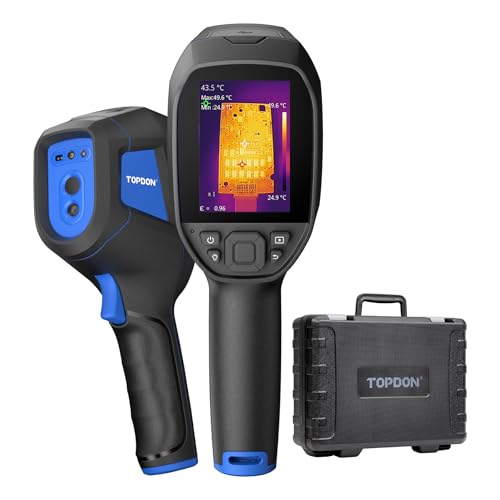
- Laser distance measurement up to 4 meters
- 3.5-inch display with 64GB storage
- Wi-Fi and USB reporting connectivity
Best For: Professional inspections requiring precise targeting and detailed documentation
Rugged Diagnostic Pick

- -13°F to 572°F measurement range
- MSX-enhanced thermal images
- Bullseye laser and IP54 protection
Best For: Technicians wanting durable, straightforward thermal diagnostics
High-Resolution Workhorse

- 256×192 resolution with TISR enhancement
- 64GB storage for images and videos
- Wi-Fi transfer and 3.5-inch display
Best For: Inspection workflows centered on detailed imaging and reporting
Best All-Around Detail

- TISR-enhanced 240×180 effective thermal resolution
- -4°F to 1022°F range with smart alerts
- Windows analysis, reporting, and 8GB storage
Best For: Detailed inspections with PC-based analysis
Best Smart Touchscreen Option
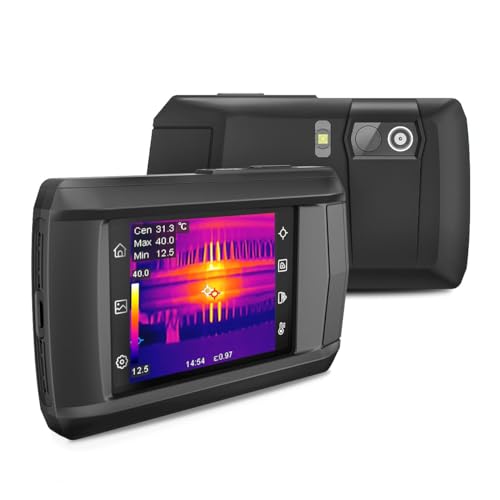
- Touchscreen controls with five imaging modes
- Scene recognition for leaks and insulation gaps
- Live super resolution and extensive storage
Best For: Guided building and electrical inspections
Best Portable Long-Runtime Pick

- Pocket-friendly design with up to 15-hour runtime
- TISR-enhanced 240×240 thermal imagery
- Smart alerts, automatic photos, and IP54 protection
Best For: Extended field inspections and mobile troubleshooting
Professional Field Reliability – FLIR E6 Pro
The FLIR E6 Pro is a practical choice among professional thermal imaging cameras for electrical, building, and general troubleshooting work. Its 240 × 180 thermal resolution, MSX enhancement, automatic exposure, and broad -20°C to 550°C measurement range support straightforward point-and-shoot inspections.
Best For: Professionals who want dependable FLIR imaging, clear MSX-enhanced visuals, and cloud-based image storage and sharing.
Pros:
- 240 × 180 thermal resolution with patented MSX image enhancement
- Measures temperatures from -20°C to 550°C
- FLIR Ignite cloud connectivity supports automatic storage, editing, and sharing
- Includes a two-year camera warranty and 10-year detector coverage
Cons:
- Fixed-focus design offers less framing flexibility
- 3-inch display and 2x digital zoom are modest for detailed remote targets
The E6 Pro emphasizes an established workflow rather than extensive manual controls. Automatic operation, wireless connectivity, and FLIR’s warranty coverage make it a strong fit for routine professional diagnostics and documentation.
High-Resolution All-Day Inspections – Thermal Master Thor002
The Thermal Master Thor002 stands out among professional thermal imaging cameras for users who need high resolution, long battery life, and flexible field documentation. Its 512 × 384 thermal output, 25Hz refresh rate, six measurement points, and wireless connectivity are suited to demanding inspection rounds.
Best For: Electrical, HVAC, mechanical, and building professionals who need detailed images, extended runtime, and on-site reporting features.
Pros:
- 512 × 384 thermal resolution with 40mK sensitivity and a 25Hz refresh rate
- Up to 10.5 hours of battery life with 18W fast charging
- Supports Wi-Fi, USB real-time analysis, voice notes, and QR code file management
- IP54 protection, 2-meter drop resistance, laser positioning, and temperature alarms
Cons:
- At 3.12 pounds, it is relatively heavy for extended handheld use
- Its larger feature set may be more than needed for basic temperature checks
With a 3.5-inch display, 4x digital zoom, photo and video recording, and a 5000mAh battery, the Thor002 is built for comprehensive field work. It is especially appealing when inspection duration and documentation matter as much as image detail.
Compact Reporting Specialist – FLIR C8 Compact Thermal Camera
The FLIR C8 combines a compact handheld format with 320 × 240 thermal resolution and a 35-degree horizontal field of view. For buyers comparing professional thermal imaging cameras, its MSX enhancement and FLIR Ignite connectivity make it a convenient option for locating faults and creating shareable inspection reports.
Best For: Building, electrical, and HVAC professionals who prioritize compact operation and streamlined customer reporting.
Pros:
- 320 × 240 thermal resolution with 76,800 pixels and a 35° HFOV
- MSX enhancement adds visual detail to thermal images
- FLIR Ignite supports direct uploads, professional reports, and email sharing
- Compact 1.2-pound design includes a lanyard, USB cable, and pouch
Cons:
- It is not water resistant
- Manual focus may require more attention during inspections
- Images are listed in JPEG format rather than radiometric JPEG
The C8 is a focused documentation tool with a useful balance of resolution, portability, and cloud workflow. Its limitations are worth noting for wet environments or users who need more advanced measurement-file flexibility.
AI-Assisted Dual-View Diagnostics – HSFTOOLS F2VW Thermal Camera
The HSFTOOLS F2VW is a versatile option among professional thermal imaging cameras, combining a 256 × 192 detector with live AI-enhanced 640 × 480 imaging. Its dual cameras, four viewing modes, Wi-Fi, and automated anomaly features help users move from thermal detection to visual troubleshooting efficiently.
Best For: Field technicians who want flexible thermal and visual views, wireless sharing, and guided anomaly recognition.
Pros:
- Live AI Super Resolution enhances imaging to 640 × 480 on a 3.2-inch display
- Visual, thermal, fusion, and picture-in-picture viewing modes
- Wi-Fi image sharing, built-in LED flashlight, and tripod support
- Temperature alarms, adjustable emissivity, and IntellFault scene detection
Cons:
- The underlying detector resolution is 256 × 192, despite the enhanced 640 × 480 output
- Temperature accuracy is specified as within the greater of ±3.6°F or ±2%
- It lacks the supplied notes’ extended battery-runtime specification
The F2VW focuses on usability and efficient fault finding rather than simply maximizing native detector resolution. Its multiple image modes and AI-assisted tools can be valuable when labels, edges, or suspicious areas are difficult to interpret thermally.
Precision Field Choice – TOPDON TC005 Dual-Lens Thermal Camera
For professionals comparing professional thermal imaging cameras, the TOPDON TC005 stands out for its dual-lens design, laser distance measurement, and broad -4°F to 1022°F temperature range. Its large display, extensive storage, and reporting connectivity make it well suited to detailed field documentation.
Best For: Inspectors and technicians who need measurable targeting, long battery life, and organized professional reports.
Pros:
- Integrated laser distance measurement reaches up to 4 meters for measurable reference points.
- 3.5-inch display and 64GB internal storage support clear evaluation and extensive documentation.
- Wi-Fi and USB connectivity enable analysis and reporting through TopInfrared and TopView software.
- Up to 8 hours of operation, IP54 protection, and 2-meter drop resistance support field use.
Cons:
- Its 1.04-pound weight may be more than simpler handheld options.
- Advanced reporting features may be unnecessary for basic spot checks.
The TC005 is a strong professional option when inspection accuracy, documentation, and durability matter more than minimal size. Its targeting and software features make it particularly useful for structured inspection workflows.
Rugged Diagnostic Pick – FLIR TG165-X Thermal Camera
The FLIR TG165-X is a practical choice among professional thermal imaging cameras for users who want straightforward temperature measurement with visual guidance. Its MSX image enhancement, Bullseye laser, and rugged housing support faster diagnostics in demanding environments.
Best For: Technicians who need a compact, durable camera for locating temperature differences and documenting field findings.
Pros:
- Measures temperatures from -13°F to 572°F with a 4,800-pixel infrared camera.
- MSX technology adds visual details to thermal images for easier interpretation.
- Bullseye laser indicates the measurement area and helps speed up detection.
- IP54 protection, drop-tested construction, and a 2-10 warranty provide added field confidence.
Cons:
- Its temperature range is narrower than the TOPDON models in this roundup.
- USB is the listed connectivity technology, without stated Wi-Fi reporting support.
- The response time is listed as 3 seconds.
The TG165-X favors dependable, focused diagnostics over extensive storage or wireless reporting. It is a sensible fit for professionals who value FLIR’s image enhancement and a rugged, easy-to-use design.
High-Resolution Workhorse – TOPDON TC004 Thermal Camera
The TOPDON TC004 is a versatile option for buyers evaluating professional thermal imaging cameras for routine inspections. It combines a 3.5-inch display, 256×192 infrared resolution enhanced up to 512×384 with TISR, a wide temperature range, and wireless file transfer.
Best For: Field users who need detailed thermal images, ample storage, and efficient documentation throughout the workday.
Pros:
- 256×192 infrared resolution can be enhanced up to 512×384 with TISR.
- 3.5-inch display helps users identify hot spots and temperature differences.
- 64GB storage accommodates thousands of images and videos.
- Wi-Fi supports cable-free transfer, analysis, and report generation through the TopInfrared app.
Cons:
- At 2.11 pounds, it is relatively heavy for a handheld thermal camera.
- The supplied notes list a red laser pointer rather than laser distance measurement.
- Its feature set may be more than needed for occasional basic inspections.
The TC004 is a capable documentation-focused camera with strong image detail and generous storage. It makes the most sense for inspection teams that regularly capture, transfer, and review thermal evidence.
Best All-Around Detail – FOXWELL RT280
For buyers seeking professional thermal imaging cameras with detailed visuals and PC-based reporting, the FOXWELL RT280 combines TISR-enhanced imaging, broad temperature measurement, and practical inspection features. Its rugged build and generous storage suit recurring electrical, HVAC, mechanical, and automotive checks.
Best For: Detailed inspections that benefit from Windows-based analysis and report generation.
Pros:
- 320×240 display and TISR enhancement to 240×180 effective resolution
- Measures from -4°F to 1022°F with high/low alerts and automatic hot-spot tracking
- 8GB storage holds more than 20,000 images and videos
- IP54 protection, 6.6-foot drop resistance, laser targeting, and LED light
Cons:
- PC analysis software is compatible with Windows, not Mac
- Its larger feature set may be more than casual users need
The RT280 is a strong choice when inspection documentation matters as much as live thermal viewing. Windows users in particular can take advantage of its temperature analysis tools and automatic reporting.
Best Smart Touchscreen Option – HP96 Thermal Imaging Camera
The HP96 stands out among professional thermal imaging cameras for its touchscreen controls, intelligent scene recognition, and multiple image modes. It is designed to make anomaly checking accessible while still offering adjustable emissivity, distance settings, and real-time temperature tracking.
Best For: Users who want guided operation, visual overlays, and quick anomaly recognition.
Pros:
- 3.5-inch touchscreen with phone-style controls and five imaging modes
- IntellFault scene detection helps identify water leaks and insulation gaps
- Live super resolution enhances 96×96 thermal imagery to 240×240
- Stores approximately 30,000 thermal images and 20 hours of video
Cons:
- Scene recognition does not provide moisture readings
- Its advanced interface may require time to learn
Choose the HP96 if ease of operation and flexible visual presentation are priorities. Its touchscreen, fusion modes, alerts, and scene recognition can streamline routine building and electrical inspections.
Best Portable Long-Runtime Pick – TOPDON TC004 Mini
For buyers comparing professional thermal imaging cameras for portable fieldwork, the TOPDON TC004 Mini offers a compact design, TISR-enhanced resolution, and unusually long stated runtime. Smart alerts and automatic photo capture help document problems during electrical, machinery, leak, and underfloor-heating checks.
Best For: Portable inspections where low weight and extended battery life are important.
Pros:
- TISR enhances 128×128 thermal imagery to 240×240
- Up to 15 hours of operation with automatic shut-off options
- Automatic warning photos and storage for up to 8,000 images
- Compact, 1.03-pound design with IP54 protection and 2-meter drop resistance
Cons:
- Charging cable is included, but no charging head
- Its temperature range ends at 842°F, lower than some dedicated inspection cameras
- An electronic manual must be downloaded rather than supplied on paper
The TC004 Mini is a practical pick for technicians who value portability and fewer charging interruptions. It provides useful alerts and documentation features without the bulk of a larger handheld imager.
How We Picked the Best Professional Thermal Imaging Cameras
We focused on practical features that affect inspection accuracy and field productivity: thermal resolution, image enhancement, temperature range, measurement tools, visual-camera integration, screen usability, storage, connectivity, and report-sharing options. The selection includes compact cameras for everyday troubleshooting, higher-resolution models for clearer diagnostics, and dual-lens options that combine thermal and visible imagery.
Specifications can vary by firmware, operating conditions, and measurement distance, so treat stated temperature ranges and resolution figures as starting points. For safety-critical electrical or industrial work, confirm the camera’s accuracy, emissivity controls, inspection procedures, and required certifications before purchase.
Quick Comparison
| Priority | Look for | Best fit |
|---|---|---|
| Clearer small-target detail | Higher thermal resolution and image enhancement | Electrical, mechanical, and building diagnostics |
| Fast troubleshooting | Simple controls, laser targeting, and a bright display | HVAC, maintenance, and service calls |
| Documentation | Visual camera, Wi-Fi, cloud storage, or easy file transfer | Contractors and inspection reports |
| Wide temperature coverage | A broad rated measurement range and adjustable emissivity | Industrial and automotive applications |
| Portability | Compact body, low weight, and straightforward operation | Routine checks and mobile technicians |
Key Buying Factors for Professional Thermal Imaging Cameras
Thermal Resolution and Image Quality
Higher resolution displays more pixels across a target, making it easier to identify smaller hot spots or separate nearby components. MSX, super-resolution, and TISR-style processing can add visible detail, but they do not replace native thermal resolution.
Temperature Range and Measurement Accuracy
Choose a range that comfortably covers your application rather than relying on the maximum number alone. Check stated accuracy, minimum measurement size, spot-size ratio, emissivity adjustment, reflected-temperature settings, and whether the camera supports multiple measurement points.
Targeting, Display, and Workflow
A laser pointer or bullseye marker can speed up troubleshooting, while a larger touchscreen or high-contrast LCD improves usability outdoors. Wi-Fi, USB transfer, cloud services, voice notes, and built-in visual cameras matter when images must become organized service documentation.
Durability and Practical Design
For frequent field use, consider grip comfort, battery runtime, charging method, storage capacity, startup speed, and resistance to dust or drops. A compact camera is easier to carry, but a larger display and controls may be preferable when wearing gloves.
Who Should Buy Which Professional Thermal Imaging Cameras?
Building inspectors and energy auditors: Prioritize thermal clarity, image enhancement, broad measurement controls, and simple report export. Models with visible imagery or cloud connectivity can make findings easier to explain.
Electricians and HVAC technicians: Look for fast startup, reliable spot measurements, laser targeting, a usable screen, and a temperature range suited to panels, motors, ducts, and equipment.
Industrial and maintenance professionals: Favor higher resolution, better documentation, durable construction, and measurement features that help compare components and track changes over time.
Occasional DIY or automotive users: A compact, easy-to-operate camera may deliver better value than advanced reporting features you will rarely use. Match the camera’s resolution and temperature range to the problems you actually expect to diagnose.