Low water pressure can prevent some tankless heaters from activating or delivering a steady shower. The right propane model combines a low startup threshold with dependable flow sensing and enough heating capacity for your setup.
This roundup compares 10 options ranging from portable camping heaters to higher-output indoor and outdoor systems, helping you match fuel use, installation needs, and hot-water demand.
Best 10 Propane Tankless Water Heaters for Low Water Pressure Picks for 2026
Best Ultra-Low-Pressure Pick
Compact 1.6 GPM Propane Heater

- Starts with only 2 PSI of water pressure
- Vent-free design needs no expensive flue
- Compact wall-mount unit with D batteries included
Best For: Low-pressure point-of-use applications and compact spaces
Best High-Capacity Option
VEVOR 100,000 BTU Smart Heater

- 100,000 BTU output with 16 L/min flow
- Temperature control stays within ±1°F
- Multiple safety protections and LED display
Best For: Indoor whole-house hot-water demand
Best Portable Pick
CAMPLUX 1.32 GPM Outdoor Heater

- Starts with only 3.0 PSI of water pressure
- Portable 10-pound design with folding handle
- Includes regulator, shower head, hose, and hardware
Best For: Camping, RVs, cabins, and off-grid outdoor showers
Best Whole-House Low-Pressure Value

- Listed water-pressure range starts at 1.5 PSI
- 4.3 GPM flow with 100,000 BTU output
- Digital control and multiple safety protections
Best For: Low-pressure indoor whole-house applications
Best Multi-Outlet Pick
VELPAX 4.76 GPM Outdoor Propane Heater

- Starts at a stated 3 PSI water pressure
- Supports up to 4.76 GPM and multiple outlets
- Includes long-cable indoor remote control
Best For: High-flow outdoor installations with low-to-moderate water pressure
Best Compact Indoor Option
CAMPLUX CX264 Propane Water Heater

- Compact 2.64 GPM indoor design
- Serves one or two water points
- Includes anti-freeze and precise temperature controls
Best For: Small indoor spaces with modest hot-water demand
Best Portable Low-Pressure Pick
6L Outdoor Camping Water Heater

- Starts at a stated 2.5 PSI
- Portable 1.58 GPM outdoor design
- Includes regulator, shower head, and hose adapter
Best For: Camping, RVs, cabins, and low-pressure outdoor showers
Best Low-Flow Indoor Pick
APUS 4.42 GPM Propane Tankless Water Heater

- Starts at a stated 0.66 GPM flow
- 95,000 BTU and 4.42 GPM output
- Indoor, compact, and wall-mounted
Best For: Indoor homes needing low-flow activation and multi-fixture hot water
Best Outdoor Budget Option
Ranein 18L Low-Pressure Propane Heater
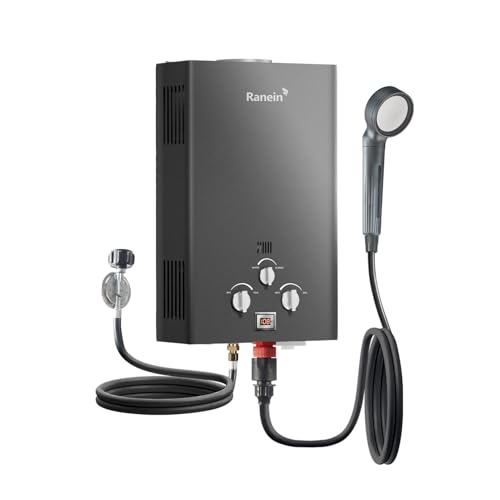
- Designed for operation from 3.6 PSI
- 4.74 GPM output from 85,300 BTU
- Portable outdoor design for cabins and campsites
Best For: Outdoor and off-grid hot water where supply pressure is limited
Best Whole-Home Controls
Ranein 4.3 GPM Indoor Propane Heater

- 100,000 BTU and 4.3 GPM capacity
- Low-water-pressure startup protection
- Four preset modes and LED status display
Best For: Indoor homes needing high output and flexible temperature controls
Best Ultra-Low-Pressure Pick – Compact 1.6 GPM Propane Heater
EXCEL TANKLESS GAS WATER HEATER Vent Free (LOW WATER PRESSURE STARTUP) 1.6 GPM PROPANE LPG
Check Price On AmazonFor shoppers comparing propane tankless water heaters for low water pressure, this EXCEL model stands out because it starts with only 2 PSI of water pressure. Its 1.6 GPM output, vent-free design, and compact wall-mount format suit smaller hot-water needs.
Best For: Low-pressure sinks, showers, cabins, and compact spaces where a vent-free propane unit is preferred.
Pros:
- Starts at just 2 PSI of water pressure.
- Vent-free technology avoids the need for an expensive flue.
- Compact 12.8-inch-wide design and included D batteries support flexible installation.
Cons:
- Its 1.6 GPM flow rate is modest for simultaneous household use.
- Maximum temperature is listed at 110°F.
This is the most specifically targeted option for very low water pressure, but its lower flow rate makes it better for point-of-use applications than whole-house demand.
Best High-Capacity Option – VEVOR 100,000 BTU Smart Heater
This VEVOR propane tankless water heater offers 100,000 BTU of heating power and a 16 L/min flow rate for larger hot-water needs. Its smart controls, LED display, and multiple protective features make it a feature-rich indoor option, though buyers should verify their water-pressure requirements before choosing it.
Best For: Indoor whole-house use where high output, digital temperature control, and built-in safety monitoring are priorities.
Pros:
- 100,000 BTU output and 16 L/min flow rate support substantial demand.
- Smart sensors maintain temperature within ±1°F of the set value.
- Includes leakage, flameout, dry-burning, overheating, anti-freeze, and other protections.
Cons:
- Requires a direct-vent connection and indoor installation planning.
- The notes do not specify a low-pressure startup threshold.
- Uses 120-volt power in addition to propane.
With strong capacity and precise controls, this model is better suited to buyers who need whole-house performance and can confirm adequate pressure and proper venting.
Best Portable Pick – CAMPLUX 1.32 GPM Outdoor Heater
For portable propane tankless water heaters for low water pressure, the CAMPLUX AY132 is designed to start at just 3.0 PSI. Its battery-powered ignition, 1.32 GPM flow rate, folding handle, and included shower accessories make it practical for camping, RVs, cabins, and other off-grid settings.
Best For: Outdoor showers, camping, RV use, rural cabins, and gravity-fed or pump-assisted water systems.
Pros:
- Low-pressure startup works with 3.0 PSI, small pumps, or gravity water bags.
- Portable 10-pound design includes a folding handle.
- Includes a gas regulator, shower head, hose, and hardware.
- CSA certified with six protective safety functions.
Cons:
- Outdoor use and 1.32 GPM flow limit its whole-house suitability.
- Maximum temperature is listed at 114°F.
This is an appealing low-pressure solution when portability matters most. It delivers convenient hot water away from utility connections, but it is not intended to replace a higher-capacity indoor system.
Best Whole-House Low-Pressure Value – 4.3 GPM Indoor Propane Heater
This indoor propane heater is one of the stronger matches for propane tankless water heaters for low water pressure because its listed operating range begins at 1.5 PSI. It combines up to 4.3 GPM of flow with 100,000 BTU, digital temperature control, and a wall-mounted design for larger household demand.
Best For: Homes needing high-flow indoor hot water while operating within a low-pressure range.
Pros:
- Operates across a stated 1.5–116 PSI water-pressure range.
- Up to 4.3 GPM and 100,000 BTU support multiple fixtures.
- Adjustable 95°F–149°F temperature range with ±1°F control.
- Includes freeze, flame-failure, overheating, and dry-fire protections.
Cons:
- Requires professional installation by a licensed technician.
- Needs 110–120V AC power and 1/2-inch NPT connections.
- Recommended for use below 2,000 feet altitude.
Its combination of low-pressure compatibility and high output makes it a compelling whole-house choice, provided professional installation and the stated altitude and connection requirements fit your setup.
Best Multi-Outlet Pick – VELPAX 4.76 GPM Outdoor Propane Heater
For shoppers comparing propane tankless water heaters for low water pressure, the VELPAX stands out with a stated operating range beginning at 3 PSI. Its 110,000 BTU output and 4.76 GPM flow rate are designed for substantial on-demand hot-water demand, including multiple outlets.
Best For: Homes, garages, RVs, farms, and other outdoor wall-mount applications needing high flow and multi-outlet use.
Pros:
- Operates across a broad 3-116 PSI water-pressure range.
- 4.76 GPM flow and support for 3-4 simultaneous outlets.
- Indoor remote control with a 16.4-foot cable and real-time temperature display.
- Weather-resistant outdoor design with staged combustion and freeze-resistant construction.
Cons:
- Designed for outdoor wall-mount installation only.
- Requires 110V AC power and propane/LPG gas.
- Residual water must be drained during long nonuse or severe cold to help prevent freezing.
The VELPAX is the strongest fit here when low-pressure capability must be paired with high flow. Its outdoor-only installation and electrical requirement are important planning considerations, but the remote control and multi-outlet capacity add everyday convenience.
Best Compact Indoor Option – CAMPLUX CX264 Propane Water Heater
The CAMPLUX CX264 is a compact indoor propane unit for smaller spaces and modest hot-water demand. It delivers 2.64 GPM for one or two water points, while its flow sensors and smart controls are intended to maintain consistent temperature during use.
Best For: Tiny houses, mobile homes, apartments, and compact indoor bathroom or kitchen setups serving one or two points.
Pros:
- Compact wall-mounted design suited to space-constrained installations.
- 2.64 GPM flow for one or two water points.
- Temperature control is rated for fluctuations within ±1°F.
- Includes anti-freeze protection below 39°F and an oxygen-free copper heat exchanger.
Cons:
- Its supplied notes do not state a minimum startup water pressure, so low-pressure compatibility should be confirmed before purchase.
- Limited to a lower flow rate than larger multi-outlet models.
- Requires compatible venting and may need the separate VP70T vent or optional WT300 wall thimble.
The CX264 is a sensible small-space choice when compact dimensions and steady temperature control matter more than maximum flow. Because the minimum startup pressure is not specified in the supplied information, buyers with notably low water pressure should verify compatibility with CAMPLUX before ordering.
Best Portable Low-Pressure Pick – 6L Outdoor Camping Water Heater
For portable propane tankless water heaters for low water pressure, this 6L outdoor model starts at a stated 2.5 PSI. Its 1.58 GPM output is modest, but the lightweight body, foldable handle, battery ignition, and included accessories make it practical for camping, RV, cabin, and outdoor washing tasks.
Best For: Off-grid outdoor showers, RV trips, camping, cabins, pet washing, horse washing, and vehicle cleaning.
Pros:
- Low-pressure startup requires only 2.5 PSI according to the supplied notes.
- Portable 12-pound design with a foldable handle.
- Includes a shower head, gas regulator, garden-hose adapter, and installation hardware.
- Six safety protections include low-water-flow, dry-combustion, flame-failure, and overheating protection.
Cons:
- At 1.58 GPM, it is intended for a single modest-flow use rather than multiple outlets.
- Below 2.5 PSI, the unit may fail to start or produce fluctuating temperatures; a booster pump may be needed.
- Designed for portable outdoor use and should be kept dry rather than exposed to prolonged rain.
This model is the most portable option and has the lowest stated startup-pressure requirement of the three. It is a strong match for intermittent outdoor use, but buyers should not expect the flow or installation profile of a residential whole-home heater.
Best Low-Flow Indoor Pick – APUS 4.42 GPM Propane Tankless Water Heater
For shoppers comparing propane tankless water heaters for low water pressure, the APUS stands out with a stated 0.66 GPM low-flow start threshold. Its 95,000 BTU output and 4.42 GPM flow rate are designed to serve up to two showers and one sink, while the indoor wall-mounted format saves space.
Best For: Indoor households that need low-flow activation, steady temperature control, and hot water for several fixtures.
Pros:
- 0.66 GPM low-flow start technology suits lower-demand fixtures.
- 95,000 BTU output and 4.42 GPM flow support up to three fixtures.
- LED touchscreen and 95°F–140°F adjustment range simplify operation.
- Includes anti-freeze, overheat, and low-water-flow protection.
Cons:
- Requires liquid propane and a 120V power connection.
- Indoor installation and venting requirements may add installation complexity.
- The unit must be drained during extended freezing conditions or long periods of nonuse.
The APUS is a practical indoor option when low-flow startup is a priority. Its compact profile, quiet 36 dB operation, and two-year warranty add convenience, though installation and freeze protection should be planned carefully.
Best Outdoor Budget Option – Ranein 18L Low-Pressure Propane Heater
The Ranein 18L is a strong fit among propane tankless water heaters for low water pressure because it is specified to operate at a minimum water pressure of 3.6 PSI. Its outdoor design and portable format make it useful for cabins, campsites, yards, and other off-grid settings.
Best For: Outdoor showers, rural properties, cabins, camping, and low-pressure water systems.
Pros:
- Operates at a stated minimum water pressure of 3.6 PSI.
- Produces up to 4.74 GPM with 85,300 BTU heating capacity.
- Compact 20.7-pound design is suited to portable or seasonal use.
- Includes six advanced safety protections and a two-year warranty.
Cons:
- Must be installed outdoors in a well-ventilated area.
- Not suitable for indoor locations such as kitchens, bathrooms, or basements.
- Its listed temperature range reaches 109.4°F, which may be limiting for some applications.
With its low minimum pressure requirement and outdoor-only installation guidance, this Ranein model is especially appealing for rural and recreational use. Confirm the installation location and temperature requirements before choosing it for a primary household system.
Best Whole-Home Controls – Ranein 4.3 GPM Indoor Propane Heater
For buyers seeking propane tankless water heaters for low water pressure, this indoor Ranein model includes low-water-pressure startup protection alongside 100,000 BTU output and 4.3 GPM flow. Four preset modes and a broad 95°F–155°F temperature range make it adaptable for kitchen, shower, bathtub, and four-season use.
Best For: Indoor households wanting high output, preset operating modes, and built-in low-pressure startup protection.
Pros:
- 100,000 BTU and 4.3 GPM output support three to four water points.
- Includes low-water-pressure startup, anti-freeze, overheat, and dry-burn protection.
- Four preset modes simplify settings for kitchens, showers, bathtubs, and seasonal use.
- LED display shows water temperature, operating status, and fault codes.
Cons:
- Indoor installation requires professional installation and venting.
- Not recommended for elevations above 2,000 feet.
- Water should be fully drained below 14°F or during extended nonuse.
This Ranein combines strong household capacity with useful controls for varying water demands. Its low-pressure startup protection is helpful, but the professional installation guidance, elevation limit, and freeze-prevention steps are important considerations.
How We Picked the Best Propane Tankless Water Heaters for Low Water Pressure
We focused on models marketed for low-pressure startup, then compared their stated flow rates, BTU output, installation style, portability, controls, and safety features. The selection includes compact units for camping, RVs, cabins, and off-grid use, as well as larger heaters intended for household fixtures.
Because manufacturer specifications and real-world performance can vary with inlet pressure, water temperature, hose size, and propane supply, treat listed flow rates as comparisons rather than guarantees. Always verify current specifications and local installation requirements before buying.
Quick Comparison
| Best For | What to Prioritize | Typical Product Type |
|---|---|---|
| One outdoor shower or sink | Low minimum activation flow, compact size, simple controls | Portable 5L–6L unit |
| Small cabin or apartment | Indoor certification, venting, freeze protection, suitable BTU rating | Indoor 2.6–4.3 GPM heater |
| Multiple fixtures | Higher output, stable pressure, adequate propane supply | Outdoor or indoor high-capacity model |
| RV or off-grid use | Lightweight housing, battery or power requirements, easy connections | Portable propane heater |
Key Buying Factors for Propane Tankless Water Heaters for Low Water Pressure
Minimum Activation Flow
This is one of the most important specifications. A heater with a lower activation threshold is more likely to ignite when water pressure is limited. Look for clear minimum-flow information rather than relying only on a large maximum GPM rating.
Heat Output and Temperature Rise
BTU capacity affects how much water the unit can heat and by how many degrees. Cold incoming water requires more energy, so a high-flow heater may not deliver its advertised output at the highest temperature setting. Choose capacity based on the number of fixtures used simultaneously.
Installation and Ventilation
Indoor propane heaters require appropriate venting, combustion air, and installation clearances. Outdoor models simplify ventilation but still need protection from weather and freezing. Portable units are convenient, but they are generally intended for outdoor use and should never be operated in an enclosed space.
Water and Propane Connections
Check inlet and outlet sizes, hose compatibility, regulator requirements, propane pressure, and whether a pump or filter is needed. In low-pressure systems, restrictive fittings, clogged filters, or undersized hoses can reduce performance even when the heater itself has a low-pressure startup design.
Safety Features and Power Needs
Useful safeguards may include flame-failure protection, overheat protection, oxygen-depletion sensing, pressure relief, and automatic shutoff. Also confirm whether the controls require batteries, household power, or a 110V connection.
Who Should Buy Which Propane Tankless Water Heaters for Low Water Pressure?
Choose a portable CAMPLUX or 6L-style model for occasional showers, camping, RV trips, and outdoor sinks. These are easiest to transport but have limited flow and are not intended to supply an entire home.
Choose a compact indoor model for a small cabin, utility room, or single-bathroom setup when you can meet venting and code requirements. Prioritize minimum activation flow and installation support over maximum advertised GPM.
Choose a larger 4.3–4.76 GPM model for higher demand or multiple fixtures, provided your incoming water pressure and propane supply can support it. For the most reliable results, have gas, venting, and water connections checked by a qualified professional.