Choosing the right rooftop solar panel means balancing efficiency, available roof space, system voltage, durability, and installation requirements. The panels in this roundup cover compact 200W options, large-format modules, bifacial designs, and high-output arrays.
Use the comparison and buying advice below to narrow the list based on your roof, inverter, battery bank, climate, and expected energy needs.
Best 10 Rigid Solar Panels for Rooftops Picks for 2026
Compact Bifacial Pick

- Bifacial design can capture reflected rear-side light
- Compact 200W format for tight installations
- 2400Pa wind and 5400Pa snow-load ratings
Best For: Small rooftops, RVs, boats, cabins, and off-grid use
Shading Specialist
Renogy 800W ShadowFlux Solar Panel Kit

- ShadowFlux technology targets partial-shade losses
- Four 200W panels provide 800W total
- N-Type 16BB cells claim 25% efficiency
Best For: Partially shaded rooftops, RVs, marine systems, and home arrays
Low-Maintenance High-Output Pick
HISHEN 990W Frameless Solar Panels

- Two 495W panels deliver 990W total
- Frameless Cleanedge design helps limit debris buildup
- UL 61730 certified with a 10-year warranty
Best For: Large rooftops, home backup, RV, marine, and off-grid systems
Proven Rooftop Workhorse
Renogy 640W N-Type Solar Panel Set

- Two 320W panels provide 640W total
- N-Type 18BB cells claim 25% efficiency
- IP68 protection with pre-drilled mounting holes
Best For: Roofs, RVs, cabins, farms, yachts, and off-grid systems
Compact High-Efficiency Pick
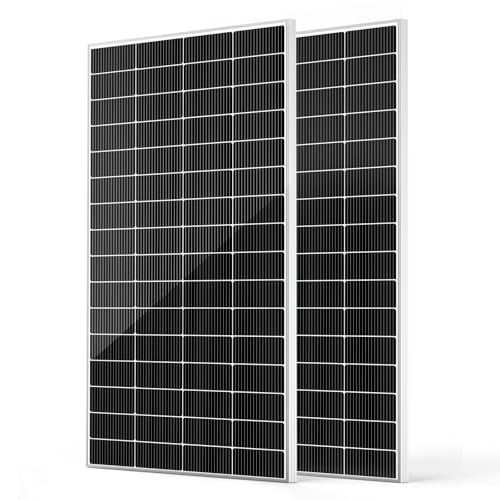
- 400W total from two compact 200W panels
- Up to 25.4% efficiency with N-Type 16BB cells
- Lightweight format for vans and tight rooftops
Best For: Compact RV, van, rooftop, and off-grid installations
High-Output Rooftop System

- Four 550W panels deliver 2200W total
- UL61730 and CEC listed
- IP68 connectors and rugged aluminum frames
Best For: Large rooftop, marine, RV, and off-grid arrays
Certified Shading-Resistant Option

- Up to 25.8% efficiency in a compact 200W module
- TÜV, IEC, and UL61730 certified
- Designed for improved partial-shading performance
Best For: Certified rooftop, RV, marine, and off-grid installations
Best with Extra Features
Callsun 200W Bifacial Solar Panel

- N-type 16BB cells reach up to 25.6% efficiency
- Bifacial design may add up to 30% output in suitable conditions
- Compact, lightweight format with durable outdoor construction
Best For: Class B vans, compact rooftops, RVs, and off-grid setups
Two-Panel Value Set
400W 2-Piece Bifacial Solar Panel Kit

- Two listed 200W panels provide 400W total capacity
- A+ N-type 18BB cells offer up to 25.6% efficiency
- IP68 protection and outdoor-rated wiring support mobile or off-grid use
Best For: RV, marine, farm, home, and off-grid systems needing two panels
High-Output Rooftop Choice
JJN 425W Bifacial Rigid Solar Panel

- 425W output with up to 25% efficiency
- UL61730-certified, A+ 16BB monocrystalline construction
- Large dual-glass bifacial panel with drainage clips and stated 30-year lifespan
Best For: Spacious rooftops, farms, carports, and high-output off-grid arrays
Compact Bifacial Pick – JJN 200W Bifacial Solar Panel
For shoppers comparing rigid solar panels for rooftops, the JJN 200W stands out when installation space and portability matter. Its bifacial monocrystalline design can capture reflected light from the rear, while the compact aluminum-framed build suits smaller rooftops, RVs, boats, and cabins.
Best For: Compact rooftop, RV, marine, camping, and off-grid installations where a single manageable 200W panel is useful.
Pros:
- Bifacial design may provide additional rear-side gain on reflective surfaces.
- 23% efficiency and 10BB construction support strong output in a compact footprint.
- Corrosion-resistant aluminum frame, IP-rated protection, and 2400Pa wind/5400Pa snow-load ratings support outdoor use.
- Includes MC4 connectors and a stated 30-year transferable power-output warranty.
Cons:
- Its 200W capacity may require multiple panels for higher-demand rooftop systems.
- Bifacial gains depend on reflective conditions beneath and around the panel.
- The listing contains differing IP ratings for the junction box and connectors, so buyers should verify the exact specification.
This is a practical choice for tight installations that benefit from a compact rigid panel and possible reflected-light gains. For a larger home array, its lower individual wattage means planning for more panels and roof space.
Shading Specialist – Renogy 800W ShadowFlux Solar Panel Kit
Among rigid solar panels for rooftops, this four-panel Renogy kit is designed for installations where partial shade is difficult to avoid. Its ShadowFlux technology targets shading from trees, buildings, leaves, roofs, and snow, while N-Type 16BB cells provide a stated 25% efficiency.
Best For: Rooftops, RVs, marine setups, and other arrays that may experience intermittent or localized shading.
Pros:
- ShadowFlux anti-shading technology is designed to maintain generation in partially shaded conditions.
- Four 200W panels provide 800W of total rated power.
- N-Type 16BB cells offer a stated 25% efficiency and are designed to reduce hot spots and micro-cracks.
- IP67-or-better construction and a 25-year output warranty covering 80% output are listed.
Cons:
- The complete kit weighs 95.3 pounds, which can make rooftop handling and installation more demanding.
- At 49.69 by 30.08 inches per panel, the set requires substantial roof space.
- Shade optimization does not eliminate the need for proper array layout and electrical planning.
This kit is a strong fit when roof shade is a recurring concern and 800W of capacity matches your energy plan. Its four-panel format offers useful output, but confirm available roof area, mounting compatibility, and total installation weight first.
Low-Maintenance High-Output Pick – HISHEN 990W Frameless Solar Panels
For buyers seeking rigid solar panels for rooftops with fewer edge areas where debris can collect, this two-panel HISHEN set uses a frameless Cleanedge design. Each panel is rated at 495W, for 990W total, and the stated 25.6% efficiency helps prioritize output in a limited installation area.
Best For: Residential rooftops, home backup systems, RVs, boats, sheds, and off-grid installations where high output and low routine upkeep are priorities.
Pros:
- Two 495W panels provide 990W of combined rated power.
- Frameless Cleanedge construction is designed to reduce dust, water, snow, and debris buildup along panel edges.
- UL 61730 certification addresses electrical, fire, mechanical, and environmental safety requirements.
- 16BB A+ monocrystalline cells and 2.0mm dual glass are listed, along with a 10-year product warranty.
Cons:
- Frameless construction may require mounting hardware specifically suited to the panel design.
- The panels are large, so roof access, handling, and layout should be checked carefully.
- The listing describes the system as 12V/24V compatible, but buyers should confirm controller and battery-system requirements.
This set makes sense for shoppers who want substantial rated capacity with a clean, low-profile appearance and less edge debris accumulation. Its large-format design is better suited to installations with adequate roof area and appropriate mounting equipment.
Proven Rooftop Workhorse – Renogy 640W N-Type Solar Panel Set
This two-panel Renogy set is a straightforward option for shoppers comparing rigid solar panels for rooftops, farms, sheds, cabins, and off-grid systems. It combines two 320W N-Type panels, 18 busbars, IP68 protection, and pre-drilled mounting holes for a more installation-friendly setup.
Best For: Rooftop, RV, cabin, yacht, shed, farm, and off-grid systems needing 640W of rated panel capacity.
Pros:
- Two 320W panels provide 640W of combined rated output.
- N-Type 18BB construction and a stated 25% cell efficiency support efficient generation.
- IP68 protection, anti-corrosion coating, and multilayer encapsulation are designed for outdoor durability.
- Pre-drilled rear holes support compatibility with several Renogy mounting options.
Cons:
- The two-panel set weighs 90.5 pounds, making rooftop handling a two-person or carefully planned task.
- The manufacturer notes the modules should be installed where they receive unobstructed sunlight year-round.
- At 64.37 by 34.65 inches per panel, the set needs considerable mounting space.
This is a sensible choice for buyers who prioritize established mounting compatibility, weather protection, and a conventional rigid-panel format. It is most effective on a roof or ground location with minimal year-round shading and enough room for both panels.
Compact High-Efficiency Pick – HQST 400W N-Type Twin Pack
For shoppers comparing rigid solar panels for rooftops, this two-panel HQST setup emphasizes useful output in a compact footprint. Its N-Type 16BB cells offer up to 25.4% efficiency, while the lighter format can suit tight rooftop, van, RV, and off-grid installations.
Best For: Class B vans, RVs, rooftops, and other installations where space, weight, and low-light performance matter.
Pros:
- Two 200W panels provide a combined 400W system with fewer mounts and cables than multiple 100W panels.
- N-Type 16BB Grade A+ cells offer up to 25.4% efficiency and a stated 30-year service life.
- Each panel weighs 20.17 lb and measures 46.3 × 30.1 × 1.2 inches, making it relatively compact.
- Corrosion-resistant aluminum, IP65 protection, and rated wind and snow-load resistance support outdoor use.
Cons:
- IP65 protection is below the IP68 rating offered by some competing panels.
- The listed 200W output is per panel, so the full 400W rating requires using both panels.
This is a practical choice when rooftop area and installation simplicity are priorities. Its low-light claims and long service-life rating add appeal for users who want consistent, long-term off-grid power without moving to oversized panels.
High-Output Rooftop System – SUNGOLDPOWER 2200W Panel Set
This SUNGOLDPOWER four-panel package is aimed at buyers who need substantial capacity from rigid solar panels for rooftops. With four 550W monocrystalline modules, UL61730 and CEC listings, and IP68-rated connectors, it is configured for larger 12V, 24V, 36V, or 48V systems.
Best For: Large rooftop, yard, marine, RV, and on- or off-grid systems needing a combined 2200W of rated panel capacity.
Pros:
- Four 550W panels provide a substantial 2200W combined rated output.
- Grade A monocrystalline cells, 18BB design, and a listed 21.5% efficiency support high-output operation.
- UL61730 and CEC listings add certification support for professional and residential installations.
- IP68 connectors, pre-drilled mounting holes, and corrosion-resistant aluminum frames support outdoor installation.
Cons:
- Each panel measures 89.7 × 44.8 inches and weighs 62.4 lb, so rooftop handling and available space are important considerations.
- The four-panel package may be more capacity than smaller RV or modest rooftop systems require.
- The stated 5-year 95% output, 10-year 90% output, and 25-year 80% output warranty terms are less extensive than some 30-year performance claims.
This package makes the most sense when the roof can accommodate full-size modules and the system is designed around high array capacity. Confirm structural support, layout, wiring, and charge-controller compatibility before installation.
Certified Shading-Resistant Option – 200W TÜV N-Type Solar Panel
For buyers evaluating rigid solar panels for rooftops with limited space or occasional shading, this 200W TÜV-certified module combines a compact format with up to 25.8% efficiency. Its N-Type 16BB construction, series-parallel cell-string architecture, and low temperature coefficient are designed to support stable output across changing conditions.
Best For: Rooftops, RVs, vans, marine installations, cabins, and off-grid systems where certification, compact sizing, and partial-shading performance are priorities.
Pros:
- Up to 25.8% efficiency helps maximize output from limited roof space.
- TÜV certification to IEC 61215, IEC 61730, and UL61730 supports confidence in module safety and durability.
- N-Type 16BB cells and the stated series-parallel architecture are designed to improve performance under partial shading.
- Tempered glass, a corrosion-resistant aluminum frame, IP68 protection, and a 30-year performance warranty support long-term outdoor use.
Cons:
- At 52.8 × 30.3 inches and 23.8 lb per the product description, it is not the lightest 200W option in this selection.
- The supplied precautions limit parallel or series connections to three panels and require careful current matching.
- Regular inspection and cleaning are specifically recommended to remove leaves, debris, or bird droppings.
This panel stands out for buyers who want strong efficiency and documented certification in a single 200W module. Its shading-oriented design is useful, but installation should follow the stated connection limits and inspection guidance.
Best with Extra Features – Callsun 200W Bifacial Solar Panel
For shoppers comparing rigid solar panels for rooftops, the Callsun 200W model combines N-type cells, bifacial generation, and a relatively compact footprint. Its split-cell design may also help limit output losses when part of the panel is shaded.
Best For: Class B vans, smaller rooftops, RVs, and off-grid systems where installation space is limited.
Pros:
- Up to 25.6% conversion efficiency from N-type 16BB cells.
- Bifacial construction can capture reflected rear-side light and may deliver up to 30% more power in suitable conditions.
- Compact 51.3-by-30.3-inch size, pre-drilled mounting holes, and a 23.8-pound weight simplify installation.
- Tempered glass, an aluminum frame, IP68 junction box, and stated 25-year performance coverage support outdoor use.
Cons:
- At 200W, it provides less peak output per panel than the larger 425W option in this roundup.
- Bifacial gains depend on rear-side light and a suitably reflective installation surface.
This is a practical choice when rooftop area and panel weight matter more than maximum wattage. Its shading-tolerant layout and durable construction add useful flexibility for mobile or compact solar installations.
Two-Panel Value Set – 400W 2-Piece Bifacial Solar Panel Kit
This two-panel set is a useful option among rigid solar panels for rooftops when you want 400W of listed capacity across two 200W panels. N-type A+ cells, bifacial construction, and included heavy-duty wiring features make it suited to several off-grid and mobile applications.
Best For: RV, marine, farm, home, and off-grid systems that benefit from two separately mounted 200W panels.
Pros:
- Two 200W panels provide a combined listed maximum power of 400W.
- A+ N-type cells and 18BB technology are rated for up to 25.6% efficiency.
- IP68 junction boxes, corrosion-resistant aluminum frames, and stated wind and snow-load resistance support outdoor installation.
- Includes standard MC4 connectivity and 11 AWG oxygen-free copper wiring designed for outdoor use.
Cons:
- The supplied notes list a one-year support/warranty period, shorter than the long-term coverage stated for some competing panels.
- The panels measure 52.8 by 26.4 inches each, so two units require substantial mounting space.
- The product details identify the package as a two-count unit, but the included-components line lists one panel, so buyers should verify package contents.
With two panels and installation-oriented connectors, this set offers flexible layout options for larger rooftops or mobile systems. Confirm the included quantity and compatibility with your charge controller before ordering.
High-Output Rooftop Choice – JJN 425W Bifacial Rigid Solar Panel
For larger rooftops, this JJN panel delivers 425W from a single rigid module. Its UL61730 certification, bifacial dual-glass design, and stated 25% efficiency make it a strong candidate for home, farm, carport, or off-grid arrays where power density is a priority.
Best For: Spacious rooftops, farms, carports, storage systems, and installations seeking higher output per panel.
Pros:
- 425W maximum power and up to 25% efficiency provide substantial output from one panel.
- UL61730 certification and A+ 16BB monocrystalline cells add useful specification detail for buyers.
- Bifacial dual-glass construction may produce up to 30% more energy when rear-side light is available.
- Drainage clips help manage water and dust, while the design is rated for a stated 30-year lifespan.
Cons:
- At 67.8 by 44.6 inches and 51.6 pounds, it is considerably larger and heavier than the 200W alternatives.
- Its output advantages depend on adequate roof space and favorable rear-side light conditions.
- The listed 38V maximum voltage and 13.78A capacity require careful system and controller matching.
This panel is best suited to fixed installations with enough structural and mounting capacity. It can reduce the number of panels needed for a target array size, but its dimensions and electrical specifications should be checked against the rooftop and system design.
How We Picked These Rigid Solar Panels for Rooftops
We focused on panels with useful specifications for rooftop and off-grid installations, including rated wattage, cell technology, efficiency, bifacial construction, certifications, and weather-resistance ratings where provided. The selection includes compact modules for smaller systems and higher-wattage panels for reducing the number of panels required on a larger roof.
Because installation conditions vary, advertised performance should be treated as a laboratory rating rather than a guaranteed daily output. Compatibility with your inverter, charge controller, mounting hardware, and local electrical requirements is equally important.
Quick Comparison
| Best For | Recommended Type | Why It Stands Out |
|---|---|---|
| Small battery systems | 200W panel | Easier handling and flexible system sizing |
| Limited roof space | High-efficiency N-type | More rated power from each square foot |
| Ground-reflected light | Bifacial panel | Can generate additional energy from the rear side |
| Large rooftop arrays | 400W–550W panel | Fewer modules and potentially simpler wiring |
| Harsh outdoor conditions | Certified, weather-resistant module | More clearly documented construction and protection |
Key Buying Factors for Rigid Solar Panels for Rooftops
Wattage and Roof Dimensions
Higher-wattage panels can reduce panel count, but they are often larger and heavier. Measure usable roof areas around vents, ridges, chimneys, and setbacks before choosing a format. Confirm that the mounting system can support the panel dimensions and weight.
Efficiency and Cell Technology
N-type and high-efficiency monocrystalline panels are useful when roof space is limited. Efficiency does not automatically determine total system value, so compare price, physical size, warranty, and expected operating conditions as well.
Electrical Compatibility
Check open-circuit voltage, operating voltage, current, and maximum system voltage against the inverter or charge controller. A panel described as suitable for 12V, 24V, or 48V batteries still requires a correctly matched controller and properly designed series-parallel configuration.
Bifacial Performance and Durability
Bifacial modules work best when the rear side receives useful reflected light, such as above a reflective surface or with an elevated mounting arrangement. For rooftop installations mounted close to a dark roof, the rear gain may be modest. Look for relevant certifications, junction-box protection, and an appropriate IP rating for the climate.
Who Should Buy Which Rigid Solar Panels for Rooftops?
Choose a compact 200W model if you are building a small RV, shed, cabin, or backup battery system and want manageable installation. Select a 400W to 550W panel when you have a larger roof, suitable lifting access, and a compatible inverter or charge controller. High-efficiency N-type panels are the strongest fit for space-constrained rooftops, while bifacial models make more sense where rear-side light can reach the cells.
Before purchasing, verify dimensions, connector compatibility, mounting requirements, shipping condition, warranty terms, and local permitting rules. Rooftop work also involves fall and electrical hazards, so use qualified installation help when the project exceeds your experience.