Choosing among rooftop solar panel kits for battery charging means balancing panel output, controller technology, roof space, battery voltage, and installation requirements. The right kit can keep an RV, cabin, shed, boat, or backup battery topped up without relying on grid power.
We’ve gathered ten options spanning compact 50W and 100W maintainers, portable kits, and larger 200W to 400W systems. Use the guide below to match capacity and features to your battery bank, available sunlight, and intended installation.
Best 10 Rooftop Solar Panel Kits for Battery Charging Picks for 2026
Best RV Kit
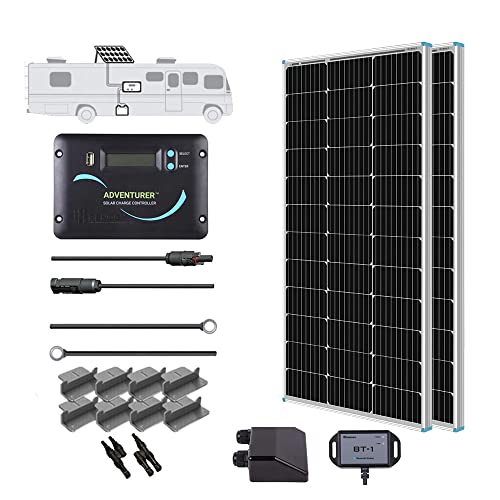
- 200W output with two 100W panels
- 30A PWM controller with multiple protections
- Supports lithium, lead-acid, and gel batteries
Best For: Permanent RV and camper battery-charging installations
Best Battery Maintainer

- 100W panel for 12V battery maintenance
- Includes controller, clips, and brackets
- Plug-and-play installation design
Best For: Smaller vehicle, boat, shed, and trailer batteries
Best Expandable System
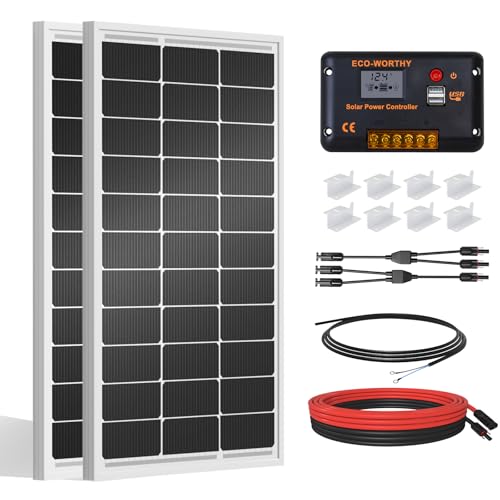
- 200W system with 30A PWM controller
- Supports series 24V or parallel 12V wiring
- Includes mounting and connection accessories
Best For: Fixed RV, camper, marine, and backup-power installations
Best Portable Option

- Folds to 20 by 27 inches and weighs 9.7 pounds
- Includes separate controller and 9.84-foot cable
- Dual USB ports support small-device charging
Best For: Portable RV, camping, van, boat, and emergency charging
Best Overall Capacity

- Four 100W monocrystalline panels
- 40A MPPT controller included
- Bluetooth phone monitoring and adjustment
Best For: Higher-capacity 12V off-grid systems
Best Compact Value
Topsolar 100W 12V Off-Grid Kit

- 100W monocrystalline panel
- 30A PWM controller with safety protection
- Expandable to 260W at 12V
Best For: Small RV, boat, cabin, and backup setups
Best Starter Kit
Renogy 100W 12V Solar Panel Kit

- 100W panel with 30A PWM controller
- Supports AGM, Gel, Flooded, and Lithium batteries
- Expandable to 400W
Best For: First-time RV and off-grid battery-charging setups
Top Single-Panel Pick

- 200W single-panel design
- 25% stated conversion efficiency
- Includes 30A controller and mounting hardware
Best For: Compact 12V battery-charging setups
Best Maintainer Kit

- 50W panel for modest charging needs
- Includes 10A PWM controller
- Comes with clips, terminals, and cable
Best For: Maintaining 12V batteries in RVs, cars, and boats
Best High-Output Setup

- Two 200W monocrystalline panels
- Up to 24.3% stated efficiency
- Includes 30A MPPT controller
Best For: Higher-output 12V RV and off-grid systems
Best RV Kit – Renogy 200W N-Type Solar Kit
For shoppers comparing rooftop solar panel kits for battery charging, the Renogy 200W kit is a practical choice for RVs, campers, boats, and other 12V off-grid setups. It combines two 100W panels with a flush-mount 30A PWM controller and supports lithium, lead-acid, and gel batteries.
Best For: RV and camper owners who want a permanent 12V installation with a higher-capacity controller.
Pros:
- 200W system can produce up to 800Wh daily under the stated four hours of sunlight.
- 22% cell efficiency with a corrosion-resistant aluminum frame.
- 30A controller includes overcharge, overload, short-circuit, and reverse-polarity protection.
- Includes mounting hardware, cables, branch connectors, and Bluetooth module.
Cons:
- The PWM controller is less advanced than an MPPT design.
- At 16.5 pounds, it is less portable than foldable alternatives.
Its durable construction, broad battery compatibility, and included installation accessories make this a well-equipped rooftop option when you have room for two fixed panels.
Best Battery Maintainer – SOLPERK 100W Solar Charger
The SOLPERK 100W kit is a compact option among rooftop solar panel kits for battery charging. It is designed for 12V batteries in RVs, sheds, caravans, boats, trailers, and similar vehicles, with a panel, controller, alligator clips, and mounting hardware included.
Best For: Maintaining smaller 12V batteries in vehicles, boats, sheds, and light-duty off-grid applications.
Pros:
- 100W panel is rated for up to 400Wh per day under four hours of full sunlight.
- Includes a controller, alligator clips, O-rings, and Z mounting brackets.
- Pre-drilled panel and plug-and-play connections simplify installation.
- Panel uses monocrystalline cells and tempered glass construction.
Cons:
- Its 100W capacity is lower than the 200W kits in this roundup.
- Only a one-year after-sale service period is specified.
This kit favors straightforward battery maintenance over high output, making it a sensible fit where modest charging capacity and simple connections matter most.
Best Expandable System – ECO-WORTHY 200W Solar Kit
The ECO-WORTHY 200W kit is a versatile choice for rooftop solar panel kits for battery charging, offering two 100W monocrystalline panels and a 30A PWM controller. It can be wired in parallel for 12V use or in series for 24V applications, supporting RVs, campers, boats, and backup power setups.
Best For: Users who want a 200W fixed system with flexible 12V or 24V wiring options.
Pros:
- Rated for up to 800Wh daily output under four hours of full sunlight.
- Panels can be connected in series or parallel.
- Corrosion-resistant aluminum frames withstand stated wind and snow loads.
- Includes controller, brackets, cables, and 2-in-1 connectors.
Cons:
- The kit uses a PWM rather than MPPT controller.
- At 31.6 pounds, the panels are relatively heavy for mobile setups.
- Support coverage is listed as one year.
With its dual-voltage wiring flexibility and complete accessory package, this kit is a strong choice for fixed installations that may need either 12V or 24V configuration.
Best Portable Option – DOKIO 200W Foldable Solar Kit
For shoppers who need rooftop solar panel kits for battery charging but also value portability, the DOKIO 200W foldable kit offers a lightweight alternative. It weighs 9.7 pounds, folds to 20 by 27 inches, and includes a separate PWM controller with a 9.84-foot cable.
Best For: RV, van, boat, camping, and emergency users who need movable 12V charging equipment.
Pros:
- Foldable design is lightweight and easy to carry or position.
- Long cable helps place the panel in direct sunlight while shading the controller.
- Controller protects against reverse polarity, overcharge, overload, and short circuit.
- Dual USB ports can power small devices when connected to a 12V battery.
Cons:
- It is less suited to a conventional permanent rooftop installation than framed panels.
- Some power stations may limit usable input to 100–150W.
- The listed controller is PWM.
This is the most convenient option for changing locations frequently, especially when compact storage, a long cable, and emergency USB charging are more important than a rigid rooftop mount.
Best Overall Capacity – Renogy 400W Premium Solar Kit
For shoppers comparing rooftop solar panel kits for battery charging, this Renogy system offers four 100W monocrystalline panels paired with a 40A MPPT controller. The included Bluetooth module, mounting hardware, cables, and adapter kit make it a substantial 12V setup for monitoring and expansion.
Best For: RVs, cabins, and off-grid users who want a higher-capacity 12V kit with MPPT charging and phone-based monitoring.
Pros:
- 400W total output from four 100W monocrystalline panels.
- 40A MPPT Rover controller is included.
- Bluetooth module supports monitoring and system adjustments from a phone.
- Includes Z-brackets, tray cable, adapter kit, and other setup components.
Cons:
- At 56.4 pounds, it is substantially heavier than the single-panel kits.
- The listed maximum battery voltage is 32V, so battery-system compatibility should be checked before purchase.
This is the strongest choice here for buyers who need more panel capacity and value MPPT efficiency plus remote monitoring. Its larger footprint and heavier weight make installation planning more important.
Best Compact Value – Topsolar 100W 12V Off-Grid Kit
This Topsolar kit is a straightforward option among rooftop solar panel kits for battery charging, combining a 100W monocrystalline panel with a 30A PWM controller, solar cable, and Z-brackets. Its pre-drilled panel and protective charging features suit smaller 12V installations.
Best For: RVs, boats, cabins, and backup applications needing a compact 100W 12V charging system.
Pros:
- Includes a 30A controller with overcharge, overvoltage, short-circuit, and reverse-polarity protection.
- Pre-drilled mounting holes and included Z-brackets simplify installation.
- System can expand to 260W at 12V or 520W at 24V.
- Tempered glass and an aluminum frame are rated for outdoor wind and snow loads.
Cons:
- Uses a PWM controller rather than an MPPT controller.
- Provides only 100W of panel capacity in the included configuration.
- The listed output voltage is 5V, so buyers should verify the intended battery and controller connections.
Topsolar keeps the initial setup simple and relatively light at about 15 pounds. It is a practical starting point for modest power needs, especially if future expansion is important.
Best Starter Kit – Renogy 100W 12V Solar Panel Kit
For a first battery-charging installation, this Renogy kit provides a 100W monocrystalline panel, 30A PWM controller, cables, and Z-brackets. Its documented safety certifications, weather-resistant components, Bluetooth-ready controller, and support for several battery chemistries make it a flexible entry point for rooftop solar panel kits for battery charging.
Best For: Beginners with RVs, campers, or off-grid systems who want a compact 12V kit with broad battery compatibility and optional remote monitoring.
Pros:
- 22.5% cell efficiency and an average stated generation of 500Wh per day, depending on sunlight.
- Compatible with AGM, Gel, Flooded, and Lithium batteries.
- Supports expansion up to 400W with additional panels.
- Panel and connectors carry weather and load certifications, including UL 61730 and IP65/IP67 ratings.
Cons:
- The included controller is PWM rather than MPPT.
- Bluetooth monitoring requires adding a Renogy BT-1 module.
- The base configuration is limited to 100W of panel capacity.
This kit balances approachable installation with useful upgrade potential. It is particularly appealing when battery compatibility, documented protection, and a long panel service plan matter more than maximum initial output.
Top Single-Panel Pick – 200W N-Type Solar Kit
For shoppers comparing rooftop solar panel kits for battery charging, this 200W N-type panel is a space-conscious option with a stated 25% conversion rate. It includes a 30A charge controller, 10AWG cables, and mounting brackets for camper, boat, or other off-grid installations.
Best For: Buyers who want a single higher-output panel for a 12V battery-charging setup.
Pros:
- Single 200W N-type panel rated at 25% efficiency.
- Includes a 30A charge controller, 10AWG solar cable, tray cable, and Z brackets.
- Manufacturer states 1,000Wh-plus average daily generation with 5–6 hours of sunshine.
Cons:
- The 20.4-pound panel may require sturdy mounting support.
- Installation guidance limits parallel or series connections to three panels.
- Actual output depends on sunlight and requires regular cleaning of obstructions.
This kit is appealing when you want substantial rated output without connecting multiple smaller panels. Verify your controller, wiring, and mounting requirements before expanding the system.
Best Maintainer Kit – 50W 12V Monocrystalline Panel
This 50W kit is a practical entry point among rooftop solar panel kits for battery charging, especially when the goal is maintaining rather than rapidly charging a 12V battery. It combines a monocrystalline panel, 10A PWM controller, extension cable, alligator clips, and O-ring terminals.
Best For: RVs, cars, boats, cabins, and other applications needing low-power 12V battery maintenance.
Pros:
- 22% stated conversion rate with a corrosion-resistant aluminum frame and tempered glass.
- 10A PWM controller provides multiple battery and system protections.
- Includes a 5-foot extension wire, clips, O-ring terminals, and pre-drilled mounting holes.
- Compatible with several 12V rechargeable battery types, including LiFePO4, AGM, SLA, and GEL.
Cons:
- 50W output is better suited to maintenance and modest charging needs than high-demand loads.
- The IP14 rating is described as suitable for water mist, not soaking.
- It uses PWM control rather than MPPT technology.
Its included connections and controller make this a straightforward choice for keeping compatible 12V batteries topped up. Confirm battery chemistry, weather exposure, and expected charging demand before installation.
Best High-Output Setup – 400W RV Solar Kit
For larger battery banks and off-grid systems, this kit offers two 200W monocrystalline panels and a 30A MPPT charge controller. The pre-drilled panels and MC4 connectors support installation on RVs, mounts, and rooftops, making it one of the more substantial rooftop solar panel kits for battery charging in this group.
Best For: RV, camper, yacht, home-storage, and off-grid users seeking a higher-output 12V solar kit.
Pros:
- Two 200W panels provide a stated 400W kit configuration.
- 18BB N-type cells are rated for up to 24.3% efficiency.
- Includes a 30A MPPT charge controller, extension cable, MC4 connectors, and Z brackets.
- Pre-drilled mounting holes support installation on rooftops, RVs, and other mounts.
Cons:
- The two-panel configuration needs more roof or mounting space.
- Output varies with sunlight intensity and regional conditions.
- The supplied specifications list maximum power as 300 watts, so buyers should clarify the system rating before purchase.
This is the strongest choice here for users prioritizing panel capacity and MPPT charging. Because the listing contains both a 400W kit title and a 300W maximum-power detail, confirm the exact delivered configuration and controller compatibility.
How We Picked the Best Rooftop Solar Panel Kits for Battery Charging
We focused on kits that combine solar panels with the essential charging hardware needed for common 12V and, where specified, 24V battery setups. Selection factors included rated wattage, panel efficiency, charge-controller type, included cables or mounting accessories, weather resistance, portability, and suitability for RV, marine, cabin, and backup-power use.
Rated output is a laboratory maximum, not a guaranteed daily yield. Shade, roof angle, season, temperature, wiring losses, and battery condition all affect real-world charging. We also considered whether each kit is best suited to maintaining a battery, replenishing daily use, or supporting a larger off-grid system.
Quick Comparison
| Kit size | Best suited to | Typical priority |
|---|---|---|
| 50W–100W | Small batteries, vehicle storage, light maintenance | Low-cost trickle charging |
| 200W | RVs, cabins, and moderate 12V loads | Balanced capacity and installation size |
| 400W | Daily energy use and larger battery banks | Higher harvest and faster replenishment |
| Portable foldable | Temporary or flexible setups | Easy deployment and storage |
Key Buying Factors for Rooftop Solar Panel Kits for Battery Charging
Panel Output and Usable Energy
Choose wattage based on daily consumption, not just battery size. A 50W or 100W kit can maintain a lightly used battery, while 200W or 400W is more appropriate for frequent RV use, multiple devices, or recovery after cloudy periods. Leave capacity headroom for shorter winter days and partial shade.
Controller Type and Battery Compatibility
PWM controllers are affordable and straightforward for smaller systems. MPPT controllers generally extract more energy, especially in colder conditions or when panel voltage is higher than battery voltage, but they often cost more. Confirm the controller supports your battery chemistry, charging profile, voltage, and maximum solar input.
Roof Installation and Durability
Check panel dimensions, mounting hardware, cable length, connector compatibility, and entry points before buying. Rooftop installations need secure attachment, weather-resistant routing, and appropriate sealant. A portable kit may be better if you cannot permanently mount panels or expect to reposition them for sunlight.
Safety and System Limits
Verify polarity before connecting the battery, use suitable fusing near the battery, and follow the controller’s connection sequence. Do not exceed its rated panel wattage, voltage, or current. A larger battery bank may require thicker wiring and a controller designed for the additional charging current.
Who Should Buy Which Rooftop Solar Panel Kits for Battery Charging?
Choose a 50W or 100W maintainer for a stored vehicle, small lead-acid battery, gate system, or low-demand backup application. A 200W kit is the practical middle ground for many RVs and cabins. Step up to 400W when you use power daily or need quicker recovery. Choose the foldable DOKIO option when portability and temporary placement matter more than permanent rooftop integration.