Reliable rooftop solar can make RV travel more comfortable by keeping batteries charged without relying on campground hookups or running a generator. The right kit depends on your power demands, roof space, battery bank, and willingness to handle installation and wiring.
We selected 10 rooftop solar panel kits for RVs across several sizes and configurations, including compact 100-watt starter systems, versatile 200-watt kits, and larger 400- to 640-watt arrays. Use the guide below to narrow the options by output, controller type, installation needs, and compatibility.
Best 10 Rooftop Solar Panel Kits for RVs Picks for 2026
Compact RV Power Kit
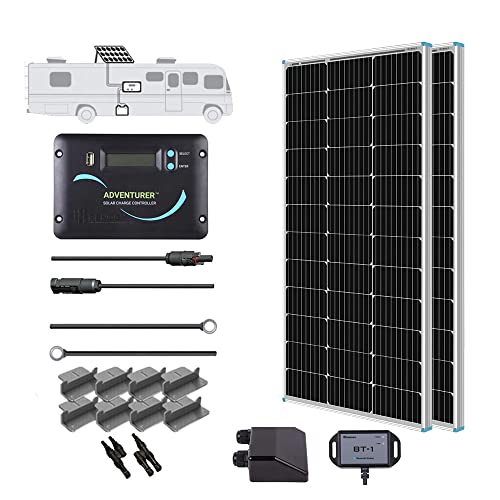
- Two 100W panels for 12V systems
- Includes 30A flush-mount PWM controller
- Supports lithium, lead-acid, and gel batteries
Best For: Small RVs, campers, boats, and compact off-grid setups
High-Output Rooftop Upgrade

- Two 320W panels provide 640W total
- Up to 25% efficiency with N-Type 18BB cells
- IP68-rated construction for outdoor use
Best For: Large RV roofs and high-demand off-grid installations
Secure Roof Hardware
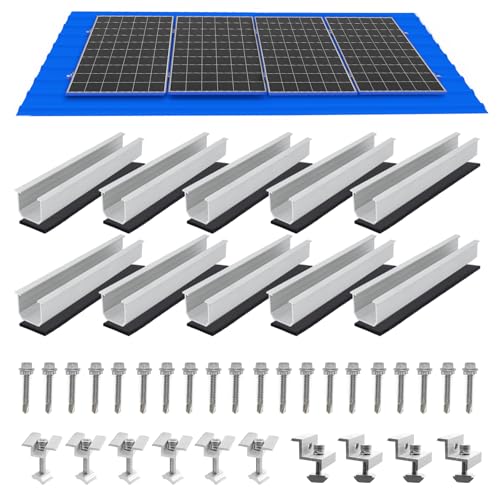
- Designed for a four-panel row layout
- Fits panels 1.18 to 1.38 inches thick
- Includes rails, clamps, pads, and screws
Best For: DIY RV roof installations needing panel mounting hardware
Space-Saving Van Panel

- Compact 200W panel for tight roofs
- 25% efficiency with 16BB cell technology
- Works with 12V and 24V battery systems
Best For: Class B vans and space-constrained RV installations
Premium MPPT Pick

- Four 100W monocrystalline panels
- 40A MPPT controller included
- Bluetooth monitoring and mounting accessories
Best For: RVers wanting a complete 400W 12V system
High-Efficiency Bifacial Option

- Two 200W N-type bifacial panels
- Up to 25.6% conversion efficiency
- Dual-module design improves shade tolerance
Best For: Custom RV and van systems using compatible equipment
Starter-System Value

- 100W monocrystalline panel and 30A PWM controller
- Includes cables and Z-brackets
- Expandable up to 400W
Best For: Small RVs and beginners building a 12V solar setup
Best Compact High-Efficiency Panel
Renogy 200W N-Type Solar Panel
- 25% efficient N-Type cells
- Compact design for Class B vans
- Compatible with 12V and 24V systems
Best For: Space-limited van and RV roofs
Best Budget Complete Starter Kit
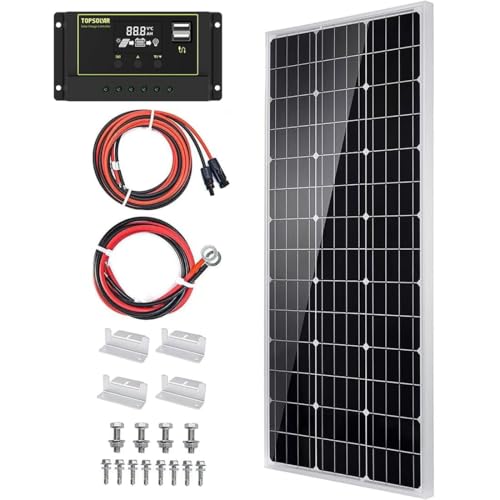
- Includes 30A PWM controller
- Mounting brackets and cables included
- Expandable to 260W on 12V
Best For: Simple 12V RV charging setups
Best Expandable Two-Panel Kit
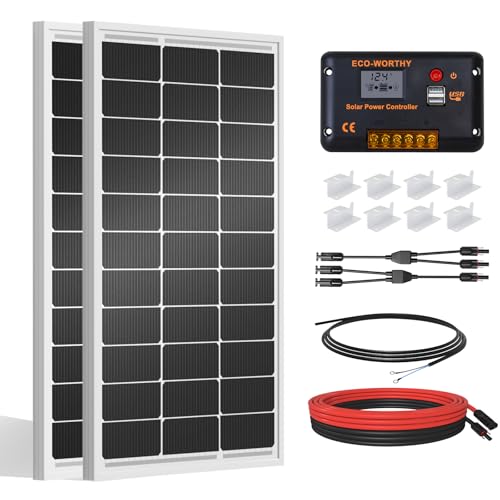
- Two 100W monocrystalline panels
- 30A controller and mounting accessories
- Supports 12V parallel or 24V series wiring
Best For: Complete 200W RV and camper installations
Compact RV Power Kit – Renogy 200W N-Type Kit
For shoppers comparing rooftop solar panel kits for RVs, this 200W Renogy package offers a compact setup with two 100W panels and a flush-mount 30A PWM controller. It is designed for 12V applications and includes the primary cables, connectors, brackets, and entry housing needed for installation.
Best For: RV owners, campers, boats, and other small off-grid systems needing a complete 12V kit.
Pros:
- Two 100W panels provide up to an estimated 800Wh daily output with four hours of sunlight.
- 22% cell efficiency and a corrosion-resistant aluminum frame support outdoor use.
- Includes a flush-mount Adventurer-Li 30A controller with protection against overcharging, overload, short circuits, and reverse polarity.
- Supports lithium, lead-acid, and gel batteries, with pre-drilled panels and plug-and-play cables.
Cons:
- The PWM controller is less advanced than an MPPT controller.
- The stated daily output depends on receiving about four hours of sunlight.
This is a practical all-in-one option when simple 12V installation and included accessories matter more than maximum controller efficiency. Its five-year warranty and 24/7 technical support add reassurance for RV installations.
High-Output Rooftop Upgrade – Renogy 640W N-Type Panels
This Renogy two-panel package is a high-output choice among rooftop solar panel kits for RVs, with two 320W N-Type panels delivering 640W total. The large rigid panels are aimed at installations with ample roof space and include pre-drilled mounting holes for off-grid applications.
Best For: Larger RVs, rooftops, cabins, and off-grid systems that can accommodate two full-size rigid panels.
Pros:
- Two 320W panels provide 640W of combined rated power.
- Up to 25% cell efficiency and N-Type 18BB construction are designed to reduce hot-spot effects.
- Multi-layer encapsulation, anti-corrosion coating, and an IP68 rating support outdoor durability.
- Compatible with several Renogy mounting options, including Z brackets, corner brackets, pole mounts, and tilt mounts.
Cons:
- Each panel is large and heavy at approximately 64.37 by 34.65 inches and 90.5 pounds as listed.
- The panels are not foldable and require a substantial, unobstructed installation area.
- The supplied listing identifies the panels but does not include a charge controller or mounting hardware.
Choose this package when maximum panel capacity is the priority and your RV roof can safely handle the footprint and weight. Careful shading checks and compatible system components will be important during planning.
Secure Roof Hardware – Four-Panel Solar Mount Kit
This mounting kit is a useful add-on when assembling rooftop solar panel kits for RVs. It is built for a four-panel-in-a-row layout and includes aluminum rails, EPDM pads, adjustable clamps, and stainless-steel hardware for compatible rigid panels.
Best For: DIY RV, boat, cabin, flat-roof, tin-roof, and ground-mounted installations using panels 1.18 to 1.38 inches thick.
Pros:
- Includes rails, rubber pads, six middle clamps, four end clamps, and 20 stainless-steel screws.
- Adjustable clamps fit panel thicknesses from 1.18 to 1.38 inches.
- Aluminum alloy, EPDM rubber, and stainless-steel components are intended for outdoor durability and weather resistance.
- Pre-drilled rails and included self-tapping screws simplify DIY installation.
Cons:
- It is mounting hardware only and does not include solar panels, wiring, or a charge controller.
- Compatibility depends on matching the panel thickness and roof surface to the kit.
This is best viewed as a structural accessory rather than a complete solar system. Confirm your panel dimensions, frame thickness, roof material, and desired four-panel layout before ordering.
Space-Saving Van Panel – Renogy 200W N-Type
For compact rooftop solar panel kits for RVs, this single 200W Renogy N-Type panel emphasizes a smaller, lighter design for tight Class B van roofs. Its 24V output is compatible with 12V and 24V battery systems when paired with suitable system components.
Best For: Class B vans and other space-constrained RV, marine, boat, and trailer installations.
Pros:
- The updated design is 7.5% smaller and 11.7% lighter than previous models while retaining a 200W rating.
- 25% efficiency and 16BB cell technology support high power conversion in a compact footprint.
- Compatible with 12V and 24V battery systems, including lithium, AGM, and deep-cycle batteries.
- Includes a 10-year output/material and workmanship commitment plus a 25-year 80% output claim.
Cons:
- This listing includes one panel only, not a complete kit with controller, cables, or mounting hardware.
- The panel has a 24V output, so system compatibility and controller selection require attention.
- Its listed dimensions are about 49.7 by 30.1 inches, which may still be too large for some small roofs.
This panel is a strong fit when roof space is limited but you still want a 200W rated module. Plan for the required controller, mounting equipment, and wiring separately, and verify the available roof area before purchase.
Premium MPPT Pick – Renogy 400W Solar Kit
For RV owners seeking rooftop solar panel kits for RVs with substantial 12-volt capacity, this Renogy package combines four 100W monocrystalline panels with a 40A MPPT controller. It includes the core mounting and wiring accessories, plus Bluetooth monitoring for system oversight.
Best For: RVers who want a complete 400W kit with MPPT charging and phone-based monitoring.
Pros:
- 400W total output from four 100W monocrystalline panels.
- 40A MPPT controller is included for efficient charging.
- Includes Z-brackets, adaptor kit, tray cable, and Bluetooth module.
- Panel has a 5-year material and workmanship warranty.
Cons:
- At 56.4 pounds, the complete kit is relatively heavy.
- The listed panel dimensions may require careful rooftop planning.
- Designed around a 12-volt system rather than a higher-voltage setup.
This is a strong all-in-one option when you have enough roof space and want higher charging capacity than a basic starter kit. The MPPT controller and included Bluetooth module add useful functionality, but confirm your RV’s roof layout and battery voltage before installation.
High-Efficiency Bifacial Option – Callsun 400W Solar Panel Pair
This two-panel Callsun setup is a distinctive choice among rooftop solar panel kits for RVs, pairing two 200W N-type bifacial panels for 400W total output. Its dual-module design can lessen the effect of partial shading, while the series configuration is suited to compatible 60V-class portable power stations.
Best For: RV, van, and off-grid users prioritizing high efficiency, bifacial generation, and shade tolerance.
Pros:
- Two 200W panels provide 400W total power and up to 25.6% efficiency.
- Bifacial construction can capture suitable reflected and diffuse light from the rear.
- Dual-module parallel design helps limit output loss from partial shading.
- Tempered glass, aluminum framing, and an IP68 junction box support outdoor use.
Cons:
- These are panels rather than a complete kit with controller, cables, and brackets.
- Each panel measures 51.3 by 30.3 inches, so roof space must be checked carefully.
- Series operation reaches 54.62V open-circuit voltage, requiring compatible equipment.
The Callsun pair is best suited to buyers assembling a custom system or charging a compatible portable power station. Its efficiency, bifacial design, and anti-shading layout are appealing, but you will need to supply compatible mounting hardware and charge-control equipment.
Starter-System Value – Renogy 100W RV Solar Kit
For smaller rigs or first-time buyers comparing rooftop solar panel kits for RVs, this Renogy starter kit offers a straightforward 100W, 12V setup. It includes a monocrystalline panel, 30A PWM controller, cables, and Z-brackets, with expansion support up to 400W.
Best For: RV and camper owners starting with modest power needs who want an expandable 12V system.
Pros:
- Complete starter package includes panel, controller, cables, and Z-brackets.
- 22.5% cell efficiency and stated average generation of 500Wh per day, depending on sunlight.
- 30A PWM controller supports expansion up to 400W.
- Compatible with AGM, Gel, Flooded, and Lithium batteries.
Cons:
- Its 100W starting capacity is lower than larger multi-panel systems.
- The included controller uses PWM rather than MPPT technology.
- Bluetooth monitoring requires the separately added Renogy BT-1 module.
This kit makes sense when you want an accessible starting point and the option to expand later. It is less appropriate for high-demand RV electrical loads out of the box, but its broad battery compatibility and upgrade path add flexibility.
Best Compact High-Efficiency Panel – Renogy 200W N-Type Solar Panel
For rooftop solar panel kits for RVs where roof space is limited, this Renogy 200W panel offers a compact option designed with Class B vans in mind. Its 25% efficiency, 24V operation, and compatibility with 12V and 24V battery systems provide flexible performance for off-grid setups.
Best For: Class B vans and RV owners who want high output from a single, space-conscious panel.
Pros:
- Compact 49.7-by-30.1-inch design that is 7.5% smaller and 11.7% lighter than previous models.
- High 25% efficiency from 16BB N-Type cells.
- Performs well in high temperatures and cloudy conditions.
- Includes a 10-year workmanship warranty and 25-year performance guarantee at 80% output.
Cons:
- At 23.4 pounds, it may require careful roof mounting.
- This listing is for one panel rather than a complete kit with controller and mounting hardware.
This is a strong choice when maximizing watts per square foot matters more than getting every installation component in one package. Confirm your controller, mounting hardware, and battery-system compatibility before buying.
Best Budget Complete Starter Kit – Topsolar 100W Solar Panel Kit
This Topsolar kit is a straightforward entry point for rooftop solar panel kits for RVs, combining a 100W monocrystalline panel with a 30A PWM charge controller, cables, and Z brackets. Pre-drilled mounting holes and included hardware help simplify installation for smaller 12V systems.
Best For: RV owners who need a basic 12V battery-charging setup with essential installation parts included.
Pros:
- Includes a 30A controller, solar cable, and four Z mounting brackets.
- Pre-drilled holes support faster mounting.
- Controller provides overcharge, overvoltage, discharge, short-circuit, and reverse-polarity protection.
- Can expand up to 260W on a 12V system or 520W on a 24V system.
Cons:
- The 100W output is more limited than larger two-panel or 200W options.
- The PWM controller is a simpler design than an MPPT controller.
For modest RV power needs, this kit offers useful value because the controller and basic mounting accessories are already included. Its expansion limit also leaves room to add capacity later, provided the system is configured within the stated limits.
Best Expandable Two-Panel Kit – ECO-WORTHY 200W Solar Kit
For shoppers comparing rooftop solar panel kits for RVs, this ECO-WORTHY package provides 200W through two 100W monocrystalline panels. It includes a 30A PWM controller, mounting brackets, extended solar cables, connectors, and tray cable, making it a practical all-in-one option for RV and camper installations.
Best For: RV, camper, and caravan owners who want a complete 200W kit with flexible 12V parallel or 24V series wiring.
Pros:
- Two 100W panels provide a combined 200W system.
- Includes a 30A controller, Z brackets, 16.4-foot solar cables, connectors, and tray cable.
- Panels can be connected in series for 24V or parallel for 12V operation.
- Aluminum frames, 2400Pa wind resistance, and 5400Pa snow-load resistance support outdoor use.
Cons:
- The two-panel layout requires more roof placement space than a single panel.
- It uses a PWM controller rather than an MPPT controller.
- The included support period is one year.
This kit is a good middle ground for buyers who want more capacity than a 100W starter system without sourcing each component separately. Check the roof layout and choose series or parallel wiring based on your battery-system requirements.
How We Picked These Rooftop Solar Panel Kits for RVs
We focused on kits suited to common RV solar setups, weighing panel wattage, cell design, stated efficiency, controller capacity, system voltage, and included hardware. The selection covers entry-level systems for maintaining batteries and larger arrays for travelers who use more demanding 12V or 24V appliances. We also considered whether each option is best for a first installation, an expansion project, or a more customized roof-mounted system.
Because roof layouts and electrical systems vary, verify current specifications, connector types, dimensions, and included components before purchasing. A kit may require additional cable, fuses, brackets, sealant, adapters, or a different charge controller.
Quick Comparison
| Best For | Typical Choice | What to Look For |
|---|---|---|
| Basic battery maintenance | 100W starter kit | Simple wiring and a compatible PWM controller |
| Weekend and moderate-use RVs | 200W system | Roof space, battery capacity, and controller headroom |
| Higher daily consumption | 400W kit or paired panels | MPPT control, adequate cable sizing, and ventilation |
| Large off-grid power needs | 640W array | Battery-bank capacity, roof layout, and inverter demand |
Key Buying Factors for Rooftop Solar Panel Kits for RVs
Wattage and Usable Energy
Panel wattage describes peak output under ideal conditions, not the amount produced all day. A 100W kit can help maintain a battery and run small loads, while 200W is a more flexible starting point for lights, fans, phones, and modest electronics. Choose 400W or more when you regularly use an inverter, compressor refrigerator, or other larger loads. Your battery bank must also be large enough to store the energy produced.
Charge Controller Type
PWM controllers are affordable and practical for smaller, straightforward systems. MPPT controllers generally extract more usable power, particularly in cooler conditions, with higher-voltage panels, or when the array and battery voltages differ. Check the controller’s maximum solar input, charging current, and supported battery chemistry before connecting anything.
Roof Fit and Installation
Measure usable roof space around vents, air conditioners, skylights, and antennas. Confirm panel dimensions and leave room for service access. Mounting brackets should be secured to the RV’s structure and sealed with materials appropriate for exterior use. Avoid shading where possible, since even partial shade can reduce output from a series-connected array.
Electrical Compatibility and Expansion
Confirm whether the kit is intended for a 12V or 24V battery system and whether its panels can be wired in series, parallel, or both. Use correctly sized cables, overcurrent protection, disconnects, and fuses. If you may add panels later, select a controller and wiring layout with sufficient capacity now.
Who Should Buy Which Rooftop Solar Panel Kits for RVs?
Choose a 100W starter system if you want basic battery upkeep, have limited roof space, or are testing solar for the first time. A 200W option is a strong general-purpose fit for weekend campers and moderate energy use. Select a 400W kit or dual-panel configuration for longer stays, frequent inverter use, or multiple daily loads. The 640W option is better suited to larger battery banks and travelers who spend extended periods away from hookups.
Before installation, compare the complete system—not just panel wattage. Factor in the controller, brackets, wiring, fuses, battery type, inverter losses, and professional installation if you are unsure about RV electrical work.