A parked car can slowly lose battery charge to alarms, electronics, and natural self-discharge. A solar maintainer can help offset those losses when an outlet is unavailable—but it needs enough sunlight and the right connection to work.
These 10 options range from compact 7.5W panels to 20W kits. The best choice depends on where you park, how you connect to the battery, and whether you need maintenance or a meaningful recharge.
Best 10 Solar Car Battery Chargers Picks for 2026
Best for Dashboard Use
POWOXI 7.5W Solar Battery Maintainer
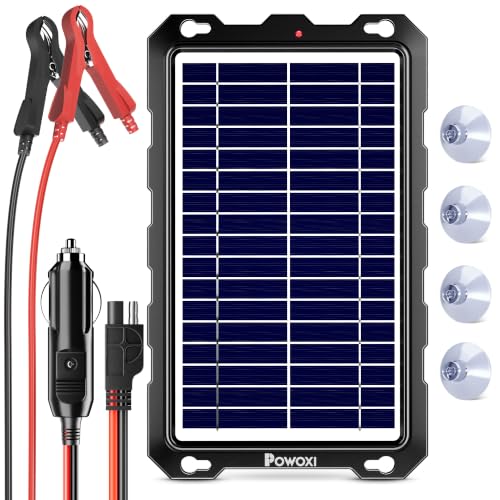
- 7.5W panel for 12V battery maintenance
- Includes outlet plug and alligator clips
- Protected controller and status lights
Best For: Drivers wanting two simple connection options
Best for Outdoor Mounting
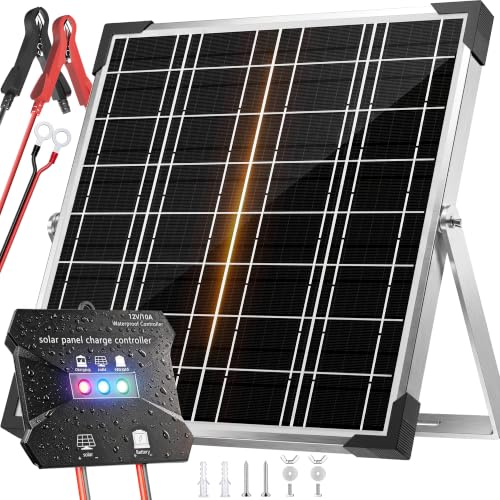
- 20W monocrystalline panel
- 360° adjustable mounting bracket
- IP67 rating and protected controller
Best For: Mounted maintenance for cars, trailers, or RVs
Best Lightweight Option

- Lightweight 1.8W panel
- Suction cups plus two connection options
- Controller helps prevent overcharging
Best For: Portable upkeep for infrequently used 12V vehicles
Best Adjustable Kit

- 20W monocrystalline panel
- MPPT controller with charging protections
- 360° bracket and mounting accessories
Best For: Adjustable, mounted 12V battery maintenance
Flexible Mounting Pick

- 20W flexible monocrystalline panel
- Four battery connection options
- Built-in charge controller
Best For: Flexible mounting on infrequently used vehicles
Simple Trickle Pick

- 10W monocrystalline panel
- Two plug-in connection options
- Charging indicator and built-in protections
Best For: Simple upkeep of an occasionally used 12V battery
Smart Charging Pick
SUNER POWER 12W MPPT Maintainer
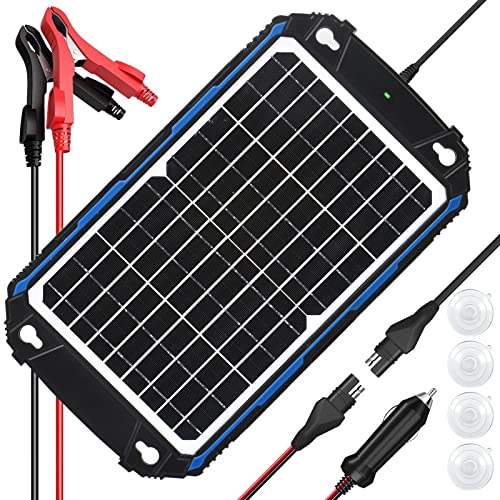
- MPPT with three-stage charging
- Automatic charge pause and restart
- Supports listed lead-acid types and LiFePO4
Best For: Automatic upkeep across multiple supported 12V battery types
Best with Extra Features
Topsolar 10W Solar Trickle Charger

- Compact 10W panel
- Clips and cigarette-lighter plug
- Built-in circuit protection
Best For: Portable 12V battery maintenance
Higher-Output Pick
SUNER POWER 20W MPPT Maintainer

- 20W rated panel
- Built-in three-stage MPPT controller
- Lead-acid and LiFePO4 support
Best For: Automatic upkeep of compatible 12V batteries
Adjustable-Mount Pick
Callsun 7.5W Solar Maintainer Kit

- 360° adjustable bracket
- Three-color status LEDs
- IP68-rated panel
Best For: Mounted upkeep of seasonal vehicles
Best for Dashboard Use – POWOXI 7.5W Solar Battery Maintainer
Among solar car battery chargers, the POWOXI 7.5W kit is a practical choice for maintaining a 12V battery in an infrequently driven car. It includes both a cigarette-lighter plug and alligator clips, giving you two connection options.
Best For: Drivers who want a compact maintainer they can connect through a vehicle power outlet or directly to a battery.
Pros:
- Built-in charge controller includes overcharge, overvoltage, and short-circuit protection.
- Tempered-glass panel and ABS+PC frame are designed for outdoor durability.
- Red and green indicators show sunlight reception and battery connection.
Cons:
- At 7.5W, it offers less rated power than the 20W kits in this roundup.
- Power-outlet connection may not work in vehicles whose outlet switches off with the ignition.
Choose this one for straightforward battery maintenance rather than fast charging. Check whether your vehicle’s power outlet remains live when parked; the included clips provide a direct-battery alternative.
Best for Outdoor Mounting – Voltset 20W Solar Charger Kit
The Voltset 20W kit is one of the more mounting-focused solar car battery chargers here. Its monocrystalline panel comes with a 10A controller and a 360° adjustable bracket, making it suited to a parked vehicle, trailer, or RV with a suitable installation spot.
Best For: Owners who want a 20W maintainer they can aim toward the sun and leave mounted outdoors.
Pros:
- Includes an adjustable bracket, controller, and alligator clips.
- Controller provides overcharge, short-circuit, reverse-polarity, and nighttime-drain protection.
- IP67-rated construction is specified for outdoor exposure.
Cons:
- A mounted panel needs a suitable surface and cable route to the battery.
- The supplied connection details list clips and SAE connections, not a cigarette-lighter plug.
This is a strong fit when you can position the panel for regular sun exposure. Its 20W rating gives it more potential output than the smaller maintainers listed here, though actual charging still depends on sunlight.
Best Lightweight Option – SUNAPEX 1.8W Solar Maintainer
For shoppers comparing solar car battery chargers mainly to offset gradual battery drain, the SUNAPEX is a small 1.8W option. It weighs 1.2 pounds and includes suction cups, a cigarette-lighter plug, and alligator clips for flexible placement and connection.
Best For: Owners of infrequently used 12V vehicles who prioritize a lightweight, portable maintainer over higher output.
Pros:
- Suction cups make window placement straightforward.
- Built-in controller stops charging when the battery is full and resumes when voltage drops.
- Red and green lights indicate sunlight exposure and charging.
Cons:
- Its 1.8W rating makes it the lowest-power option in this roundup.
- Window placement requires a suitable sun-facing spot.
The SUNAPEX makes the most sense for maintenance, not for quickly restoring a depleted battery. Its included clips are useful if a vehicle’s power outlet is inactive while parked.
Best Adjustable Kit – SOLPERK 20W Solar Panel Kit
The SOLPERK 20W kit stands out among solar car battery chargers for its included 360° adjustable bracket and smart MPPT controller. It is designed to maintain compatible 12V batteries across cars, trailers, boats, and other equipment.
Best For: Buyers planning a mounted setup who want to adjust panel angle as sunlight conditions change.
Pros:
- Includes a 20W monocrystalline panel, MPPT controller, mounting hardware, and alligator clips.
- Adjustable bracket helps aim the panel toward the sun.
- Tempered-glass surface and corrosion-resistant aluminum frame are built for outdoor use.
- Controller provides three-stage charging and protections against overcharge, overvoltage, and short circuits.
Cons:
- Mounting and routing the cable take more planning than placing a portable panel in a window.
- The listed accessories do not include a cigarette-lighter plug.
Pick the SOLPERK if bracket adjustment and a complete mounting kit matter more than quick dashboard placement. As with any solar maintainer, output depends on how much direct sunlight the panel receives.
Flexible Mounting Pick – FlexSolar 20W 12V Maintainer
Among solar car battery chargers, this 20W FlexSolar kit stands out for its thin, flexible panel and multiple ways to connect to a 12V battery. It is designed to maintain vehicles that sit unused, rather than recharge a deeply depleted battery.
Best For: Drivers who want a flexible panel and several connection options for an infrequently used vehicle.
Pros:
- 0.11-inch-thin panel can conform to curved surfaces; suction cups and carabiners are included.
- Includes cigarette-lighter, alligator-clip, OBD-II and ring-terminal connections.
- Built-in controller stops charging at full capacity and prevents reverse-current drain.
Cons:
- Intended for battery maintenance, not deep-discharge recovery.
- Requires a suitable sun-exposed mounting location.
The connection choices make this a versatile maintenance kit, especially where a rigid panel would be awkward to position.
Simple Trickle Pick – ECO-WORTHY 10W 12V Charger
If you need solar car battery chargers for a vehicle parked for weeks, this ECO-WORTHY 10W panel offers a straightforward 12V maintenance setup. Connect it through the cigarette-lighter plug or directly to battery terminals with the included alligator clips.
Best For: Keeping an occasionally used 12V vehicle or boat battery maintained with a simple hookup.
Pros:
- Includes SAE-connected cigarette-lighter and alligator-clip options.
- Built-in protections address reverse charging and overcharging.
- Charging indicator helps you check its status; the panel is described as waterproof.
Cons:
- 10W output makes it better suited to maintenance than substantial recharging.
- Offers fewer connection methods than kits with ring-terminal or OBD-II adapters.
This is a practical choice when easy setup matters more than a higher-wattage panel or extra connectors.
Smart Charging Pick – SUNER POWER 12W MPPT Maintainer
For shoppers comparing solar car battery chargers by charging controls, the SUNER POWER 12W model pairs an MPPT controller with bulk, absorption and float charging stages. It automatically pauses at full charge and resumes when the battery discharges.
Best For: Owners who want automatic 12V maintenance with support for several listed lead-acid battery types and LiFePO4.
Pros:
- Built-in MPPT controller uses three-stage charging.
- Lists protections including reverse polarity, short circuit and over-temperature.
- Supports flooded, gel, AGM, SLA, maintenance-free and LiFePO4 batteries.
- Tempered glass and a corrosion-resistant frame are designed for outdoor use.
Cons:
- At 3.3 pounds, it is heavier than the other panels in this roundup.
- Its 12W rating is primarily suited to maintenance rather than rapid charging.
Choose this one if charge management and broad stated battery compatibility matter more to you than a lightweight, flexible panel.
Best with Extra Features – Topsolar 10W Solar Trickle Charger
Among solar car battery chargers, this 10W Topsolar panel is a compact option for maintaining a 12V battery while a vehicle is parked. It comes with alligator clips and a cigarette-lighter plug for connection.
Best For: Drivers who want a portable maintainer for a car, motorcycle, boat, or other vehicle with a compatible 12V battery.
Pros:
- Lightweight, compact panel with a waterproof design.
- Includes alligator clips and a cigarette-lighter plug.
- Built-in circuit protection addresses overcharging, reverse charging, and reversed connections.
Cons:
- Its 10W output is better suited to maintenance than rapid charging.
- Battery and vehicle connection methods should be checked before purchase.
This is the straightforward, easy-to-carry choice if you need to counter battery drain during storage rather than recharge a depleted battery quickly.
Higher-Output Pick – SUNER POWER 20W MPPT Maintainer
If you are comparing solar car battery chargers for longer-term upkeep, this 20W SUNER POWER model offers more rated panel power than the smaller options here. Its built-in MPPT controller uses three-stage charging and switches to maintenance when the battery is full.
Best For: Owners who want automatic maintenance for a compatible 12V lead-acid or LiFePO4 battery in a car, RV, boat, or other vehicle.
Pros:
- 20W panel with a built-in MPPT charge controller.
- Automatic bulk, absorption, and float charging.
- Includes multiple electrical protections and plug-and-play cables.
- Supports listed 12V lead-acid types and LiFePO4 batteries.
Cons:
- At 5.2 pounds and about 20 by 14 inches, it takes more room than a compact panel.
- Still depends on adequate sunlight for useful charging.
Choose this one when controller features and rated output matter more than keeping the panel small and light.
Adjustable-Mount Pick – Callsun 7.5W Solar Maintainer Kit
This 7.5W Callsun kit stands out among solar car battery chargers for its included 360° adjustable bracket, which gives you more flexibility in aiming the panel. A separate smart controller and three-color LEDs provide charging-status feedback.
Best For: Owners of seasonally parked vehicles who want a mountable maintainer for a compatible 12V LiFePO4, AGM, or gel battery.
Pros:
- Includes an adjustable bracket, alligator clips, and ring-terminal cable.
- Three-color LEDs indicate sunlight, charging, and maintenance status.
- IP68-rated panel has tempered glass and an aluminum frame.
Cons:
- Its 7.5W rating makes it a maintenance-focused option, not a fast charger.
- Requires space to position and mount the bracket and panel.
The mounting hardware is the main reason to choose this kit: it suits a fixed spot where you can orient the panel toward available sunlight.
How We Picked These Solar Car Battery Chargers
We focused on practical differences across the 10 selected products: advertised panel wattage, the presence of a charge controller, connection options, mounting style, and stated weather resistance. Those details help distinguish a small panel suited to offsetting self-discharge from a larger kit intended for longer parking periods. Advertised wattage is a panel rating, not a promise of continuous output; shade, season, panel angle, and glass can substantially reduce charging. Check the current listing and manual for included parts and compatibility before ordering.
Quick Comparison: Which Size Makes Sense?
7.5W–10W panels are compact choices for maintaining an otherwise healthy 12V battery in a sunny location. 12W panels offer a middle ground, while 20W panels provide more potential output when space and mounting options allow. The 20W Voltset, FlexSolar, and SUNER POWER options are worth comparing if you want that extra capacity; POWOXI and the listed 7.5W kit suit shoppers prioritizing a smaller panel. For a fixed outdoor installation, compare the SOLPERK kit’s bracket and controller with your available mounting space.
None of these small panels should be treated as a jump starter. If a battery is deeply discharged or repeatedly goes flat, test the battery and vehicle charging system rather than relying on a solar maintainer to solve the fault.
Key Buying Factors for Solar Car Battery Chargers
Controller and Battery Compatibility
A charge controller helps manage charging and protect against unwanted reverse current; confirm the specific protections stated for your chosen kit. Verify that the charger supports your battery chemistry and nominal voltage—especially if you use AGM, gel, or lithium rather than a conventional 12V lead-acid battery.
Sun Exposure and Placement
Choose a location with several hours of direct light. A panel behind a windshield may be convenient, but tinted or shaded glass reduces performance. Outdoor mounting can improve exposure, provided the panel and connections are rated for the conditions and secured against movement.
Connections and Vehicle Power Outlets
Battery clamps provide a direct connection but require access to the battery. A 12V accessory-plug connection works only if that socket remains live when the ignition is off; many cars switch it off. Follow the kit’s instructions for polarity, fusing, and cable routing, and avoid pinching a wire in a door or hood.
Who Should Buy Which Solar Car Battery Chargers?
For a car parked outdoors in good sun, start with a compact 7.5W–10W maintainer if you only need to offset routine drain. Consider 12W–20W when parking periods are longer, sunlight is less consistent, or the vehicle has higher standby consumption—without assuming extra wattage will overcome heavy shade. Choose a kit with suitable outdoor mounting hardware for a boat, RV, or long-term parking spot. If your car stays in a garage, a plug-in battery maintainer is usually the more dependable choice.