When it comes to managing your solar energy system, choosing the right charge controller can make all the difference. With various options available, it’s essential to find a model that not only suits your needs but also enhances performance. The 10 best solar charge controllers with displays provide valuable insights into your system’s status, helping you optimize energy use. Let’s explore these top contenders and what features set them apart.
Renogy Voyager 20A PWM Waterproof Solar Charge Controller

If you’re looking for a reliable solar charge controller that excels in various outdoor conditions, the Renogy Voyager 20A PWM Waterproof Solar Charge Controller is an excellent choice for RV enthusiasts, boaters, and anyone utilizing solar power on the go. This controller supports AGM, Gel, Flooded, and Lithium batteries, ensuring versatility. With its advanced 4-stage PWM technology, it maximizes charging efficiency while protecting battery health. Its IP67 waterproof design means you don’t have to worry about rain or condensation. Plus, multiple safety features guard against common issues, giving you peace of mind while monitoring via the easy-to-read backlit LCD display.
Best For: Outdoor enthusiasts such as RV owners, boaters, and solar power users who require a reliable and waterproof solar charge controller.
Pros:
- Advanced 4-stage PWM technology ensures efficient charging and prolongs battery life.
- IP67 waterproof design allows for operation in adverse weather conditions without damage.
- Comprehensive safety features protect against overcharging, short-circuits, and other common risks.
Cons:
- Limited to a maximum of 20A, which may not be sufficient for larger solar setups.
- PWM technology, while efficient, may not match the performance of MPPT controllers in certain scenarios.
- The user interface, while functional, may lack advanced features found in more expensive models.
Renogy 10 Amp Solar Charge Controller
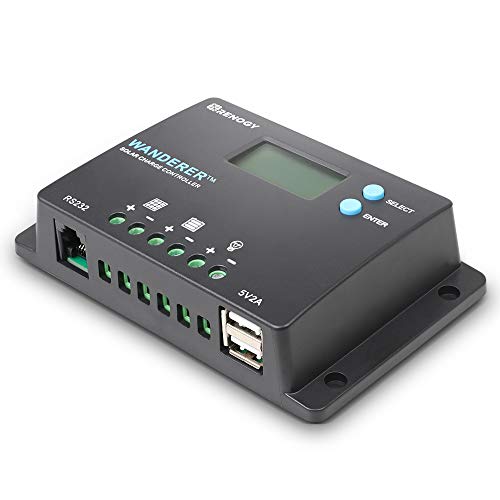
The Renogy 10 Amp Solar Charge Controller is an excellent choice for RV and marine enthusiasts seeking reliability and efficiency in their solar systems. Its compact design (5.2×3.1 inches) and IP32 waterproof rating guarantee it can handle tough outdoor conditions. With a smart 4-stage charging method, it maximizes battery life, extending it by 30% compared to basic controllers. You’ll appreciate the advanced load management and safety features that protect your system. Plus, the backlit LCD offers real-time data tracking, while the USB port lets you charge devices directly. This controller is a fantastic investment for off-grid living.
Best For: RV and marine enthusiasts looking for a reliable and efficient solar charge controller to optimize their off-grid solar systems.
Pros:
- Compact design and IP32 waterproof rating ensure durability in outdoor conditions.
- Smart 4-stage charging method extends battery lifespan by 30% compared to basic controllers.
- Backlit LCD provides real-time data tracking and a USB port allows for convenient device charging.
Cons:
- Requires a separate purchase of the BT-1 Bluetooth module for remote monitoring via the app.
- Limited to a maximum of 10 amps, which may not be sufficient for larger systems.
- Some users may find the manual/automatic/timed load management options complex to configure.
Renogy 30A PWM Solar Charge Controller

Designed specifically for RV enthusiasts and off-grid adventurers, the Renogy 30A PWM Solar Charge Controller stands out with its smart 4-stage charging system. It efficiently manages bulk, boost, float, and equalization phases, extending your battery life considerably. You’ll appreciate its compatibility with various battery types, including sealed, gel, flooded, and lithium. The sleek design makes installation a breeze, while the backlit LCD keeps you updated on status and diagnostics. With a range of safety features, including reverse polarity protection and auto temperature compensation, you can trust this controller to perform reliably in extreme conditions. Plus, it’s backed by a 2-year warranty.
Best For: RV enthusiasts and off-grid adventurers looking for a reliable solar charge controller to manage their battery systems.
Pros:
- Smart 4-stage charging system enhances battery longevity and performance.
- Compatible with multiple battery types, including sealed, gel, flooded, and lithium.
- User-friendly design with a backlit LCD for easy monitoring and diagnostics.
Cons:
- Limited to a maximum of 30A, which may not be sufficient for larger solar setups.
- Some users may find the installation process challenging without prior experience.
- The app compatibility may require additional setup for real-time data tracking.
30A PWM Solar Charge Controller with LCD Display

For those seeking a reliable and user-friendly solution to manage solar energy, the 30A PWM Solar Charge Controller with LCD Display stands out as an excellent choice. It’s compatible with 12V and 24V systems and works effectively with lead-acid batteries like OPEN, AGM, and GEL. The LCD display allows you to easily monitor status and adjust settings. With built-in protections against overcurrent and short circuits, it guarantees longevity for your devices and batteries. Plus, the dual USB output lets you charge mobile devices effortlessly. Installation is straightforward, and you’ll have access to a 12-month guarantee for peace of mind.
Best For: Individuals looking for an efficient and user-friendly solar charge controller to manage lead-acid batteries in 12V or 24V systems.
Pros:
- Easy-to-read LCD display for monitoring and adjusting settings.
- Includes built-in safety protections against overcurrent and short circuits.
- Dual USB output for charging mobile devices conveniently.
Cons:
- Not compatible with Lithium batteries.
- Requires specific installation sequence which may be challenging for beginners.
- Limited to lead-acid battery types, restricting options for users with different battery systems.
100A MPPT Solar Charge Controller with Dual USB Port and LCD Display

If you’re looking for a reliable solar charge controller that balances performance with user-friendly features, the 100A MPPT model with dual USB ports and an LCD display stands out. This controller is compatible with 12V/24V solar panel batteries and utilizes upgraded MPPT technology, achieving an impressive tracking efficiency of up to 99%. The easy-to-read LCD display helps you monitor status and configure settings effortlessly. Plus, it protects your lithium batteries from over-discharge. With built-in safety features and a 12-month guarantee, you can trust this controller to enhance your solar energy system’s efficiency and lifespan.
Best For: Those seeking an efficient and user-friendly solar charge controller for their 12V/24V solar panel systems.
Pros:
- High tracking efficiency of up to 99% ensures optimal energy harvesting.
- User-friendly LCD display simplifies monitoring and configuration.
- Comprehensive safety features protect batteries and enhance system longevity.
Cons:
- May be overkill for small-scale solar setups requiring lower amperage.
- Initial setup may be complex for users unfamiliar with solar technology.
- Limited to 12V/24V batteries, which may not cater to all users’ needs.
Upgraded 30A Solar Charge Controller with Adjustable LCD Display

The upgraded 30A solar charge controller with an adjustable LCD display is perfect for anyone seeking reliable and efficient solar management for their 12V or 24V systems. This controller automatically manages your solar panels and batteries using an industrial microcontroller, memorizing your settings even when the battery runs out. It’s compatible with various lead-acid batteries and features dual USB outputs for charging devices. With intelligent protections against overcurrent and overcharge, you can guarantee safety during operation. The user-friendly interface allows you to easily monitor performance and configure settings, making it a great choice for home or commercial use.
Best For: Individuals or businesses looking for an efficient and user-friendly solar charge management solution for 12V or 24V lead-acid battery systems.
Pros:
- Automatically adapts to 12V and 24V systems without manual adjustments.
- Features intelligent protection against various electrical issues, ensuring safety during operation.
- User-friendly LCD display allows easy monitoring and configuration of settings.
Cons:
- Not compatible with lithium or nickel-metal hydride batteries.
- Requires installation on a flat, well-ventilated surface for optimal performance.
- May require technical support for proper installation and setup, which could be a barrier for DIY users.
SUNYIMA 100A MPPT Solar Charge Controller with LCD Display
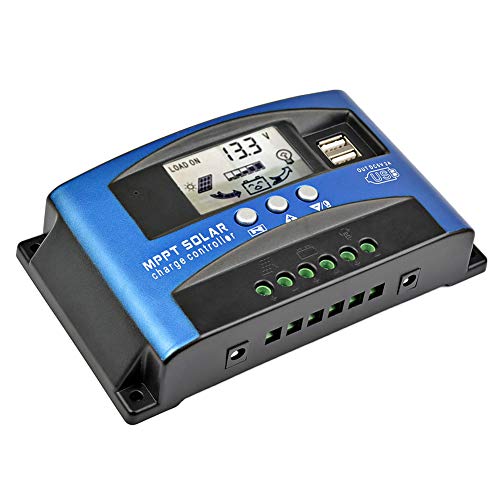
Designed with efficiency in mind, the SUNYIMA 100A MPPT Solar Charge Controller is an excellent choice for solar enthusiasts seeking reliable performance. With a maximum charging current of 100A and innovative MPPT technology, it achieves tracking efficiency up to 99%. The multi-function LCD display automatically adapts to 12V or 24V systems, providing real-time data on temperature and charging metrics. It features robust protections against overvoltage, short circuits, and overcharges, ensuring your system’s safety. Just remember to connect the battery before the solar panel to avoid issues. For any connection confusion, don’t hesitate to reach out for assistance!
Best For: Solar enthusiasts looking for an efficient and reliable charge controller with high tracking performance.
Pros:
- High Efficiency: Achieves tracking efficiency up to 99% with innovative MPPT technology.
- User-Friendly Display: Multi-function LCD display provides real-time data on temperature and charging metrics.
- Robust Protection: Offers reliable safeguards against overvoltage, short circuits, overloads, and overcharges.
Cons:
- Initial Setup Requirement: Requires battery connection before solar panel connection, which can be confusing for new users.
- Limited to 100A: Maximum charging current may not be sufficient for larger solar systems.
- Technical Support Needed: Users may need to reach out for assistance if they encounter connection issues.
SOLPERK 10A 12V MPPT Solar Charge Controller

For those seeking an efficient and reliable solution for charging 12V batteries, the SOLPERK 10A 12V MPPT Solar Charge Controller stands out with its advanced Maximum Power Point Tracking (MPPT) technology. This controller charges your batteries up to 20% faster than traditional PWM models. It’s compatible with various 12V battery types, including Sealed, AGM, Gel, Flooded, and LiFePO4 Lithium. The intelligent 3-stage charging optimizes battery health and lifespan. With extensive safety features and a compact, weather-resistant design, installation is a breeze. Just connect your battery before the solar panel, and you’re ready to harness solar energy efficiently.
Best For: Those looking for an efficient and reliable solar charge controller for charging 12V batteries in RVs, campers, or cabins.
Pros:
- Fast Charging: Charges 12V batteries up to 20% faster than PWM controllers.
- Wide Compatibility: Supports various battery types including Sealed, AGM, Gel, Flooded, and LiFePO4 Lithium.
- Safety Features: Equipped with comprehensive protection systems against over-charge, over-voltage, and other risks.
Cons:
- Limited Voltage: Not suitable for batteries with voltages higher than 12V.
- Installation Order: Requires connecting the battery first before the solar panel, which may be inconvenient for some users.
- Compact Design: While space-saving, the small size may limit some advanced features found in larger controllers.
Renogy Charge Controller Rover 20A MPPT
Renogy’s Rover 20A MPPT Solar Charge Controller stands out as an excellent choice for solar enthusiasts seeking efficiency and reliability. With dual-peak tracking and 99.9% efficiency, it auto-detects 12V/24V systems, supporting various battery types. Its storm-ready design withstands extreme temperatures and includes surge protection for added safety. You’ll appreciate its 4-stage charging technology, which prolongs battery life, and the exclusive lithium reactivation feature for deeply discharged batteries. The LCD display allows real-time monitoring, while the optional BT-2 module enables remote tracking via the Renogy DC Home App. This controller truly optimizes your energy management for various conditions.
Best For: Solar enthusiasts seeking a highly efficient and reliable charge controller for various battery types and conditions.
Pros:
- Dual-peak tracking with 99.9% efficiency ensures optimal energy conversion.
- Storm-ready design with temperature compensation and surge protection for durability in harsh environments.
- Real-time monitoring via LCD display and optional remote tracking with the BT-2 module enhances user convenience.
Cons:
- Initial setup may be complex for users unfamiliar with solar systems.
- The price point may be higher compared to basic charge controllers.
- Limited compatibility with some non-standard battery types may restrict user options.
Upgraded 30A Solar Charge Controller with Dual USB Port
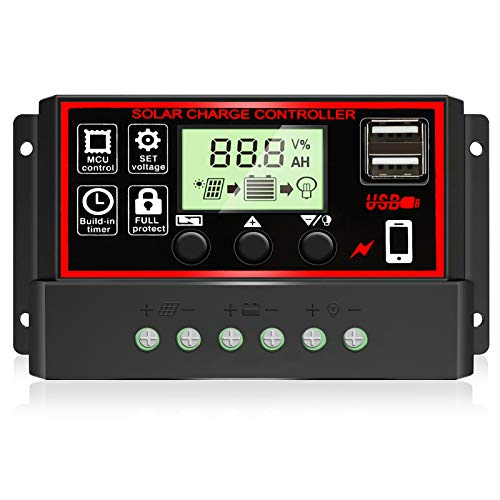
The Upgraded 30A Solar Charge Controller with Dual USB Port is an ideal choice for solar enthusiasts seeking efficient power management. It’s compatible with both 12V and 24V systems, featuring a built-in microcontroller that automates operations. You’ll appreciate the dual USB ports, providing 5V/2.5A max for your devices. The LCD display keeps you informed on status and data, while safety features like overcurrent and short-circuit protection guarantee reliable performance. Plus, it’s designed specifically for lead-acid batteries, including OPEN, AGM, and GEL. With a 12-month warranty, you can rest easy knowing support is just an email away.
Best For: Solar enthusiasts looking for an efficient and reliable charge controller for lead-acid battery systems.
Pros:
- Easy to use with automatic operation and memory for user-set parameters.
- Dual USB ports allow charging of devices while managing solar power.
- Comprehensive safety features ensure protection against overcurrent, short circuits, and low voltage.
Cons:
- Limited to lead-acid batteries; not compatible with lithium or other battery types.
- Maximum USB output may not support high-demand devices.
- LCD display may require regular monitoring for optimal performance.
Factors to Consider When Choosing a Solar Charge Controller With Display
When choosing a solar charge controller with a display, you need to contemplate several key factors. Think about compatibility with your battery types, as well as how readable and sized the display is for your needs. Don’t overlook protection features, charging efficiency, and the user interface, as these can greatly impact your overall experience.
Compatibility With Battery Types
Choosing a solar charge controller that matches your battery type is essential for best performance and longevity. Make sure the controller you select is compatible with the specific battery types you plan to use, whether they’re lead-acid (AGM, Gel, Flooded) or lithium batteries. Not all controllers support both categories. For lithium batteries, you’ll need specialized controllers with features like lithium reactivation technology, which standard lead-acid controllers lack. PWM controllers typically work well with lead-acid batteries, while MPPT controllers can handle a broader range, including lithium variants. Also, check the voltage compatibility; some controllers are designed for 12V or 24V systems. Automatic voltage detection can simplify setup, ensuring proper compatibility without manual adjustments.
Display Readability and Size
Getting the right solar charge controller involves not just compatibility with your battery type but also ensuring the display is easy to read and user-friendly. Look for a display that’s large enough to see from a distance, especially when installed in an RV or on a boat. A backlit screen enhances visibility in low-light conditions, allowing you to monitor performance anytime. Clarity is key; high-resolution displays with clear fonts help reduce eye strain. Multi-line displays are beneficial, showing voltage, current, and battery status simultaneously, so you don’t have to navigate through multiple screens. Also, a user-friendly interface with intuitive icons and layout makes it easier to understand the information, improving your overall experience with the controller.
Protection Features Available
While selecting a solar charge controller with a display, it’s essential to prioritize protection features that safeguard your investment and guarantee safe operation. Look for controllers with overcharge protection, which disconnects the charger when batteries reach full capacity, preventing damage. Short-circuit protection is critical too, as it interrupts power flow during faults, keeping your system safe. Reverse polarity protection helps avoid damage from incorrectly connected solar panels or batteries. Additionally, overload protection limits current to prevent overheating and potential fire hazards. Finally, consider models with automatic recovery features that reset after a fault, minimizing downtime and ensuring continuous operation. These protection features are fundamental for maintaining the longevity and efficiency of your solar energy system.
Charging Efficiency Technology
When it comes to selecting a solar charge controller with a display, understanding charging efficiency technology is essential for maximizing your solar energy system’s performance. Look for controllers that utilize MPPT (Maximum Power Point Tracking), which can achieve up to 99% efficiency in solar energy conversion. Alternatively, PWM (Pulse Width Modulation) technology enhances battery health by regulating voltage and current through multiple charging stages. Controllers featuring a 4-stage charging process—Bulk, Absorption, Float, and Equalization—help improve battery lifespan and efficiency. Additionally, high-quality models often incorporate intelligent load management systems for better energy use. Real-time monitoring via LCD displays allows you to track charging efficiency, ensuring peak energy management and battery maintenance throughout your setup.
User Interface and Controls
Choosing a solar charge controller with a user-friendly interface can greatly enhance your experience and efficiency in managing your solar energy system. Look for a controller that features a clear, easy-to-read display, providing real-time information on voltage, current, battery status, and error codes. A backlit LCD guarantees visibility in low-light conditions, which is essential for nighttime operations. Controllers with integrated connectivity options like Bluetooth or Wi-Fi let you monitor and control settings remotely through mobile apps. Customizable settings enable you to adjust charging parameters and load control modes, improving performance and battery longevity. Finally, an intuitive navigation with buttons or touchscreen capabilities simplifies accessing different settings and monitoring functions, making your energy management hassle-free.
Installation Ease and Design
Installing a solar charge controller can be straightforward if you consider its design and ease of installation. Look for compact models that fit easily in tight spaces, like RVs or boats. A waterproof rating, such as IP67 or IP32, guarantees durability and reliability in outdoor conditions. Choose controllers with user-friendly LCD displays; they make monitoring and adjustments a breeze. It’s also crucial that the installation sequence is clear, connecting the battery first, followed by the solar panel to avoid damage. Finally, check for detailed installation manuals that offer step-by-step guidance, helping you set up and configure your controller correctly. Taking these factors into account will make your installation process smoother and more efficient.
Power Consumption Metrics
Understanding power consumption metrics is essential for optimizing your solar setup and ensuring efficiency. When selecting a solar charge controller, consider the current draw measured in milliamps (mA). Look for models that consume less than 10mA during standby to maximize battery life. Controllers with MPPT (Maximum Power Point Tracking) technology can offer up to 100% tracking efficiency, ensuring faster charging and better energy use compared to PWM controllers. Pay attention to self-consumption rates; a higher rate can drain your battery quickly, reducing system efficiency. Additionally, if you need USB charging ports, note their output ratings, as these contribute to overall power consumption. Finally, choose controllers designed for harsh environments to minimize power loss from temperature fluctuations.
Monitoring and Connectivity Options
When evaluating solar charge controllers with displays, consider how effectively they monitor and connect with your devices. Look for controllers equipped with a backlit LCD that shows real-time data, like voltage and current, helping you make informed decisions. Advanced models often feature an RS232 port for remote monitoring via smartphone apps, enhancing your control over the system. Data logging capabilities can help you track performance metrics over time, allowing you to optimize energy usage and efficiency. Additionally, some controllers enable mode switching and parameter configuration directly through their displays, giving you more control over charging settings. Dual USB ports on select models also offer convenient charging options for your mobile devices while managing solar energy input.